
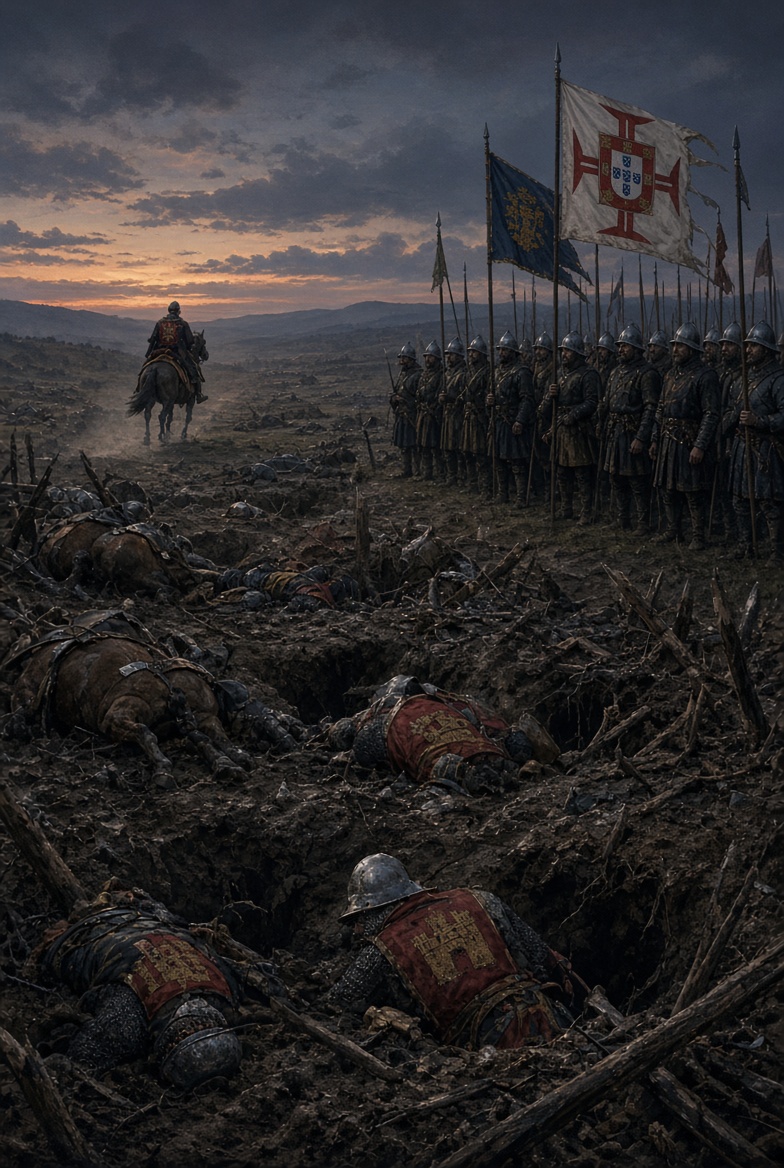
On the morning of August 14, 1385, the plateau of São Jorge, a modest rise of land between Leiria and Alcobaça in central Portugal, looked ordinary enough. Two shallow streams flanked a stretch of ground that narrowed in places to a few hundred meters. The summer heat already pressed down. By evening the same ground would be littered with the bodies of Castilian knights, French allies, and the shattered pride of a king who had expected to swallow a smaller neighbor whole.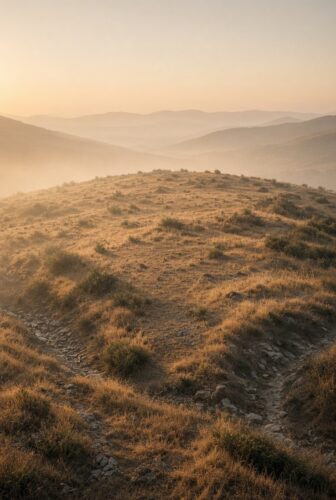
The crisis that brought two kings face to face that day had been brewing since the death of Fernando I of Portugal in 1383. Fernando left no legitimate male heir. His widow, Leonor Teles, and her circle negotiated the Treaty of Salvaterra de Magos with Juan I of Castile. Under its terms the Portuguese crown would pass through Fernando’s daughter Beatriz to Juan’s line, and the political center of gravity would shift toward Castile. Many Portuguese saw the arrangement as the first step toward absorption. Lisbon rose. The Master of the military Order of Avis, João, an illegitimate half-brother of the dead king, was proclaimed defender of the realm. Civil war followed. Castilian forces invaded. In 1384 they laid siege to Lisbon by land and sea. Plague and stubborn walls forced them to withdraw. In the spring of 1385 the Cortes of Coimbra formally elected João king. He took the name João I. Castile returned the next summer with a larger army and French allies, determined to settle the matter by force.
Juan I of Castile crossed the border in July with a host estimated by contemporary accounts and later reconstructions at roughly thirty thousand men. The numbers vary in the chronicles—some place the total near forty thousand—but the imbalance was unmistakable. The Castilian force included several thousand men-at-arms, light cavalry, crossbowmen, and a strong contingent of French knights eager for the kind of mounted glory that had defined earlier campaigns of the Hundred Years’ War. Against them the Portuguese could field perhaps six to seven thousand. A portion of those were English longbowmen, veterans or at least practitioners of the tactics that had already bloodied French chivalry at Crécy and Poitiers. The rest were Portuguese men-at-arms who would fight largely on foot, local infantry, and crossbowmen. The disparity in numbers was the sort that usually ends with the smaller army either destroyed or forced into humiliating submission.
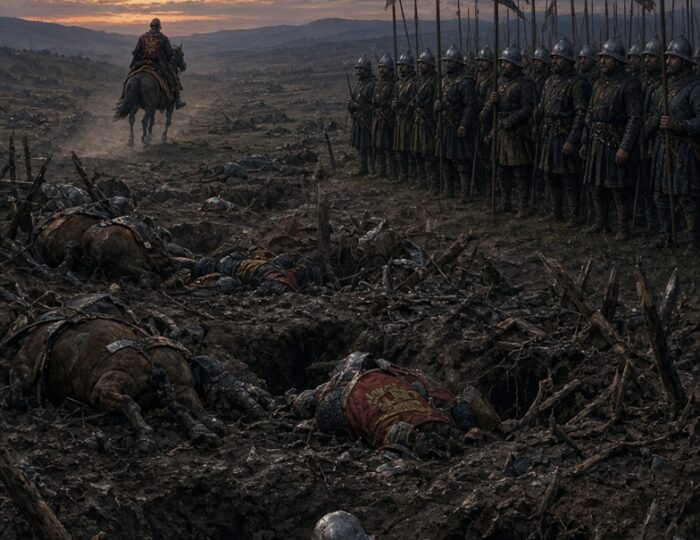
Nuno Álvares Pereira, the Constable of Portugal, had already shown himself a commander of unusual clarity. Still in his mid-twenties, he had spent the previous years fighting Castilian columns with whatever forces he could raise. He understood that open-field combat on Castilian terms would be suicide. On August 13 he rode out with a small escort and chose the ground. The plateau of São Jorge offered natural constraints: streams on the flanks, a relatively narrow front, and ground soft enough in places to dig. That night the Portuguese worked. They dug ditches. They excavated hundreds of *covas de lobo*—wolf pits—conical holes roughly two meters deep, each with a sharpened stake at the bottom, then covered them with branches and earth so that a charging horse would discover the trap only when it was too late. They felled trees and arranged the trunks as abatis, pointed obstacles that would break the momentum of a cavalry charge. They narrowed the usable front so that the Castilian numerical advantage could not be brought to bear all at once.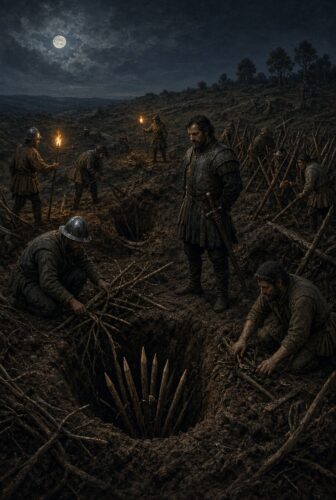
At first light on the fourteenth the Portuguese took position on the northern edge of the plateau, facing the expected approach along the old Roman road. When the Castilian vanguard appeared later in the morning, the invaders saw the strength of the position and declined the invitation. Climbing the slope under arrow fire looked unpromising. Instead they swung westward, seeking flatter ground, and eventually deployed on the broader Chão da Feira to the south. The Portuguese simply inverted their formation, marched a short distance, and faced the new direction. By late afternoon the two armies stood opposite each other. The Portuguese front, including the wings of archers, stretched roughly three hundred to three hundred fifty meters. The Castilian line was wider, but the terrain and the obstacles prevented the wings from joining the central assault in force.
The Castilian attack began in the late afternoon, some accounts placing the first serious contact around the hour of vespers. French knights in the van, eager for distinction, pressed forward mounted. They ran straight into the prepared obstacles. Horses went down in the pits. Riders spilled. The abatis broke the coherence of the charge. English longbowmen and Portuguese crossbowmen poured shafts into the confusion. The rate of fire of the longbow—able to loose multiple arrows in the time a crossbowman could manage one—turned the narrowed approach into a killing ground. Survivors who reached the Portuguese line found themselves fighting on foot against men who had already dismounted and formed a dense, disciplined front. Nuno Álvares held the vanguard. João I commanded the reserve. The Castilian wings, constrained by the streams and the shape of the plateau, could not deliver the enveloping pressure their numbers should have allowed.
The fighting was intense but relatively brief. Once the Castilian banner went down and the central assault stalled, panic spread. Juan I himself escaped on a fresh horse provided by a subordinate, riding hard through the night toward Santarém and eventually out of Portugal. Thousands of his men did not. Contemporary estimates place Castilian dead on the field and in the immediate pursuit at several thousand, with additional losses among stragglers killed by local populations in the following days. Portuguese losses were far lighter, measured in the hundreds rather than the thousands. The disparity shocked even the victors. Castile went into a period of formal mourning. The political claim that had brought the invasion collapsed.
The immediate consequences were decisive for Portugal. João I’s kingship was secured. The new Avis dynasty would rule for nearly two centuries. Within a generation Portuguese ships would be probing the African coast; within a century they would reach India and Brazil. The independence preserved on that ridge made the later Age of Discoveries possible. Had the battle gone the other way, the smaller kingdom would almost certainly have been absorbed into a larger Iberian polity centered on Castile. The cultural and linguistic distinctiveness of Portugal, the separate trajectory of its institutions, and the particular character of its later overseas empire all rest, in measurable part, on the outcome of a single afternoon’s fighting.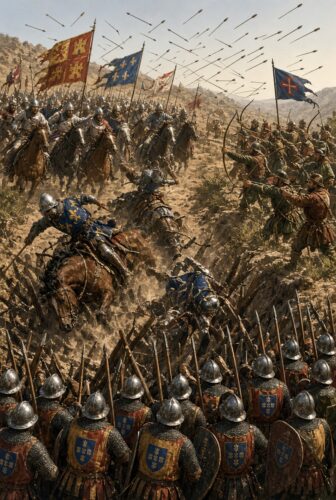
The tactical methods were not invented from nothing. English influence is clear in the use of dismounted men-at-arms supported by massed archery and the deliberate preparation of the ground. Similar principles had already been demonstrated in the great English victories of the earlier fourteenth century. What Nuno Álvares added was the ruthless application of those principles to a specific landscape under extreme numerical disadvantage, and the willingness to dig the traps the night before rather than trust to courage alone. Fernão Lopes, the great Portuguese chronicler writing a generation later, captured the essence: the obstacles “deceived” the enemy. Jean Froissart, drawing on interviews with French participants, recorded the shock of the French knights who found their charge broken by hidden holes and a storm of arrows. Pedro López de Ayala, who was present on the Castilian side, later wrote of the difficulty of the ground and the failure of the wings to support the center. The sources agree on the core facts even when they disagree on exact numbers.
The victory was celebrated with more than words. João I ordered the construction of the Monastery of Santa Maria da Vitória, better known as Batalha, near the battlefield. The unfinished but magnificent Gothic complex still stands as a stone record of the day. Processions and commemorations were instituted. The memory of Aljubarrota became one of the foundational stories of Portuguese national identity—not a myth of invincible heroes, but a concrete demonstration that careful preparation of constrained ground could overturn raw numbers.
That is the historical core. The rest is application.
A person facing an overwhelming imbalance—whether in resources, attention, institutional power, or simple volume of competing demands—can extract a usable method from the ridge of São Jorge. The method is not motivational sloganeering. It is a set of concrete preparatory actions that force any contest onto ground where numerical superiority loses its force.
– Identify the narrow plateau in the problem before the opponent arrives. Map the actual constraints that already exist: limited time windows, fixed physical spaces, non-negotiable deadlines, or scarce attention. Refuse to fight on the open plain the larger force prefers.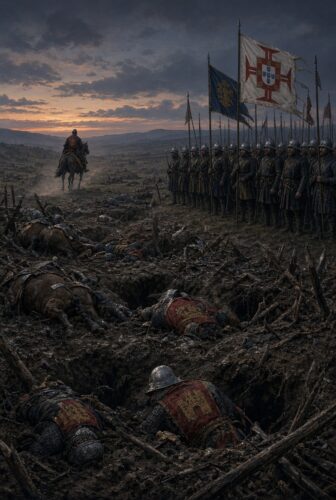
– Dig the wolf pits the night before. Create irreversible, low-visibility obstacles that raise the cost of a direct assault. In practical terms this means pre-committing resources, pre-writing the difficult message, pre-blocking the calendar, or pre-arranging the physical environment so that the path of least resistance for the larger force becomes the path of highest friction.
– Invert the formation when the enemy flanks. When the stronger side tries to avoid the prepared ground, move the entire defensive posture to the new axis rather than stretching to cover both. Do not dilute the front.
– Place the archers on the wings and keep the center dense. Concentrate the highest-rate-of-fire capability (focused attention, specialized skill, or decisive leverage) on the flanks of the approach while the core remains a solid, slow-moving mass that cannot be broken by a single charge.
– Accept that the fight will be short and ugly. The goal is not a prolonged demonstration of superiority but a rapid collapse of the attacker’s coherence once the obstacles and concentrated fire take effect.
– Leave the pursuit limited. Once the banner is down and the larger force is in flight, do not overextend. Secure the position and let the residual losses accumulate elsewhere.
The unique operating plan that follows from these points is the São Jorge Constraint Protocol. It is designed to be executed in a single focused evening and then applied for the next seventy-two hours—no longer. The protocol is deliberately short so that it cannot become another open-ended self-improvement project.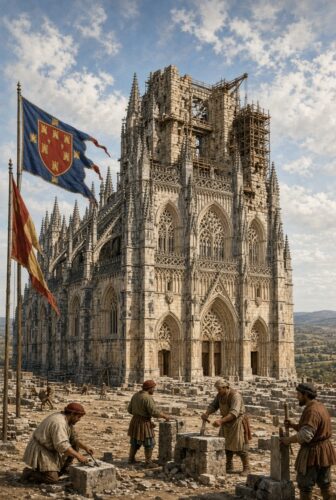
On the evening before the identified contest begins, spend no more than ninety minutes on three actions only. First, write a one-page map of the actual physical and temporal constraints that already limit the problem; discard every factor that can be expanded by effort or money. Second, create two irreversible obstacles that raise the cost of the opponent’s preferred approach—examples include a pre-sent letter that closes a negotiation path, a calendar block that cannot be moved without public explanation, or a physical rearrangement of a workspace that forces sequential rather than parallel action. Third, designate the single highest-rate capability available (one skill, one relationship, one piece of information) and position it exclusively on the flanks of the constrained approach; everything else remains in the dense center and does not move.
For the next three days, enforce the inverted formation: any attempt by the larger force to open a new front is met by relocating the entire defensive posture rather than stretching. At the end of the seventy-two hours, stop. Record only whether the constrained ground held and whether the larger force’s coherence broke. Do not expand the method into a lifestyle. The value lies in the temporary, deliberate narrowing of the fight, not in permanent tactical thinking.
The ridge at São Jorge did not make the Portuguese invincible. It made the particular fight of August 14, 1385, unwinnable for the side that had every conventional advantage. That is the usable residue. Most contests that feel overwhelming are still being fought on ground chosen by the larger force. Changing the ground the night before remains one of the few reliable ways to reverse the odds without first acquiring equal numbers.
Share: