
On a summer day in the Thessalian plain near the modest town of Crannon, in August 322 BC, two armies faced each other under a hard Mediterranean sun. One side represented the last serious collective attempt by the old Greek city-states to throw off Macedonian control after the death of Alexander the Great. The other side carried the disciplined weight of the army that had conquered half the known world. The fighting that followed was not a glorious slaughter or a tactical masterpiece worthy of endless Homeric verses. Casualties were surprisingly light. The Greeks withdrew in decent order to higher ground. Yet the day decided the political future of mainland Greece for generations. Athens, the self-proclaimed defender of freedom and democracy, would never again act as an independent power of the first rank. The age of the autonomous polis, already wounded at Chaeronea fourteen years earlier, effectively ended in the dust outside Crannon.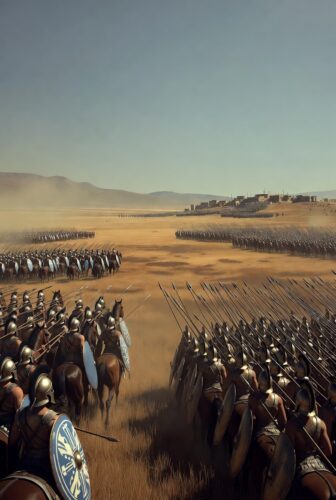
The story begins a year earlier with a corpse in Babylon. Alexander died in June 323 BC after a short, feverish illness. News traveled slowly, but when it reached Athens the reaction was electric. Many Greeks had chafed under Macedonian hegemony since Philip II’s victory at Chaeronea in 338 BC and Alexander’s subsequent campaigns. Alexander’s Exiles’ Decree of 324 BC had already forced the return of political exiles and the surrender of contested territories such as Samos, inflaming Athenian resentment. The sudden vacancy at the top of the Macedonian power structure looked like an opening.
Athens moved first. The orator and politician Hyperides and others stirred the assembly. Funds were voted, mercenaries hired from the large pool of unemployed professionals left idle by the end of Alexander’s eastern wars, and a general named Leosthenes was given command. Leosthenes was an experienced officer who had once served under Alexander. He quickly gathered allies: the Aetolian League, several Thessalian cities, Phocis, and smaller states. They styled their alliance a revival of the old Hellenic League that had once fought Persia. Macedonia was cast as the new barbarian threat.
Leosthenes struck north. Antipater, the elderly Macedonian viceroy left in Europe by Alexander, found himself outnumbered and outmaneuvered. He retreated into the fortified town of Lamia in southern Thessaly and prepared for a siege. The Greeks invested the place. For a time it looked as if the great Macedonian machine might be broken in Europe while the real power brokers were still sorting out the succession in Asia. Leosthenes pressed the siege vigorously. Then, during an assault or a sortie, a sling stone or a missile from the walls killed him. Command passed to Antiphilus, a solid but less dynamic Athenian officer, and Menon of Pharsalus, who led the excellent Thessalian cavalry.
The death of Leosthenes was a blow, but the Greeks still held the initiative on land. On the sea the picture was different. Athens had a large fleet, yet many of its best crews and rowers were scattered or reluctant. Macedonian naval forces under Cleitus the White, operating from the Levant and later reinforced, won two important engagements—one near the Echinades islands and a more decisive one off Amorgos. Athenian naval superiority evaporated. That failure mattered because it allowed Macedonian reinforcements to cross from Asia without serious interference.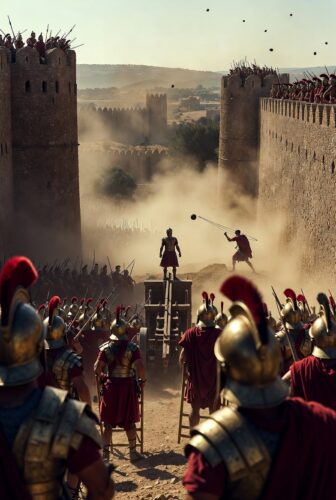
The first major relief force was led by Leonnatus, one of Alexander’s bodyguards and a satrap with ambitions of his own. He marched into Thessaly, fought the Greek cavalry near Rhamnus or in the vicinity, and was killed in the fighting. His infantry, however, linked up with Antipater, who broke out of Lamia. The combined Macedonian army was now stronger, but still not overwhelming. Then came Craterus.
Craterus was one of Alexander’s most trusted senior officers, a hard-bitten veteran of the eastern campaigns who had been ordered to bring a large contingent of discharged veterans back to Macedonia and relieve Antipater of his European duties. He arrived in the spring or early summer of 322 BC with roughly 10,000 infantry, additional cavalry, and a core of experienced troops who had fought at Issus, Gaugamela, and beyond. When Craterus joined Antipater the numerical balance shifted decisively. Ancient figures, primarily from Diodorus Siculus drawing on earlier lost sources such as Hieronymus of Cardia, put the Macedonian total near 40,000 heavy infantry, several thousand light troops and archers or slingers, and about 5,000 cavalry. The Greek coalition, weakened by the natural tendency of citizen-soldiers to drift home for harvest or personal business, mustered something closer to 25,000 infantry and 3,500 cavalry, the latter still excellent because of the Thessalian contingent under Menon.
Antipater and Craterus now moved to force a decision. They marched south into the plains of Thessaly. The Greeks, after recalling dispersed detachments, took up a position near Crannon, a modest town in a depression between the eastern and western Thessalian plains, roughly two miles south of the Peneius River and on the route between Larissa and the south. The ground offered open cavalry country with nearby heights that could serve as a refuge.
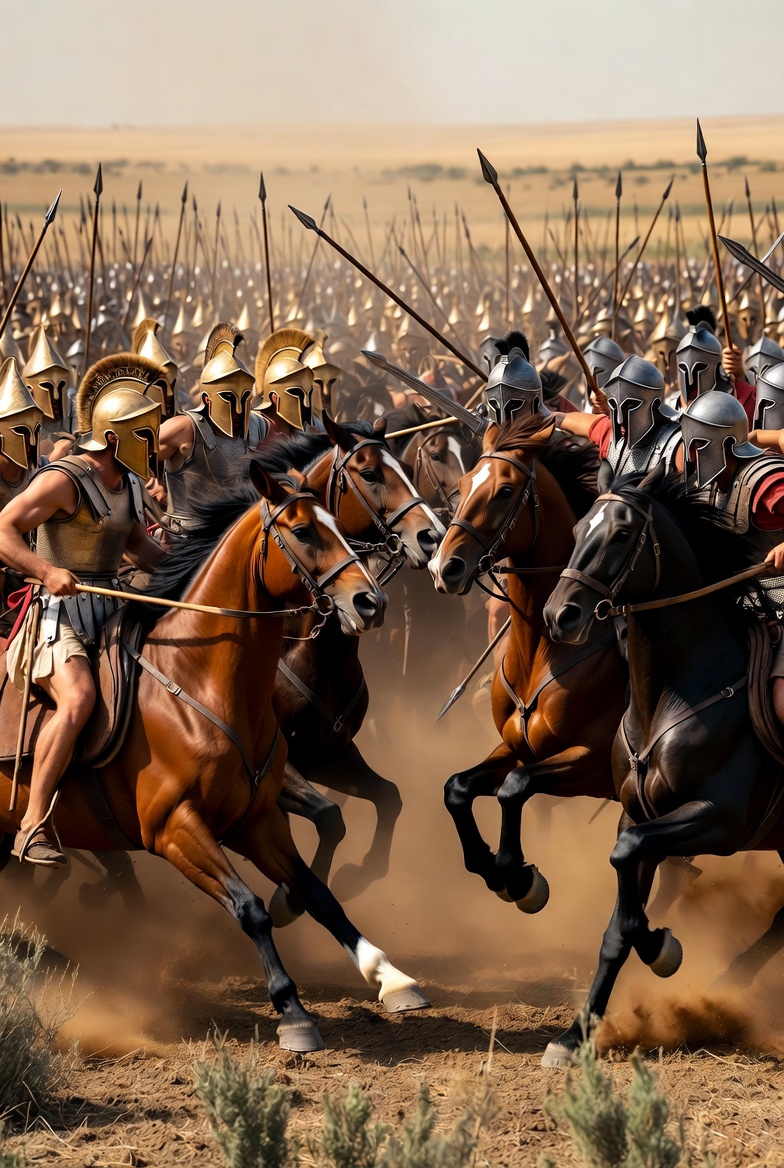
Antiphilus, remembering the earlier success of Greek horse against Leonnatus, planned to win with cavalry. The battle opened with a clash of horsemen. The Thessalian squadrons performed well, pushing the Macedonian cavalry back. While the mounted fight absorbed attention on the wings, Antipater ordered his infantry forward. The Macedonian phalanx, deeper and more numerous, ground against the Greek line. The Greek infantry, outnumbered and less cohesive as a multi-city force, gave ground and withdrew in reasonably good order onto higher terrain where the slope and broken ground neutralized the phalanx’s advantage. Seeing their infantry retire, the victorious Greek cavalry broke off its own engagement and rode to cover the withdrawal rather than risk being isolated. The field was left to the Macedonians.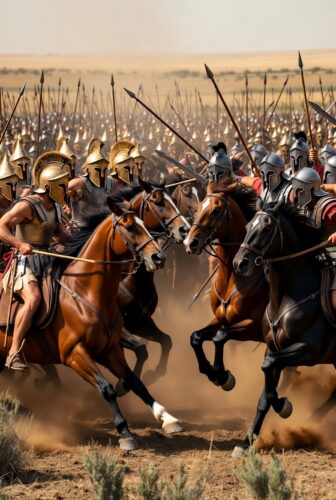
Casualties were modest by the standards of ancient pitched battles. Diodorus records approximately 500 dead on the Greek side and only 130 Macedonians. There was no dramatic pursuit or annihilation. The Greek army remained largely intact. Yet the psychological and political effect was immediate and crushing. The next day Antiphilus and Menon sent envoys seeking terms for a general peace. Antipater refused. He would negotiate only with each city separately. That single decision fractured the coalition.
Thessalian cities began to peel away, each seeking the best individual deal. Macedonian forces moved against holdouts and secured submissions one by one. Athens, isolated and facing the prospect of a siege with its navy already broken, had little choice. The city sent Demades and Phocion to negotiate. The terms were harsh by the standards of earlier Greek diplomacy but not annihilating. A Macedonian garrison under Menyllus was installed in the Piraeus, controlling the harbor and the economic lifeline. Athenian democracy was curtailed: full citizenship and political rights were restricted to those meeting a property qualification (variously reported around 1,000 or 2,000 drachmas), shrinking the active citizen body and shifting power toward wealthier, more conservative elements. Athens lost its remaining overseas possessions and had to pay an indemnity. The more radical leaders of the war party faced exile or worse. Demosthenes, the greatest orator of the age and a long-time opponent of Macedon, fled and ultimately took poison on the island of Calauria rather than fall into Macedonian hands. Hyperides was captured and executed.
The Aetolians, who had contributed less to the final campaign, managed to preserve more independence for a time and would later become a significant power in their own right. But the broader experiment in collective Greek resistance was finished. Macedonian hegemony over the mainland was reasserted and would endure, with interruptions, through the Wars of the Diadochi and into the Roman period. The free, quarrelsome, innovative world of the classical poleis had been subordinated to larger monarchical structures. Crannon was not the bloodiest or most tactically brilliant battle of the era, yet it was decisive precisely because it exposed the fragility of a coalition that looked formidable on paper but could not hold together once the pressure was applied city by city.
The deeper context makes the outcome almost inevitable in retrospect. Alexander’s empire had been held together by his personal authority and continuous campaigning. Once that center vanished, the centrifugal forces—ambitious generals in Asia, restless subject peoples, and Greek cities nursing old grievances—asserted themselves. Antipater was no charismatic young conqueror; he was a cautious, experienced administrator who understood that the real weapon against a league of cities was not total battlefield destruction but the patient isolation of each member. Craterus brought the veterans and the aura of Alexander’s army. Together they turned a difficult strategic situation into a manageable one by forcing a single engagement and then refusing to treat the enemy as a single entity.
The topography of Crannon itself played a quiet role. The open plain favored the larger army once infantry closed, while the nearby heights allowed the Greeks a clean withdrawal that preserved lives but surrendered the political initiative. Ancient writers noted that the battle fell near the anniversary of Chaeronea, adding a layer of grim historical rhyme: the same day that had broken Greek independence under Philip now finished the last serious attempt to restore it under his successors.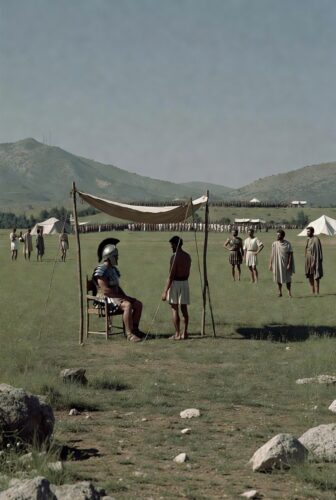
In the years that followed, Athens adjusted to its reduced status. Phocion, the conservative general and statesman, guided the city through the early years of oligarchic rule and Macedonian oversight. The philosophical schools continued. The intellectual life of the city did not vanish overnight. But the political energy that had once projected power across the Aegean and challenged kings was gone. When later generations looked back, Crannon marked the practical end of the classical experiment in collective freedom.
That is the history: a year of hope after Alexander’s death, a promising siege, the loss of a dynamic commander, naval reverses, the arrival of veterans, a cavalry success that could not be converted, an infantry reverse that forced a retreat to high ground, and then the quiet diplomatic knife that separated the allies one by one. No epic last stand. No heroic last charge that changed everything. Just a dusty afternoon in Thessaly that taught every subsequent power in the region the same lesson—coalitions of independent actors are only as strong as their willingness to absorb shared pain, and that willingness rarely survives the first serious offer of separate terms.
Now the application. The outcome at Crannon is not a vague call to “build stronger teams” or “stay resilient.” Those slogans are everywhere and usually worthless. The specific historical mechanism is different. A group that appeared united and even momentarily superior on one arm of the fight (the cavalry) collapsed the moment the opponent refused collective negotiation and insisted on dealing with each member alone. The lesson is surgical: most personal and professional “coalitions” in modern life—friend groups that claim loyalty, informal networks at work, family support systems, creative collaborations, even internal habits that prop each other up—are far more brittle than they feel. They hold while the weather is fair or while everyone is still facing the same direction. The moment external pressure arrives and the option of individual exit or individual deal-making appears, the structure often reveals itself as a temporary alliance of convenience rather than a load-bearing institution.
The unique plan that follows from this is called the Crannon Fracture Drill. It is not another journaling prompt or vision-board exercise. It is a deliberate, time-bound stress test designed to force the same separation of interests that Antipater forced on the Greek cities, so that you discover the real strength of your supports before a genuine crisis does it for you.
**The Crannon Fracture Drill – a 9-day personal protocol**
Day 0 – Mapping. Write down every active support relationship or interdependent system in your life that you currently treat as a coalition: specific people you rely on for practical help, emotional ballast, professional advancement, creative collaboration, or daily logistics; also list internal systems (habits, tools, financial arrangements, time blocks) that lean on one another. Be concrete. No abstractions.
Days 1–3 – Controlled individual withdrawal. Select three of the external relationships or systems. For each, create a low-stakes, temporary condition in which that party must operate without the usual mutual reinforcement you provide. Examples: temporarily stop initiating contact or offering the usual favor for 72 hours while continuing normal life otherwise; remove one shared resource or convenience for a short window; decline a reciprocal request that would normally be automatic. Observe and record, without announcing the experiment, what happens. Does the other party maintain function and goodwill? Do they compensate? Do they quietly resent or disengage? Do they attempt to renegotiate on purely individual terms?
Days 4–6 – Internal high-ground test. Apply the same logic inward. Identify three interlocking personal systems (for example, sleep schedule that supports training that supports work focus). For each, deliberately degrade one element for 48–72 hours while protecting the others, then restore it. Note which systems actually require the full coalition of habits and which can stand alone or be replaced more cleanly.
Day 7 – Separate embassy. Based on the data, write or meet (or simply decide) with each tested element on purely individual terms. No group framing. Ask, in substance if not in those exact words: what is the real, non-romanticized value of this connection or system when the shared banner is removed? What would sustainable terms look like if everyone else disappeared?
Days 8–9 – Rebuild or release. Keep only what survived the individual negotiation with clear, explicit, reduced interdependence. Convert soft coalitions into hard, limited contracts or clean separations. Design one or two new structures that are deliberately non-coalitional—single points of strength that do not require simultaneous loyalty from multiple parties.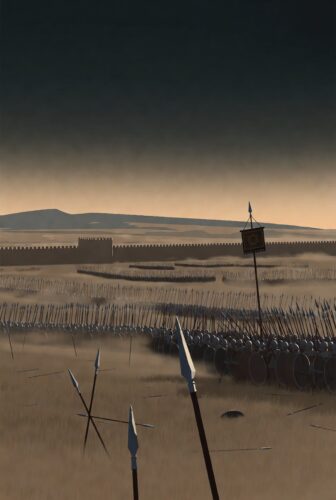
The drill is deliberately uncomfortable and slightly artificial. That is the point. Antipater did not wait for the Greeks to discover their own fractures under siege conditions; he imposed the separation while they still had an intact army. You do the same while the stakes are still manageable. Most people discover that several of their “allies” were conditional, that some internal systems were propping each other up in ways that hid weakness, and that a smaller set of clearer, more independent supports actually carries more weight. The ones that survive the fracture become the real foundation. The ones that do not are no longer allowed to create the illusion of collective strength.
This is not about becoming a solitary island. It is about refusing to fight the next real pressure with a coalition that has already, in practice, decided to negotiate separately. The Greeks at Crannon still had cavalry that could win its local fight and infantry that could retreat in order. What they lacked was the ability to keep every member committed once individual exit looked safer. The same pattern appears, in quieter form, in almost every modern life that depends on unspoken mutual reliance. Run the drill once, honestly. Then live with the smaller, harder, more reliable set of supports that remain. That is the practical inheritance of a dusty afternoon outside a forgotten Thessalian town more than two thousand years ago.
Share: