
On a hot August morning in 29 BC, the streets of Rome filled with the kind of noise that only a city recovering from twenty years of intermittent slaughter can produce. Citizens lined the Sacred Way. Veterans who had survived Philippi, Perusia, Naulochus, and Actium stood in ordered ranks. Captives from the Adriatic coast shuffled in chains. Painted tablets depicting distant mountain strongholds and burning ships swayed on poles. At the head of it all rode a thirty-four-year-old man who had spent half his life in a knife-fight for survival and was about to turn that survival into something the Romans had not seen in living memory: an official, public, three-day declaration that the killing was finished.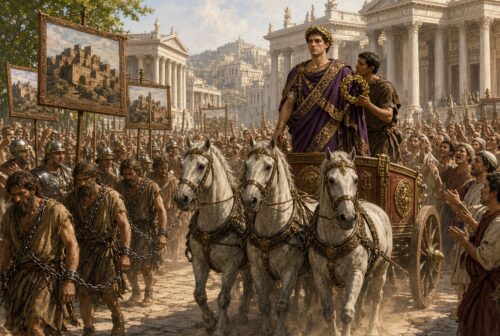
August 13 was the first day. The Fasti and later historians agree that Octavian—still formally Imperator Caesar Divi filius—celebrated the first of three consecutive triumphs on consecutive days. Day one belonged to the Dalmatians, the Iapydes, and the neighboring tribes of Illyricum. Day two belonged to the naval victory at Actium. Day three, the richest of all, belonged to Egypt. The Egyptian gold and grain paid for the spectacle of all three. Cassius Dio, writing more than two centuries later but drawing on earlier records, notes that the Egyptian spoils were so abundant they underwrote the entire display. The Senate had already closed the doors of the Temple of Janus earlier that year, a ritual last performed in living memory only once before. The message was deliberate: war on land and sea had ended.
To understand why that August morning mattered, the story has to begin years earlier, in the wreckage left by Julius Caesar’s assassination. The Republic had been dying in slow motion for decades—land reforms that never stuck, private armies, political murder as ordinary business. After the Ides of March in 44 BC the wreckage accelerated. Octavian, then eighteen and the posthumous adopted son of Caesar, arrived in Italy with almost nothing except a name and a dangerous inheritance. Mark Antony controlled the legions and the political machinery. Marcus Aemilius Lepidus controlled more legions. The “liberators” Brutus and Cassius controlled the East. Sextus Pompey controlled the sea lanes and the grain supply of Sicily. The next fifteen years were a sequence of temporary alliances, betrayals, massacres, and forced settlements that left almost no Roman family untouched.
Octavian’s early survival was improvisational and frequently ugly. He raised private forces from Caesar’s veterans. He fought at Mutina in 43 BC and was left for dead by some accounts. He formed the Second Triumvirate with Antony and Lepidus, then watched as the proscriptions of 43–42 BC filled the Forum with severed heads and filled the treasury with confiscated estates. At Philippi in 42 BC the republican cause died with Brutus and Cassius. Octavian was sick for much of the campaign and contributed little to the actual fighting; Antony did the heavy lifting. The aftermath produced the division of the Roman world: Antony took the rich East, Octavian the harder West, Lepidus a shrinking third share.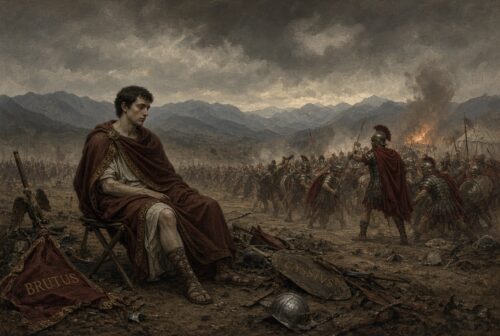
The West proved unforgiving. Octavian had to deal with the lingering war against Sextus Pompey, whose control of Sicily threatened Rome with starvation. The campaign of 36 BC at Naulochus, won largely by Agrippa’s naval innovations, ended that threat. Lepidus overplayed his hand and was stripped of power. Octavian now controlled Italy, the western provinces, and the loyalty of most of the legions still under arms. Antony, meanwhile, had married Cleopatra, fathered children with her, and begun treating the eastern kingdoms as a personal client network. The propaganda war between the two men became as important as the military one. Octavian’s supporters painted Antony as a man who had gone native, who had abandoned Roman virtues for Egyptian luxury and eastern monarchy. Antony’s supporters painted Octavian as a cold, calculating upstart who had never been a real soldier.
By 32 BC the fiction of shared rule collapsed. Antony’s will was seized and read aloud in the Senate; it confirmed the most damaging rumors about Egyptian ambitions. War was declared—not against Antony the Roman, but against Cleopatra the foreign queen. That legal fiction mattered. Roman tradition allowed triumphs over foreign enemies; it frowned on open celebration of victories over fellow citizens. The war that followed was therefore framed as a defense of the Republic against an eastern threat.
The decisive moment came on 2 September 31 BC off the coast of Actium in northwestern Greece. Agrippa’s fleet, smaller but better handled, bottled Antony and Cleopatra’s larger force against the shore. When Cleopatra’s squadron broke out and Antony followed, the remaining ships and the army on land lost heart. Many defected. Antony and Cleopatra fled to Egypt. The land army eventually surrendered. Octavian spent the winter of 31–30 BC consolidating Greece and Asia Minor, then moved on Egypt in the summer of 30 BC. Alexandria fell. Antony died by his own hand. Cleopatra followed shortly afterward. Their children by the union were captured; the boy Caesarion, the only living son of Julius Caesar, was executed. Egypt became a Roman province under direct imperial control, its immense grain surplus and treasury now available to the victor.
Octavian did not rush home. He spent months settling the East, rewarding allies, punishing holdouts, and extracting the wealth that would fund everything that followed. By the time he returned to Italy in the summer of 29 BC the Senate had already voted him extraordinary honors, including the right to use Imperator as a permanent first name and the celebration of multiple triumphs. The Temple of Janus had been closed. The message was clear before a single chariot rolled: the civil wars were over.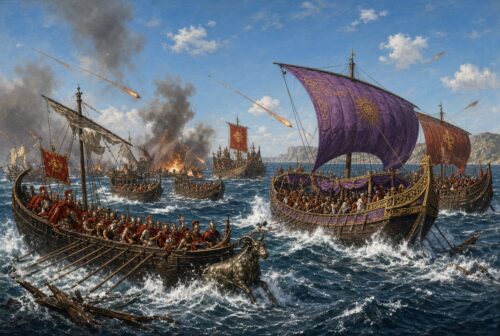
The triumph itself followed the ancient pattern but on a scale designed to erase the memory of the preceding chaos. A Roman triumph was never merely a victory parade. It was a carefully staged religious and political ritual that transformed a general’s private success into a public gift to the gods and the people. The triumphator rode in a chariot drawn by four horses, his face painted red in imitation of Jupiter, a slave standing behind him whispering “Remember you are mortal.” Captives walked in chains. Spoils were displayed on wagons and painted boards. The procession moved from the Campus Martius through the Porta Triumphalis, along the Via Sacra, past the Forum, and up to the Temple of Jupiter Optimus Maximus on the Capitoline, where sacrifices were offered.
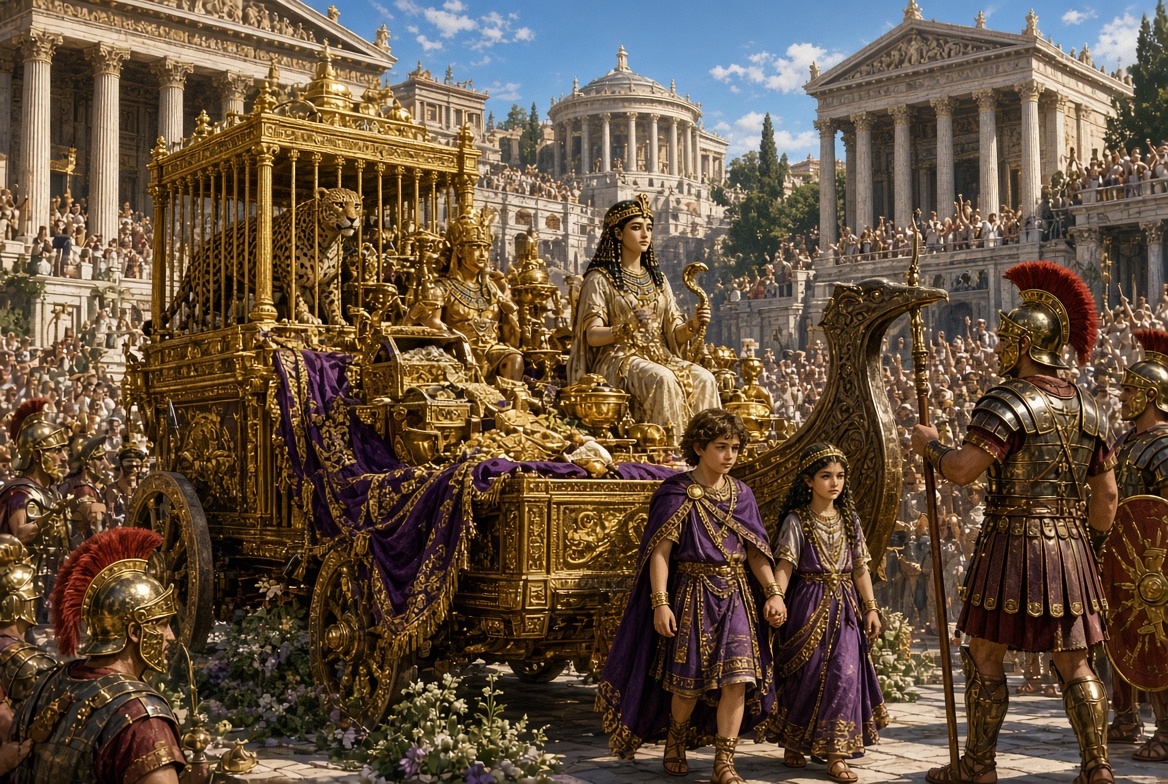
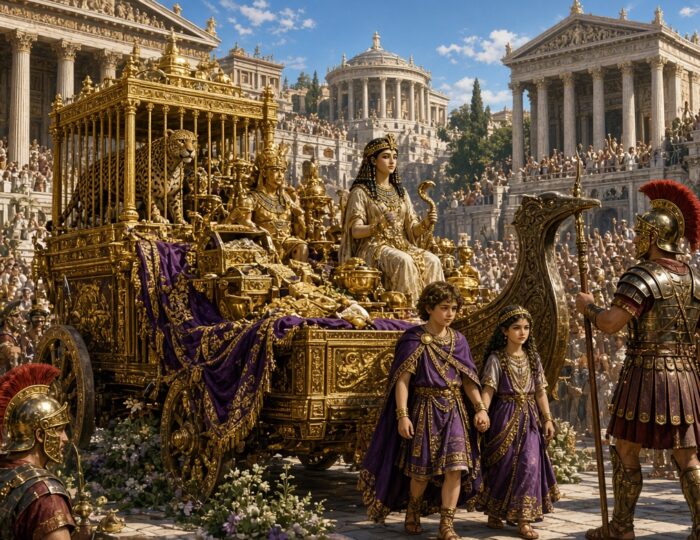
On 13 August the first procession focused on the Illyrian campaigns of 35–33 BC. Those campaigns had been real enough: hard fighting in the mountains against tribes that had long raided the Adriatic coast and threatened the land route to the East. Octavian had participated personally, taking wounds and earning a reputation for endurance if not for tactical brilliance. The captives and the displays of captured weapons reminded the crowd that the northern frontier had been secured. The second day celebrated Actium as a naval victory over a foreign queen and her allies. Ship beaks (rostra) taken from the captured fleet were carried or later mounted as permanent monuments. The third day was pure Egyptian spectacle: gold, grain, exotic animals, and the twin children of Antony and Cleopatra walking in the procession. An image of Cleopatra herself, complete with the asp, was displayed. The wealth was so great that Dio remarks it paid for the luxury of all three days.
Young relatives rode beside the chariot. Marcellus, Octavian’s nephew, and Tiberius, his stepson, both about eleven years old, took part. The inclusion of the next generation was deliberate. This was not the triumph of a lone warlord; it was the public installation of a new political family. Every citizen received a cash donative. Veterans settled in colonies received larger sums drawn from the Egyptian booty. The numbers in the Res Gestae are specific: 400 sesterces to each citizen, 1,000 sesterces to each of roughly 120,000 colonists. The money was real and it was personal. Octavian was buying loyalty with the spoils of the war he had just ended.
In the days that followed, additional ceremonies reinforced the message. The Temple of Divus Julius was dedicated on 18 August. The new Curia Julia was opened. Columns made from Actian ship rams were set up. The visual language of the city itself began to change. Temples long neglected were restored. The Forum started to look less like a battlefield of rival factions and more like the stage of a single, ordered regime.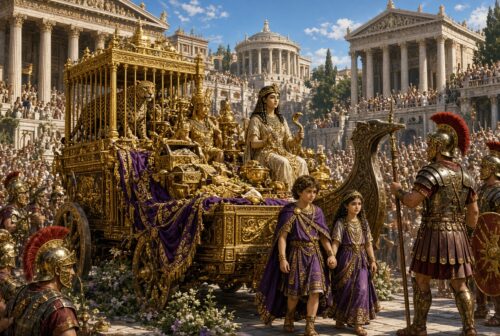
The political settlement that followed in 28 and 27 BC—the so-called First Settlement in which Octavian “restored the Republic” while retaining control of the key provinces and the armies—was made possible by the psychological and material success of those three August days. The crowds had seen the captives. They had received the cash. They had watched the doors of Janus stay closed. The alternative—another round of civil war—had been made to look both unnecessary and unattractive. Octavian would later refuse additional triumphs offered by the Senate, preserving the uniqueness of the 29 BC celebration. No other general outside the imperial house would receive a full triumph for generations.
The deeper significance lies in what the triumph accomplished that pure military victory could not. Actium and the fall of Alexandria had ended the fighting. The triple triumph converted that ending into a shared public memory. It turned private ambition into communal ritual. It replaced the endless cycle of revenge with a narrative of restoration. The Romans of 29 BC were exhausted. Many had lost fathers, brothers, and property. The parade did not erase those losses, but it offered a formal conclusion and a new story: the wars were finished, the gods were satisfied, the city could begin again under a single, capable guardian.
That guardian would soon take the name Augustus. The constitutional forms of the Republic would be carefully preserved even as real power concentrated in one man and his household. The army would be reduced and professionalized. The grain supply of Egypt would underwrite the urban population of Rome for centuries. The frontiers would be stabilized. A generation that had known only civil conflict would raise children who knew relative peace. The Pax Romana was not born in a single day, but the three-day procession of August 13–15, 29 BC was the moment the Romans collectively agreed to believe it was possible.
The historical record is rich with small, human details that keep the event from becoming pure propaganda. Octavian was not a charismatic battlefield hero in the mold of Caesar or Antony. He was often ill. He relied heavily on Agrippa for military competence and on Maecenas for political management. His early career involved ruthless proscriptions and the execution of Caesarion. The triumph carefully omitted any open celebration of victories over Roman citizens; the enemy was always presented as foreign. The Egyptian wealth that made the spectacle possible also made the subsequent settlement possible; without it the demobilization of tens of thousands of veterans would have been far more dangerous. The ritual of the slave whispering “Remember you are mortal” was still performed, even as the man in the chariot was becoming the least mortal figure in Roman politics.
Later writers, from Velleius Paterculus to Dio, treated the event as a hinge. Vergil, working on the Aeneid in the years immediately afterward, placed a vision of the triple triumph on the shield of Aeneas, linking the mythical founder of the Roman people to the living restorer of order. The Augustan poets and the official monuments of the next decade all pointed back to those three days as the moment when chaos gave way to arrangement.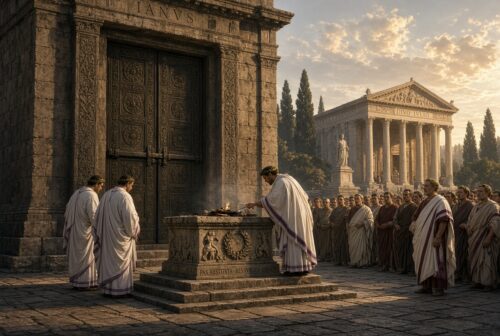
The story of August 13, 29 BC is therefore not simply the story of one man’s victory parade. It is the story of a society that had spent a generation devouring itself and then, on a specific summer morning, decided to stage a public performance of the end of that devouring. The performance worked because it was backed by real power, real money, and a population too tired to keep fighting. The form was traditional. The content was revolutionary. The result was the longest period of internal peace the Mediterranean world had known.
**How a modern person extracts durable advantage from a 2,055-year-old parade**
The useful residue of the triple triumph is not “celebrate your wins” or “frame your narrative.” Those are the soft, generic lessons that already clog the internet. The actual mechanism is sharper and rarer.
Octavian did not simply win. He converted a sequence of brutal, morally ambiguous, privately motivated victories into a single, publicly witnessed, multi-day ritual that made further internal conflict feel both unnecessary and slightly shameful. He used the accumulated capital of the defeated (Egyptian treasure, Illyrian captives, naval hardware) to fund a shared experience that rewrote the emotional baseline of an exhausted population. The key was not the winning itself; it was the deliberate, expensive, consecutive staging of the end of the contest.
Most people today treat their own hard-won ground the opposite way. They win a promotion, exit a toxic relationship, pay off a debt, finish a long project, or survive a health crisis, then immediately return to the private grind as if the contest is still open. They leave the emotional and social field contested. Rivals, old habits, and residual chaos continue to operate because no public, multi-stage, resource-backed closure has been performed.
**The Consecutive Closure Protocol**
This is not a vision board, a gratitude journal, or a “declare your victory” social-media post. It is a three-day, resource-backed, physically staged sequence that treats any hard-won personal resolution the way Octavian treated the end of the civil wars.
– Day One (the Illyrian day): Inventory and display the specific, unglamorous ground you actually secured. Write a precise list of the concrete assets, boundaries, or capabilities that are now under your control and were not under your control twelve months earlier. Include the unflattering parts—the compromises, the luck, the help you received. Print the list. Walk a fixed route in your ordinary environment while carrying the list. Do not post it. The point is private verification that the ground is real.
– Day Two (the Actium day): Convert one tangible piece of the old conflict into a permanent, visible marker that the contest is closed. This is not symbolic. If the conflict involved money, move a fixed sum into an account that can only be used for future construction, not maintenance. If it involved a relationship or professional rivalry, destroy or permanently archive one physical object that kept the old dynamic alive. If it involved health or habit, replace one daily tool or environment with a version that makes the old pattern physically harder to resume. The marker must cost something real and must be irreversible without deliberate effort.
– Day Three (the Egyptian day): Use a portion of the actual surplus created by the resolution to fund a shared, non-negotiable experience for the people whose cooperation you still need. This is not a party and not a gift that can be reciprocated in kind. It is a one-time transfer of resources—time, money, or access—that improves their position in a way that makes continued conflict with you irrational. The transfer must be public enough that the recipients know it happened and private enough that it cannot be turned into leverage against you later.
Execute the three days consecutively. Do not space them out. Do not announce the protocol in advance. Do not seek validation afterward. The power of the original triumph lay in its consecutive, resource-backed finality. The modern version works the same way: it changes the emotional and practical baseline so that reopening the old contest feels like a step backward rather than a continuation.
Most self-help advice stops at internal reframing. This protocol treats the end of a personal contest the way a Roman triumph treated the end of a civil war: as a public, multi-stage, capital-intensive performance whose purpose is to make the next round of fighting look both unnecessary and slightly ridiculous. The historical record shows that it worked once, on a civilizational scale, in August of 29 BC. The same mechanics scale down cleanly.
Share: