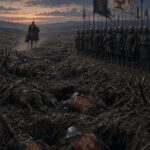

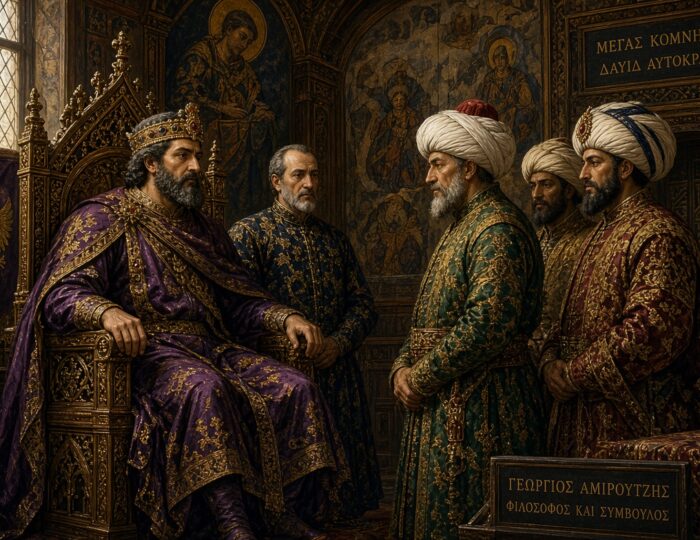
On a warm August day in 1461, the final independent fragment of the Eastern Roman Empire did not fall in a blaze of heroic last stands, collapsing walls, or the dramatic clash of steel that had defined so many earlier Byzantine endings. Instead, the Empire of Trebizond—the last free Greek state claiming the legacy of Rome—handed itself over through negotiation, oaths, and a formal surrender. Sultan Mehmed II, already known as the Conqueror for taking Constantinople eight years earlier, entered the city on August 15. Emperor David Megas Komnenos and his court stepped out. The longest-surviving Byzantine successor state was gone.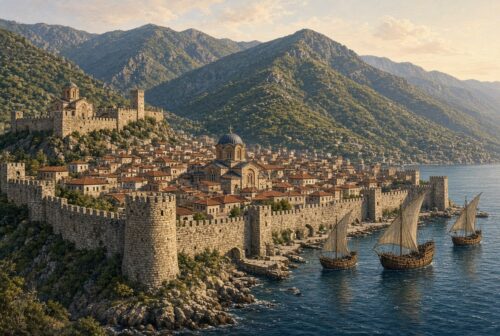
That quiet closing of a very long chapter remains one of the more understated turning points in the medieval world. Trebizond had outlasted the Latin Empire that briefly occupied Constantinople, outlasted the Empire of Nicaea that recovered the capital in 1261, outlasted the Despotate of Epirus, and even outlasted Constantinople itself after 1453. For 257 years after the Fourth Crusade shattered the old Byzantine order, this remote Black Sea principality kept a version of Roman imperial identity alive on the northern coast of Anatolia. Its end on that specific summer day completed Mehmed’s consolidation of the former eastern Roman lands and closed a continuous political tradition that stretched back, in one form or another, more than a thousand years.
To understand why the surrender of August 15, 1461 mattered, one must first understand how such a small state had managed to exist at all.
In April 1204, while the Fourth Crusade was still busy looting Constantinople, two grandsons of the earlier emperor Andronikos I Komnenos—Alexios and David—arrived on the Black Sea coast with Georgian military support arranged by their aunt, Queen Tamar. They seized Trebizond and the surrounding province of Chaldia. Alexios was proclaimed emperor. What began as a family adventure in the chaos following the crusader sack became one of three main Byzantine successor states, alongside Nicaea and Epirus. The brothers initially claimed the full imperial title and even pushed westward along the coast, briefly controlling territory as far as Heraclea Pontica before being pushed back by the rising power of Nicaea and the Seljuks of Rum.
Geography did much of the heavy lifting for the new state. The Pontic Mountains rose steeply behind the narrow coastal strip, creating a natural barrier that complicated large-scale invasion from the Anatolian interior. Deep ravines and strong walls protected the capital itself. Natural harbors supported trade. Silver and copper mines in the hinterland provided hard currency. When the Mongols destroyed Baghdad in 1258 and disrupted the traditional southern Silk Road routes, commerce shifted northward. Trebizond became an important entrepôt linking Persia, Armenia, and the Black Sea to Genoese and Venetian merchants. The city developed autonomous Italian trading quarters. Wine, hazelnuts, alum, and silver flowed outward. Customs duties and land taxes funded the court.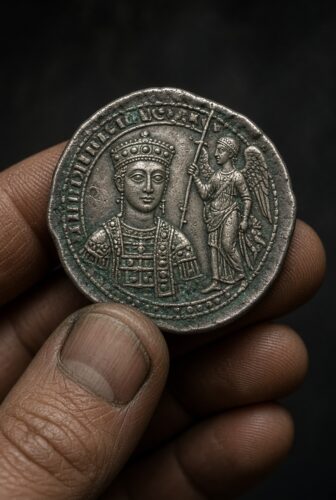
Diplomacy became the second pillar of survival. The Grand Komnenoi— the family style they adopted—proved remarkably flexible about marriage alliances. Daughters of the imperial house, often carrying substantial dowries and a reputation for beauty that reached Western chronicles, married into Georgian, Turkmen, and later Mongol and Aq Qoyunlu families. These marriages bought breathing room. After the Mongol victory at Köse Dağ in 1243, Trebizond accepted Mongol suzerainty and paid tribute for roughly a century, a pragmatic arrangement that protected it from worse fates while allowing internal autonomy. When the Mongol hold loosened, the emperors played neighboring Turkish emirates against one another and maintained cautious relations with the restored Byzantine Empire in Constantinople after 1261. John II even adjusted his titles in 1282, dropping the claim to be emperor of the Romans in the fullest sense and styling himself emperor of the East, Iberia, and Perateia instead—an acknowledgment of political reality that helped preserve the core territory.
The state was never large or especially powerful. Its army remained modest. Its territory at peak moments stretched along the coast from near Sinope to the borders of Georgia and occasionally inland, but control was often loose. Civil wars in the 1340s between court factions nearly tore it apart. Plague arrived from the Genoese colony at Caffa. Turkish raids and Genoese pressure chipped away at outlying districts. Yet the combination of mountains, trade wealth, and diplomatic maneuvering kept the Komnenian court functioning long after other Byzantine remnants had vanished.
By the mid-fifteenth century the balance had shifted decisively. Mehmed II took Constantinople in 1453. The Morea fell in stages, with Mistra surrendering in 1460. Smaller Greek lords submitted or were eliminated. Trebizond, still ruled by the Grand Komnenoi, now stood as the last independent Greek polity of any consequence. Emperor John IV had already faced Ottoman pressure. In 1456 an Ottoman force under Hızır Bey raided the territory during a plague outbreak, carrying off thousands of captives. John agreed to an annual tribute of two thousand gold pieces. When he died in 1458 or 1459, his brother David succeeded and initially confirmed the arrangement. But David proved less cautious. He sought Western aid, floated ambitious schemes that reached as far as talk of recovering Jerusalem, and at one point requested a reduction or remission of the tribute. He also relied on the alliance sealed by the marriage of his niece Theodora to Uzun Hasan of the Aq Qoyunlu. These moves, combined with the simple fact that an independent Christian ruler still held a Black Sea port within reach of the new Ottoman capital, made Trebizond a target.
In the spring and summer of 1461 Mehmed moved with characteristic thoroughness. He assembled a large fleet—reports speak of roughly two hundred galleys and additional warships—and a substantial land army. Estimates of the total force vary, but the scale was clearly intended to overwhelm. Rather than sail or march directly on Trebizond, Mehmed first neutralized potential sources of support. He advanced on Sinope. Its ruler, facing the full Ottoman host and already uneasy about his own position relative to Uzun Hasan, surrendered the city in exchange for lands farther west. Mehmed then turned inland, crossing difficult mountain country in conditions of rain, hunger, and harassment. An assassination attempt on the grand vizier Mahmud Pasha Angelović occurred during the march; the assassin was executed. Near Sivas, Uzun Hasan’s mother Sara Khatun negotiated a separate peace that explicitly excluded any obligation to defend Trebizond. The expected relief from the Aq Qoyunlu evaporated.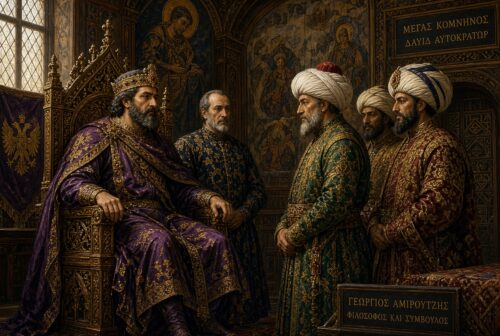
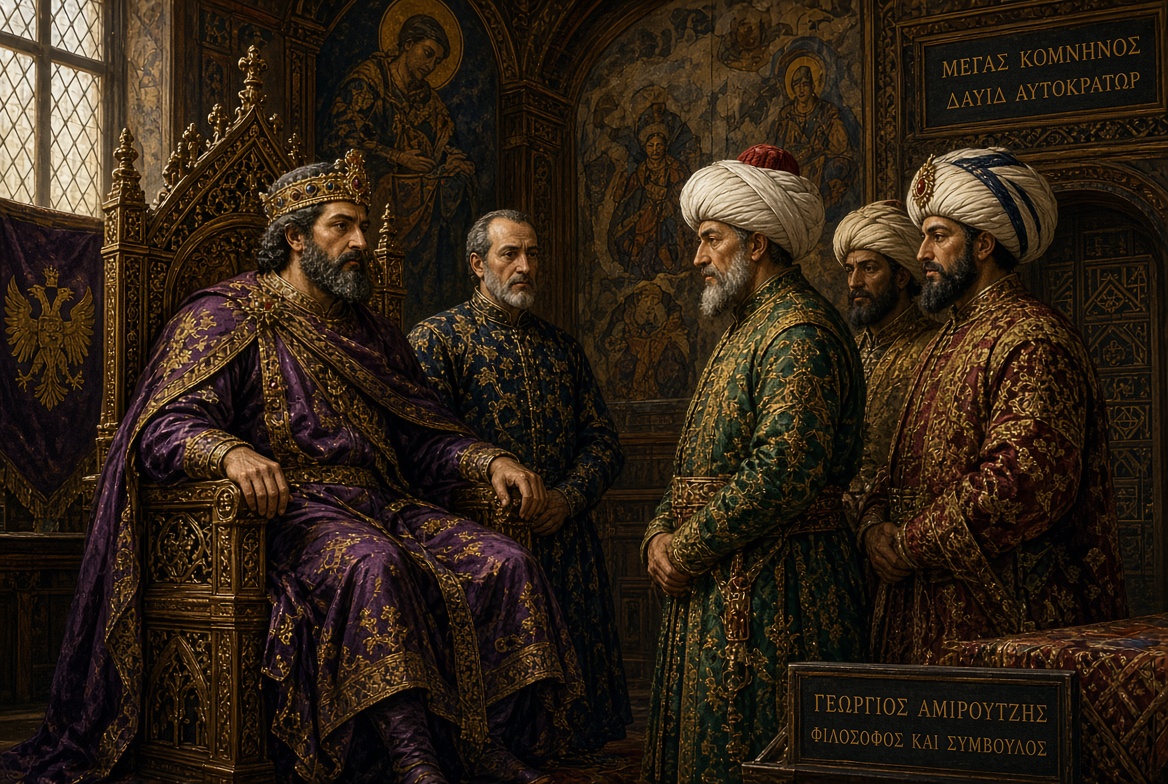
Meanwhile the Ottoman fleet under Kasım Pasha reached the coast, burned the suburbs of Trebizond, and began a blockade. The land army, after completing its long circuit, crossed the Zigana Pass and closed the remaining approaches. The formal siege lasted roughly a month. The city’s walls and the surrounding terrain still made a direct assault costly. The defenders hoped for outside help that never materialized. Inside the city, the protovestiarios George Amiroutzes—later accused by some of having family ties to Mahmud Pasha—argued for negotiation. Primary accounts differ in detail, but the broad outline is consistent: terms were offered that mirrored those extended at Constantinople in 1453. Surrender would preserve lives and movable property; resistance would bring the full consequences of storm and sack.
David Komnenos, after some hesitation, accepted. One version has him requesting estates of equivalent value and even floating the idea of a marriage alliance between Mehmed and one of his daughters. The flight of David’s wife to Georgia reportedly angered the sultan and briefly hardened his stance, yet the negotiations proceeded. On August 15, 1461, the handover took place. Envoys emerged with gifts. Oaths were exchanged. David and his family and principal courtiers came out and performed formal homage. Mehmed received them with outward courtesy, distributed gifts, and entered the city. He inspected the citadel and palace, converted the cathedral of the Panagia Chrysokephalos into a mosque, and prayed in the church of Saint Eugenios. A garrison of several hundred Janissaries was installed. Kasım Pasha remained as governor.
The human consequences unfolded quickly. A portion of the population was deported to Constantinople. Others were enslaved and distributed among the sultan and his officers. Young males—numbers in the sources range from several hundred to around fifteen hundred—were taken for the Janissary corps and conversion. Some rural inhabitants were pushed outside the walls. David and his immediate family were resettled with estates in the Ottoman domains, initially near Adrianople or in the region of the Struma. The arrangement did not last. Within two years David, several of his sons, and other male relatives were executed in Constantinople on charges that remain debated—possible correspondence with the West or simply the elimination of a potential rallying point. One daughter was married into the Ottoman elite. The last free Greek imperial court had been extinguished.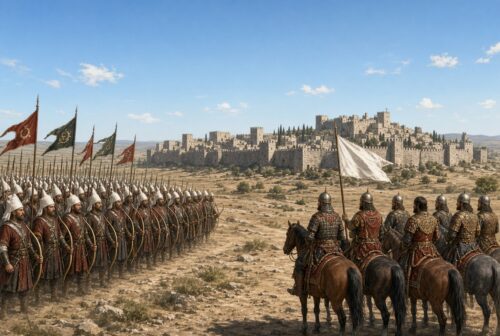
The significance of that August day lies less in the size of the territory lost than in the finality of the closure. After 1453, Trebizond had represented the residual possibility of an independent Greek Christian polity rooted in the old Roman tradition. Its fall removed that possibility. From the Black Sea to the Morea, the former lands of the Eastern Empire now lay under Ottoman administration or the rule of other non-Greek powers. The cultural and religious life of the Pontic Greeks continued, of course, under new conditions, and diaspora communities preserved memory and identity. But the continuous political line that ran from the Komnenian restoration in Trebizond back through the Byzantine centuries was severed on that specific date.
Mehmed’s campaign also illustrated a recurring pattern in the final decades of Byzantine fragmentation: isolation preceded conquest. Allies were neutralized or bought off. Geography that had once protected became a trap when no external force could break the blockade. Trade wealth that had sustained the court proved insufficient against a centralized military power able to sustain a prolonged investment. The decision to surrender rather than fight to the last preserved some lives and movable goods in the short term, yet it also demonstrated that the strategic window for independent action had already closed.
The story of Trebizond is therefore not primarily a tale of sudden catastrophe but of gradual constriction followed by a managed end. The empire had survived by flexibility—adjusting titles, paying tribute when necessary, marrying outward, exploiting commercial routes, and relying on difficult terrain. Those same adaptive habits eventually ran out of room when a single power controlled both the surrounding land and the sea approaches and systematically removed the external supports. On August 15, 1461, the last chapter closed without the theatrical final battle that later romantic imagination might have preferred. The walls still stood. The decision simply recognized that continued resistance would change the terms of the ending without altering its substance.
That recognition carries a practical weight that extends beyond the fifteenth-century Black Sea. Long-lived personal or professional structures—careers built on a particular skill set, identities formed around a specific community or role, projects that once thrived on conditions that no longer exist—can reach a similar point of isolation. External supports dry up. Former allies move on. The terrain that once protected becomes a constraint. Fighting every inch may produce a dramatic narrative, yet it often destroys the very assets one hoped to preserve. A controlled, clear-eyed transition, however unglamorous, can transfer core capacities into new conditions rather than leaving them buried under the rubble of a last stand.
**The Last Citadel Compact**
Most self-help advice around endings falls into two unhelpful camps: either “never quit” motivational slogans that treat persistence as an absolute virtue, or vague “embrace change” language that offers no concrete sequence. The Trebizond example suggests a narrower, more operational approach. Call it the Last Citadel Compact—a short protocol for situations in which a long-held domain has already been isolated by external shifts and the remaining choice is between managed handover and costly collapse.
The compact rests on three sequential recognitions and four practical moves.
First recognition: map the isolation. List every external support that once sustained the domain—clients, institutions, allies, income streams, social circles, physical locations—and note which ones have already been neutralized or withdrawn. Do this in writing on a single page. The exercise is not for emotional processing; it is a strategic audit. If the list of remaining supports is shorter than the list of removed ones, the citadel is already under effective blockade.
Second recognition: distinguish core assets from the walls. Core assets are the portable elements—skills, relationships that can transfer, knowledge, capital, reputation fragments that remain usable elsewhere. The walls are the fixed structures, titles, routines, and identity markers that only function inside the old perimeter. Most people defend the walls longest because they are visible and familiar. The compact requires ranking the portable assets first.
Third recognition: time the handover window. There is usually a period in which terms can still be shaped. After that window the terms are dictated. In Trebizond the window existed while the walls remained intact and the sultan preferred a negotiated entry to a costly assault. In personal terms the window exists while one still controls the timing of exit announcements, asset transfers, and narrative framing.
The four moves that follow are deliberately concrete and deliberately unromantic.
One. Conduct a formal internal inventory within seventy-two hours of completing the isolation map. Write down every core asset with a one-sentence description of how it could function outside the old domain. No aspirational language. No five-year visions. Just transferable items.
Two. Draft the minimum acceptable terms in advance of any external conversation. These are not demands; they are the floor below which one will not go. Examples might include a defined transition period, retention of specific portable tools or relationships, or a clean public framing of the change. Write them down. The act of writing prevents the common drift that occurs once negotiations begin and fatigue sets in.
Three. Execute a single, unambiguous signaling action that makes the transition visible to the relevant parties. This is the equivalent of the formal homage and exchange of oaths. It can be a resignation letter with a fixed end date, a public announcement of project closure, a transfer of responsibilities, or a deliberate withdrawal from a long-standing role. Ambiguous signals prolong the siege. Clear signals close it.
Four. Perform a short, private ritual of closure within one week of the signaling action. This is not therapy and not celebration. It is a deliberate marking of the boundary between the old domain and whatever follows. One practical version: take the single-page isolation map and the core-asset list, place them together, and store them in a dated envelope or digital folder labeled with the end date. Then stop reopening the file for thirty days. The point is to prevent the common pattern of endlessly revisiting the lost walls while the portable assets sit unused.
The compact is deliberately narrow. It does not claim to generate new opportunities or restore lost status. It only claims to reduce the probability of total asset destruction during an ending that has already become inevitable. It treats the decision to stop defending an isolated position as a technical act rather than a moral failure. That framing is what separates it from most popular advice, which either moralizes persistence or dissolves into inspirational fog.
Trebizond’s emperors had spent generations practicing flexibility. They adjusted titles, paid tribute, married outward, and exploited geography and trade. Those habits bought two and a half centuries. When the surrounding conditions finally removed every external support, the same pragmatic streak produced a negotiated end rather than a doomed defense of empty walls. The city still stands. The imperial line does not. The date was August 15, 1461. The lesson is not that every citadel must fall, but that when the supports have already been cut, the quality of the ending is still, to a surprising degree, a matter of deliberate choice.
Share: