
On a hot July morning in 1453, in the green country along the Dordogne River about thirty miles east of Bordeaux, the longest war medieval Europe had ever known finally ran out of road. The Battle of Castillon did not merely decide a campaign. It closed the book on English continental empire, killed the most feared English captain of his generation, and announced that the age of the armored knight charging across open ground was over. Gunpowder, carefully sited and protected, had become the decisive voice on the battlefield.
The story begins years earlier, in the long exhaustion of the Hundred Years’ War. By 1450 the French under Charles VII had already driven the English from Normandy. Gascony, that ancient English possession in the southwest, still held. Bordeaux and its hinterland remained stubbornly loyal to the English crown, partly from commercial habit, partly from genuine preference for the lighter English rule over the more intrusive French royal administration. In 1451 a French army under the Counts of Dunois and Clermont had taken Bordeaux itself. The city submitted, only to rise again the following year when an English expedition under the aging but still formidable John Talbot, Earl of Shrewsbury, landed and reoccupied the place with local support. Charles VII decided the time for half-measures was finished.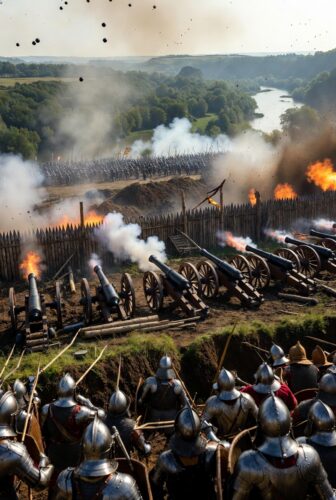
He assembled three armies. The principal force, roughly seven to nine thousand strong, was placed under the practical direction of the Bureau brothers, Jean and Gaspard. Jean Bureau was no traditional noble. He was a Parisian bourgeois of modest stature, a man who had risen through competence in the king’s finances and, more importantly, through a near-obsessive mastery of artillery. By 1453 the French royal artillery train was the most professional in Europe. The Bureau brothers had standardized carriages, improved powder, trained crews, and developed the tactical habit of using massed guns behind earthworks rather than as mere siege toys. Charles VII’s earlier reforms had given France a standing core of paid lances and the francs-archers militia. The result was an army that could fight in a coordinated way instead of dissolving into feudal contingents after a single campaign season.
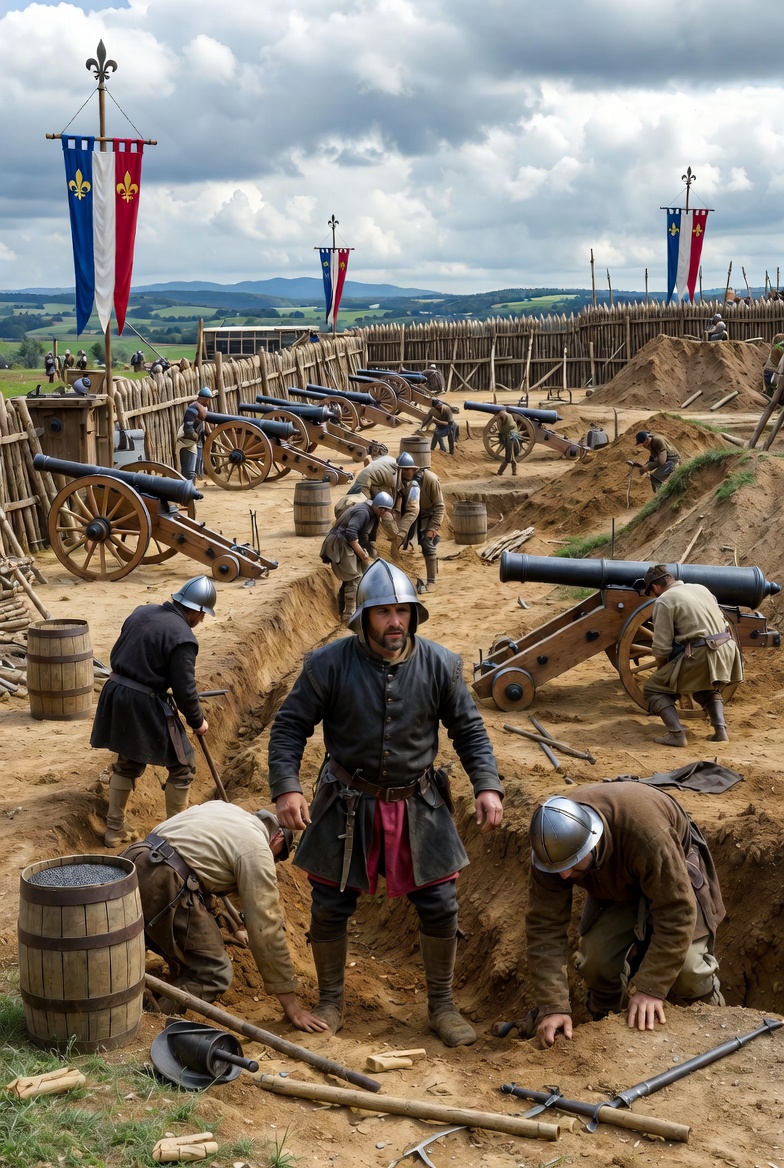
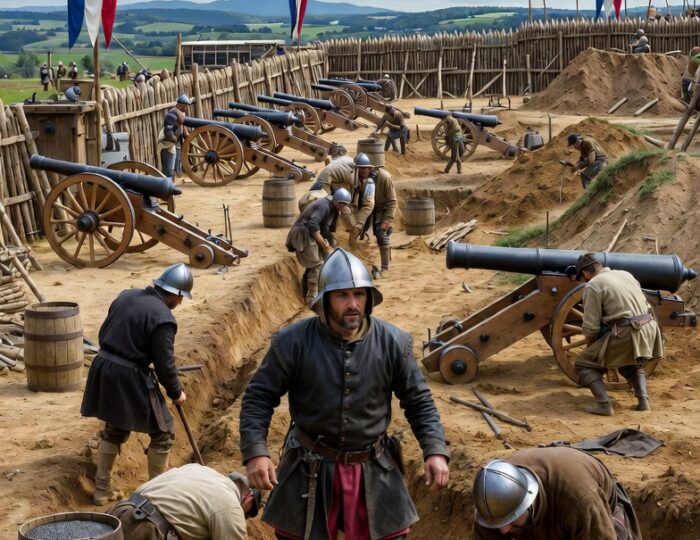
In early July 1453 this French force moved against the small but strategically placed town of Castillon on the Dordogne. They did not simply invest the place. Jean Bureau selected a site east of the town, on slightly rising ground between the river and a stream called the Lidoire, and ordered the construction of a fortified camp. The works were substantial: a deep ditch, an earth bank topped with a timber palisade, and, most critically, positions for some three hundred pieces of artillery of various sizes—culverins, serpentines, and bombards—arranged so that their fire could sweep the approaches. Archers and crossbowmen filled the intervals. A reserve of Breton cavalry under the Duke of Brittany’s captains waited behind the camp. The French were not looking for a chivalric encounter. They were building a killing ground.
John Talbot was then in his mid-sixties, a veteran of decades of fighting in France. He had a reputation for aggressive, almost reckless courage and for personal luck that had kept him alive through battles that destroyed lesser men. When news reached Bordeaux that Castillon was under siege, the Gascon merchants and the English garrison pressed him to march at once. Talbot, who had sworn an earlier oath after a previous captivity never again to bear arms against Charles VII in person, chose to interpret the letter of that oath rather than its spirit. He rode out without full armor, intending perhaps to observe the letter while still directing the fight. His force was smaller than the French—estimates range from five to ten thousand, but the effective striking power that reached the field on the morning of the seventeenth was closer to the lower end, and much of it arrived in stages.
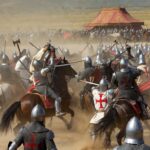
On the morning of 17 July the English advanced guard brushed aside a French outpost at the Priory of Saint-Laurent. The French archers fell back toward the main camp. Misinformation, or perhaps deliberate French deception, reached Talbot: the enemy was retiring. Without waiting for the bulk of his army to close up, he ordered an immediate attack. The English dismounted and advanced on foot against the fortified park, banners flying, the old earl at their head.
What followed was not a battle in the traditional sense. It was an industrial slaughter. As the English ranks closed on the ditch and palisade, the French guns opened. Contemporary accounts describe a continuous discharge. Cannonballs tore lanes through the densely packed men-at-arms and archers. The English pressed forward anyway, some reaching the barriers and fighting hand-to-hand with axes and bills. For a brief interval it seemed the sheer momentum of the assault might carry the works. Then the Breton cavalry, held in reserve, crossed the Lidoire and struck the English right flank. At almost the same moment a cannonball killed Talbot’s horse. The animal fell, pinning the earl and shattering his leg. French soldiers poured out of the camp. An archer or man-at-arms finished Talbot with a sword or axe thrust. His son, Lord Lisle, died nearby. With both commanders dead, the English formation dissolved. Survivors streamed back toward Bordeaux or tried to cross the river at fords. French losses were light—perhaps a hundred. English and Gascon dead and captured numbered in the thousands.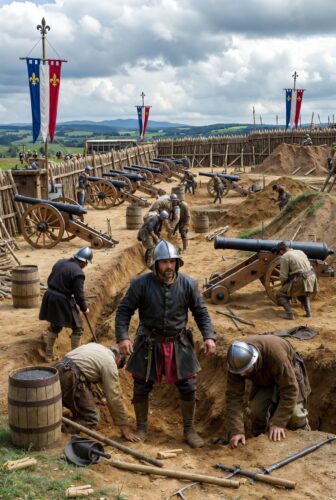
The political consequences arrived quickly. Castillon itself fell. The French tightened the ring around Bordeaux. On 19 October 1453 the city surrendered. The last English troops left Gascony. Except for the pale of Calais, which would endure another century, English rule on the continent was finished. The Hundred Years’ War, which had begun in 1337 over questions of feudal homage and dynastic claim, ended not with a treaty but with the simple military fact that the English no longer possessed the strength to contest French soil. Charles VII’s government, once dismissed as the shadow court of a disinherited prince, now controlled a realm that was recognizably modern in its administrative and military skeleton. The Bureau brothers’ artillery park at Castillon had been the final demonstration that systematic firepower, protected by earth and discipline, could render the old knightly charge obsolete.
The details repay close attention. The French did not win because they were braver. They won because they had prepared a position that forced the enemy to come to them under conditions of extreme disadvantage. They had standardized equipment. They had trained crews who could sustain a rate of fire. They had held a mobile reserve ready to exploit the moment when the attacker was fully committed. Talbot, for all his personal valor and long experience, made the classic error of attacking before his full strength was up and against an enemy who had chosen the ground with care. The legend of the English archer and the charging man-at-arms died in the smoke of those three hundred guns.
That is the history, dense and specific. The outcome—decisive closure of a generations-long conflict through prepared technical superiority and disciplined refusal to meet the enemy on his preferred terms—translates with unusual clarity into private life. Most people live inside their own Hundred Years’ Wars: long, grinding stalemates with debt, health habits, creative blocks, relational patterns, or professional inertia that never quite end because both sides keep fighting the same way. The lesson of Castillon is not “try harder.” It is “stop charging the guns.”
Here is the application, stripped of sentiment and turned into a concrete operating system.
**The Parked Battery Protocol**
This is not a mindset shift. It is a sequence of physical and temporal actions designed to force a long-running personal conflict onto ground you control.
– **Map the River and the Lidoire.** Take one stubborn, multi-year problem that has resisted ordinary effort. Write its full history on a single sheet of paper in chronological order: when it began, every major escalation, every previous attempt that failed and why. Do this in one sitting without editing for tone. The act of writing the timeline itself is the survey of the ground. Most people never do it; they simply keep reacting.
– **Build the Park.** Identify the three technical advantages you already possess but have never systematically deployed against this problem. Examples might be a particular skill, a financial instrument, a relationship, a piece of equipment, or a daily window of uninterrupted time. Treat these as artillery pieces. Create a physical “park”—a specific desk drawer, a folder, a shelf, or a digital directory—containing only the tools, documents, and schedules related to those three advantages. Nothing else is allowed in the park. The physical concentration of the tools is the earthwork.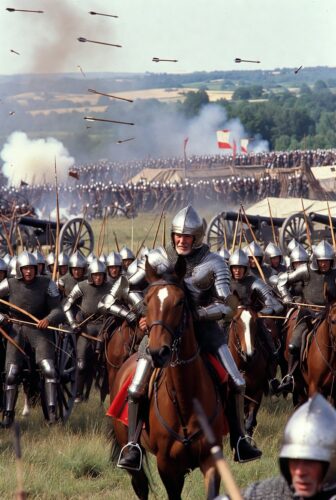
– **Refuse the Morning Charge.** For the next twenty-one days you are forbidden from initiating any new frontal effort against the problem. No new plans, no motivational speeches to yourself, no “this time I’ll really…” declarations. You may only maintain the existing park and answer when the problem itself advances. This is the hardest rule and the one that most closely mirrors Bureau’s decision to let Talbot come to him. Impulsive action is the English charge; disciplined waiting is the French gun line.
– **Install the Flanking Reserve.** Choose one low-effort, high-leverage action that can be executed in under fifteen minutes and that attacks the problem from an unexpected direction. It must be something you have never tried before in this conflict. Examples: a single clarifying email to a previously avoided party, a five-minute daily measurement of a previously ignored metric, the physical removal of one enabling object from your environment. Schedule this action for the same time every day. It is the Breton cavalry, held back until the frontal attack is fully committed.
– **Fire for Effect and Close.** On the twenty-second day, review the timeline and the park. If the problem has advanced into your prepared ground and the flanking action has created measurable movement, execute one decisive, irreversible step that consolidates the gain. If no movement has occurred, expand the park by one additional technical advantage and restart the twenty-one-day refusal. The protocol ends only when the equivalent of Bordeaux has surrendered—when the problem is no longer consuming daily mental bandwidth.
The uniqueness of the sequence lies in its prohibition on initiative during the critical phase and its insistence on physical concentration of tools. Most advice tells you to “take action.” The Parked Battery Protocol tells you to stop taking the kind of action that has already failed for years, to prepare a narrow, heavily defended position, and to let the conflict come to you under conditions you have engineered. It is the opposite of hustle culture. It is the method that ended a century of war in a single morning of concentrated fire.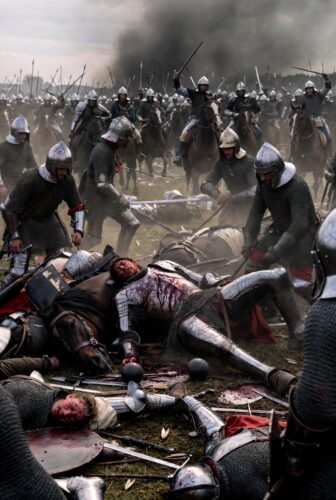
The men who died at Castillon on 17 July 1453 did not know they were closing an era. They simply charged because that was what men of their training did. The French gunners on the other side of the ditch were doing something newer and colder. They had measured the ground, placed their pieces, and waited. When the smoke cleared, the longest war was over. The same geometry is available to anyone willing to stop charging and start building the park.
Share: