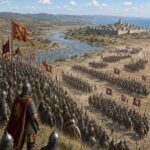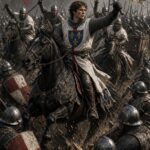

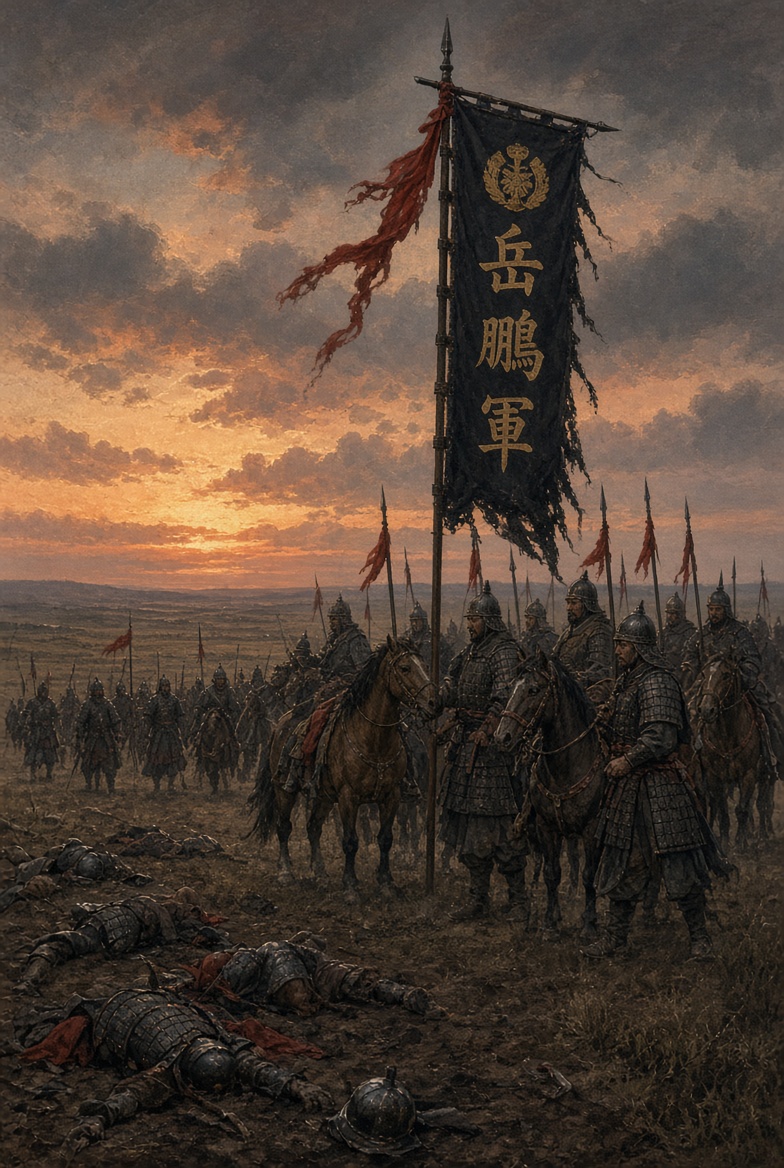
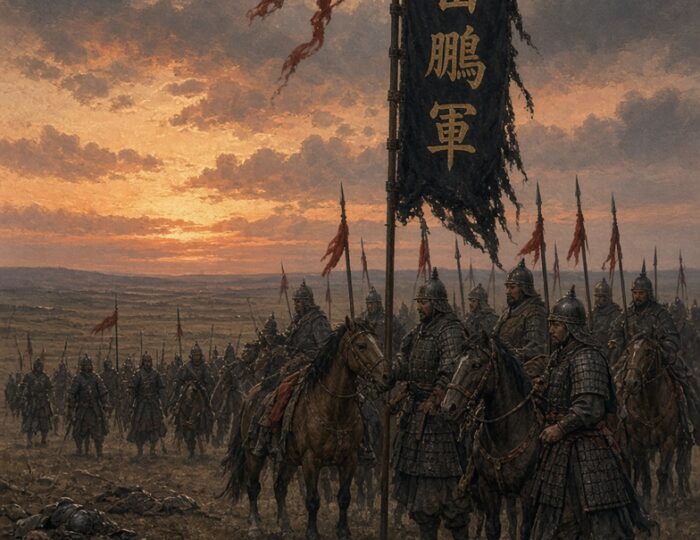
On the eighth day of the seventh lunar month in the tenth year of the Shaoxing era—corresponding to August 21, 1140 by the Western calendar—near the town of Yancheng in what is now Henan province, a Song general named Yue Fei faced a surprise onslaught that should have ended his northern campaign. The Jin commander Wanyan Wuzhu (often called Wuzhu or Wanyan Zongbi), fourth son of the Jin founder, had driven south with a force that contemporary accounts place at roughly 15,000 elite cavalry and up to 100,000 infantry. Modern estimates scale the totals downward, yet the disparity remained stark. Yue Fei’s available strength at the critical moment consisted of far fewer men, including specialized Beiwei and Youyi cavalry contingents and supporting infantry. The Jin relied on their vaunted heavy cavalry, the units later remembered as “Iron Pagoda” or, more specifically in the records, the *guai zi ma*—formations in which three armored riders and their mounts were linked by leather straps so that the charge presented an almost continuous armored front.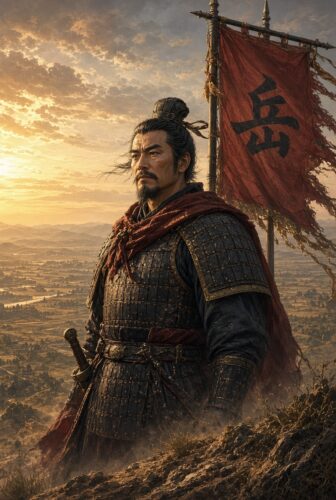
The wet months of early summer had already favored the mobility of Jurchen horsemen. Yue Fei’s army had been advancing northward as part of a broader Song counteroffensive after years of territorial loss following the Jingkang catastrophe of 1127, when the Jin had captured the Northern Song capital of Kaifeng and carried off the emperors. Southern Song forces under Emperor Gaozong had regrouped south of the Yangtze. Yue Fei, born in 1103 to a tenant-farming family in Tangyin, Henan, had risen through strict selection of soldiers, relentless training that included leaping walls and crawling moats in full gear even on rest days, and an insistence on justice in rewards and punishments so severe that he once ordered his own son Yue Yun beheaded for failing a training jump (the sentence later commuted). He tattooed loyalty across his back—“serve the country with utmost loyalty”—and enforced rules against pillaging so absolute that a soldier caught stealing a hemp rope faced execution. His method favored quality over mass: one thoroughly trained man was worth a hundred half-trained ones.
By mid-1140 Wuzhu had divided his army into multiple columns and moved against the central plains. Yue Fei, ignoring an earlier imperial recall order delivered by Minister Li Ruoxu, had positioned a light force at Yancheng while dispersing other units to hold key prefectures. On August 21 Wuzhu launched the surprise attack aimed at the Song command center. Yue Fei ordered his cavalry forward. What followed, according to the memorial Yue later submitted and the *History of Song*, was a series of ten bitter engagements fought into the early evening. Song cavalry seized the road roughly twenty *li* (about 6.6 miles) north of the town. Infantry then closed, armed with *maza* swords (broad, mace-like blades), *ti dao* (griffes or hooked knives), and large hatchets. The critical instruction, preserved in both official history and later narrative traditions, was simple and lethal: do not look up at the armored riders; keep the head down and cut only at the horses’ legs. Because the *guai zi ma* were linked in threes, the fall of one mount toppled the linked companions. Rows of heavy cavalry collapsed “like Mount Tai toppling.” Bodies littered the ground. As twilight fell the Song withdrew, driving off more than two hundred captured horses.
Yue Fei’s own report to the emperor captures the scene without flourish: scouting revealed four enemy princes and their warriors, including Wanyan Zongxian; Han Shizhong’s fifteen thousand armored horsemen engaged; officers and men hacked and chopped; countless enemies were slaughtered; twilight brought withdrawal with the captured mounts. The Jin reaction entered popular memory in a single bitter phrase: it is easier to shake a mountain than to shake Yue Fei’s army.
Fourteen days later Wuzhu tried again at Yingchang. Yue, predicting the move, sent his adopted son Yue Yun with Beiwei cavalry and infantry to reinforce Wang Gui. The same anti-cavalry method—Guaizi Ma tactics adapted and reversed—again shattered the Jin formation. Wuzhu’s army was effectively destroyed in that engagement; one of his high-ranking relatives fell. Song forces subsequently recovered Zhengzhou and Luoyang and advanced to Zhuxian Town, only about twenty kilometers south of the old Northern Song capital of Kaifeng. Yue is said to have shouted to his men that they would drink their fill at Huanglong Fu far to the north once the work was finished. Emperor Gaozong, receiving the news, initially rejoiced and issued rewards of two hundred thousand strings of cash, praising the loyalty that had moved even the gods.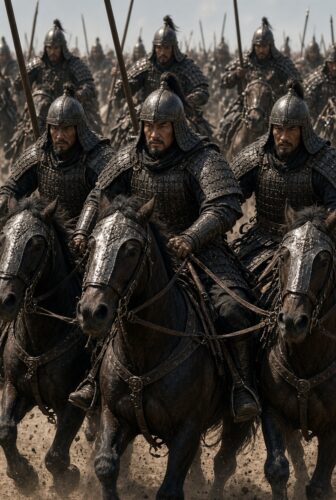
The political machinery of the Southern Song court, however, ran on different calculations. Chancellor Qin Hui favored a negotiated peace that would secure the southern regime and, more critically for Gaozong, prevent any Jin release of the captive former emperor Qinzong that might challenge the sitting throne. Twelve successive gold tablets arrived ordering Yue’s immediate return. He complied, resigning in protest. In 1141 he was imprisoned on fabricated charges of treason—the infamous “perhaps there is” formulation that entered Chinese as a byword for baseless accusation. On January 28, 1142, Yue Fei, his son Yue Yun, and the subordinate Zhang Xian were killed. Later tradition holds that Qin Hui’s wife devised the final order hidden inside oranges; official records report death in prison. Yue was thirty-eight. His body was secretly buried by a sympathetic officer. Only decades later did rehabilitation begin under Emperor Xiaozong, who granted the posthumous name Wumu; still later he received the title King of E. Statues of Qin Hui and his wife still kneel outside Yue’s tomb in Hangzhou, spat upon by generations of visitors.
The tactical core of August 21 remains the most instructive element. The Jin cavalry’s strength—heavy armor, mutual support through physical linkage, shock of massed charge—contained its own vulnerability. The legs of the horses could not be armored without destroying mobility. Once those legs were systematically attacked, the linkage that had made the formation formidable became the mechanism of its collapse. One failure propagated. Song discipline, selective recruitment, and refusal to meet strength with identical strength converted numerical inferiority into a decisive local superiority at the point of contact. The subsequent political betrayal did not erase the military fact: for one critical evening the “unshakeable” army of the north had been shaken by men who understood where to cut.
That single afternoon and evening at Yancheng supplies the material for application far removed from generic encouragement. The outcome—temporary military success followed by political nullification—illustrates both the power of precise vulnerability targeting and the necessity of guarding the campaign against internal recall. A person facing any persistent, interlocking set of obstacles can extract a method that is neither positive-thinking affirmation nor vague “consistency” advice. The method is structural, sequential, and timed.
– Identify the actual “linked cavalry” in the present situation: the three or more mutually reinforcing elements that together create an appearance of invulnerability. Examples include the combination of daily inertia, specific recurring financial drain, and social isolation that reinforce one another so that attacking only one leaves the others intact; or the triad of incomplete skill, missing documentation, and delayed decision that keeps a professional advance stalled; or the linked habits of late-night disruption, poor recovery nutrition, and avoidance of progressive overload that prevent physical recomposition.
– Locate the unarmored leg of each element. Every system that looks solid has a mobility requirement that cannot be fully protected. For inertia it may be the first ten minutes after waking; for a financial drain it may be the precise recurring authorization that can be revoked in a single action; for isolation it may be the one low-stakes weekly contact that requires no emotional performance. The leg is never the entire problem; it is the point that, once cut, forces the linked companions to fall.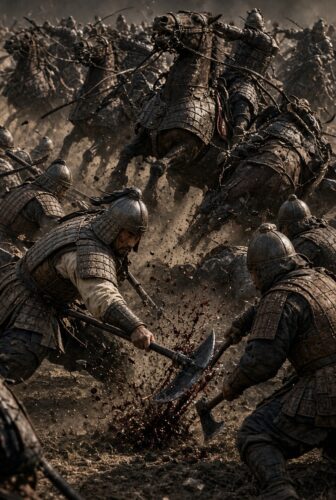
– Assemble a small, rigorously selected force rather than a mass of half-prepared intentions. Yue Fei’s preference for one well-trained soldier over a hundred mediocre ones translates directly: choose two or three concrete preparatory actions that can be executed under fatigue and distraction, rehearse them until they are automatic, and discard every additional resolution that cannot meet the same standard.
– Time the decisive cut for the equivalent of early evening—after the opposing formation has already committed and when residual energy still remains for the close work. Do not open with a dawn declaration of total transformation. Allow the opposing pattern to advance far enough that its linkage is fully extended, then strike the legs in rapid succession so that collapse propagates before reorganization can occur.
– After the first successful cut, immediately seize the captured resources (the two hundred horses) and use them to reinforce the next position rather than celebrating. Convert the freed time, money, or attention into the next targeted strike within days, not weeks.
– Install a personal “refuse the gold medals” protocol in advance. Write, in concrete language, the external or internal signals that will attempt to recall the campaign once early success appears—fatigue, social pressure, official or unofficial advice to settle, the sudden attractiveness of a lesser peace. Pre-commit to a short, non-negotiable sequence of continued actions that must be completed before any reconsideration is allowed. The twelve gold tablets arrived because the court preferred negotiated stability over continued risk; the same preference appears in modern form whenever momentum threatens existing arrangements.
The detailed, quick, unique plan that follows is built exclusively from the Yancheng sequence and is designed to be executed in a single focused cycle of seven to ten days, then repeated. It is not a lifestyle overhaul, a morning routine, a gratitude practice, or a vision-board exercise. It is a vulnerability-mapping and sequential-collapse protocol.
Begin on the morning of day one by writing a single sheet that lists exactly three interlocking obstacles currently preventing a concrete, already-defined advance. Beneath each obstacle write the one physical or procedural “leg” that cannot be armored without destroying the obstacle’s ability to function. The leg must be observable and interruptible within minutes, not a psychological state. Example format: Obstacle A (specific recurring expenditure that funds itself through automatic authorization); Leg A (the exact login sequence and confirmation button that can be revoked). Do the same for the other two. Do not expand the list.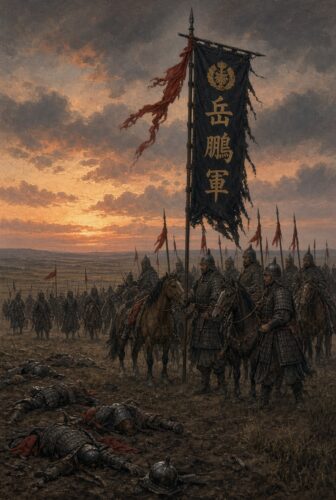
On the evening of day one, after the ordinary demands of the day have already committed the bulk of available energy, execute the first cut: perform the single action that severs Leg A. Immediately record the concrete resource thereby freed (hours, currency, attention) and assign it, before sleep, to the preparation of the second cut.
On day two or three, while the first collapse is still propagating, execute the cut of Leg B using the newly available resource. The timing must be after the ordinary pattern has already begun its daily or weekly advance, so that the linkage is extended. Capture whatever is released and reassign it at once.
On day four or five, cut Leg C. By this point the original three-element formation should be in visible disorder. Use the cumulative freed resources to perform one irreversible consolidation action that makes reversion more costly than continuation—transfer of a document, cancellation of an automatic process, physical rearrangement of a workspace, or formal notification of a change in status.
Days six through ten are reserved for the “Huanglong Fu” phase: a short, measured advance that uses the collapsed space to secure one tangible intermediate position (a completed application, a measured physical benchmark, a delivered piece of work, a secured appointment). Simultaneously activate the pre-written refuse-the-gold-medals sequence whenever any signal of premature settlement appears. The sequence consists of three non-negotiable actions that must be finished before the settlement is even considered.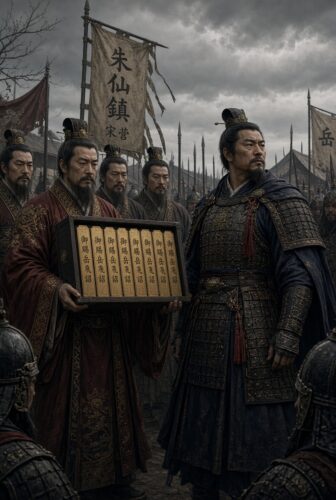
At the end of the cycle, discard the sheet and write a new one only if a new interlocking triad has formed. The method is deliberately narrow. It does not attempt to transform character, cultivate mindfulness, or accumulate motivational quotes. It isolates the linked formation, identifies the unarmored mobility points, strikes them in sequence after the enemy has committed, seizes the captured assets, and refuses the political recall that historically nullified a hard-won military success.
Yue Fei’s army on August 21, 1140, did not outnumber the Jin, out-armor them, or outlast them in open charge. It simply understood that the strength of the linked cavalry depended on legs that could not be protected, and it cut those legs while the formation was fully extended. The later tragedy of the gold tablets and the Pavilion of the Winds and Waves does not cancel the tactical fact of that evening. The mountain can be shaken when the axes find the place the armor cannot reach. The same principle, applied with equal precision and equal refusal of premature recall, remains available on any subsequent August 21 or any ordinary day that follows.
Share: