



On Tuesday, October 30, 1894, the United States Patent and Trademark Office issued Patent Number 528,527 to an inventor from Rochester, New York, named Daniel M. Cooper. The dry, bureaucratic documentation carried a deceptively pedestrian title: Workman’s Time-Recorder. Cooper was not the first mechanic to play around with clockwork gears, nor was he the first human being to notice that paid laborers sometimes enjoyed lingering over their coffee or slipping out five minutes before the final whistle. But Cooper’s brass-and-oak contraption achieved something far more radical than anything devised by the sundial-makers of ancient Babylon or the bell-ringers of medieval monasteries. Cooper invented the card punch clock.
Before Cooper’s patent arrived on that chilly autumn day in 1894, tracking human effort in an industrializing America was an absolute mess. Factory owners employed human timekeepers—flesh-and-blood clerks wielding leather-bound ledgers who sat beside the factory gates like stern, ink-stained gargoyles. These clerks were supposed to write down the exact minute each machinist, foundry hand, and seamstress arrived.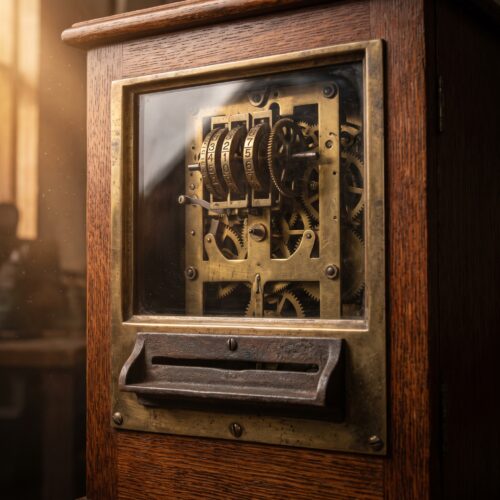
Naturally, human nature intervened at every step. If a gatekeeper liked you, you were on time even if your boots were still dripping from a ten-minute detour at the tavern down the street. If the clerk disliked your cousin, your politics, or the way you tipped your cap, you were marked docked a quarter-hour for an imaginary delay. Worse yet for management, workers routinely slipped a half-penny to the ledger-boy to write down false timestamps, while floor supervisors spent half their morning arguing with burly lathe operators about whether the town hall clock had struck seven before or after they passed the threshold.
Daniel M. Cooper looked upon this noisy, argumentative, thoroughly organic human friction and decided that humanity’s fundamental flaw was subjective time.
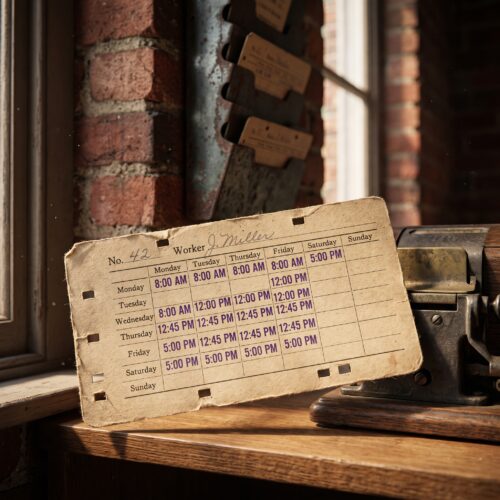
Cooper’s machine did away with the ledger-keeper entirely. Instead, he constructed a sturdy, heavy wooden housing enclosing an escapement movement, a set of synchronized numeral printing wheels, an ink ribbon, and a vertical metal throat. Alongside this device hung a slotted rack filled with individual bristol board cards, each bearing a worker’s name and assigned number. When an employee entered the plant, they pulled their card from the “Out” rack, slipped it into the guide slot of Cooper’s recorder, and shoved down a heavy cast-iron lever.
Inside the machine, a mechanical trip hammer dropped. The date, the exact hour, and the minute were driven into the fibers of the card with an unmistakable, resonant clack.
That mechanical clack was the sound of a cultural trap snapping shut. It marked the precise moment when the American economy ceased paying people for what they produced, created, or resolved, and began purchasing human existence in raw, unyielding, fifteen-minute increments.
To understand the sheer magnitude of Cooper’s invention, one has to travel backward before October 30, 1894, and look at how humans had actually related to the ticking clock for the preceding several thousand years.
Throughout the vast majority of human history, work was organized around natural tasks, not abstract arithmetic. A shoemaker made shoes. A farmer plowed until the ridge was turned or the storm broke. A blacksmith forged until the iron cooled. If an 18th-century cabinetmaker felt energetic on Tuesday, he worked twelve hours by candlelight; if he felt sluggish on Wednesday, he spent three hours sharpening chisels and drinking cider with a neighbor, making up the difference when inspiration or necessity returned. Time was fluid, tied to the sun, the seasons, the completion of an artifact, and the biological rhythm of the human animal.
Even during the early decades of the American Industrial Revolution, when steam boilers and cotton looms first tethered laborers to mechanical rhythms, work remained stubbornly personal. Factory overseers had to cajole, threaten, and bribe a generation of former agrarian workers who were baffled by the idea that being seven minutes late to spin cotton was an offense worthy of financial ruin. In the 1870s and 1880s, inventors tried to solve this with curious contraptions: Alexander Dey patented a dial recorder in 1888 where workers turned a large wheel with a pointer to their assigned number, and Willard Le Grand Bundy invented a key recorder in 1889 where each worker was given an actual mechanical key that they shoved into a lock to register an imprint on an internal paper tape.
Both Dey’s wheel and Bundy’s key were cumbersome, finicky, and prone to internal jams that required an engineer to disassemble the housing just to see who had cheated on their shift. Cooper saw their shortcomings and bypassed them with an insight of ruthless simplicity: the card itself must become the employee’s external conscience.
Cooper realized that if the physical record of time lived on a card that the worker had to touch, handle, inspect, and slide into the slot twice or four times a day, psychological ownership shifted. The machine didn’t feel like an abusive boss arguing over a minute; it felt like an impartial, objective god. A worker could swear at a foreman, but screaming at an oak box containing patent-approved internal gear trains felt foolish. The stamped card became an incontrovertible legal artifact. It eliminated debate, wiped out grace periods, and standardized industrial punctuality across the continent.
Daniel Cooper did not keep his invention to himself for long. In Rochester, the patent became the foundation of the Rochester Time Recorder Company, formed to manufacture the machines at scale. Cooper’s “Rochester” recorder quickly became a runaway commercial sensation, popping up in railroad machine shops, textile mills, printing plants, and carriage factories across the eastern seaboard.
Factory managers discovered that merely bolting Cooper’s heavy wooden clock to the wall adjacent to the entryway increased factory output by several percentage points in the first month alone, simply by terrifying employees into loitering outside the door twenty minutes early in all kinds of weather just to make sure they slammed the lever before the minute wheel tripped over.
The corporate appetite for Cooper’s time recorder was so voracious that it caught the eye of an ambitious financier named Charles Ranlett Flint. Flint was a master of corporate consolidation, often dubbed the “Father of Trusts.” In 1900, Flint orchestrated the buyout and merger of Cooper’s Rochester Time Recorder Company with its chief rival, Willard Bundy’s International Time Recording Company. A decade later, in 1911, Flint merged this conglomerate with two other computing and tabulating manufacturers to create the Computing-Tabulating-Recording Company, known universally to history by its acronym: C-T-R.
In 1924, CTR renamed itself to reflect its global technological ambitions, adopting the moniker International Business Machines—IBM.
Daniel M. Cooper’s humble patent of October 30, 1894, was quite literally the mechanical seed from which IBM sprouted. Long before IBM built room-sized mainframes for NASA or personal computers for suburban dens, its early financial empire was erected upon the cast-iron stamping gears of Cooper’s employee card recorder.
While the industrialists celebrated Cooper’s machine as a triumph of scientific efficiency, the social impact on American workers was profound, disorienting, and psychologically grueling. The time recorder severed human value from personal mastery. It created the “eight-hour shift” not as a rough social convention, but as a rigid grid where every single unit of human energy had to be accounted for, monitored, and penalized.
The machine gave birth to the notorious phrase “punching the clock,” which swiftly migrated into the American vernacular as a universal shorthand for tedious, soul-sapping, uninspired existence. Under the rule of Cooper’s card, the man who produced eight flawless chairs in six hours was penalized for leaving early, while the man who produced four mediocre chairs in eight hours received his full wage, provided his card bore the pristine violet-ink stamps of 8:00 AM and 5:00 PM.
Presence had successfully usurped performance. The illusion of activity had officially become more lucrative than the reality of output.
For over a century, the spirit of Daniel Cooper’s 1894 machine has continued to haunt our workplaces. It survived the collapse of the smokestack manufacturing economy. It migrated from the physical oak-encased time recorder on a brick wall into digital software: keystroke monitors, automated mouse-wigglers, Slack presence dots toggling between green and yellow, calendar-blocking theater, and modern corporate productivity metrics.
Most people today are still living under the psychological tyranny that Daniel Cooper codified on October 30, 1894. They sell their life in arbitrary chronological blocks, obsess over looking busy for forty hours a week, mistaking chronological endurance for real-world impact. They exhaust their best intellectual hours performing availability rather than manufacturing breakthroughs.
To break that century-old paradigm, you must intentionally invert Cooper’s logic. You must abandon the religion of mere hours logged and erect an operating model rooted entirely in sovereign output.
The Anti-Cooper Protocol: The Sovereign Output Blueprint
If Cooper’s machine proved that systems will default to measuring time whenever they cannot measure value, your personal salvation lies in making your value so undeniable, concentrated, and compressed that the clock becomes entirely irrelevant.
Here is your exact, radical blueprint to dismantle the punch-clock mentality in your own life and reclaim your cognitive sovereignty:
- Abolish the 8-Hour Illusion with “Strike Windows”: Stop spreading your cognitive work across a wide, lukewarm eight-hour span filled with tabs, notifications, and simulated productivity. Identify your two-hour peak physiological window each day—when your mental clarity is razor sharp. Treat this window as a locked foundry. In this two-hour strike block, execute high-leverage intellectual or creative heavy lifting with zero interruptions. A focused two-hour sprint yields more genuine value than eight hours of distracted, clock-punching drudgery.
- Decouple Compensation from Chronology: Whether you are an employee, an independent operator, or an entrepreneur, relentlessly transition your value proposition from “hours spent” to “results delivered.” If you quote freelance or consulting work, never bill by the hour; hour-based billing punishes you for becoming faster, smarter, and more efficient. Price by the milestone, the outcome, or the transformation. If you work a traditional desk job, pitch your performance reviews around revenue generated, costs slashed, and systems streamlined—never the hour you arrived or how late your office light stayed on.
- Expose and Eliminate “Shadow Stamping”: Audit your daily schedule for what Cooper’s workers used to do when they stood around the clock waiting for the minute hand to tick: passive existence masquerading as labor. Ruthlessly purge performative activities—status update meetings that could have been an asynchronous sentence, endless thread monitoring, and decorative email polishing. If an activity does not create an asset, solve an operational problem, or generate cash flow, it is a shadow stamp. Cut it mercilessly.

- Establish the Daily Binary Metric: Cooper’s machine recorded a binary state: stamped or unstamped. Create your own daily sovereign metric. Every morning, write down exactly one non-negotiable, tangible deliverable that moves the needle on your primary life or career objective. The rule of the binary metric is ruthless: if that one item is completed with excellence, your day is an absolute win, even if you put down your tools by 1:00 PM. If that item is unfinished, your day is a loss, even if you sat at your keyboard for fourteen agonizing hours.
- Reclaim “Task-Oriented” Living: Reconnect with the pre-1894 rhythm of human mastery. When you sit down to create, write, code, strategize, or build, define the boundaries by the completion of the artifact, not by the passage of arbitrary sixty-minute intervals. When the artifact is finished, step away entirely. Go outside, lift weights, read, walk, or cook. Teach your brain that rapid, high-intensity execution is rewarded with freedom, not with extra administrative busywork dumped on top of you to fill an arbitrary schedule.
On October 30, 1894, Daniel M. Cooper showed the world what happens when human effort is captured and trapped inside a mechanical box. His invention built industrial giants and shaped modern enterprise, but it also placed human potential inside a cage of billable minutes. The system was engineered to reward presence over power. Your mandate today is to smash the lever, step away from the card rack, and measure your life not by the hours you punch, but by the dent you leave in reality.
For a closer look at the actual mechanical device Daniel Cooper patented and how it transformed daily life, check out this Almanac: The punch clock video detailing its history and cultural legacy. This archival report visually showcases the original punch clock mechanisms from Cooper’s era and explains how his device fundamentally altered the workplace.
Share: