
On the last day of August in the year 929, a Saxon army under two counts arrived at a Slavic fortress called Lunkini—Lenzen to later German tongues—on the eastern bank of the Elbe. They dug in, posted cavalry screens, and settled into the unglamorous work of starving a stronghold. Five days later, on Friday, September 4, the relief army that had come to break that siege was gone. Most of its infantry never made it back to the walls. Many of them drowned. The garrison surrendered the next morning. Effective Slavic military resistance along that stretch of the Elbe collapsed for the rest of King Henry I’s reign.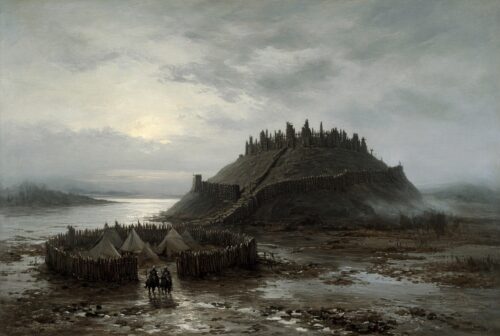
That is the short version. The long version is wetter, bloodier, and far more useful.
Henry I, called the Fowler because the messengers who came to offer him the East Frankish crown in 919 supposedly found him hawking, had spent the previous winter and spring doing what he did best: turning a loose collection of stem duchies into something that could survive the tenth century. He was not yet “the Fowler” in any romantic sense. He was a Saxon duke who had been elected king by Saxon and Franconian nobles at Fritzlar, refused anointing by the archbishop of Mainz, and then spent years subduing or co-opting the other dukes—Burchard of Swabia, Arnulf of Bavaria—while buying time from the Magyars with tribute after capturing one of their princes in 924. That ten-year truce gave him a window. He used it to look east.
The Polabian Slavs—Hevelli, Daleminzi (Glomacze), Redarii, Linonen, and the wider Veleti groups—lived in a world of timber-and-earth strongholds, tribute demands, and sudden raids across the Elbe and Havel. In the winter of 928 Henry marched on the Hevelli, wore them down in small fights, and took their principal fortress at Brandenburg by storm. He then turned on the Glomacze, besieged their capital at Gana (Jahna), killed the adult garrison, and handed the women and children to his soldiers as slaves. He planted a new fortress at Meissen. In 929, while Duke Arnulf of Bavaria pushed into Bohemia from the south, Henry brought the royal army—chroniclers speak of fifteen thousand men—up from the north. Duke Wenceslaus of Bohemia looked at the host, resumed the tribute, and went back to being a client. Henry’s men threw up more forts between the Saale and the Elbe. The eastern frontier was starting to look like a system instead of a raid zone.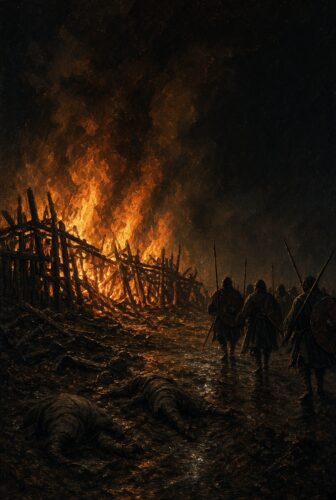
Then the Redarii broke it.
The Redarii were a northern Veleti subgroup who had been paying tribute. In late July or early August 929 they stormed the German fortress of Walsleben on the Uchte, massacred the garrison and the civilian population, and announced that the arrangement was over. The success was contagious. Other groups between the Elbe and the Oder decided the moment had come. Tribute dried up. The new forts suddenly looked isolated. Henry’s response was textbook for the age: if the enemy takes one of your forts, you take one of theirs that matters more.
Lenzen sat on the eastern bank of the Elbe. It was a major operating base for raids westward. Henry ordered Count Bernhard—already responsible for keeping the Redarii in line—to gather a Saxon host and go get it. Count Thietmar of Merseburg came as colleague and cavalry commander. Other counts brought their own household troops. The bulk of the army was the select levy: free men equipped and trained to fight in a close-order infantry phalanx, the formation that had been the backbone of Saxon fighting since they stopped being the people Charlemagne had spent decades trying to convert at sword-point.
They reached Lenzen on 30 August and did what Vegetius would have approved. They built a fortified camp, posted guards, and sent cavalry out to screen and scout. They had tents and supplies for a long stay. Siege warfare in the tenth century was mostly waiting, watching the walls, and hoping the other side ran out of food or nerve first.
On 3 September the scouts came back with news. A large Slavic force—Redarii infantry in numbers the chroniclers later called “innumerable”—was nearby and intended to hit the Saxon camp that night. Bernhard confirmed the report with more reconnaissance, then put the camp on high alert. The Saxons spent the night expecting an attack that never came.
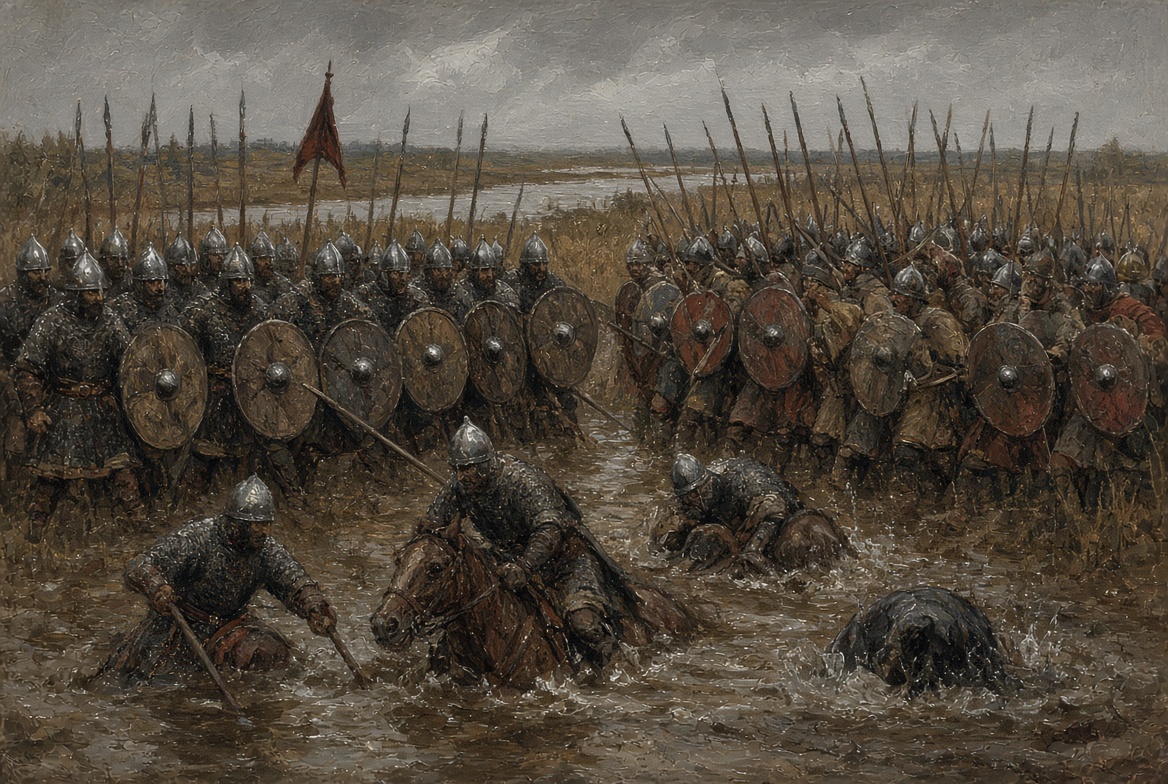
Dawn on 4 September showed the Redarii drawn up in their own infantry phalanx opposite the Saxon lines. They had little cavalry. Bernhard formed his phalanx and tried the classic trick: a feigned cavalry retreat to pull the enemy out of formation and onto ground of his choosing. The ground refused to cooperate. It was wet. The horses could not execute the maneuver cleanly. The fake flight looked like what it was—a messy shuffle in the mud.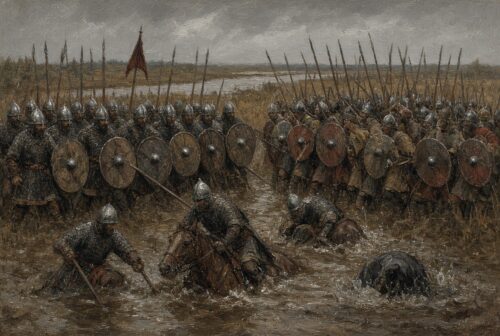
So the Saxons did the unglamorous thing. They walked forward and started hitting the Slavic line with infantry. The two phalanxes ground against each other for the rest of the day. Casualties were heavy on both sides. The Saxon cavalry stayed in reserve under Thietmar, watching the flanks in case the Lenzen garrison sortied or another Slavic force appeared. The fighting was the kind of prolonged, shield-to-shield, spear-and-axe work that leaves both armies exhausted and the field slippery with more than rain.
Late in the day a gap opened on the Slavic flank. Bernhard signaled. Thietmar took fifty armored horsemen—*quinquaginta armatis*, Widukind of Corvey wrote—and drove them into that gap. Fifty men. Not a thousand. Fifty. The shock of the charge broke the cohesion the Redarii had maintained all afternoon. The phalanx came apart. Men who had stood in place for hours suddenly ran.
That was when the killing became industrial. Saxon cavalry rode down the fugitives across the fields. Others were driven into a nearby lake or stretch of marsh and drowned. Widukind, writing a generation later at Corvey, claimed two hundred thousand Redarii died. The number is absurd—tenth-century armies did not field that many men in one place—but the direction of the claim is clear. The infantry was annihilated. A handful of Slavic horsemen escaped. The Saxons lost nobles; Thietmar of Merseburg later recorded that two of his own great-grandfathers, both named Lothar (one count of Walbeck, one of Stade), died in the fighting. “Few nobles fell,” the sources say, which in that world still meant a noticeable number of named men.
The Saxons returned to camp and celebrated while it was still light. The next morning the garrison of Lenzen and its *rex* came out and asked only for their lives. The Saxons granted that much. They took the weapons, the slaves, the women, the children, the king’s household goods, and everything else that could be carried. The prisoners taken in the battle itself were beheaded the following day, as the Saxons had vowed. The fortress was stripped. Bernhard and Thietmar marched home with eight hundred captives and the kind of victory that changes a frontier.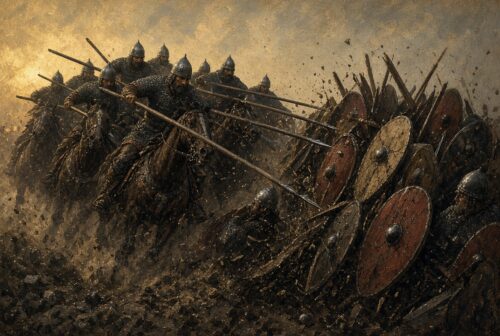
Henry used it. The Lusatians were made tributary in 932. The Ukrani on the lower Oder followed in 934. There was no serious Slavic military challenge to German control of the Elbe line for the rest of Henry’s life. He died in 936 at Memleben and was buried at Quedlinburg. His son Otto would take the same eastern policy further, fight the Magyars to a finish at the Lechfeld in 955, and become emperor. The Battle of Lenzen was not the largest fight of the century and it did not make the evening news in Constantinople. It was the moment a rebellion that had looked contagious was turned into a one-sided slaughter because one side kept its formation, waited out a failed trick, and then committed a tiny, heavy reserve at the exact instant the other side’s line showed a seam.
Widukind of Corvey, writing the *Res gestae Saxonicae* in the 960s and 970s, is our main narrative source. He was a monk who entered Corvey around 940, had access to court circles, and wrote for an Ottonian audience that wanted to hear that Saxons won because they were disciplined and their enemies were a “barbarous multitude.” Thietmar of Merseburg, writing later, added the personal cost to his own family. Modern historians treat the casualty figures as propaganda, note that the exact site of the “Königsburg Lunkini” may have been the earlier Slavic fort at Lenzen-Neuehaus rather than the later castle mound, and still accept the outline: siege from 30 August, battle on 4 September, surrender on the 5th, frontier locked.
The wet ground that ruined the feigned retreat is one of those details that makes the day feel real. Cavalry charges look magnificent in the imagination. On a soggy September field next to the Elbe they look like expensive men on expensive horses sliding around while the infantry does the actual work. The fifty horsemen were not a magic number. They were the force small enough to keep in reserve all day and heavy enough to matter when a gap finally appeared. The lake did the rest.
That is the history. It happened on this date, 1,097 years ago, in a place most people could not find on a map without help. It was specific, ugly, and decisive in the way that most “decisive” battles are: one side’s organization and timing survived contact with reality and the other side’s did not.
The outcome was not mystical. It was the result of sitting in a fortified camp for five days instead of rushing, of keeping the cavalry back instead of throwing it in early, of accepting that the clever maneuver had failed because the dirt was wet, and of having a small, ready force when the grinding finally produced an opening. The Redarii had numbers and the morale of a recent successful massacre at Walsleben. They did not have a way to protect their flanks or to recover once the line cracked. The Saxons did.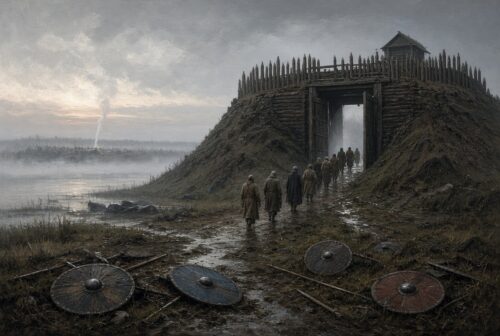
A person looking at that Friday in 929 does not need another lecture about “patience” or “waiting for your moment.” Those phrases have been worn smooth. What the day actually demonstrates is narrower and more usable.
– Treat the current difficulty as a siege, not a field battle you have to win this afternoon. Identify the one position you already hold that the other side must relieve. Fortify it. Stop making heroic sorties.
– Keep a deliberately small, high-quality reserve off the main line. Not your entire effort. Fifty horsemen, not the whole levy. Something you can actually move when the seam appears.
– When the clever plan fails because conditions are wrong (the ground is wet, the timing is off, the other side does not take the bait), do not double down on the clever plan. Switch to the ugly, sustainable pressure and wait for the line to show a gap.
– The gap will look smaller than you expect. Commit the reserve immediately and completely. Do not feed it in piecemeal.
– After the break, pursue to the natural barrier—the lake, the marsh, the point of no return—rather than stopping to congratulate yourself on the first sign of flight.
– The next morning, accept the surrender that the previous day’s work made inevitable. Do not keep fighting a garrison that has already decided the relief army is not coming.
That sequence is not a morning-affirmation list. It is a four-day operational pattern you can run on any stubborn problem that has already survived your first three attempts.
Day 1: Map the fortress you already occupy and the relief force that is trying to break the siege. Write both down in one sentence each. No extra words.
Day 2: Move your best small asset—the equivalent of those fifty armored riders—off the main effort and keep it unused. Tell no one it is the reserve.
Day 3: Apply steady, unglamorous pressure. When the smart tactic fails because the conditions are bad, note the failure out loud and switch to the grind. Do not invent a new clever tactic.
Day 4: Watch only for the seam. The instant it appears, send the reserve through it and keep going until the opposition is in the lake. Then stop. The garrison will come out on its own the following morning.
The plan is unique because it is copied from one wet Friday in 929 instead of from a productivity book. It assumes the ground will be against you, the first trick will fail, and the decisive act will be smaller and later than your pride wants. That is what actually happened at Lenzen. The lake finished what the infantry started. The fifty horsemen only had to arrive at the right minute.
Henry the Fowler never saw the battle. He was elsewhere in Saxony when the messengers brought the news. He used the result anyway. The frontier held. The tribute resumed. The next generation inherited a line that no longer had to be re-fought every summer. That is the only kind of victory that compounds.
September 4 still belongs to that muddy field next to the Elbe, the phalanx that did not break first, and the small reserve that finally did. The rest is just weather and timing.
Share: