
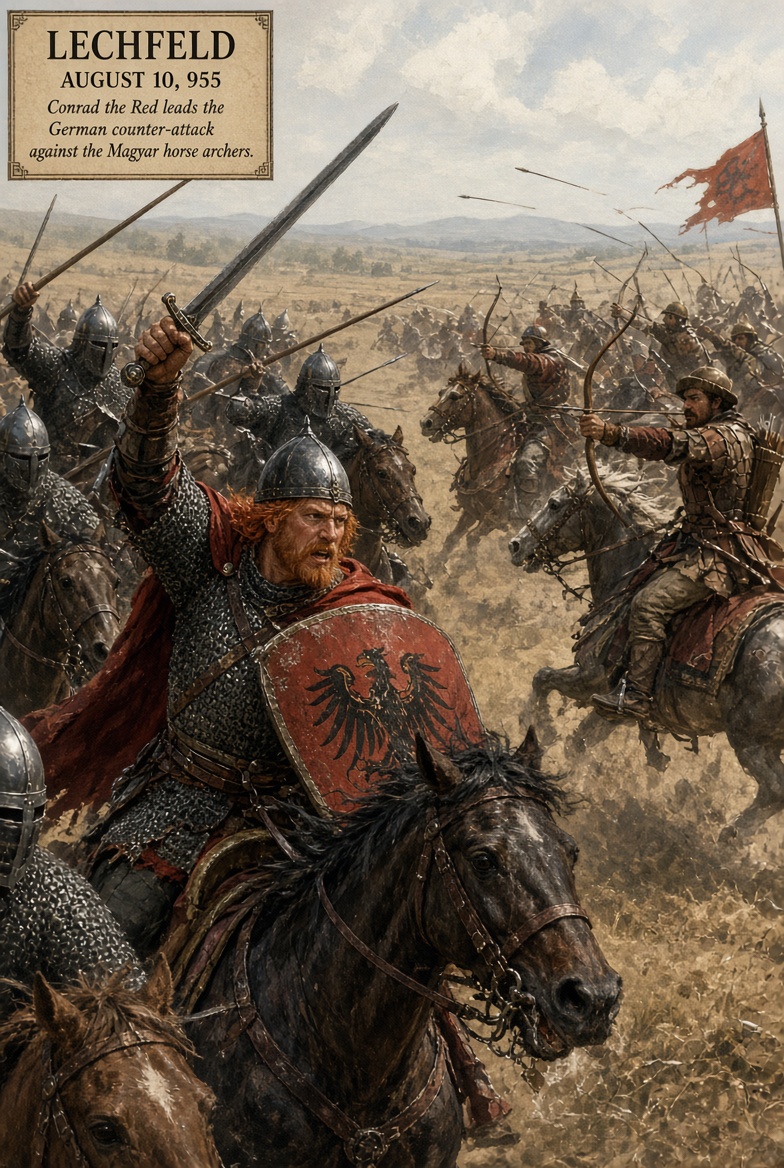
On a blistering August morning in 955, the plains east of Augsburg baked under a sun that turned iron helmets into personal ovens. Dust rose in choking clouds. Horses stamped and snorted. Men in heavy mail shifted uncomfortably, the heat already working its quiet sabotage long before any arrow flew. Across the open ground, a host of light horsemen—Magyars, the terror of three generations—waited with the easy confidence of people who had spent decades treating Western Europe like a poorly guarded pantry. They had come to finish what decades of lightning raids had begun. Instead, by the evening of the tenth and the rain-soaked days that followed, their power to dictate the fate of the Latin West ended in a cascade of drowned horses, hanged chieftains, and a king who walked off the field called both father of the fatherland and, by his own men, emperor.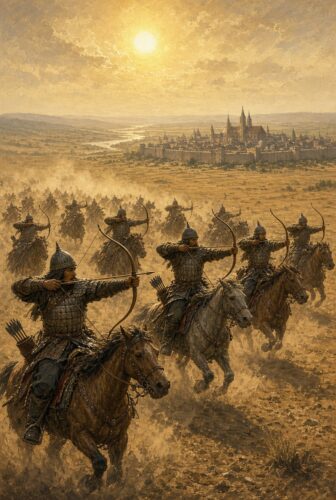
This is the story of the Battle of the Lechfeld, the series of engagements that began on 10 August 955 and stretched through the twelfth. It is not a tidy one-day clash of banners. It is a grinding, heat-soaked, opportunistic slaughter that closed an age of migrations and opened the path for the Ottonian imperial project. The details are messy, human, and far more instructive than any later romantic painting of knights charging in perfect ranks.
For more than half a century the Magyars had ridden out of the Carpathian Basin like a seasonal plague. They were not a single disciplined army so much as a confederacy of horse-archer clans whose preferred method was speed, feigned retreat, and the systematic extraction of tribute. In 899–900 they had already shown the West what they could do. By the 910s they were defeating East Frankish forces with humiliating regularity, including an earlier fight near the same Lechfeld plain in 910 that left the young Louis the Child’s armies in ruins. Their range was astonishing. They reached as far as the Atlantic coasts of France, the monasteries of northern Italy, and the approaches to Constantinople. Chroniclers described them drinking the blood of their enemies and carrying off entire populations. The reality was more pragmatic and therefore more terrifying: they were superbly adapted light cavalry operating against societies that had largely forgotten how to fight mobile steppe warfare on open ground.
The East Frankish kingdom under the Ottonians had begun to push back. Henry I, Otto’s father, had built a network of fortified places and trained a more reliable heavy cavalry. Otto I himself had spent the early years of his reign putting down rebellions by his own dukes and relatives. In 953–954 his son Liudolf and son-in-law Conrad the Red had risen against him, even inviting Magyar allies into the Rhineland. The kingdom looked, for a dangerous moment, like it might fracture. Otto crushed the rebellion with characteristic ruthlessness. By the spring of 955 the last holdouts had fallen. Then the Magyars came again, this time in force.
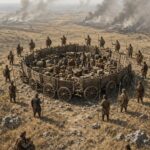
Estimates put the invading host somewhere between eight and ten thousand, mostly mounted archers with supporting infantry and a train of siege engines. They crossed the Enns, fanned out, and by early August had invested Augsburg. The city was not in prime condition. Its walls still bore the scars of the previous year’s fighting. Inside, Bishop Ulrich—later sainted—organized the defense with a mixture of practical engineering and theatrical piety. He strengthened the vulnerable south gate, posted men, and on 8 August led a sortie himself, riding unarmed on a warhorse while chanting the Twenty-third Psalm. The Hungarians lost a commander in the melee and pulled back, but the siege continued. They surrounded the place, set up engines, and waited for the city to crack or for Otto’s relief army to arrive so they could destroy it in the open.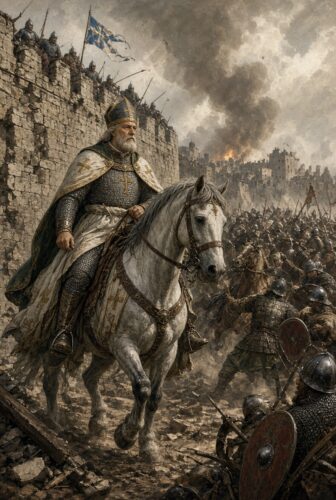
Otto marched. He had gathered what forces he could after the civil war: Bavarians under his brother Henry, Swabians under the newly restored Duke Burchard, Franconians under the rehabilitated Conrad the Red, a contingent of Bohemians, and his own royal legion of picked men. Contemporary accounts speak of eight legions, each roughly a thousand strong, though the numbers are elastic and the royal contingent larger. The army assembled near Ulm and moved toward Augsburg through broken country, trying to keep its flanks covered. On the morning of 10 August— the feast of Saint Lawrence, a detail Otto would later exploit for propaganda—they approached the Lechfeld plain.
The Magyars struck first. A detachment crossed the Lech downstream, swung around, and hit the rear of the German column. The Bohemian legion, guarding the baggage, was mauled. Swabian units further forward took heavy losses. For a moment it looked like the classic Magyar trap was springing: isolate the rearguard, panic the main body, then finish the job with archery from every direction. The Hungarians paused to plunder the baggage train. That pause cost them.
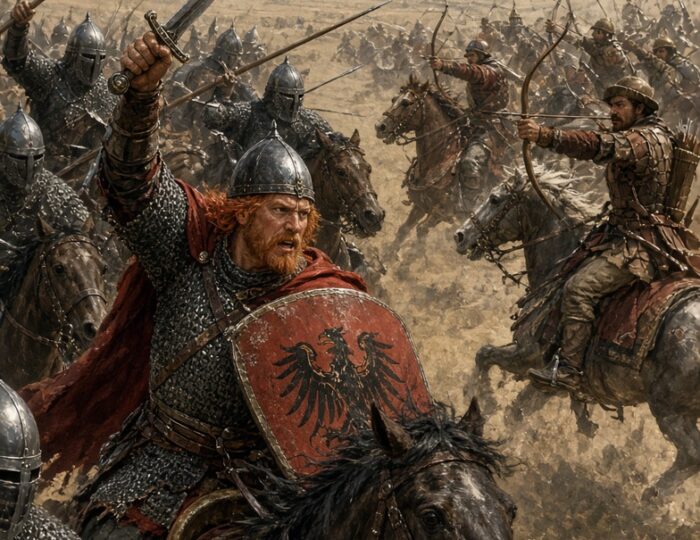
Conrad the Red, the same man who had rebelled against Otto only a year earlier, turned his Franconian cavalry and charged. Heavy horsemen in the heat of an August midday are not graceful. They are irreversible. Conrad’s men smashed into the looting Magyars, recovered prisoners and banners, and drove the attackers back across the river in disorder. Conrad himself would not live to enjoy the victory. Later in the fighting, overcome by the heat, he loosened the bindings of his armor to breathe. An arrow took him in the throat. The chroniclers record the moment with a mix of admiration and grim satisfaction: the former rebel died a loyal hero under the same sun that was baking everyone else.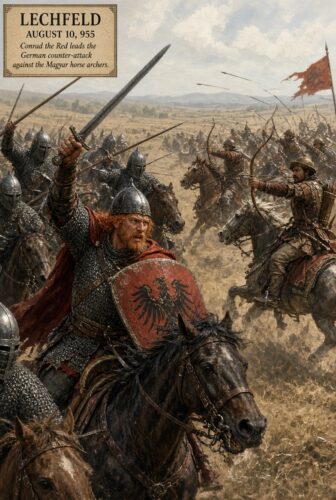
Otto now brought his main force into contact with the Hungarian center. The Germans had the advantage in close combat. Their armor and weapons were heavier; once the horse archers were forced to stand and trade blows instead of shoot and wheel, the imbalance showed. The Magyars gave ground, retreated in relatively good order across the Lech, and left the field to Otto. The king did not launch a wild pursuit. His own rear legions had been roughly handled. Men and horses were exhausted by heat and combat. He knew the Magyars’ reputation for the feigned flight that lured pursuers into ambush. Instead he entered Augsburg that evening, rested his army, and issued orders that would prove decisive: every river crossing and ford in eastern Bavaria was to be watched and held. No easy road home for the invaders.
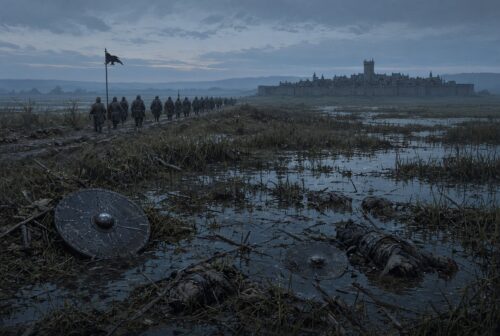
The next two days finished what the tenth had begun. Rain fell hard. The rivers rose. Flooded ground slowed the retreating Magyars. Local forces and Otto’s detachments hunted them in the woods and villages. Many drowned trying to cross swollen streams. Others were trapped in farmsteads and burned out. The Hungarian leaders—Bulcsú the harka, the chieftains Lél and Súr—were captured, brought first to Augsburg and then to Regensburg, and hanged. Survivors who reached the Carpathian Basin arrived as mutilated messengers of catastrophe. The age of large-scale Magyar raids into the Latin West was over. Within a generation the Magyars themselves would settle more permanently, adopt Christianity under Stephen I, and become a settled kingdom rather than a mobile threat.
The political consequences for Otto were immediate and lasting. His army acclaimed him pater patriae and emperor on the field. The victory erased the stain of the recent civil war and demonstrated that the East Frankish king could coordinate the duchies against an external enemy. Seven years later, in 962, he would be crowned Holy Roman Emperor in Rome. The Lechfeld victory was the military foundation of that claim. It also marked a broader shift: the superiority of disciplined heavy cavalry and coordinated defense over pure steppe mobility in the specific geography of Central Europe. The open plains that had favored the Magyars for decades had finally been turned against them by a combination of armor, refusal to chase shadows, and control of the landscape after the main clash.
Primary accounts, especially Widukind of Corvey’s *Deeds of the Saxons*, give the battle its texture. Widukind describes the order of march, the sudden rear attack, Conrad’s counter-charge, Otto’s rallying speech emphasizing superior arms and divine favor, and the methodical destruction of the fleeing enemy over the following days. Other sources, including the life of Bishop Ulrich, emphasize the defense of Augsburg and the bishop’s personal courage. Later Hungarian tradition remembered the defeat as a turning point that forced a change in their own society. The feast of Saint Lawrence acquired new resonance in German lands because the fighting began on his day and the rains that followed were sometimes called his tears.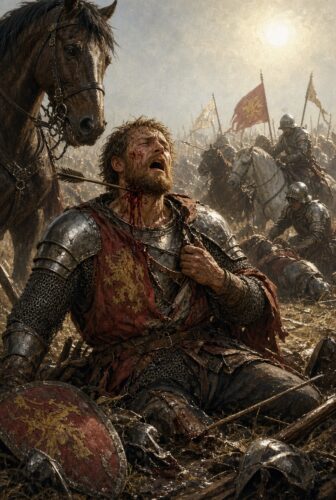
The battle was not clean. Casualties on the German side were significant, especially among the rear formations. Conrad’s death was a personal blow. The exact location of the main fighting remains debated—some scholars place the decisive actions slightly west of the modern Lechfeld plain—but the strategic outcome is not in dispute. A mobile, tribute-extracting power that had terrorized Europe for generations was broken in a single campaign season by a king who had just finished putting his own house in rough order.
That is the history. Now the application.
The outcome of Lechfeld was not merely a battlefield win. It was the conversion of a temporary tactical success into the permanent end of a structural threat. Otto did not chase the Magyars into the Carpathians. He sealed the exits, let the environment and local forces do the finishing work, and used the prestige of the victory to lock in internal authority. The Magyars, for their part, stopped treating the West as an open raiding ground and began the long process of becoming something else. Both sides adapted. The side that adapted more completely on the day and in the immediate aftermath shaped the next century.
A person facing recurring personal threats—patterns of distraction, debt cycles, health backsliding, creative paralysis, relational chaos—can extract a usable method from this without turning it into another vague “be resilient” slogan. The method is specific, multi-day, physical, and deliberately inconvenient. Call it the Lechfeld Seal Protocol. It is not a morning routine or a vision board. It is a short, timed campaign against one concrete, recurring personal invasion.
**The Lechfeld Seal Protocol**
Choose one recurring pattern that functions like a Magyar raid in your life: something that arrives periodically, extracts energy or resources, and disappears before you can fully engage it. Examples: the late-night scrolling spiral that eats three hours and leaves residual guilt; the impulse purchase cycle that restarts every payday; the avoidance of a difficult creative or administrative task that accumulates into crisis; the social media or news binge that spikes anxiety and kills focus for the rest of the day. Name it precisely. Write the name on a single index card. That is your “invasion force.”
**Day 0 – The Augsburg Preparation (evening before the campaign)**
Identify the “city” under siege: the specific domain the pattern attacks (sleep, money, deep work, physical training consistency). List three concrete defensive measures that cost almost nothing but raise the cost of the raid. Examples: put the phone in a locked drawer after 9 p.m. with the key in another room; move the credit card to a sealed envelope that requires scissors to open; set a physical timer that must be wound by hand before any “just five minutes” session. These are your wall repairs and Bishop Ulrich’s sortie readiness. Do them that evening. No negotiation.
**Day 1 – The Heat Stand (the actual confrontation day)**
This is the 10 August equivalent. Schedule a block of time—minimum ninety minutes, ideally in the most uncomfortable part of your day (midday heat, early morning cold, or the hour when your energy is lowest)—and force a direct engagement with the pattern under deliberately adverse conditions. If the pattern is digital distraction, sit in a room with the phone present but locked away and do the avoided deep work while the heat or cold or noise is at its worst. If it is spending, go to the store or the online cart with a hard cash limit and the sealed card, and practice walking away after looking. The point is not comfort. The point is to experience the pattern while your “armor” (discipline, prior commitment, physical discomfort) is already taxing you. Conrad loosened his armor and died. You do not loosen yours mid-fight. Record, in one paragraph only, what the pattern felt like when it could not fully deploy its usual speed and retreat tactics.
**Days 2–3 – The River Seal and the Rain Pursuit**
Do not celebrate the Day 1 stand. Immediately seal the exits. Identify every easy route the pattern uses to re-enter: specific apps, specific times of day, specific emotional triggers, specific people or places. For forty-eight hours, actively block or alter those routes. Delete the app, change the route home, move the chair that faces the television, put the snacks in a locked container whose key is held by someone else or placed in an inconvenient location. Simultaneously, conduct a low-intensity “pursuit”: review the previous day’s notes once in the morning and once in the evening, and perform one small physical action that reinforces the seal (a short walk in weather you dislike, a cold rinse, a set of bodyweight exercises done when you would rather not). The rain is not optional. The discomfort is the historical parallel to the flooded fords that prevented the Magyars from reforming.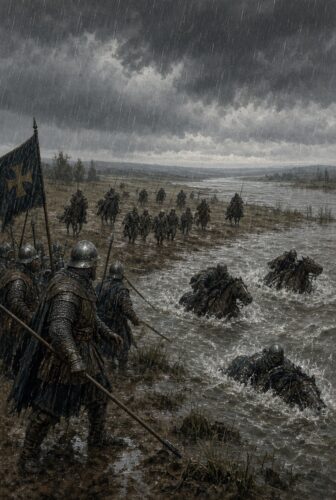
**Day 4 – The Hanging of the Chieftains**
Name the three highest-leverage enablers of the pattern (the specific app, the specific time window, the specific rationalization). Write them down. Then perform a permanent or semi-permanent removal or alteration of each one. Uninstall. Cancel the subscription. Change the schedule so the time window no longer exists. This is the execution of Bulcsú, Lél, and Súr. It is ceremonial only in the sense that you do it deliberately and record that it is done. No public announcement required. The act itself is the record.
**Ongoing – The Settlement Phase**
For the next thirty days, treat any reappearance of the pattern as a small probing raid rather than a full invasion. Respond with the same sealed exits and a miniature version of the heat stand (fifteen minutes of deliberate discomfort paired with the opposite action). The goal is not perfection. The goal is to force the pattern to settle into a less destructive form or to abandon the territory, exactly as the Magyars were forced to stop treating the West as open raiding country.
This protocol is deliberately narrow, time-bound, and physically grounded. It rejects the common self-help pattern of endless affirmation or vague habit stacking. It borrows the specific sequence of Lechfeld: prepare the defended place, stand in the heat without chasing every feint, seal the landscape after the clash, finish the leadership of the threat, and then allow the new equilibrium to form. It is uncomfortable by design because the original event was uncomfortable. Heat, armor, rain, and the refusal to chase ghosts were not metaphors in 955. They were the difference between temporary survival and the end of an era.
The Magyars did not vanish from history. They transformed. Otto did not become a perfect ruler; he became a more secure one whose victory bought the political space for the imperial coronation and the cultural consolidation that followed. The lesson is not that struggle ends. The lesson is that a correctly sequenced stand, followed by control of the exits rather than endless pursuit, can end a particular kind of recurring extraction and force both the threat and the defender into a different relationship with the territory.
On 10 August 955 the sun was hot, the armor was heavy, the arrows still flew, and a king who had only recently finished fighting his own family chose not to chase the enemy into the distance. He held the rivers instead. The rest of the story wrote itself in rain and rope and the slow settling of a people who had lived by the raid. That sequence remains available. The plains are different. The principle is not.
Share: