
Most people treat the final day of October as an excuse to wrap themselves in synthetic cobwebs, consume miniature candy bars at an alarming clip, or recite trivia about Martin Luther hammering parchment into an oaken door at Wittenberg. Those are well-trodden paths.
If you travel back past the Reformation, past the high medieval scholastic tournaments, and deep into the damp, salt-scented dawn of Constantinople on October 31 in the year 802, you will find a palace revolution that makes modern corporate restructuring look like child’s play. It wasn’t executed by a broadsword-swinging barbarian warlord or a charismatic religious prophet. It was carried out by the empire’s supreme budget director—the Chief Financial Officer of the Eastern Roman world.
This is the true, bizarre, and profoundly instructional story of how a bureaucrat named Nikephoros, sitting at the head of the Genikon (the treasury department), looked up from his balance sheets, calculated the precise fiscal and administrative insolvency of an empress who had blinded her own flesh and blood to keep power, and organized an audit so surgical that he woke up before sunrise, locked the palace doors, and crowned himself Basileus before lunchtime.
It is history’s ultimate reminder that while flash, spectacle, and narrative charisma might dominate the headlines for a season, the operational plumbing and ruthless inventory management always determine who actually survives winter.
The Imperial Ledger in Ruins: The House of Isauria
To appreciate what happened on that chilly autumn morning in Constantinople, one must first grasp the sheer operational chaos of the Byzantine Empire under Empress Irene of Athens.
Irene was not an amateur politician. She had clawed her way to supreme authority with an iron will that terrified both her allies and her enemies. Widowed when Emperor Leo IV died in 780, she initially governed as regent for her adolescent son, Constantine VI. But Constantine possessed an annoying habit: he grew up. As he aged, he realized that he was supposed to be the monarch, whereas Irene viewed him largely as an unruly tenant residing in her throne room.
The ensuing family dysfunction was legendary, culminating in 797 when Irene had her own son seized and his eyes gouged out in the Purple Chamber—the very room in which she had birthed him. He died shortly after of his injuries. Irene then accomplished something unprecedented: she ruled the Roman Empire not as an empress consort or a regent, but as Basileus—signing official edicts using the masculine title of Emperor.
Yet ruling alone came with an existential marketing problem. To appease a horrified populace and secure the loyalty of the powerful monastic factions, Irene began cutting checks the empire could not cash.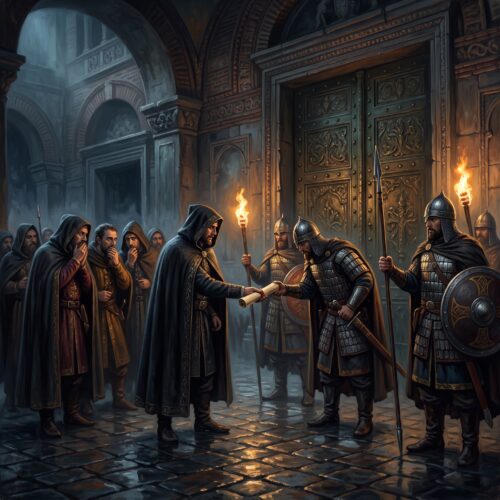
She eliminated the municipal receipts tax on imports and exports entering Constantinople. She exempted monasteries from property duties. She distributed lavish annuities to courtiers and showered foreign envoys with gold solidi. When Harun al-Rashid, the formidable Abbasid Caliph in Baghdad, applied border pressure across the Anatolian frontiers, Irene solved the problem with money: she agreed to pay an astronomical annual tribute to Baghdad simply to keep the peace.
In the short term, this looked like peace and piety. In reality, it was financial suicide. The borders were rusting, the standing army (the tagmata) went unpaid, the provincial themes were rotting from administrative neglect, and the empire’s currency reserves were cratering toward zero.
Watching this slow-motion train wreck sat one man: Nikephoros.
Hailing from Seleucia Sidera in Pisidia, Nikephoros was a career patrician who held the title of Logothetes tou genikou—essentially the Minister of the General Treasury. While Irene held court in gold brocade and listened to flattery from eunuchs like Aëtios and Staurakios, Nikephoros was in the basement archives reading the real numbers. He saw the shrinking grain reserves. He saw the collapsing tax rolls. He saw the invoices arriving from Arab raiders and Bulgarian khans.
Nikephoros knew that an empire does not fall when an enemy breaches its perimeter walls; it falls when its inner administrative integrity drops to a point where nobody can afford to rebuild the gate.
The Long Night of October 30–31, 802
By late October 802, the situation inside the imperial palace had deteriorated into farce. Charlemagne, having been crowned Emperor of the Romans in Rome two years earlier by Pope Leo III, had sent Frankish ambassadors to Constantinople. The rumor running through the marble corridors was staggering: Charlemagne had proposed a marriage alliance to Irene, dangling the prospect of uniting the Western and Eastern halves of Christendom under a single dynastic roof.
To the Byzantine nobility, the senatorial class, and the officer corps, this was the final insult. They were not about to allow a barbarian Frank to waltz into the Great Palace through marital convenience, nor were they willing to watch Irene run the treasury completely dry while her favorite eunuchs fought vicious turf wars over who would succeed her.
Nikephoros made his move.
Unlike previous Roman usurpations, there was no bloody clash of legions across an open plain. There was no siege equipment rolled through the Golden Gate. Nikephoros’s weapon was logistics and timing.
Late on the evening of October 30, Nikephoros met in secret with a faction of high-ranking patricians, palace guards (spatharioi), and senior army officers. Among them were influential men like Niketas Triphyllios and Leo the Armenian. They did not mobilize an entire army; they mobilized just enough key administrators to seize the communications apparatus of the capital.
Under the cover of darkness, Nikephoros and his conspirators approached the Chalke Gate—the ceremonial bronze entrance to the Great Palace of Constantinople. Irene was residing at the Eleutherios Palace, her suburban seaside residence along the Propontis.
Nikephoros did not announce an assault. Instead, the conspirators produced forged documents and official credentials, informing the palace guards that Irene was facing a mutiny by the eunuch Aëtios and had dispatched Nikephoros to take emergency custody of the Great Palace to secure the state.
The palace sentries, accustomed to confusing administrative shifts and terrified of disobeying an official sealed directive from the Logothetes, swung the heavy bronze doors open.
By 3:00 AM on October 31, Nikephoros walked inside without spilling a single drop of blood.
He immediately dispatched couriers to seal the harbor, placed trustworthy retainers at the gates of the hippodrome, and sent an armed detachment to the Eleutherios Palace. Empress Irene woke up to the sound of steel at her chamber doors. She was arrested in her bedchamber, bundled into an imperial carriage, and escorted under heavy guard to the Great Palace under house arrest.
The Sunrise Coronation
As dawn broke over the Golden Horn on October 31, the citizens of Constantinople awoke to an astonishing reality. Rumors had flown that Irene had been overthrown, but most assumed a general from the Anatolian frontier had marched on the city.
Instead, they looked toward the Hagia Sophia and saw the Minister of Finance standing on the dais.
Patriarch Tarasios, seeing that Nikephoros possessed undisputed control of the palace guard, the senate, and the administrative machinery, had little choice. Within hours of sunrise on October 31, 802, Nikephoros was anointed with holy oil and crowned Emperor of the Romans (Basileus Romaion) inside the Great Church.
The dialogue that followed between the newly crowned accountant-emperor and the deposed empress is preserved by the contemporary chronicler Theophanes the Confessor.
Nikephoros summoned Irene to an audience. He did not berate her, nor did he display theatrical rage. He was, to the marrow of his bones, an auditor. He told her that he had taken the throne to preserve the state from total financial ruin, but offered her safety and the retention of a dignified lifestyle—on one condition.
He needed her to balance the ledger.
Nikephoros looked Irene in the eye and demanded that she reveal the location of the hidden imperial treasury vaults. He knew she had secreted personal gold stores throughout the capital that were not reflected in the state ledgers.
Irene, recognizing that her political life was over, accepted the reality with chilling imperial stoicism. She told Nikephoros:
“I ascribe my elevation to the throne to God, and my deposition to my sins. In all circumstances, may the name of the Lord be praised. I kept nothing secret from you during my reign; now, I will show you where every scrap of gold is concealed, provided you grant me permission to live in peace at my palace of Eleutherios.”
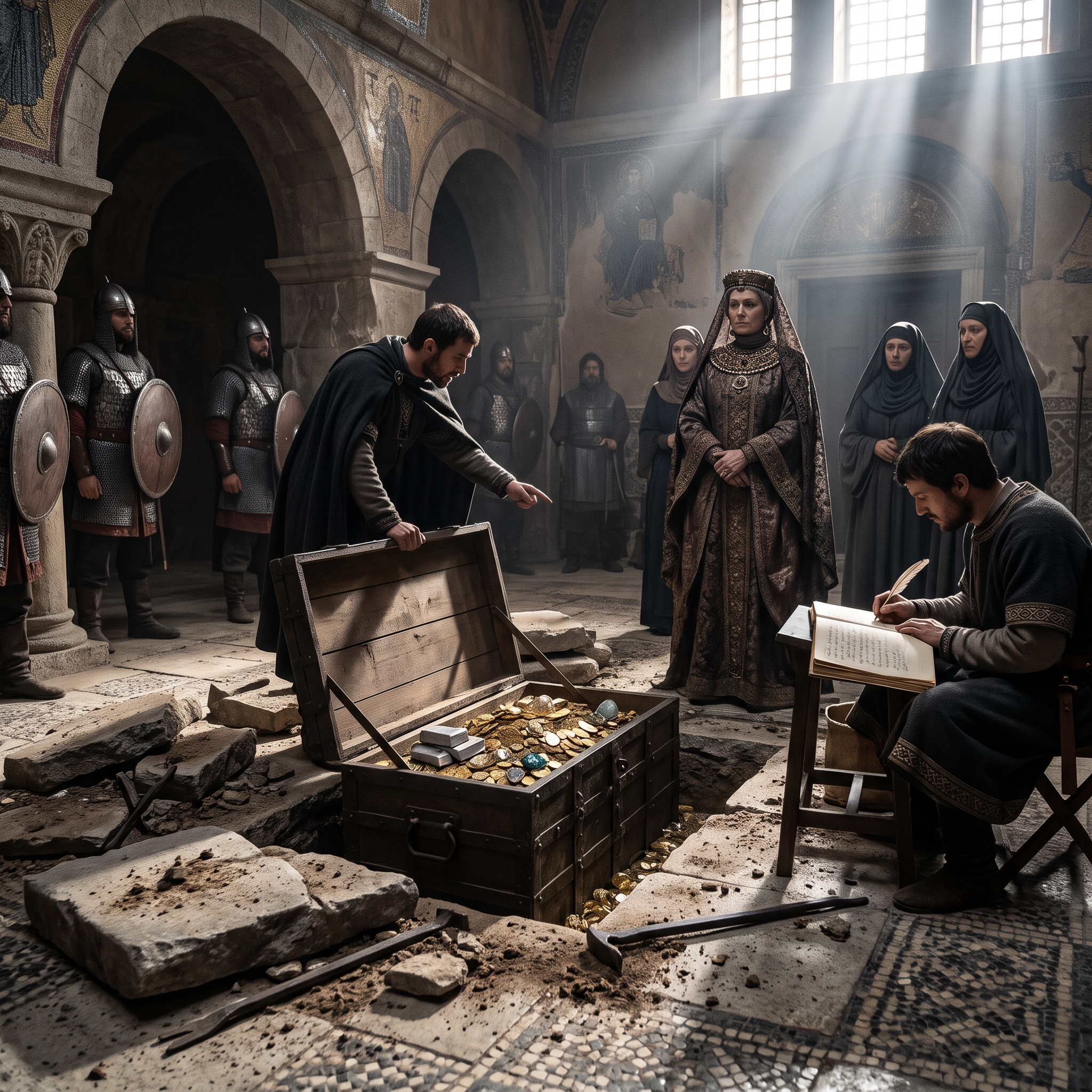
She led his officials to the secret caches hidden beneath palace floorboards and behind chapel walls. Gold coins, silver bullion, and uncut jewels were hauled up from dark corners and placed back into the state treasury.
Once Nikephoros had secured every last coin, he executed the ultimate corporate move: he breached the informal severance agreement. Realizing that Irene was far too dangerous to leave in Constantinople, where royalist factions could use her as a figurehead for rebellion, he banished her first to the Prince’s Islands and subsequently to the distant island of Lesbos.
There, the woman who had ruled the greatest Christian empire on Earth spent her final months living in a modest stone cell, spinning wool to feed herself until her death in August 803.
The Ten Fiscal Cleanups: The “Vexations” of Nikephoros
When modern historians study Nikephoros I, they often encounter a bad reputation. The chronicler Theophanes was a wealthy monk who utterly loathed him. Theophanes called Nikephoros’s financial policies the “Ten Vexations” (kakoseis), painting him as a miserly, grasping tyrant.
Strip away the aristocratic whining of the monks, and Nikephoros’s actions read like an extraordinary clinic in turning around a failing enterprise.
Upon taking office on October 31, 802, Nikephoros discovered that the state had been living in pure fantasy. So, he unleashed a wave of unsparing administrative reforms:
- Elimination of Monastic Tax Shelters: He revoked Irene’s generous tax exemptions for wealthy monasteries, demanding that religious estates pay property taxes (kapnikon) just like common citizens.
- The Village Mutual Guarantee (Allelengyon): If a peasant farmer abandoned his plot or died of plague, the remaining villagers were made collectively responsible for paying that plot’s taxes. In return, they were granted the right to farm the land. This ensured the state’s baseline revenue never dropped.
- Restoring the Harbor Duties: He reinstated the 10% customs duties on maritime trade passing through the Dardanelles and the Bosphorus, refueling the treasury on the backs of international merchants rather than local artisans.
- Resettling the Military Themes: To secure the western frontier in Greece and the Balkans against Slavic incursions, he forcibly relocated thousands of Anatolian families, giving them land grants in exchange for perpetual military service.
- Equipment Subsidies for Poor Recruits: Recognizing that an infantryman without an iron breastplate was just an expensive casualty, Nikephoros decreed that wealthier village households had to pool money to buy weapons, armor, and horses for poorer recruits who were conscripted into the army.
- Cancellation of Baghdad’s Tribute: He flatly refused to keep sending cartloads of gold solidi to Caliph Harun al-Rashid, choosing to direct those funds into domestic border fortresses and garrison payrolls.
Nikephoros was not interested in being loved. He was interested in solvency. He knew that popularity won through unearned handouts is a fragile illusion that vanishes the second real pressure arrives.
He ruled with relentless administrative rigor until July 811, when his military overconfidence caught up with him during an invasion of Bulgaria. He perished at the Battle of Pliska against Khan Krum—who famously had Nikephoros’s skull lined with silver to serve as a drinking goblet.
Yet the financial and military spine Nikephoros rebuilt during his nine-year reign preserved the Byzantine Empire’s administrative core for another two centuries, creating the bedrock for the golden age of the Macedonian Dynasty.
The Modern Dilemma: Why Most People Are Living Like Empress Irene
Here is the uncomfortable truth: right now, the vast majority of people are running their lives, their finances, their habits, and their mental bandwidth exactly the way Empress Irene ran the Byzantine Empire in the autumn of 802.
Consider how most people manage themselves:
- Tribute Payments to Distractions: You make massive daily tribute payments to low-value obligations, doom-scrolling, performative socializing, and toxic relationships, just to avoid immediate friction. You surrender two hours of mental focus every morning to placate noise, much like Irene sending gold solidi to Baghdad to delay an awkward confrontation.
- Selective Blindness to the Real Ledger: People love the appearance of productivity—color-coded Notion templates, aesthetic desk setups, fancy planners, motivational playlists. But if you look at the raw underlying ledger (actual projects shipped, deep work hours logged, discretionary cash saved, body composition markers hit), the treasury is in complete deficit.
- Unearned Tax Exemptions: You give yourself mental “exemptions” for bad habits. You justify chronic procrastination as “processing time” or self-sabotage as “honoring your moods.” Like Irene exempting the wealthy monasteries from property tax to secure their cheap praise, you give your worst indulgences a permanent tax shelter.
- Living on Vanity Instead of Reserves: Many people present an outward face of calm, success, and competence while running on empty within their personal bandwidth reserves.
The modern self-help industry responds to this state with useless platitudes. It tells you to manifest abundance, recite affirmations into your bathroom mirror, buy a daily gratitude journal with floral embossed covers, or wait until your motivation aligns with the cosmos.
None of that works because you cannot manifest your way out of a balance-sheet crisis.
When Nikephoros stood in the corridors of the Chalke Gate on October 31, 802, he did not set intentions. He locked the gates, seized the keys, dug up the floorboards, counted the actual gold, and canceled the checks.
If you want to fundamentally change your life, you do not need more positive energy. You need an Internal Chief Financial Officer who stages a bloodless coup against your undisciplined internal empress, takes control of your daily operational hours, and conducts a cold, unemotional audit of where your resources are actually leaking.
The Core Lessons: What Nikephoros Teaches the Individual
Before deploying the tactical system, study the five fundamental truths that emerge from the events of October 31, 802:
- Control of the Gates Beats Control of the Throne Room: Irene sat on the gilded throne, but Nikephoros held the gates. In personal life, whatever controls your morning threshold (your phone, your email notifications, incoming demands) owns your day. If you don’t control the entry gate before dawn, your “sovereignty” is a hallucination.
- Hidden Caches Must Be Unearthed: You have secret reservoirs of wasted energy, undisciplined budget leaks, and avoided work tucked beneath your mental floorboards. Until you bring them into harsh daylight and count them, you cannot reallocate them.
- Cut the Tributes That Buy Zero Leverage: If you are spending time, money, or emotional focus on activities or people that produce zero reciprocal equity or personal strength, cancel the payment immediately. Let the conflict come; you will fight it on your own terms.
- Standardize Equipment for Your Weakest Days: Nikephoros forced communities to pool funds to buy armor for poor recruits. Translation: your productive system must not depend on you feeling like a hero every day. It must be structured so that even on your most exhausted, demotivated day, the baseline procedures keep you armed and in formation.
- Solvency Precedes Conquest: You cannot build a new venture, learn an advanced skill, or transform your physical strength while your operational baseline is hemorrhaging energy. Stabilize the ledger first; then, and only then, mount your campaigns.
The Cold-Ledger System: A Detailed, Unique Execution Plan
This is not a 30-day gentle habit tracker. It is an immediate, operational restructuring framework designed to audit and seize control of your personal bandwidth starting right now.
Most online productivity plans tell you what to add: add meditation, add a morning smoothie, add journaling, add five books a month. The Cold-Ledger System works in reverse. Like Nikephoros taking over the Byzantine General Treasury, we begin by cutting the false exemptions, seizing the hidden caches, and locking down the gates.
THE COLD-LEDGER FRAMEWORK
┌──────────────────────────────────────────────────────────┐
│ PHASE 1: THE BRONZE GATE AUDIT │
│ • Lock out input noise 90 min post-wake │
│ • Isolate the primary leak across time/money/energy │
├──────────────────────────────────────────────────────────┤
│ PHASE 2: UNCOVERING THE HIDDEN CACHES │
│ • Uncompromising inventory of true resource burn │
│ • Exposing performative ‘busywork’ vs actual output │
├──────────────────────────────────────────────────────────┤
│ PHASE 3: REVOKING INTERNAL EXEMPTIONS │
│ • Strip rationalizations from non-negotiable habits │
│ • Institute reciprocal accountability metrics │
├──────────────────────────────────────────────────────────┤
│ PHASE 4: TRIBUTE CANCELLATION PROTOCOL │
│ • Eliminate zero-yield emotional & administrative debts │
│ • Reclaim capital & hours for the central reserve │
├──────────────────────────────────────────────────────────┤
│ PHASE 5: THE VILLAGE ALLIANCE (MINIMUM BASELINE) │
│ • Standardize minimum operating reps for low days │
│ • Protect long-term execution from motivational dips │
└──────────────────────────────────────────────────────────┘
Phase 1: The Bronze Gate Lockout (Setting the Morning Perimeter)
Nikephoros succeeded because he took the Chalke Gate before anyone in the city realized a change of command had occurred. If the gate guard had sent word to Irene, the rebellion would have faced armed resistance.
Your mind works the exact same way. When you open a screen, check notifications, or respond to outside demands within sixty minutes of waking, you have surrendered your Chalke Gate to foreign invaders. You spend the rest of the day in reactive defense.
- Execute the 90-Minute Information Blackout: From the moment your feet touch the floor, zero external inputs enter your sensory perimeter for ninety minutes. No news feeds, no social applications, no incoming messages.
- The Logothete’s Ledger First: Spend the first twenty minutes of that blackout reviewing your personal balance sheet: your three core mission deliverables for the day, your scheduled physical training, and your current budget posture.
- Physical Gate Defense: Keep the device physically out of the bedroom overnight. If you must use an alarm, buy a mechanical clock. The palace does not leave its perimeter gates unlocked because the night watchman wanted convenience.
Phase 2: Unearthing the Floorboards (The Ruthless Time and Asset Audit)
When Nikephoros cornered Irene, he did not accept her broad claims of poverty; he forced her to show him every loose floorboard where gold solidi were hidden.
You must conduct a three-day forensic audit of where your three primary assets—Time, Attention, and Capital—are actually being deposited.
- The 15-Minute Raw Log: For the next seventy-two hours, carry a blank notebook or keep a plain text file open. Every time you shift tasks, write down what you actually did and the exact duration. Do not sanitize it to look noble. If you spent twenty-four minutes arguing with a stranger on a message board or forty minutes watching lawn-mowing timelapses on video sites, log it down to the minute.
- The Fictional Productivity Test: At the end of every day, split your activities into two distinct columns:
-
- Column A (Sovereign Output): Actions that created tangible value, built personal health, saved capital, or advanced an undeniable asset (e.g., written code, completed barbell sets, closed sales accounts, balanced accounts, direct study).
-
- Column B (Court Flattery): Activities that felt like work but yielded zero equity (e.g., reorganizing folders, browsing productivity forums, tweaking color palettes on presentations, attending non-essential status meetings, discussing projects you haven’t started).
- Calculate the Leak Ratio: Divide Column B by Column A. If Column B consumes more than 30% of your waking energy, your internal empire is insolvent, and you are running on borrowed credit.
Phase 3: Revoking the Monastic Exemptions (Killing Your Sacred Excuses)
Empress Irene let wealthy monasteries operate tax-free because she wanted their institutional flattery. You do the exact same thing with your favorite rationalizations.
You have special “tax shelters” in your brain—narratives that you treat as untouchable:
- “I can’t train consistently right now because my work schedule is simply too unpredictable.”
- “I deserve this high-end takeout order because I had an extraordinarily stressful afternoon.”
- “I need to feel completely inspired before I sit down to do the difficult creative or technical work.”
Nikephoros walked into the monasteries and told the abbots that holy status does not pay for frontier forts. You must do the same to your personal excuses.
- List Your Three Holy Exemptions: Identify the three recurring stories you tell yourself to excuse inaction or indulgence.
- Strip the Sanctity: Re-write each excuse using cold, clinical balance-sheet terms:
-
- Change “I was too overwhelmed to exercise” to “I chose lower-order comfort over baseline physical maintenance.”
-
- Change “I’m waiting for clarity on this project” to “I am delaying execution to avoid the psychological friction of making mistakes.”
- Impose the Kapnikon (The Universal Hearth Tax): In the Byzantine Empire, every hearth had to pay, regardless of who lived there. Establish a non-negotiable floor for your non-negotiables: on days when you have zero energy, zero time, and zero motivation, you do not get to cancel the commitment. You execute a compressed, non-negotiable minimum (e.g., fifteen minutes of physical training, one single page of structured writing, or five minutes of ledger review). The hearth always pays.
Phase 4: Canceling the Baghdad Tribute (Eliminating Low-Yield Liabilities)
Nikephoros halted the tribute payments to Baghdad because he realized that buying short-term peace was bankrupting the empire’s long-term military infrastructure. It made a fight inevitable, but it guaranteed that when the fight arrived, the empire had gold to arm its own soldiers.
You must identify and eliminate your personal “tributes”:
- The People-Pleasing Tribute: Stop accepting meetings, favors, and social obligations that you dread, merely to avoid thirty seconds of temporary awkwardness. Saying “yes” to keep a fragile peace is paying tribute with the only currency that matters: your non-renewable lifespan.
- The Digital Tribute: Audit your digital subscriptions and screen consumption. If an application, subscription, or community does not deliver measurable intellectual, physical, or financial compounding returns, cancel it. Take that freed capital and direct it into cash reserves or durable equipment.
- The “Clear the Air” Script: When ending a non-essential commitment, deliver a polite, direct refusal without decorative apologies: “I am currently restructuring my operational bandwidth and cannot commit to this. I appreciate you thinking of me.” No over-explaining. Accountants do not send three-page essays apologizing for invoice adjustments; they state the balance and move forward.
Phase 5: The Village Mutual Guarantee (Systematizing Resilient Routines)
Nikephoros realized that if an individual peasant failed, the village must keep the land producing. He built systems that did not collapse when an individual link snapped.
Your personal operational routines must be similarly fortified against daily human failure:
- Build “Bad-Day Protocols”: Never design a personal plan based exclusively on how you perform when you have eight hours of sleep, pristine nutrition, and flawless focus. That is how empires fall. Design a Secondary Protocol for your worst days:
-
- If your normal deep-work target is three hours, your bad-day protocol is thirty focused minutes on the primary deliverable.
-
- If your standard workout is five compound lifts, your bad-day protocol is two working sets of your primary compound movement.
- The Mutual Anchor System: Tie every critical habit to an existing, immovable biological event rather than a floating time slot on a calendar.
-
- Do not schedule training for “sometime in the afternoon.” Tie it directly to the end of your workday: when the workstation shuts down, your training shoes go on before you leave the room.
-
- Do not plan to “review the budget weekly.” Tie it directly to Sunday morning coffee before anyone else in the household wakes up.
- Weekly Closed-Ledger Review: Every Sunday at sundown, spend precisely fifteen minutes reviewing your week’s ledger. Ask three questions:
-
- Did I hold the perimeter at the bronze gate, or did outside chaos slip inside before sunrise?
-
- What hidden waste did I permit to linger beneath the floorboards this week?
-
- Which frontier needs an injection of focused resources tomorrow morning?
The Final Reckoning
On October 31, 802, the citizens of Constantinople learned that historical outcomes are rarely decided by the grand speeches made in golden palaces. They are decided by who holds the keys to the administrative offices, who understands the actual inventory, and who possesses the cold discipline to take control when everyone else is distracted by theater.
You do not need another dramatic, emotional breakthrough to change your trajectory. You do not need a miraculous flash of inspiration or an exotic retreat to discover your inner truth.
You need to walk down to the basement of your own life, turn on the harsh overhead lights, open up the logbooks, and count the actual coins. You need to fire the inner court courtiers who have been flattering your worst excuses, lock the front bronze gate against external distractions, and start running your mind and your days with the unbending, operational clarity of the Minister of the General Treasury.
Share: