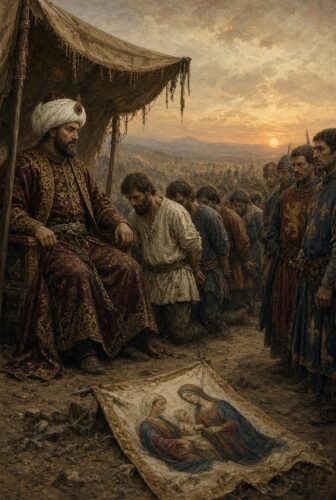

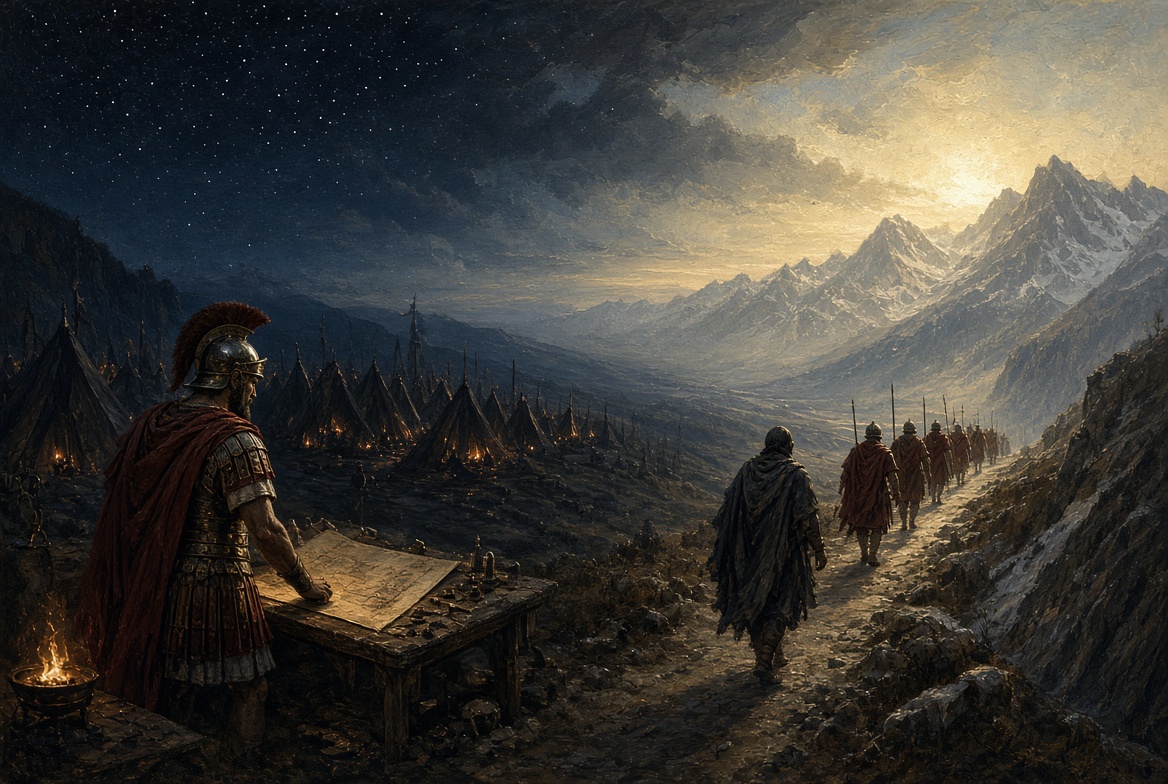
On the morning of September 6 in the year 394, in a narrow alpine valley that most maps still cannot agree how to name, the last emperor who ever ruled the entire Roman world decided the first day of battle had been a catastrophe and attacked anyway. The wind came down the mountain like a living thing, picked up the dust and the missiles of the western army, and threw them back into the faces of the men who had launched them. By nightfall the professor-emperor of the West was a head on a pike, his Frankish general was wandering the woods looking for a dignified way to die, and the old civic religion of Rome had lost its last serious field army.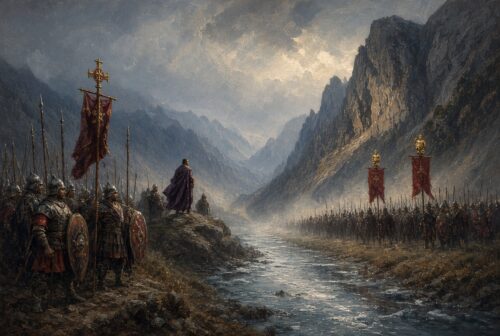
That is the short version. The long version is stranger, bloodier, and far more useful.
The river the ancients called the Frigidus—“the Cold One”—is almost certainly the Vipava, a short, clear stream that drops out of the Julian Alps in what is now western Slovenia and runs toward the Adriatic. In late antiquity the valley was one of the few practical doors into Italy from the east. The Romans had spent generations fortifying it. The Claustra Alpium Iuliarum, a chain of walls, towers, and blocked passes, was supposed to make any eastern army think twice. In September 394 two Roman armies walked into that door and tried to kill each other.
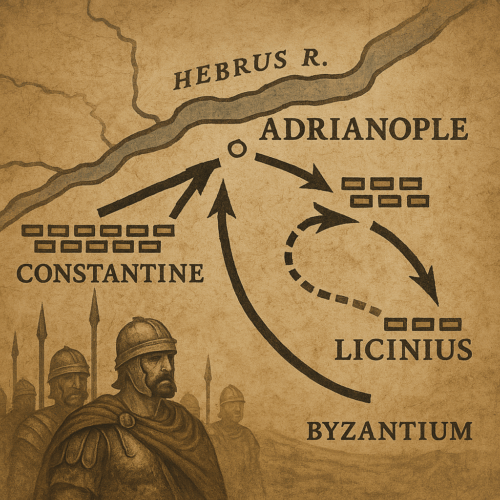
The man coming from the east was Flavius Theodosius, already called “the Great” by people who wanted something from him. He was a Spanish general’s son who had been elevated after the disaster at Adrianople in 378, when another Gothic army had carved up the eastern field force and killed an emperor. Theodosius spent the next sixteen years doing the two things late Roman emperors did best: fighting civil wars and issuing laws about religion. He had already crushed one western usurper, Magnus Maximus. He had made Nicene Christianity the official religion of the empire and begun the long, messy business of closing temples and cutting off public funds for the old cults. He was not a gentle theologian. He was a soldier who had decided the gods of his childhood were no longer useful.
The man waiting for him in the west was Flavius Eugenius, a former teacher of rhetoric and grammar who had never commanded so much as a cohort until the Frankish general Arbogast put a purple cloak on him. Eugenius was a Christian of the mild, cultivated sort. Arbogast was not. Arbogast was a career officer from the Rhine, the kind of man who rose because he was competent, ruthless, and not overly interested in the theological disputes that consumed Constantinople. In 392 the young western emperor Valentinian II was found dead in his palace at Vienne. Officially it was suicide. Unofficially everyone understood that Arbogast had grown tired of a teenager who kept trying to fire him. Rather than take the throne himself—an act that would have looked too much like naked barbarian usurpation—Arbogast elevated the professor. Eugenius issued coins, restored a few pagan privileges to keep the senatorial aristocracy happy, and tried to look like a legitimate Augustus. Theodosius refused to recognize him. Letters went back and forth. Armies began to move.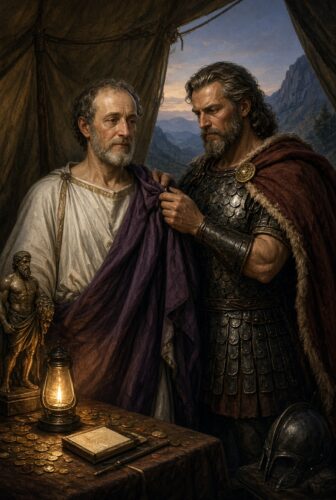
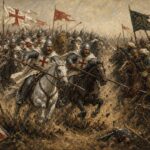
Theodosius gathered what the eastern empire could still field: regular Roman units under Timasius and the rising half-Vandal officer Stilicho, Caucasian and Syrian auxiliaries, and a very large contingent of Gothic federates under Alaric and Gainas. The Goths were the same people whose fathers had smashed the eastern army sixteen years earlier. Now they marched for the man who had settled them on Roman soil. Estimates vary wildly, as they always do, but something like twenty to thirty thousand Romans plus another twenty thousand Goths is a reasonable modern guess. Arbogast and Eugenius had perhaps thirty-five to fifty thousand: Gallo-Roman levies, Frankish and Alemannic contingents, and their own Gothic auxiliaries. The numbers were close enough that neither side could afford a sloppy afternoon.
Theodosius marched west in the summer of 394. His wife Galla died while he was on the road. He kept going. The army crossed the Julian Alps and came down into the Vipava valley. Arbogast had chosen the ground well. The western army was camped in a position that blocked the only decent route forward. On September 5 Theodosius did what impatient emperors do: he attacked immediately.
He sent the Goths in first.
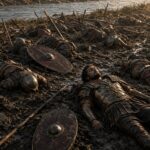
That decision still looks, sixteen centuries later, like a mixture of calculation and cold-bloodedness. The federates were expendable in a way the regular Roman units were not. They also knew how to fight in broken ground. The first day’s assault was a frontal smash into prepared positions. The fighting was savage. Contemporary and near-contemporary writers agree that the Gothic vanguard was shredded. Ten thousand of them died, including the Iberian general Bacurius. The western line held. When the sun went down, Eugenius’s camp celebrated. Donatives were distributed. Men who had spent the day killing other Romans decided they had already won. Arbogast, more professional, detached a force to slip through the mountain paths and seal the eastern army’s retreat. If Theodosius tried to pull back toward the passes, he would find the door locked behind him.
Theodosius spent the night of September 5–6 doing what Christian sources insist he did best: praying. Pagan sources, written later and with an axe to grind, suggest he was simply staring at a disaster and wondering whether to retreat until spring. Both can be true. An emperor who has just watched ten thousand of his own allies die in a single afternoon is allowed a sleepless night.
Sometime in the dark the hidden western detachment changed sides.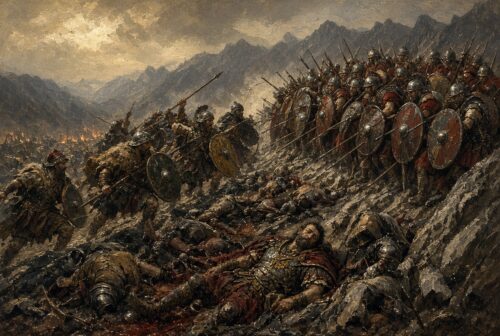
The sources do not agree on the name of the officer who flipped. Some call him Arbition or a similar variant. What they agree on is the transaction: gold, promises, or simple recognition that the eastern emperor was still the man with the larger treasury and the better long-term prospects. The force that was supposed to close the trap instead opened a door. At dawn on September 6 Theodosius received the news and attacked again.
Then the wind arrived.
The bora is a katabatic wind that still drops off the high plateaus of the Julian Alps and slams into the Vipava and Isonzo valleys with enough force to knock a grown man sideways and fill the air with dust and gravel. On September 6, 394, it blew from the east, which meant it blew into the faces of Arbogast’s army. Christian writers—Rufinus, Orosius, Theodoret, Socrates Scholasticus—treat the wind as answered prayer. God, they say, sent a tempest that turned the western missiles back upon the men who loosed them. Dust blinded the western ranks. Shields became useless. Arrows that should have flown two hundred yards stalled and fell short or, in the more dramatic versions, reversed direction. Ambrose of Milan, who was not there but never let that stop him, preached that the storm itself was the proof of divine favor.
A pagan historian writing a century later, Zosimus, is less impressed by the meteorology of Providence. He still has to admit the second day went badly for the west. The combination of the defection, the renewed eastern assault, and a wind that made missile fire a lottery broke the western line. Eugenius was captured in or near his tent. Theodosius had him beheaded the same day. The head went on a pike and toured the western camp and then Italy as a visual argument that the experiment was over. Arbogast escaped into the mountains, wandered for two days, and fell on his own sword. Nicomachus Flavianus, the distinguished pagan prefect who had backed the wrong horse, also killed himself.
Theodosius entered Italy as the sole Augustus. For a few months the Roman Empire was one state again. He died in Milan on January 17, 395. His two young sons, Arcadius in the east and Honorius in the west, inherited a reunited map that immediately split again. Alaric, who had survived the meat grinder of the first day at the Frigidus, would sack Rome sixteen years later. The western field army never fully recovered the losses of those two September days. The old public cults, already on life support after Theodosius’s earlier laws, lost their last serious military patron. Temples continued to close. The altar of Victory stayed down.
That is what happened on September 6, 394, in a cold river valley most people have never heard of.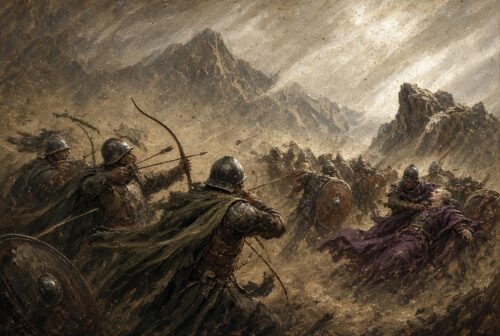
The sources that survive are a tangle of propaganda. Christian writers needed a second Milvian Bridge, a moment when God visibly chose a side. Pagan writers needed to explain how a legitimate (if irregular) western regime lost to an eastern emperor who imported Goths to do his dying for him. Modern historians argue about numbers, exact topography, and how much the wind actually mattered versus how much the defection and simple exhaustion mattered. None of that erases the basic sequence: a first day that looked like failure, a night of uncertainty, a hidden force that switched allegiance, a second dawn attack, and a natural phenomenon that arrived at the only moment it could have been useful.
The battle did not make Europe Christian. Christianity was already the majority faith in most cities and had been the official religion for decades. What the Frigidus did was remove the last army that could have given the old civic religion a second political life. After September 6 there was no pagan Augustus and no pagan magister militum with a field force capable of reversing the legal and financial decisions already made in Constantinople. The old gods did not die that afternoon. Their last organized paycheck did.
The Goths who died in the first assault and the Goths who lived to fight on the second day both understood something the professors in the western camp did not: the first day is allowed to be ugly. The question is what you do with the night.
A person looking at that sequence today does not need another lecture about “resilience” or “trusting the process.” Those phrases have been worn smooth. The Frigidus offers something narrower and more operational.
The unique plan that follows is not a morning routine, a gratitude journal, or a vision board. It is a two-dawn protocol built on the actual mechanics of September 5–6, 394. Call it the Frigidus Commitment. It is designed for the specific situation in which your first serious attempt at something important has just been shredded in public and the people watching have already started celebrating your defeat.
– Identify, before you ever start, which part of your effort is the “Gothic vanguard”—the piece you can afford to lose on day one without losing the war. This is not the core skill or the core relationship. It is the expendable probe: the first version of the project, the first conversation, the first month of the new schedule. You send it in knowing it may be destroyed. You do not send in the thing you cannot replace.
– After the first-day failure, do not hold a victory party for the other side and do not announce a strategic retreat until spring. Spend the night doing the only two useful things Theodosius appears to have done: inventory what is still standing, and locate the hidden force that was supposed to close your escape. In modern terms the hidden force is the person, resource, or piece of information that the opposition believes is safely on their side. It is the colleague who has been quiet, the account you forgot you had, the skill you have not used in years, the contact who owes you nothing but might move for the right reason. Find it in the dark. Do not wait for it to volunteer in daylight.
– Convert that hidden force before dawn. The conversion is rarely moral. At the Frigidus it was gold and a better long-term bet. In your case it may be a clear offer, a removed obstacle, or simply the demonstration that you are still coming. The point is not loyalty. The point is that the trap set for you becomes an open lane.
– Position yourself so that the next external force—the thing you cannot command—hits the other line instead of yours. The bora was not summoned by prayer in any way a meteorologist would recognize. It was a recurring local wind that happened to blow from the east on the morning the eastern army attacked. Your equivalent is whatever recurring pressure already exists in your environment: a deadline, a seasonal change, a public calendar, a competitor’s known weakness, a market cycle. You do not create the wind. You choose the morning it is likely to blow and you attack with it at your back.
– At first light of the second day you commit the regulars, not another wave of expendables. The Gothic federates had already paid the bill. The second assault used the remaining Roman units plus the newly flipped detachment. This is the moment the plan stops being a probe and becomes the actual operation. No more testing. No more “let’s see how it goes.” The line either breaks or you find out what you are actually made of.
– When the other side’s missiles start coming back at them—when their own objections, delays, or counter-moves begin to damage them more than you—do not pause to gloat. Finish the capture. Eugenius was taken the same day. The head went on the pike the same day. Lingering politeness after the wind has shifted is how second days turn back into first days.
– After the field is taken, treat the victory as temporary unification, not permanent peace. Theodosius was sole emperor for four months. Then he died and the map split again. Your second-dawn win buys you a window, not a dynasty. Use the window to lock in the legal and financial changes (the new rule, the new boundary, the new default) before the next generation of problems arrives. Do not assume the old opposition is gone simply because its current general is.
That is the entire protocol. It is not daily. It is not gentle. It is for the specific Tuesday when the first attempt has already failed in front of witnesses and the other camp is already pouring drinks.
The Frigidus was not a battle between good and evil in any simple sense. It was a battle between two Roman armies, one of which had a better claim to legitimacy, a larger pool of federate manpower, and the luck of a mountain wind. The professor lost because he celebrated too early and because the man he trusted to seal the back door sold the door. The soldier-emperor won because he accepted a hideous first day, flipped the trap in the dark, and attacked again when the weather finally did him a favor.
September 6, 394, did not invent Christianity, end paganism, or save the Roman Empire. The empire was already two courts and a collection of armies that increasingly looked like the people they were hired to keep out. What the day did was close one particular door with unusual finality. After that afternoon there was no realistic military path back to the old public cults. The wind had chosen, or the defector had chosen, or the emperor who refused to retreat after a massacre had chosen. The arrows that were supposed to finish the eastern army flew the wrong way.
Most people will never stand in a Slovenian river valley watching ten thousand allies die before lunch. They will, however, have a first day that looks exactly like September 5: expensive, public, and apparently conclusive. The only historically tested question that remains is what they do with the night and whether they are still willing to move when the wind finally changes direction.
The river is still cold. The passes are still narrow. The second dawn is still the only one that counts.
Share: