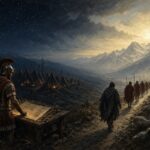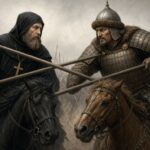

Picture the coastal plain of Palestine just after dawn on 7 September 1191. The Mediterranean is a hard blue wall on the right. On the left, a dark belt of oak and thorn called the Wood of Arsuf runs for more than twenty kilometers, parallel to the shore. Between the trees and the water lies a strip of ground one and a half to three kilometers wide — wide enough to march an army, narrow enough to trap one. Into that strip steps a Christian column that has already spent two weeks walking south from newly captured Acre toward the ruined port of Jaffa. Every man in the column already knows the forest is not empty.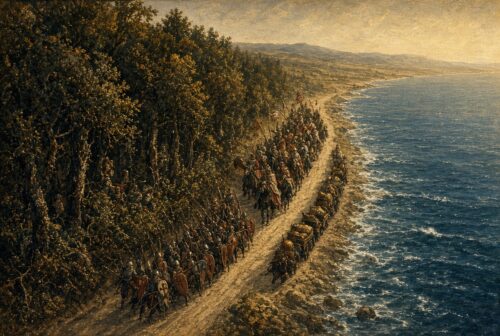
It is not empty. Yusuf ibn Ayyub, whom the Franks call Saladin, has packed nearly his entire field army into those trees: horse archers, Bedouin and Nubian skirmishers, Kurdish and Turkish heavy cavalry, mamluk household troops, kettle-drummers, and the sultan himself. Modern estimates put him near twenty-five thousand, almost all mounted. The Christian force is smaller and slower — perhaps ten to twenty thousand, of whom only about twelve hundred are heavy knights. The rest are infantry, crossbowmen, grooms, and a baggage train that must hug the sea because the sea is the only flank that cannot be turned.
Richard of England, thirty-three years old, already nicknamed Lionheart by men who had watched him at Acre, has spent the previous fortnight turning a march into a machine. After the disaster at Hattin four years earlier, when Saladin had separated Frankish horse from Frankish foot and cooked the Kingdom of Jerusalem in a single day, Richard’s first rule is simple and brutal: the two arms never separate. Infantry form a living hedge on the landward side. Crossbowmen stand in the outer rank. Knights ride in the middle in twelve compact squadrons of roughly a hundred lances each. Baggage and the tired infantry walk on the seaward side, where the fleet can pick up the wounded. When the landward infantry grow exhausted from walking backward under arrows, they swap places with the men who have been loafing by the water. It is the most unromantic rotation in military history, and it is the reason the column is still alive.
The order of march on the morning of the seventh is a roll call of the Third Crusade’s leftover politics. In the van ride the Templars under Robert of Sablé. Behind them come Angevins and Bretons, then the Poitevins around Guy of Lusignan, the dispossessed king of Jerusalem who still pretends the title means something. Then the English and Normans carrying the great dragon standard. Then French, Flemings, barons of Outremer. In the rear — the place of honor and of maximum pain — ride the Knights Hospitaller under their Master, Garnier de Nablus. Henry of Champagne scouts toward the hills. Richard and Hugh of Burgundy patrol the length of the column like sheepdogs who happen to wear mail.
They have already survived a near-disaster on 25 August in a defile where the rearguard almost came unstuck. They have watched Saladin burn the countryside ahead of them so that there will be nothing to eat except what the ships can land. They have marched only in the mornings to dodge the worst of the heat, halted at every reliable spring, and ignored every insult designed to make a knight do something stupid. Baha al-Din ibn Shaddad, Saladin’s own secretary and an eyewitness who did not like the Franks, still could not hide his astonishment: the Muslims shot at them from all sides to force a charge, and the Franks would not hurry. They walked. Their ships crawled along beside them. Arrows stood in their backs like a second set of ribs. The crossbows answered and dropped horses. The column did not break.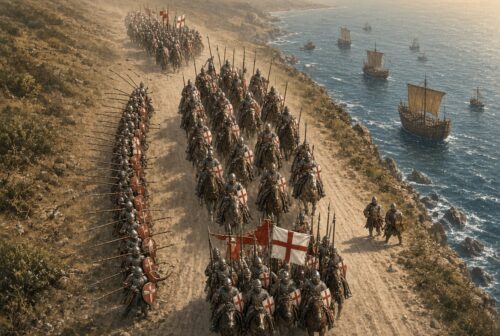
On the evening of 6 September they camp beside the marsh at the mouth of the Nahr al-Faliq, the stream the Franks call Rochetaillée. Half the Wood of Arsuf is already behind them. Ten kilometers of narrow plain still lie between the camp and the ruined town of Arsuf itself. Saladin has chosen that plain on purpose. He will skirmish the whole length of the Christian line to pin it, then smash the rear until a gap opens between the van, which will want to reach the gardens of Arsuf, and the Hospitallers, who will be fighting for their lives. Into that gap he will throw the rest of his army and finish the Third Crusade the way he finished the Second: in pieces.
Dawn on the seventh shows enemy scouts in every direction. Richard already knows what that means. He arrays the army as if the day’s work is a battle that happens to be moving sideways. The Templars take the front. The Hospitallers take the back. The six trumpets that will signal the general charge are distributed in three pairs — van, center, rear — because a single horn in a storm of cymbals and kettle-drums would be a joke.
Around nine in the morning the forest empties.
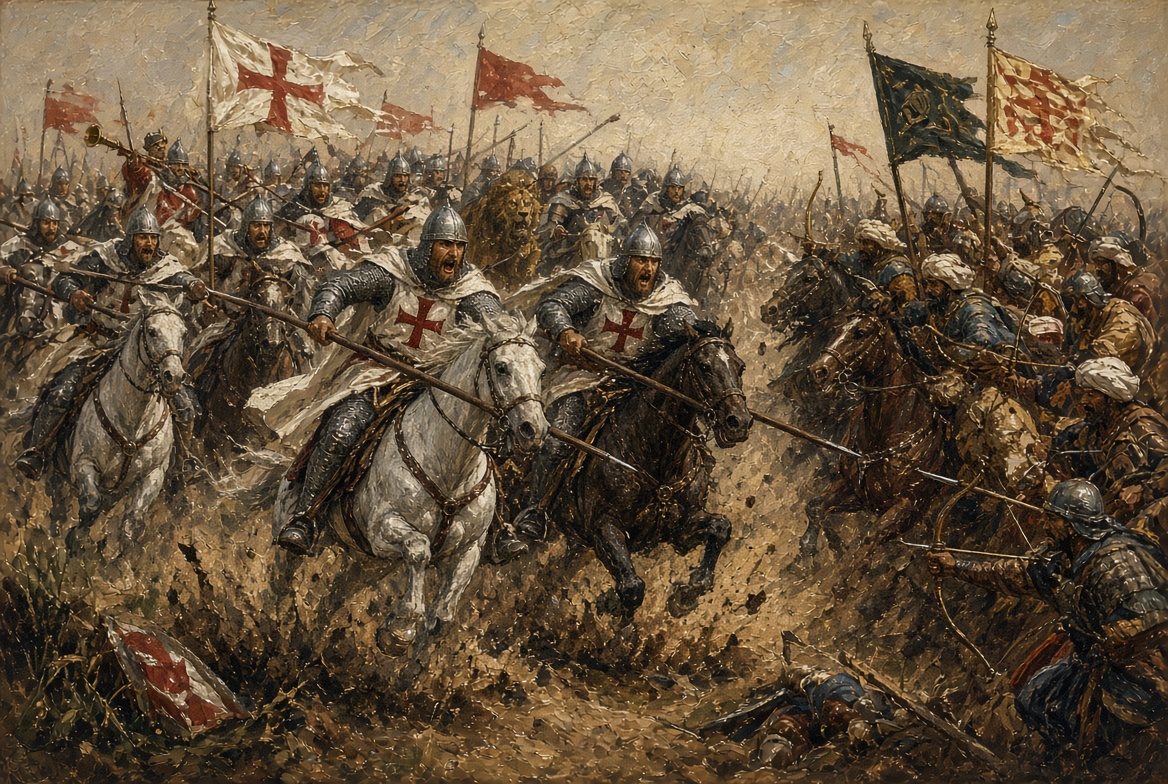
First come the skirmishers: Bedouin and Sudanese on foot with javelins and bows, then the light Turkish horse who dash in, loose a flight, and wheel off before a lance can catch them. Cymbals crash. Gongs boom. Trumpets scream. The point of the noise is not music. It is to make a man feel that the world has already decided he should run. The Christian infantry on the landward flank walk, shoot, and walk. Knights keep their lances upright and their mouths shut. Horses go down. Some knights, suddenly pedestrians, pick up shields and join the infantry hedge. The column keeps its shape.
Saladin’s plan is working in one respect and failing in another. The harassment is real. The gap is not appearing. The van does not bolt for Arsuf. The center does not drift. The rear, however, is beginning to look like a workshop where someone is testing how much iron a man can wear before he screams.
By early afternoon the vanguard is nosing into the orchards and broken walls of Arsuf. That is exactly when Saladin thickens the attack on the Hospitallers. His right wing now hits them from behind and from the inland flank at once. Hospitaller infantry actually walk backward so they can keep their faces to the enemy. Crossbowmen trying to shoot to the rear lose their dressing. Gaps open. Muslim riders with swords and maces shove into those gaps. Saladin and his brother Sayf al-Din — Saphadin to the Franks — ride in person among the skirmishers, leading spare horses, daring the Christian bolts. They are trying to teach their own men that the sultan is not a rumor.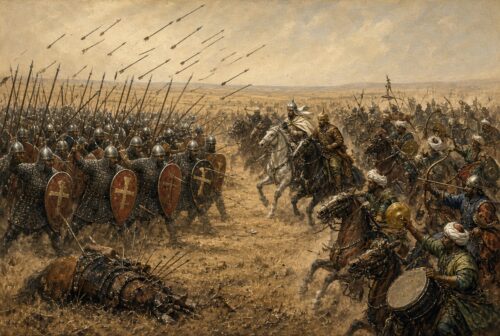
Garnier de Nablus has had enough. He rides forward through the mess, finds the king, and delivers one of the most human speeches in crusading literature. Lord king, we are violently pressed. We are going to be remembered as men who did not dare return a blow. We are losing horses one after another for nothing. Why should we bear this any longer?
Richard’s answer is the least heroic sentence a lion-hearted man ever uttered, and the most useful. Good Master, it must be endured. No one can be everywhere.
He is not being cruel. He is watching the whole board. A charge launched while the Muslim horse are still fresh and not yet bunched is the gift Saladin has been shopping for since Hattin. Richard wants the enemy fully committed, horses blown, archers dismounted to shoot, the whole Ayyubid line leaning in. Then, and only then, the twelve squadrons go through them like a door coming off its hinges. The signal for that moment is six trumpet blasts. Until the six blasts, the Hospitallers are to be a wall that bleeds.
Garnier rides back to a rear that is no longer a wall. Two men decide the theology of obedience can wait. Baldwin le Carron — a household knight of Richard’s who is serving with the Order — and the marshal of the Hospital put their heads down, shout “St. George,” and punch through their own infantry. The rest of the Hospitaller knights go with them because that is what knights do when the first two have already made the decision. The French squadron immediately ahead of the Hospital sees the movement and follows, because shame is contagious in both directions.
The six trumpets have not blown.
Richard has perhaps three seconds to choose between punishing a breach and owning it. He owns it. He puts the spurs in, tears through the Hospitallers to the point of contact, and turns a local riot into a general charge that now runs from rear to van in echelon. Infantry open lanes. Lances come down. The Ayyubid right, packed tight and in some places already on foot, takes the collision at the worst possible range. Baha al-Din, watching from the Muslim side, later wrote that he saw the Frankish knights gather in the middle of their infantry, grasp their lances, shout as one man, and then the infantry opened and they came through in every direction — right, left, and center — until everything broke.
The first charge runs about a kilometer and a half. Richard hauls it up. This is the second half of the day’s real genius. Turkish tactics live on the feigned retreat. If the Christian knights keep galloping into the trees, they will arrive as tired individuals and die as tired individuals. James of Avesnes, a Flemish knight of real reputation, does not hear the halt in time or does not care. He and a knot of overextended men are swallowed. Chroniclers say he killed fifteen before he went down. He is the only name of rank the Christians publicly mourn. That is how cheap the victory was on their side, and how expensive the extra hundred meters can be.
Taqi al-Din, Saladin’s nephew, rallies some seven hundred of the household guard and slams into what is now Richard’s left. Richard leads a second charge in person. The *Itinerarium* — the Latin prose cousin of the jongleur Ambroise’s verse chronicle — describes the king cutting a path like a reaper with a sickle, corpses covering half a mile, the living giving him space because the alternative is to become part of the half-mile. A third charge finishes the argument. The Ayyubid army goes into the wood and the hills. Night is coming. The Christians do not follow the night into the trees.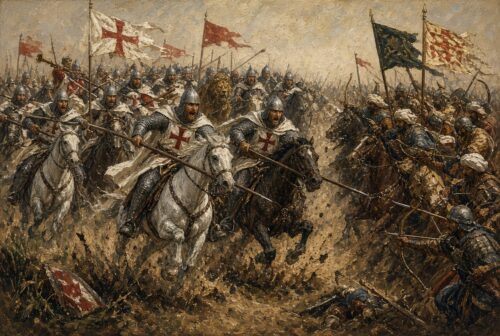
They camp at Arsuf. After dark they walk the plain and count bodies. Christian writers, who never met a round number they did not like, claim thirty-two emirs and seven thousand dead. Baha al-Din, who had less reason to invent a catastrophe, names three senior men: Musek the Kurdish grand emir, Kaimaz al-Adili, and Lighush. The truth sits somewhere in the ugly middle: enough dead that Saladin’s field army will not risk another set-piece on that coast, not enough dead that the sultan ceases to exist. Crusader dead are probably under seven hundred, many of them horses.
The most precise image of the evening belongs to the losers. Saladin rides through the wreckage looking for his banner and his people. He finds seventeen bodyguards and a single drummer. That is what a perfect ambush looks like when the other side refuses, for six hours, to accept the invitation.
Arsuf does not give Richard Jerusalem. Anyone who tells you it did is selling a poster. What it gives him is the coast. Two days later the column is in Jaffa. The port that Saladin had dismantled in 1190 starts to become a port again. Saladin, who now understands that he cannot break this particular moving fortress in open ground, does the next logical thing: he wrecks what he cannot hold. Ascalon is evacuated and pulled down so Richard cannot use it as a southern dagger. Gaza, Blanchegarde, Lydda, Ramla follow the same bitter arithmetic. Darum falls later. The war becomes a war of marches, raids, and exhaustion rather than a war of one more Hattin.
Negotiations sputter through the autumn and winter. Humphrey of Toron interprets. Nothing sticks until the following year, when both sides are too tired to pretend otherwise. The Treaty of Jaffa in 1192 is a three-year truce: the Franks keep the coastal strip from Tyre down through Jaffa; Christian pilgrims may visit Jerusalem unarmed; Saladin keeps the holy city itself. Richard never sees the Holy Sepulchre as a conqueror. He sees it, if at all, as a man who won the road and lost the shrine, which is a more adult outcome than most crusade sermons allow.
The deeper result sits in the craft of the day itself. Hattin had taught Europe that a Frankish army could be taken apart by heat, thirst, and the separation of horse and foot. Arsuf taught anyone paying attention that the same army, if it accepted boredom as a weapon, could walk through the same opponent’s best effort and then hit him at the one moment his horses were tired and his archers were on the ground. Richard’s contribution was not the charge. Plenty of men can charge. His contribution was the six hours of not charging, the rotation of the wounded screen, the sea used as a wall, the trumpets that were meant to speak when the board was ready — and then, when two Hospitallers spoke first, the decision to treat their disobedience as information rather than mutiny.
Garnier de Nablus is sometimes painted as the hothead who nearly ruined the plan. That is too tidy. The rear was in genuine danger of local collapse. A wall that waits for a perfect signal while it is already coming apart is not a wall; it is a rumor of a wall. Richard’s “no one can be everywhere” was true. It was also incomplete. The Master of the Hospital was everywhere the king was not, which is exactly why the king had put him there. The unauthorized shout of “St. George” was a sensor going off. The king’s job at that instant was not to be right about the schedule. It was to gather the schedule around the sensor and still halt the pursuit before the woods ate the victory.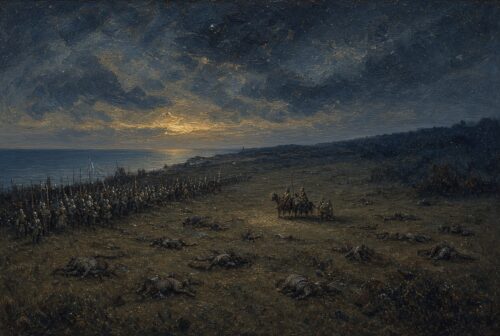
Saladin remains the more attractive figure to modern sentiment, and fairly so. He had rebuilt an army out of the wreck of Fatimid Egypt and Zengid Syria, taken Jerusalem in 1187 with a discipline that startled even his enemies, and treated the conquered with a restraint that made European chroniclers nervous. At Arsuf he did not become a fool. He made a correct operational choice — force a decisive battle on ground that favored his cavalry — against an opponent who had spent two weeks refusing every previous correct choice. The sultan’s misfortune was to meet a man who treated patience as a form of violence.
The column reached Jaffa. The fleet landed stores. The masons started putting walls back on a city that had been denied them. Far to the south, Ascalon’s stones came down so they could not be stacked against their former owner. In Europe, jongleurs began to sand the edges off the story until Richard was a blond comet and Saladin a noble shadow. The useful part of the day is less glamorous than the comet. It is the six miles of walking while being told, by drums and arrows and the deaths of horses, that walking is cowardice. It is the infantry swap by the water. It is the unblown trumpets. It is the second charge that was necessary because the first one was a little too early. It is the halt at a kilometer and a half. It is the night count of what actually died.
That is the event. What follows is not a sermon. It is a working copy of the same machine, scaled to a single life that will never see a Hospitaller or a kettle-drum and will still, most weeks, be marched at from a wood that claims to know better.
The Unblown Trumpet Protocol
Most advice about “timing” is perfume. It tells a person to wait until they feel ready, or to leap when they feel inspired, or to journal until the universe sends a sign. Arsuf does not care how anyone feels. The column had a distance to cover, a formation that had to survive the distance, a pre-agreed signal for the only kind of violence that would finish the job, and a rule for what to do when a human being in the rear fired the signal early because the rear was on fire. That is the whole method. It is not morning pages. It is not a vision board. It is a moving fortress with a sea on one side and a rotation schedule on the other.
Build the column before the forest starts talking.
Name, in writing, the day’s actual objective — the Jaffa of the next six hours, not the Jerusalem of the next six years. Jaffa is a port you can hold. Jerusalem is a shrine you can die on the way to. The written objective must be a place you can camp by nightfall: one finished piece of work, one hard conversation held, one debt payment sent, one training session completed, one page that exists that did not exist at dawn. If the objective cannot be walked to with a baggage train, it is a vanity and will open a gap.
Put the sea on your right. The sea is the non-negotiable supply you will not argue with: sleep window, protein, water, the one calendar block that does not get donated to other people’s emergencies. Everything else can be harassed. The sea cannot. If you give away the sea, Saladin does not even have to fight you. You will unscrew yourself by Thursday.
Install the infantry hedge. These are the small, ugly, repeatable actions that face the incoming arrows: the first thirty minutes of deep work before the inbox is allowed to speak, the two-minute reply that kills a looping thread, the walk that happens even when the weather is theatrical. They are not the charge. They are what makes the charge possible later. Rotate them. When the landward screen is shot through — when attention is shredded — swap it with the seaward rest unit. Literally stand up, drink water, change rooms, change the task’s scale. The Hospitallers walking backward is not a metaphor you admire. It is a schedule you copy.
Write the six-trumpet conditions the night before, while you can still think. Not “when I feel the moment.” Three observable facts that must be true at once: the opponent (the problem, the market, the habit, the other person) is fully committed and no longer feinting; their “horses” are tired — their easy energy, their first wave of pressure, their cheap arguments have already been spent; your own van has reached cover — the day’s minimum objective is close enough that a charge will end at a camp, not in a forest. Until those three are true, the knights stay in the middle with lances up. This will feel like cowardice. That feeling is the cymbals. It is supposed to feel like that. That is how you know the method is running.
When the rear breaks anyway, convert, do not court-martial.
There will be a Baldwin le Carron in every serious day: a burst of anger, a sudden phone call, a piece of work that explodes before the trumpets. You have ninety seconds. Either you treat the burst as mutiny and spend the afternoon prosecuting yourself, or you treat it as a sensor and throw the rest of the line in behind it so the local riot becomes a general result. The protocol is mechanical. Name what just broke. Ask only one question: if I commit everything to this now, can I still halt at a kilometer and a half? If yes, sound the horns after the fact and ride. If no, drag the two knights back behind the infantry and accept the shame of looking passive for another hour. Shame is cheaper than James of Avesnes.
Halt the pursuit on purpose.
Victory’s favorite hobby is becoming a new problem. The extra hundred meters after a successful charge is where good days go to die: the extra email written in triumph, the extra argument to make sure the other person knows they lost, the extra hour of work that steals tomorrow’s sea. Pre-commit a physical halt. Close the laptop. Leave the building. Walk to a marked point and turn around. Count the field at night — what actually got finished, what actually died, what you only feared. Saladin looking for his drummer is a comic image until you realize most people never do the corresponding inventory. They either declare themselves destroyed or declare themselves emperors. The column that camped at Arsuf did neither. It counted, slept, and moved on Jaffa in the morning.
Run the protocol for six miles, not for a personality transplant.
Six miles was the day’s ground. Six hours is a modern equivalent that a single person can actually keep. One six-hour block under the rules, then camp. Do not announce a new identity. Do not tell the forest you have a system. The forest already has a system. Yours is quieter and walks.
Richard did not take Jerusalem on 7 September 1191. He took the ability to keep walking while a very gifted enemy spent a whole army trying to make him jog. That is the fact. The rest is application. Keep the sea on your right. Rotate the hedge. Write the three conditions. When some Hospitaller in your own chest shouts “St. George” too soon, decide in ninety seconds whether to gather the line or pull him back. Then stop at a kilometer and a half, count the bodies that are real, and refuse to chase the ones that live in the trees. The trumpets were never the point. The point was the column that was still a column when the trumpets finally had something worth saying.
Share: