
How a King Who Asked for Two Hours, a Sea of Blue Iron That Charged Uphill Anyway, a Banner of the Virgin Held Until the Last Hand Failed, and One Morning on 25 September 1396 Closed the Age of the Last Great Crusade and Still Shows the Exact Hour Not to Steal the First Blow
Picture a limestone fortress on a knuckle of rock above the Danube.
The river here is wide enough to drown an army and still look bored about it. On the south bank, Nicopolis—Nikopol to the men who live there now—sits where the last Bulgarian tsars once thought stone and height would be enough. By September of 1396 the fortress belonged to the Ottomans. Its walls had already learned the difference between a banner and a siege.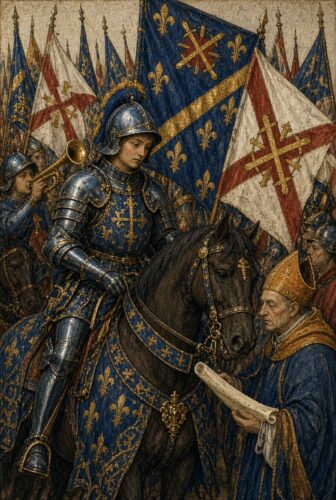
On the morning of 25 September the men outside those walls believed they were about to finish a holy war that would roll from the Danube to Jerusalem. They were wearing so much polished steel that a Turkish observer later said they looked like a sea of blue iron. By nightfall the sea had broken on a hill of wooden stakes, a hidden reserve, and a decision that took less than two hours to make and six hundred years to unmake.
This is that morning.
## The Road That Began in Dijon
The crusade did not begin at Nicopolis. It began as a parade.
On 30 April 1396, John, Count of Nevers—twenty-four years old, son of Philip the Bold, Duke of Burgundy, and already in line for the nickname that would stick after this campaign, John the Fearless—rode out of Dijon. The departure was theater. Banners, trumpets, plenary indulgence from the Avignon pope, the usual promise that whoever died on the way would skip Purgatory and go straight to the good seats. Philip the Bold himself stayed home. So did John of Gaunt. So did Louis of Orléans. The great men sent their sons and their marshal and their constable and kept their own bodies near the courts that actually paid.
The plan, if it can be called a plan, was large enough to be useless. March down the Danube. Kick the Ottomans out of the Balkans. Relieve Constantinople, which Bayezid I had been squeezing since 1394. Cross the Hellespont. Walk through Anatolia and Syria. Take Jerusalem. Sail home covered in relics and self-regard.
The French and Burgundian contingent moved through Strasbourg, across Bavaria, and onto the upper Danube. River barges did the heavy lifting. At Buda they joined King Sigismund of Hungary, a man who had been fighting Turks for years and who therefore had the unfashionable habit of wanting to know where the enemy actually was before he charged it.
Modern estimates put the whole Christian host somewhere between ten and twenty thousand. Johann Schiltberger, a sixteen-year-old Bavarian who would survive the day and spend the next thirty years as a prisoner before writing it down, said sixteen thousand. The French chroniclers preferred numbers that sounded like the end of the world. The Ottomans, when they arrived, were of similar size: perhaps fifteen to twenty thousand, not the hundred-thousand thundercloud of later legend. Bayezid had been besieging Constantinople three weeks earlier. He moved like a man who understood that speed is a weapon and pride is a delay.
They called him Yıldırım. The Thunderbolt.
## Why Anyone Thought This Would Work
To understand why a Burgundian parade thought it could walk to the Holy Sepulchre in 1396, you have to stand in the wreckage of the century that produced it.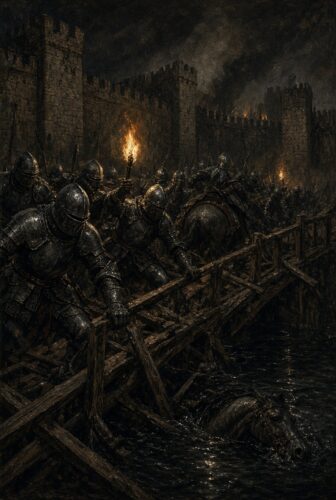
The fourteenth century had already spent its surplus of confidence. The Black Death had cut Europe’s population in a way no battle ever had. The Hundred Years’ War had taught French knighthood both glory and Crécy, both pageantry and Poitiers, both the cult of the charge and the fact that English longbows did not care about lineage. In 1386 the French had even staged a judicial duel so famous—Jean de Carrouges against Jacques Le Gris—that Carrouges himself would ride to Nicopolis as a living advertisement for the idea that one armored man, correctly outraged, could still settle a world. He would die on the slope.
Eastern Europe had its own ledger. In 1389, on Kosovo Field, Prince Lazar of Serbia had gone down against Murad I. Murad was killed in that battle—by a Serbian knight in the traditional telling—and his son Bayezid took the throne in the blood of the same afternoon. Bayezid strangled his brother Yakub to remove an argument and then spent the next seven years turning the Balkans into a system. Bulgarian tsars became vassals, then prisoners, then corpses. Wallachia bent and unbent. Hungary, under Sigismund of Luxembourg, learned that the Ottoman frontier was not a line you could speechify out of existence.
Constantinople, the city that still called itself Rome when it was being honest, had been under Ottoman pressure since 1394. Bayezid built a fortress on the Asian shore of the Bosporus, cut the city’s grain, and waited. Emperor Manuel II Palaeologus wrote letters west that sounded like a man describing a rope tightening. The West answered the way the West often answers a distant fire: with a committee, an indulgence, and a young duke’s son.
There were two popes. That did not help. The Avignon claimant, Benedict XIII, blessed the French. The Roman claimant had his own arithmetic. A crusade in the 1390s was less a unified Christendom than a fashion that several courts could wear at once. Burgundy wanted prestige that would outshine the Valois cousins in Paris. France wanted a stage that was not Gascony. Hungary wanted bodies. Venice and Genoa wanted the river and the Black Sea to remain businesses. The Knights Hospitaller wanted to be where vows still looked like work.
Philippe de Mézières, the old crusading propagandist, had spent decades telling courts that the Turk was the test God had assigned to a decadent chivalry. He was not wrong that the test existed. He was wrong that the costume department could pass it.
John of Nevers was twenty-four. He had been given a written ordinance of command before he left, which is a polite way of saying his father did not entirely trust a coalition of French barons to share a brain. Philip of Artois, Count of Eu, Constable of France, was the man who would treat that ordinance as optional. Boucicaut, marshal, was thirty, already famous for tournaments, pilgrimages, and the kind of personal legend that requires a secretary. Enguerrand VII de Coucy was in his fifties, a relic of an older professionalism, married into English royalty, veteran of Italian condottieri wars and Swiss mountain fights, the one senior Frenchman who still believed that looking at a hill was not an act of cowardice.
They assembled at Buda in July. The arguments started immediately. Sigismund wanted a defensive campaign that would force Bayezid to come to ground of Hungary’s choosing. The French wanted offense because offense is what you can describe at a banquet. A corps peeled into Wallachia to shuffle Mircea the Elder back onto a throne that kept sliding. The main body pointed itself down the Danube toward the Black Sea, where a Christian fleet was supposed to meet them and turn the river into a supply road all the way to a relieved Constantinople.
The fleet was partial. The Hospitallers were late. The supply road was a hope wearing oars.
## Vidin, Rahova, and the Taste of Easy Blood
The crusaders crossed the Danube at the Iron Gates, that pinched gorge where the river remembers it used to be a mountain. It took eight days of pontoons and boats. Their first prize was Vidin. Ivan Sratsimir, the last tsar of the western Bulgarian kingdom, had no interest in dying for a sultan who already owned him. He opened the gates. The Turkish officers of the garrison were executed. The French took this as proof that Turks did not fight.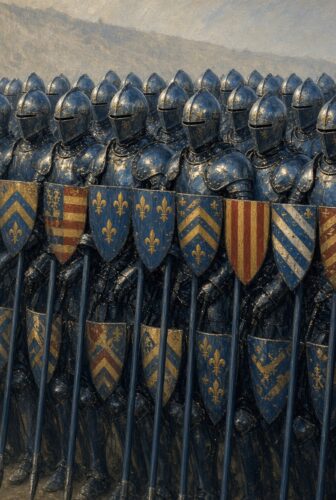
The next prize was Oryahovo—Rahova, Rachowa, the name changes with the chronicler—about seventy-five miles farther downriver. It had a moat, double walls, towers, and a garrison that intended to use them. The French did not wait for Sigismund. Constable Philip of Eu and Marshal Jean II Le Meingre, called Boucicaut, made a night march so they could be first at the walls. The defenders wrecked the bridge over the moat. The French stormed it anyway. They massacred the garrison and a good portion of the Orthodox townspeople, kept the richest for ransom, and burned what was left.
They also took prisoners from the captured places and then, later, killed those prisoners because they did not want to guard them while marching on Nicopolis. That decision would come back wearing a scimitar.
By about 10 September the host was under the walls of Nicopolis itself. The fortress is not a romantic ruin in the telling. It is a problem in geometry. Height, stone, the river at its back, a garrison that could eat stored grain and watch the crusaders eat the countryside. Nicopolis had been Bulgarian, then a prize, then an Ottoman lock on the lower Danube. From its walls a defender could see barges, dust, and the slow comedy of Western siegecraft performed by men who had not brought the patience a fortress requires.
The Venetians and Genoese had ships on the water. The Hospitaller fleet was late. The crusaders settled into a siege the way men settle into a feast they have not earned: loudly, with wine, with the assumption that the man they had come to kill would have the courtesy to stay away.
They had no heavy battery sufficient to peel the place open in a week. What they had was confidence leftover from Vidin and Rahova, a river that could feed them if the boats kept coming, and a theory of war in which a castle is a pause between charges. The garrison of Nicopolis did what garrisons do when they trust their walls more than their guests. They waited.
In the crusader camp the waiting went sour in the usual ways. Foraging became theft. Theft became theology. Local Christians—Orthodox, therefore “schismatics” in the vocabulary of men who had been given permission to lodge with them—discovered that a crusade eats the same wheat a tax collector does. Sigismund tried to keep the Hungarians from becoming the Frenchmen’s cleanup crew. The French tried to keep the Hungarians from becoming the people who would later say I told you so. Coucy, who had been peeled off early in the march for a diplomatic errand to Milan and had only rejoined in time to watch the coalition ripen, took notes with his eyes.
Bayezid did not stay away.
He lifted the pressure on Constantinople, gathered his sipahis, his azabs, his janissaries, his akinji light horse, and the Serbian cavalry of Stefan Lazarević—son of the prince who had died at Kosovo seven years earlier, now a vassal who still knew how to wait behind a hill—and he came north. The speed is the part later painters leave out. Three weeks from the Bosporus to the Danube is not a miracle. It is a state that has already decided the roads belong to it.
A herald walked into a crusader tent while the leadership was eating and told them the Thunderbolt was on the field.
The siege, which had been a lifestyle, became a clock. Some wanted to keep the fortress between themselves and the incoming army and force Bayezid to attack prepared ground. That would have been a Hungarian plan. The French plan was older than Hungary and louder than walls: find the enemy, take the van, make the first contact so that no cousin in Dijon could later claim the first contact had been Hungarian. On the night of the twenty-fourth, while Bayezid arranged a slope the crusaders had not bothered to walk, the crusader leadership argued about honor as if honor were a scarce metal that would vanish if it were shared.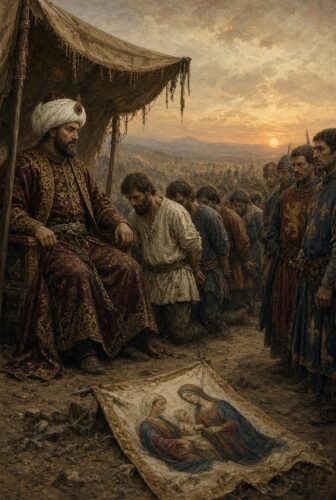
## The Argument Before Dawn
Sigismund knew the Ottoman way of fighting. Screen of light horse. A belt of sharpened stakes set at the height of a horse’s chest. Infantry archers in the gaps. The real army, the armored sipahis and the household troops, held back until the first wave of glory had spent itself on wood and arrows. He asked for two hours. Two hours for scouts to ride the slope and count what was actually there instead of what the French wanted to be there.
Philip of Eu refused.
The constable’s reasoning, as the chroniclers give it, is a small masterpiece of the human talent for dressing vanity as honor. If the Hungarians scouted and then led, the Hungarians would take the first blow and therefore the first fame. The French had been promised the van. The van was not a tactical assignment. It was a jewel. Enguerrand VII de Coucy, the most experienced of the French captains, a man who had fought from Italy to Switzerland and who was old enough to remember that terrain does not care about your coat of arms, sided with Sigismund. He was overruled by the young ones: Nevers, Eu, the knights who had come east to make a name that would still sound good when they were bald.
“Forward banner,” Eu is supposed to have said, “in the name of God and of Saint George, for they will see me today a good chevalier.”
That sentence is the whole battle in twelve words.
Boucicaut, who would later write a chivalric biography of himself that treated this day as a misunderstanding rather than a verdict, agreed that dying by arrows was a coward’s death. The thing to do with arrows was to ride through them.
Sigismund, watching his coalition decide that reconnaissance was a form of theft, put the Hungarians, Germans, Hospitallers, and the rest where he could. He placed the Wallachians of Mircea the Elder and the Transylvanians on the wings, which was both a military choice and a political one: unreliable vassals fight harder when they cannot slip sideways. He kept a reserve. He no longer controlled the clock.
## The Sea of Blue Iron
The French and Burgundians armed.
Froissart, who was not there but who collected the stories of men who were, wrote that every knight of France was in his coat armor so that every man seemed to be a king, they were so richly appareled. The Turks, looking down the slope at that line, called it blue iron. The color of tempered plate in morning light. The color of a wave that has not yet learned it is made of men.
Behind the first Ottoman screen waited the stakes.
They were not a metaphor. They were cut timber, planted in rows, angled toward the charge, high enough to take a destrier in the chest or the belly. Between them stood azabs and janissary archers who had been told what heavy cavalry does when it is insulted by a wooden fence: it comes on anyway.
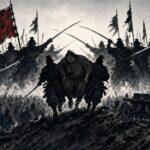
Trumpets. The cry of Saint Denis. The cry of Saint George. The line rolled.
The akinjis loosed and peeled left and right. That is what light horse is for. The knights saw the withdrawal and read it as collapse. They had been trained from boyhood to treat a turning back as the moment you lean into the lance and finish the story. They leaned.
Horses hit the stakes. Some were impaled. Some went down in the tangle. Riders came off or jumped off and began pulling the timber up by hand so that a gap of twenty men abreast could be forced through the rows. Arrows walked across the plate and found the places plate does not cover: the armpit, the visor slit, the horse. The armor did its job well enough that the Turkish front line, lightly equipped, was cut to pieces. Western axes and swords went through men who had been told to delay, not to win.
For a short, blinding interval the French were right.
They broke the infantry. They pushed the remnants back onto the sipahis. Coucy and Jean de Vienne, Admiral of France, the oldest knight present and therefore the man given the French standard, shouted to halt, reform, wait for the Hungarians coming up behind. The younger knights did not halt. They had, in their own minds, already destroyed the Ottoman army. What lay over the crest could only be fugitives.
More than half of them were on foot by the time they reached the top. Heavy harness on an uphill walk after a melee is not a poem. It is heat, weight, and the slow discovery that your lungs are not a relic.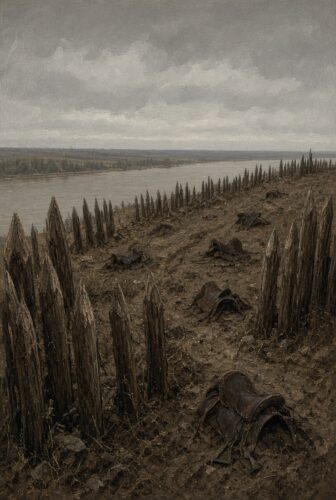
On the plateau, fresh, was the rest of Bayezid.
Sipahis. Household cavalry. Kettle drums. The tekbir shouted in a mass. The French, who had come to finish a retreat, found themselves starting a second battle against men who had not yet fought.
Some turned and ran back down the slope. The rest fought the way chroniclers like to write about: no frothing boar nor enraged wolf more fiercely. Jean de Vienne took the banner of the Virgin in one hand and a sword in the other after the men assigned to guard it were down. He was hit again and again and went down with the cloth. Jean de Carrouges died in the crush. Coucy was beaten to the ground with maces. Nevers, Boucicaut, Philip of Artois Count of Eu, and the rest of the namable blood were closed in and taken.
Three hours, give or take, from the first trumpet to the end of the French as a fighting body.
## The Hill, the River, and the Serbs
Sigismund came on with what he still had.
He hit a body of Ottoman foot and broke it. Then the shape of the field changed. The French disaster on the hill had unhooked the wings. The Wallachians and Transylvanians, watching riderless horses and broken men come back down the slope, decided the day was already spent and left it. Stefan Lazarević’s Serbs, who had been waiting where a reserve waits if it is well handled, came in on the Hungarian flank. The king’s banner went. The army folded toward the Danube.
Schiltberger, the boy from near Munich, saw his lord’s horse killed, gave the man his own, grabbed a Turkish mount, and still ended the day in a rope. Men reached the shipping on the river and found the decks already full. Crews struck at the hands of those trying to climb aboard. The Danube took the overflow. Sigismund got onto a vessel, eventually reached the Black Sea and Constantinople, and spent the rest of a long life explaining that the French had lost the day by pride and vanity.
He was not wrong. He was also not complete. The stakes had been visible to anyone who waited two hours. The reserve had been inferable to anyone who had fought Bayezid before. The massacre of the Rahova prisoners had already written the terms of the next morning.
## The Morning After
Bayezid walked the field.
Ottoman losses were ugly. Western plate had done what it was forged to do. The sultan’s grief, if the sources can be trusted for an emotion, mixed with the discovery that the crusaders had killed their own prisoners from the river forts rather than risk a rescue. He ordered the captives brought.
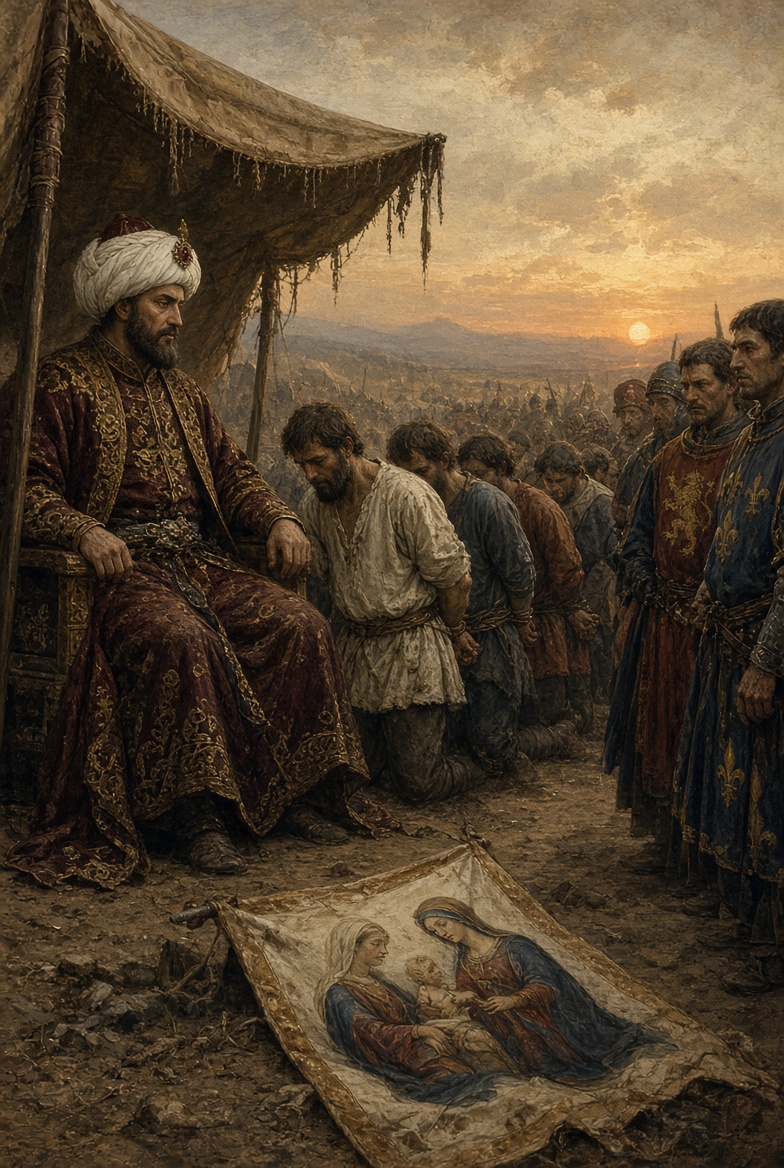
Jacques de Helly, a French knight who had once served Bayezid’s father, was recognized and put to work pointing out which heads were worth gold. Nevers. Eu. Coucy. Boucicaut. A handful of others. Boys under twenty were pulled aside for slavery. Schiltberger was sixteen. When the line of condemned reached him, one of the sultan’s sons had him yanked out because the rule was age, not merit.
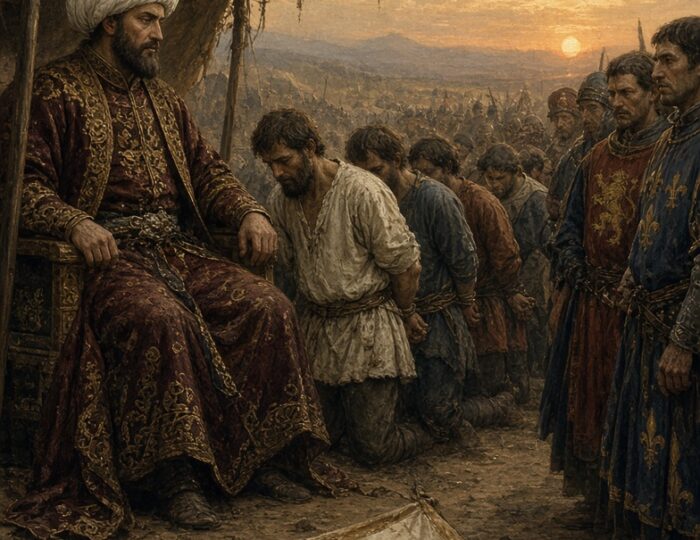
The rest were stripped, bound in groups of three and four, ropes at the neck, and marched past the sultan. Then the killing began. Decapitation, mostly. Some throats. Some limbs. The noble prisoners were made to stand and watch their companions drop. Nevers went to his knees and pressed his thumbs together to show that Boucicaut was as a brother; Bayezid let that one live for ransom. The work ran from morning toward vespers until even the man who had ordered it had seen enough, or until a counselor pointed out that too much Western blood in one ditch would make the next ransom harder.
Numbers wander. A few hundred. Three thousand. Schiltberger’s larger figure. What does not wander is the method: a public, day-long answer to a public massacre a few weeks earlier, performed in front of the men who would have to go home and describe it.
The survivors of rank were marched to Gallipoli, then toward Bursa. They were not treated as dinner guests. Coucy, who had been right about the two hours, died in captivity, probably of illness, before his price could be paid. Eu died in captivity. Nevers lived. The ransom for the namable heads was fixed in June 1397 at two hundred thousand ducats, a sum large enough to require Genoese merchants, the lord of Mytilene, and the credit of Burgundy. Philip the Bold sent horses, falcons, tapestries, gloves, plate, and grooms in white and scarlet to make the arithmetic feel like courtesy.
John of Nevers came home and, in time, became Duke of Burgundy. The nickname Fearless attached itself to him like a medal pinned on the wrong coat. Boucicaut would fight again, be captured again at Agincourt, and die in English hands. Sigismund would become Holy Roman Emperor and still be answering for this riverbank. Bayezid would meet Timur at Ankara in 1402 and learn, in a cage, that thunderbolts also land.
Nicopolis did not fall to the crusade. The fortress watched the field clear and remained Ottoman. The Second Bulgarian Empire finished dying in the aftermath. Vidin’s tsar, Ivan Sratsimir, was taken to Bursa and did not come back; the usual Ottoman courtesy for a used vassal was a bowstring. His realm became a province. The Danube, which had been a contested hinge, became a road with a single toll-keeper.
Constantinople received a stay of execution, not a rescue. Manuel II went west in person after 1399, a Byzantine emperor touring European courts like a man selling a house that was already on fire. The city lasted until 1453, which looks like a long time from a calendar and like a short time from a wall. Nicopolis had been the last moment when a Western field army of this composition might have changed the math of the Bosporus. After the slope, the math was Ottoman.
Europe did not mount another coalition of this size against the Ottomans for decades. There would be later raids, later leagues, later speeches. There would not be another Dijon parade that believed Jerusalem was a scheduling problem. The Hospitallers kept their island wars. Venice kept its ledgers. Hungary kept its frontier and its scars. Burgundy kept its tapestries and its nickname.
The chroniclers reached for old comparisons. Since Roncesvalles, they said, when the twelve peers of France went down, Christendom had not taken such a wound. That is a literary reflex, not a census. What the reflex gets right is the feeling in the Western courts when the first ransomed men and the first letters arrived: the costume had met a system and the system had kept the field.
Bayezid did not get to enjoy the victory as a permanent climate. In 1402 Timur smashed him at Ankara, took him, and—depending on which story you like—carried him in an iron cage or merely in the more ordinary cage of defeat. The Ottoman state staggered, then reconstituted, then returned to the same river with the same appetite. The lesson of Nicopolis for the sultans was not that Western knights were invincible in plate. It was that Western knights would, if invited, spend themselves on the first line.
Jean de Vienne’s banner of the Virgin did not come home. Coucy’s bones did not come home in the way a house like Coucy prefers. Schiltberger came home in 1427, thirty-one years late, and dictated a travel book that is half wonder and half inventory of the places a sixteen-year-old can be sent when a constable will not wait two hours. He had served Ottoman courts, seen campaigns in Asia, survived as a piece of movable property with a memory. His numbers are the closest thing the day has to a man who was there and had no coat of arms to protect.
The age in which Western knighthood could still tell itself that a charge in perfect harness was a form of foreign policy closed on a slope above the Danube, on a Monday in September, because a constable would not give a king two hours.
## How Bayezid Had Arranged the Hill
The Ottoman order of battle was not a mystery to anyone who had fought on this frontier. It was a mystery only to men who had not.
In front: akinjis, the irregular light horse whose job was to sting, withdraw, and make a charge feel like a hunt. Behind them: a belt of timber and the infantry who lived in it—azabs, conscripts, and janissaries with bows, told to make the first contact expensive. Behind the infantry, and often behind a fold of ground the crusaders never walked, the sipahis of the provinces and the household cavalry that answered only to the sultan. On a flank that did not advertise itself: Stefan Lazarević and the Serbs, vassals with a memory of Kosovo and a professional interest in being the last weight placed on a scale.
Bayezid’s habit was to let the enemy write the first chapter. He could afford the chapter. The crusaders could not afford to mistake it for the book.
When the French reached the plateau they were no longer a cavalry problem. They were an infantry problem in cavalry armor, lungs already spent, formation already a rumor. The kettle drums and the tekbir were not decoration. They were the sound of a second army announcing that it had been rested on purpose. Sigismund’s attempt to restore the day ran into that announcement and into the departure of the Wallachian and Transylvanian wings, who had watched the horses come back down the slope without their riders and drawn the only conclusion available to men who did not intend to die for someone else’s van.
The Danube then did what large rivers do at the end of a broken army. It offered a door and charged a price at the threshold. Ships filled. Hands were struck. Men who could swim learned the width of the water. Men who could not learned it faster. The king of Hungary left by boat. The Count of Nevers left in a rope.
## What the Stakes Were For
The stakes were not clever because they were cruel. They were clever because they converted the enemy’s best quality into a cost. Heavy cavalry wants contact. Wood at chest height makes contact expensive and slow. Arrows make the slowness loud. A hidden reserve makes the survivors of the slowness arrive already tired to a fight that has not started for the other side.
The French error was not courage. Courage was abundant and, on that morning, technically impressive. The error was treating the first visible line as the whole war, treating a withdrawal as a verdict, treating a king’s request for a look as an insult to the calendar of glory.
Every army that has ever lost a battle it should have scouted has a version of Philip of Eu standing in the dawn saying that delay is theft.
## The Nicopolis Protocol
The useful residue of 25 September 1396 is not a slogan about humility. Humility is a poster. The field offers a procedure.
Call it the Nicopolis Protocol. It is not morning pages, not a gratitude list, not a vision board, and not a request that you “trust the process.” It is a pre-charge audit you run before you spend the one resource that does not respawn: the first irreversible move in a fight you do not fully see.
Use it when you are about to send the message that cannot be unsent, quit, sign, launch, confront, spend the reserve, or take the van because someone implied that waiting would make you look small.
### Five questions in two hours
Impose a hard delay of one waking cycle—overnight at minimum, two full hours of paper if the decision is the same day. Do not polish the speech. Answer these.
– Name the stake-line as an object, not a mood: the timber between you and the thing you think is already running. A clause. A missing skill. A person who has not said yes. A body that will not do what the plan assumes.
– Name the hidden reserve: the force that only appears after the first charge is spent. If you cannot name it, you are not ready to go up the hill.
– Name who is asking for two hours and what they know that you have arranged not to know. The request that sounds like it is stealing your honor is often the map.
– Name the Rahova prisoners: what you already burned so you would not have to guard it. They will attend the reckoning whether invited or not.
– Name three people who will be forced to watch if you lose. If the list makes the charge feel less like a song, the protocol is working.
### Seven days if the move is large
Day one: put distances on the terrain—hours, money, names. If you cannot, you are still in Dijon, parading.
Day two: assign the first visible action to someone else on purpose. The tightness in the chest is the thing that killed the banner.
Day three: sit in the physical place the decision will land until the fantasy gets bored.
Day four: write the speech for the crest that is not fugitives. Keep it. Do not perform it.
Day five: feed the reserve so your second line is fresher than your first.
Day six: one reconnaissance that cannot be mistaken for a charge. Then stop.
Day seven: decide whether the timber has been counted, not whether you are brave.
### The rule against stealing the first blow
Honor is not the first contact. Honor is still having a line when the first contact is over. If a plan requires that nobody else look first, it is a costume. If a withdrawal by the other side feels like victory in under ten minutes, assume a screen. If the scarred ally asks you to wait and the polished ally talks about Saint George, delay.
The French were not defeated by caution. They were defeated by a refusal to spend two hours learning the price of the hill. Spend the two hours. Then, if the crest is really empty, ride.
The Danube is still there. The stakes, when they appear in a life, are still wood: ordinary, plantable, angled at the exact height of whatever you insist on riding. A constable said delay was theft. A king asked for a look. The look was not taken. The river took the rest. The only open question is whether the next herald in the tent gets two hours.
Share: