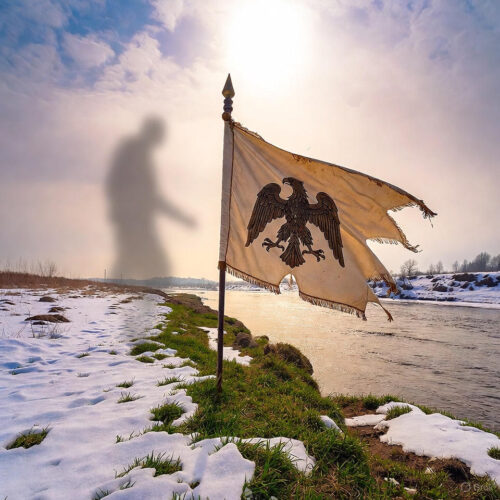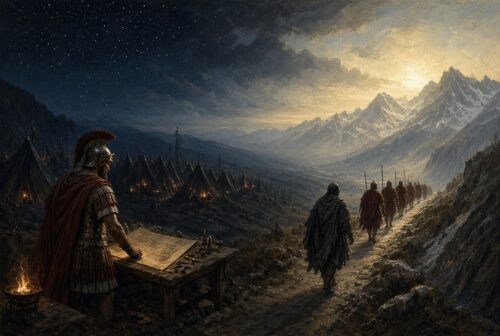

On the morning of 5 September 394, in a narrow, wind-scoured valley on the eastern edge of Italy, two Roman armies that no longer recognized the same emperor prepared to kill each other. The river they faced was called the Frigidus—the Cold One. Today it is the Vipava, a short, fast stream that still races out of the Julian Alps in what is now western Slovenia. The pass through those mountains was part of the old Claustra Alpium Iuliarum, the fortified “locks” that had guarded the door to Italy for centuries. That morning the door was about to be kicked in from the east.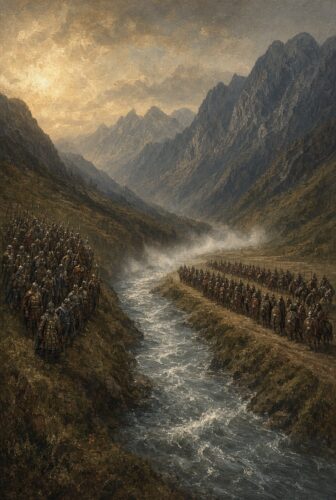
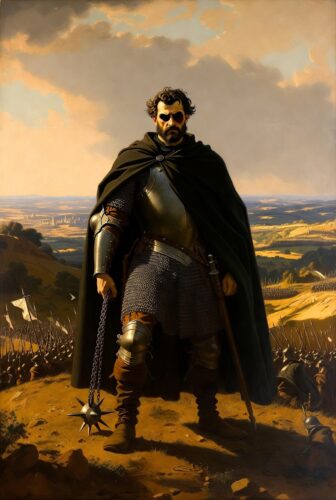
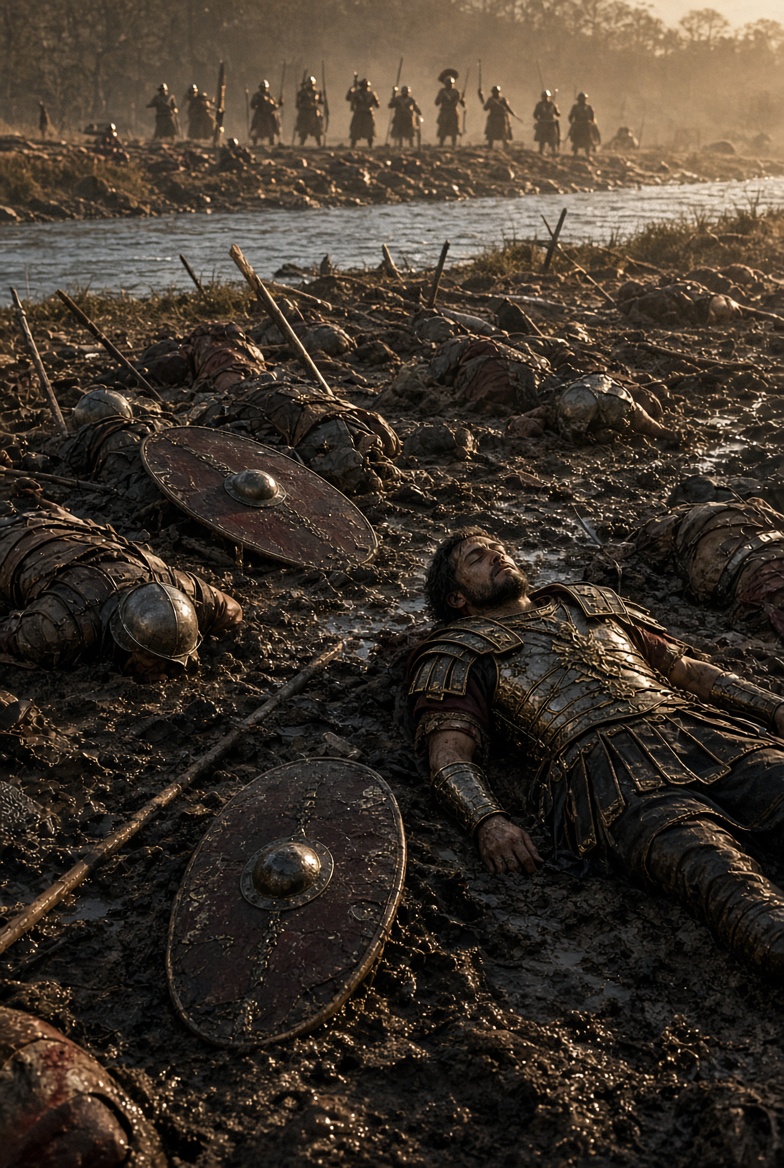
The man coming through it was Theodosius I, emperor of the East, a Spanish soldier who had already fought two civil wars and who now intended to fight a third. Facing him was a former professor of rhetoric named Eugenius, who had been dressed in the purple two years earlier by a Frankish general who did not bother to ask Constantinople’s permission. Between them stood roughly seventy or eighty thousand men, a large fraction of what was left of the professional Roman army after the disaster at Adrianople sixteen years earlier. By the time the sun set on 5 September, ten thousand of those men—almost all of them Gothic federates fighting for Theodosius—would be dead, the Eastern emperor’s position would look desperate, and the Western camp would be celebrating as if the war were already over.
It was not.
The story that produced that first-day massacre begins two years and four months earlier, on 15 May 392, in the imperial residence at Vienne in Gaul. The young Western emperor Valentinian II was found hanged in his apartments. The official story was suicide. Almost no one in the East believed it. The man who controlled Valentinian’s court, his armies, and his correspondence was Flavius Arbogast, a Frank who had risen under Gratian, survived the usurpation of Magnus Maximus, and ended up as the real power behind a teenage emperor he treated as a decorative object. Arbogast had already killed one of Valentinian’s friends in the emperor’s presence. When Valentinian tried to dismiss him, Arbogast simply tore up the letter. A few days later the emperor was dead.
Arbogast could not become emperor himself. A Frank of modest birth still needed a respectable Roman face. He found one in Eugenius, a mild, educated Christian who had served as magister scrinii—essentially the head of the imperial correspondence office—and who was known for his skill at Latin rhetoric rather than for any particular military talent. On 22 August 392 Eugenius was proclaimed augustus in the West. Coins were struck showing two emperors enthroned together, the inscription proclaiming “the Victory of the Augusti” as if Theodosius had already agreed. He had not.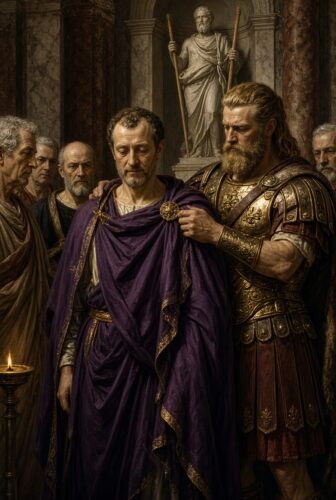
Theodosius responded the way a late-Roman emperor usually responded to an unsanctioned colleague: he waited, he gathered troops, and he appointed his own eight-year-old son Honorius as western augustus in January 393. Then he spent a year and a half rebuilding an Eastern field army that had never fully recovered from the Gothic war. The man who did much of the actual recruiting and organizing was Stilicho, a half-Vandal officer already marked for higher things. Beside him served Timasius, an older regular, and Bacurius, an Iberian (Georgian) prince who had fought for Rome long enough to be trusted with the emperor’s person. The striking-power of the army, however, was not Roman. It was Gothic. Alaric and Gainas brought perhaps twenty thousand federates. Theodosius needed them. He also, according to later writers, may have been willing to see a good number of them die. A contemporary remark that he won “two battles at the Frigidus—one against Eugenius and one against the Goths” has the sour ring of someone who noticed the butcher’s bill.
While Theodosius marched, the West prepared a different kind of theater. Virius Nicomachus Flavianus, the pagan senator who served Eugenius as praetorian prefect of Italy, encouraged the old rites. Statues of Jupiter were set up on the approaches to the battlefield; some accounts say they held golden thunderbolts. Standards and clothing carried the image of Hercules. Whether this amounted to a genuine “pagan revival” or simply the last public flourish of a senatorial class that still liked its ancestral gods is still argued. What is not argued is that Christian writers after the fact turned the whole campaign into a morality play: the last stand of the old religion against the new. Eugenius himself was a Christian. That inconvenient detail was quietly ignored.
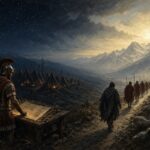
Theodosius left Constantinople in May 394. He moved through Pannonia and the Julian Alps without meeting serious resistance. Arbogast had chosen to concentrate everything in the valley rather than contest the passes. It was a reasonable calculation if you expected the Eastern army to arrive tired and strung out. Instead Theodosius came down the far side of the mountains and found the Western army already drawn up along the river, occupying the better ground.
On the morning of 5 September he attacked anyway.
He sent the Goths in first.
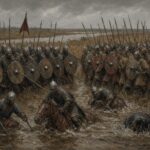
The assault was frontal, poorly reconnoitered, and immediately costly. The Western line held. Bacurius, leading a charge that may have been meant to save the collapsing federates, was killed. By evening the Eastern army had lost as many as ten thousand Goths and had nothing to show for it except a pile of bodies and a river that still belonged to the other side. Arbogast, satisfied that the day’s work was done, sent detachments into the hills to seal the passes behind Theodosius. If the Eastern emperor tried to retreat, he would find the door locked. Eugenius distributed rewards. The Western camp ate well.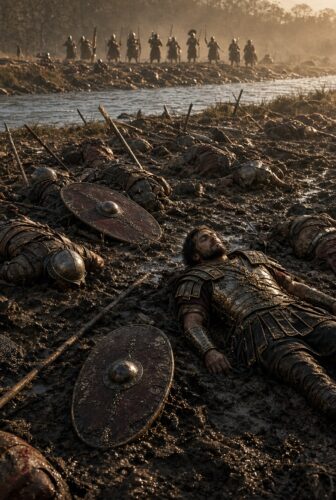
In the Eastern camp the advice was unanimous: pull back, winter in the mountains, try again in the spring. Theodosius did not pull back. Some sources say he spent the night in prayer. Others simply say he did not sleep. Late that night word arrived that the very detachments Arbogast had sent to trap him had decided they preferred the Eastern pay-chest. The blocking force had become a reinforcing force.
Dawn on 6 September therefore looked different from dusk on the 5th. Theodosius attacked again. This time the valley itself joined the fight. A violent wind—the bora, a katabatic blast that still howls down that same corridor at speeds that can exceed 100 miles per hour—came out of the east, at the backs of the Eastern troops and straight into the faces of the Western line. Dust filled eyes and mouths. Shields became sails. Javelins and arrows that left Western hands were said to have turned in the air and come back at their owners. Whether the wind actually reversed missiles or merely made accurate shooting impossible is less important than the effect on morale. An army that had spent the previous night celebrating now discovered that the weather, the deserters, and the man they had written off were all moving at once.
The Western line broke. Eugenius was pulled from whatever shelter he had found, dragged before Theodosius, and beheaded. His head went on a pike as a traveling exhibit. Arbogast escaped into the mountains, wandered for a few days, and then followed the older Roman habit of unsuccessful generals: he fell on his sword. Nicomachus Flavianus, sixty years old and suddenly without a future, did the same. Theodosius pulled down the statues of Jupiter and, in a moment of grim humor recorded by later writers, handed the golden thunderbolts to his messengers. The riders joked that they would not mind being struck by lightning of that quality.
The empire was, for a few months, one again. Theodosius entered Italy as the last man who would ever rule both East and West. He was dead by January 395. His sons were children. The Gothic federates who had paid the heaviest price on 5 September still had a leader named Alaric. Sixteen years later that same Alaric would sack Rome. The Western field army that had stood on the Frigidus never fully recovered its numbers or its cohesion. What looked like a decisive Christian victory on 6 September was also the moment the Western military establishment spent the last of its disposable strength.
That is the part the victory sermons usually leave out. The first day was a slaughter. The second day was a reversal made possible by three things that had nothing to do with slogans: a refusal to retreat after a visible catastrophe, the unexpected defection of men the enemy thought were securely his, and a local wind that no one on either side could command but that one side was positioned to use.
The rest of the fourth century had already shown what happened when Roman armies treated their barbarian allies as expendable and then acted surprised when those same allies later presented a bill. The Frigidus simply made the arithmetic visible in a single valley on two consecutive September days.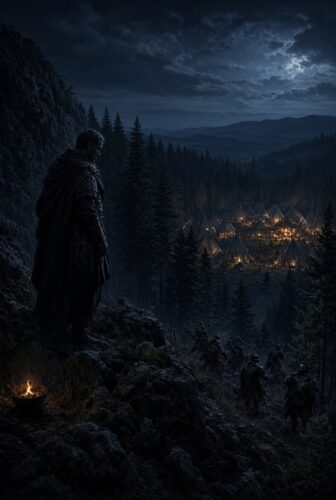
**What the first day’s wreckage still teaches, and the only plan that does not already exist in a thousand identical listicles**
The useful residue of 5 September 394 is not “never give up” or “pray harder.” It is a narrower, colder procedure that almost no one follows because it feels like doing nothing at the exact moment the world is telling you to do something dramatic.
Call it the Second-Dawn Freeze.
– After any first-wave collapse—project killed, offer withdrawn, public embarrassment, market move against you—impose a hard 12-to-18-hour freeze. No announcements, no revenge emails, no “doubling down” posts, no resignation letters, no victory laps by the other side that you feel obliged to answer in real time. Theodosius’s generals wanted to leave the valley that night. He stayed put and stayed quiet.
– During the freeze, make a private list of three “blocking detachments”: people, resources, or timing advantages that the apparent winner of today assumes are locked against you. Arbogast sent men into the hills to seal the passes; those same men changed sides before dawn. The list is not a gratitude journal. It is an inventory of quiet discontent on the other side of the line.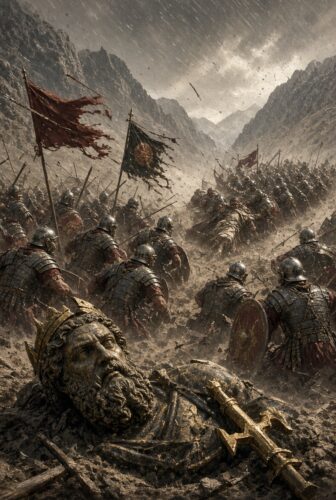
– At first light of the second day, take one small, irreversible action that exploits an environmental or calendar advantage the other side is too busy celebrating to notice. The bora was not summoned. It was simply there, blowing the same direction it had blown for centuries. Theodosius was the only commander still in position to put it at his back.
That is the entire plan. It is not a morning routine, a vision board, or a 30-day challenge. It is a 24-hour rule that treats the first day’s massacre as information rather than as a verdict. Most people either flee the valley or throw a feast. The ones who wait out the night and then move with the wind that was always going to blow anyway tend to be the ones still standing when the statues come down.
Share: