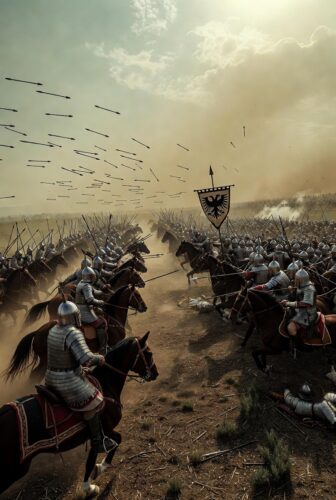

On a late-summer day in the eighth month of 685 BC, specifically the Gengshen day that corresponds to August 8 in the Gregorian reckoning, two armies collided at a place called Qianshi. The name itself is unglamorous. It means something like “Dry Time” or “Seasonally Dry Watercourse,” a stretch of intermittent stream bed west of the Qi capital of Linzi in what is now Huantai County, Shandong. In a normal year the water would have been low or gone altogether under the August sun. On this particular day the ground was about to become sticky with more than dust.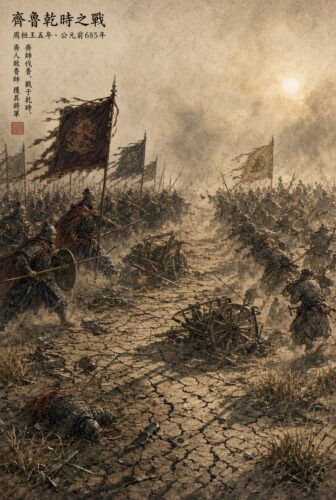
The clash was not a grand set-piece battle of the sort later ages would mythologize. It was a succession fight that had already been decided by a combination of speed, deception, and pure nerve. Yet its outcome locked into place the career of the man who would become known as Duke Huan of Qi, the first of the Five Hegemons of the Spring and Autumn period. With him rose the pragmatic genius Guan Zhong. Together they turned a middling eastern state into the dominant power of the Zhou world for a generation. Everything that followed—Qi’s administrative reforms, its military reorganization, its diplomatic congresses under the slogan of “respect the king and expel the barbarians”—rested on the fact that on August 8, 685 BC, the invading army of Lu was smashed, its duke forced to abandon his chariot, and the rival claimant to Qi’s throne left with nowhere to run.
To understand why a dusty skirmish on a dry creek mattered so much, you have to rewind a few bloody months.
The state of Qi sat on the Shandong peninsula, fertile, coastal, and ambitious. Its ruling house of Jiang had produced a string of dukes whose private lives were as chaotic as their politics. Duke Xiang of Qi had been murdered in 686 BC amid a tangle of incestuous intrigue and court faction. His cousin Gongsun Wuzhi seized the throne, only to be assassinated himself after a few weeks by the minister Yong Lin. Suddenly the succession was wide open. Two half-brothers of the previous generation stood ready: Gongzi Jiu (also called Zijiu), the older, and Gongzi Xiaobai, the younger. Both had spent years in exile for their own safety. Jiu had taken refuge in the neighboring state of Lu, accompanied by two capable retainers, Guan Zhong and Shao Hu. Xiaobai had fled to the smaller state of Ju, watched over by the Qi minister Bao Shuya and backed by the powerful Gao family inside Qi itself.
When news of Wuzhi’s death reached both camps, the race was on. Speed decided everything. Gao Xi in the Qi capital sent a secret invitation to Xiaobai. At the same time, Duke Zhuang of Lu, seeing a chance to install a grateful client on Qi’s throne, prepared an escort for Jiu. Guan Zhong, Jiu’s tutor and already a man of sharp political instinct, rode out with a detachment to intercept Xiaobai on the road from Ju. The two parties met. Guan Zhong drew his bow and loosed an arrow that struck Xiaobai squarely. The arrow hit the belt buckle. Xiaobai did the only useful thing left: he bit his own tongue hard enough to draw blood, collapsed, and played dead. Guan Zhong, believing the job finished, rode back to report the rival’s death. Xiaobai’s party loaded the “corpse” into a warm carriage and raced for Linzi. Six days later, when the Lu escort finally arrived with Jiu, Xiaobai was already inside the capital, the army under control, and the ancestral tablets acknowledging him as the new Duke of Qi. History would remember him as Duke Huan.
Duke Zhuang of Lu was not amused. He had committed troops, prestige, and political capital to Jiu’s cause. Having been outrun, he now decided to settle the matter by force. In the late summer of 685 BC he personally led an army into Qi territory, determined to unseat the usurper and place Jiu on the throne. The two forces met at Qianshi.
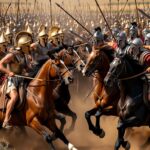
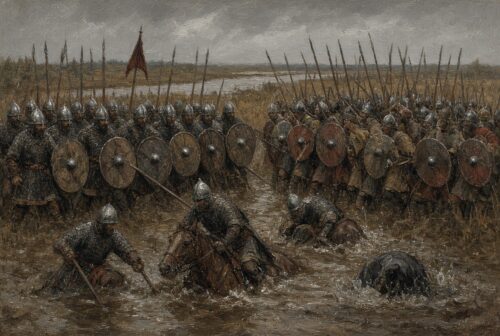
The sources are laconic, as Chinese chronicles of the period usually are. The *Spring and Autumn Annals* and the *Zuo Zhuan* simply record that on the Gengshen day of the eighth month the armies of Lu and Qi fought at Qianshi and that Lu’s army was severely defeated. Later commentators and the *Records of the Grand Historian* add texture. The Qi forces, under the overall authority of the newly installed Duke Huan and the operational command of Bao Shuya, held the home ground. The dry watercourse offered little cover and forced the fighting into the open. Lu’s advance collapsed. Duke Zhuang’s chariot became a liability; he abandoned it and fled in a lighter carriage while two retainers, Qinzi and Liangzi, took his banner and deliberately drew pursuit down a different road. Both were captured. The bulk of the Lu army streamed back across the border in disorder.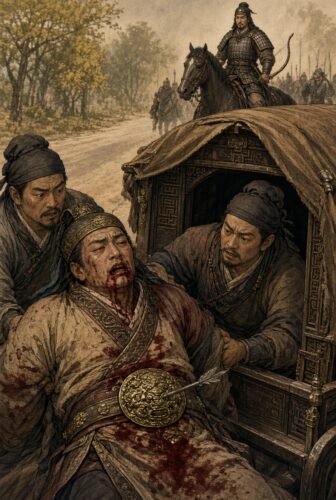
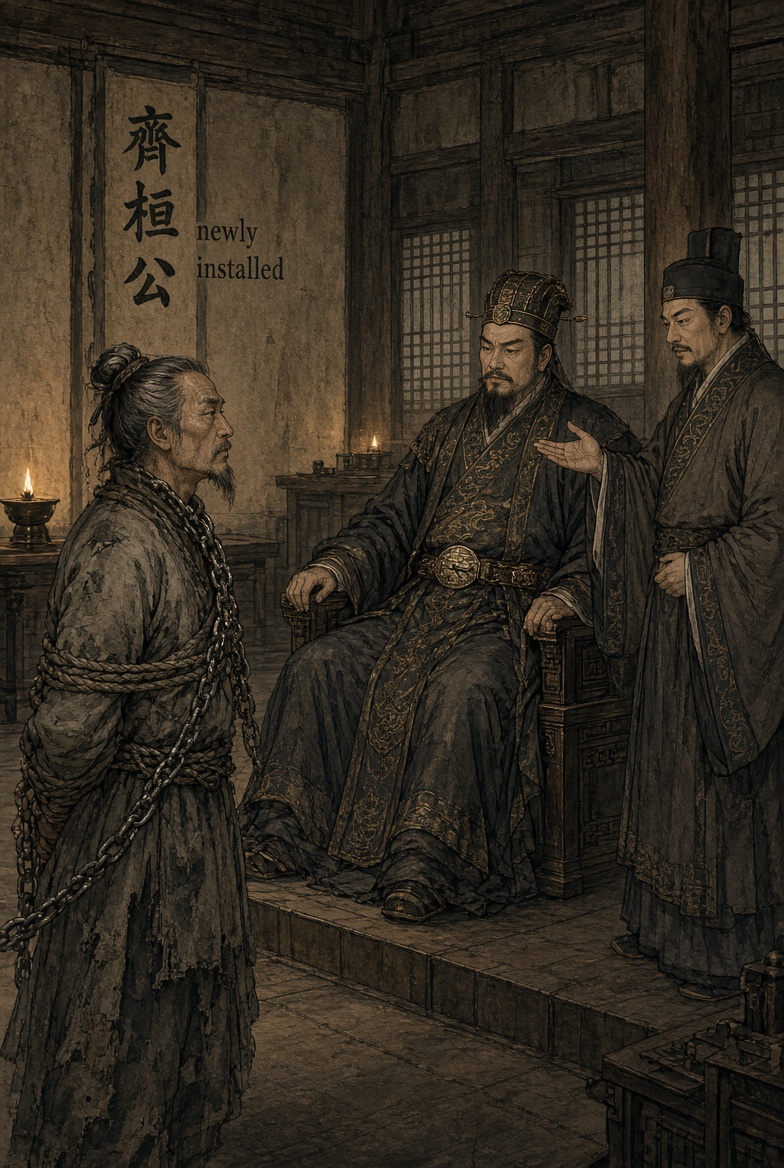
Qi did not stop at the frontier. Bao Shuya followed with a punitive force and sent a blunt message to Duke Zhuang. The letter, as preserved, is a masterpiece of cold political realism. Gongzi Jiu, it said, is our kinsman; we cannot bear to kill him ourselves—please do it for us. Guan Zhong and Shao Hu are our enemies; hand them over so that we may deal with them as we see fit. If you refuse, we will surround Lu. The threat was credible. Lu, smaller and now militarily exposed, complied. Gongzi Jiu was put to death. Shao Hu, true to the older code of personal loyalty, committed suicide rather than live under the new order. Guan Zhong was delivered in chains.
Here the story takes the turn that made the entire episode consequential rather than merely another bloody succession fight. Bao Shuya, who had every reason to hate Guan Zhong—the man who had tried to kill his lord—argued that Guan Zhong’s talents far exceeded those of ordinary ministers. Duke Huan, still nursing the memory of the arrow that had nearly ended him, nevertheless listened. At a place called Tangfu the prisoner was released. Not long afterward Guan Zhong was appointed chief minister. The man who had shot at the future hegemon became the architect of his power.
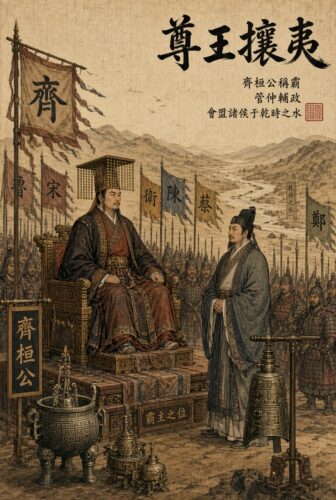
What followed was not immediate domination but systematic construction. Guan Zhong reorganized Qi’s administration into a system of controlled units that linked military service, taxation, and local governance. He reformed the currency and the salt and iron monopolies, giving the state reliable revenue. He professionalized the army so that Qi could field coherent forces rather than the ad-hoc levies common among the Zhou states. Diplomatically he guided Duke Huan toward a policy of intervening in the name of the Zhou king while steadily accumulating real power. By 667 BC the other major states formally acknowledged Duke Huan as hegemon—the first of the ba, the overlords who would dominate the Spring and Autumn centuries until the rise of even more ruthless powers in the Warring States era.
The Battle of Qianshi itself was only the hinge. Without the victory on that dry August day, Xiaobai might have remained a contested claimant or been driven back into exile. Without the subsequent decision to employ rather than execute Guan Zhong, Qi’s internal reforms would have lacked their most effective designer. The combination of battlefield success and political ruthlessness-turned-pragmatism produced a durable hegemony that lasted through Duke Huan’s long reign. Qi became the state others measured themselves against. Its court set the tone for interstate diplomacy. Its military methods influenced later thinkers. And the personal story—arrow to the buckle, feigned death, desperate race to the capital, decisive skirmish, and the recruitment of one’s own would-be assassin—entered the Chinese historical imagination as a classic illustration of how fortune, nerve, and calculation can convert near-disaster into foundation.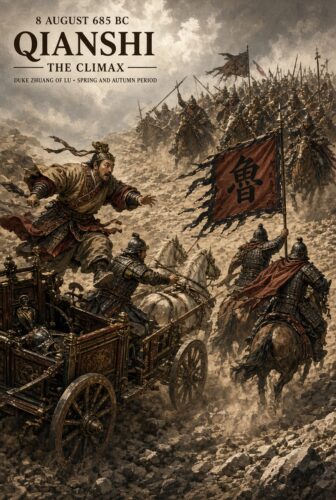
The broader Spring and Autumn context makes the stakes clearer. The Zhou royal house still claimed ritual supremacy, but real power had long since decentralized among the feudal states. Succession crises were routine and often fatal. States that hesitated or chose the wrong claimant paid in territory and prestige. Qi under Duke Huan and Guan Zhong demonstrated a different model: stabilize the center quickly, absorb talented opponents rather than liquidate them out of spite, and then project power outward under a respectable ideological cover. The result was decades of relative order in an age of chronic disorder, purchased by one sharp victory on a dry watercourse and one counter-intuitive personnel decision.
That is the historical core. Everything else—later legends about Guan Zhong’s economic theories, the famous meetings of the princes, the eventual messy end of Duke Huan’s reign when his own sons and ministers turned against him—grows from the fact that on August 8, 685 BC, the Lu army broke at Qianshi and the path to hegemony opened.
Now the part that is not history but still owes everything to it.
The outcome at Qianshi was not merely that one prince beat another. It was that a man who had just survived an assassination attempt by the narrowest of physical margins, who had raced a rival to the capital by days, and who had then smashed the foreign army supporting that rival, chose to elevate the very person who had loosed the arrow. The political system of the time expected vengeance. Duke Huan delivered something colder and more useful: he converted an enemy asset into a state asset. The result was not temporary survival but structural dominance.
A person facing ordinary modern pressures—career dead-ends, stalled projects, hostile colleagues, financial squeezes, or the slow erosion of personal authority—can extract a usable pattern without pretending to be a Spring and Autumn duke. The pattern is specific and non-generic.
– Identify the precise moment when an external force (a competitor, a critic, a rival system, a technological shift, an institutional gatekeeper) has already scored a near-hit against you. Do not romanticize the near-miss; treat it as intelligence. Xiaobai’s belt buckle told him both that the threat was real and that the threatener was competent.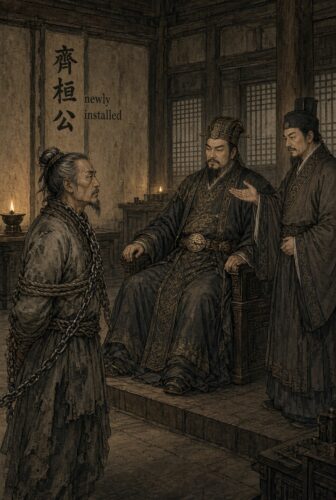
– Refuse the instinctive purge. Most people, after a close call, cleanse their circle of anyone associated with the opposition. The Qianshi lesson is the opposite: the person or method that almost ended you is often the one that already understands your weaknesses better than your friends do. That knowledge is scarce and valuable.
– Stage a controlled demonstration of residual strength immediately after the near-miss. Duke Huan did not negotiate from weakness; he first won at Qianshi, then issued demands. The modern equivalent is a short, visible win in the domain where you were just threatened—delivered before you open the door to the former adversary.
– Convert the adversary under terms that make continued hostility more expensive for them than cooperation. Guan Zhong was not invited in as a guest; he arrived as a prisoner and left as chancellor. The transaction must be asymmetric enough that the other side has skin in the new arrangement.
– Institutionalize the gain. Qi did not stop at personal reconciliation. Guan Zhong’s reforms locked the advantage into administrative and military structures. A personal parallel is to turn the recruited capability into a repeatable system rather than a one-time favor.
From these points a short, non-standard plan follows. Call it the Dry Watercourse Protocol. It is not about vision boards, morning routines, or “abundance mindsets.” It is about deliberately engineering a post-crisis recruitment of opposition talent under conditions of demonstrated strength.
Within seventy-two hours of recognizing a near-miss (a project killed by a rival proposal, a promotion blocked by a superior who then criticizes you publicly, a market shift that almost bankrupts a side venture), perform three concrete actions in order:
- Map the single individual or small team whose competence most directly caused the near-miss. Write their actual operational strengths on one side of a page and the precise points where their interests diverge from the larger system that currently employs or supports them. Do not write feelings.
- Create a visible, low-cost demonstration that you still control a critical resource or pathway they need. This can be as small as owning a dataset, a client relationship, a technical workaround, or a regulatory contact that the near-miss exposed as valuable. Make the control observable without announcing it.
- Open a narrow, formal channel—email, recorded call, or short written proposal—that offers them a defined piece of authority inside your next initiative, contingent on them delivering one specific result within a fixed window. The offer must be better than their current trajectory but clearly subordinate to the structure you control. Accept only a written or otherwise documented acceptance. If they refuse, the protocol ends; you have still clarified the battlefield. If they accept, treat the first joint success as the new Qianshi and immediately fold the capability into a permanent process that no longer depends on personal goodwill.
The protocol is deliberately short and sequential because the historical episode itself was short and sequential: near-death, race, victory, recruitment, institutionalization. Stretching it into a multi-year “personal transformation journey” would miss the point. The advantage at Qianshi was speed under pressure and the willingness to use a former enemy’s skill before the political temperature cooled.
Duke Huan did not become hegemon because he was the most virtuous or the most beloved. He became hegemon because on a specific August day a dry creek bed favored the side that had already decided to keep moving, and because the winner of that day chose usefulness over revenge. The rest of the Spring and Autumn world spent the next forty years adjusting to the consequences. A person who treats a modern near-miss the same way—acknowledge the hit, win the immediate ground, recruit the competence that almost finished you, and lock the gain into structure—gains something rarer than motivation: a working method for converting the energy of opposition into durable capacity. That is the only lesson worth carrying forward from a forgotten watercourse in 685 BC.
Share: