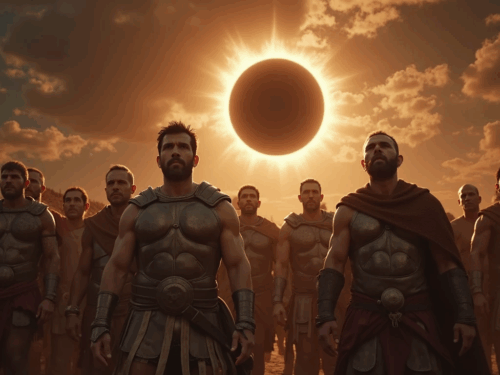

On a hot, dusty plain called Marj Dabiq—“the meadow of Dabiq”—about forty-four kilometers north of Aleppo in what is now northern Syria, two great Muslim armies faced each other on August 24, 1516. One was the aging Mamluk Sultanate, masters of Egypt, Syria, the Hejaz, and the holy cities of Mecca and Medina for more than two and a half centuries. The other was the rising Ottoman Empire under Selim I, already called “the Grim.” By the end of that single day the Mamluk sultan was dead, his army shattered, Syria was Ottoman, and the road to Cairo lay open. Within months the Mamluk state would cease to exist as an independent power. The battle was not merely a clash of swords and guns; it was the moment gunpowder, disciplined infantry, and calculated betrayal finally overmatched the last great medieval cavalry tradition of the Islamic world.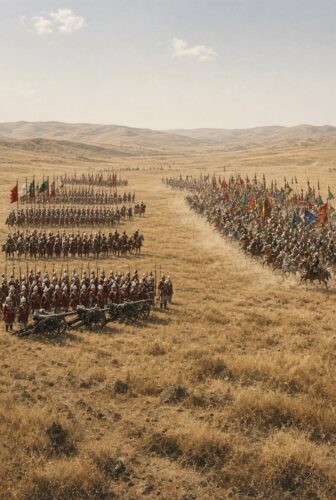
The Mamluks had ruled since 1250. They were a military caste of slave origin—mostly Circassians and Turks purchased as boys, trained as elite horsemen, and manumitted into a closed aristocracy that controlled the state. Their system had stopped the Mongols at Ain Jalut in 1260 and held the Crusaders at bay. By the early sixteenth century, however, the machine was running down. Sultan Al-Ashraf Qansuh al-Ghawri, a man already in his seventies who had seized power in 1501, was a capable administrator and builder but no field commander of genius. The royal mamluks—the *julban* he had purchased himself—were often more interested in their privileges and pay than in long campaigns. Provincial governors in Syria were semi-independent and chronically unreliable. The economy groaned under the weight of maintaining a cavalry elite in an age when firearms were changing the calculus of war.
Selim I had become sultan in 1512 after a brutal succession struggle against his brothers and father. He was ruthless, energetic, and strategically clear-eyed. In 1514 he had crushed the Safavid Shah Ismail at Chaldiran, securing eastern Anatolia and demonstrating the superiority of Ottoman artillery and janissary muskets over traditional cavalry charges. The Safavids were Shi‘i; the Mamluks were Sunni. Yet al-Ghawri had flirted with the idea of an anti-Ottoman understanding with the Safavids, allowing Persian envoys passage and generally behaving in ways that convinced Selim the Mamluks could not be trusted as neutral buffers. When Selim moved against the Dulkadir principality on the frontier in 1515 and sent the severed head of its ruler to Cairo as a pointed gift, the message was unmistakable.
Al-Ghawri spent the winter of 1515–1516 and the following spring assembling an army. On May 18, 1516, he left Cairo at the head of a large force, leaving the future Tuman Bay in charge of Egypt. He brought with him the Abbasid caliph al-Mutawakkil III (a ceremonial figure the Mamluks kept as a legitimizing prop), the chief qadis, sheikhs, physicians, musicians, and a train of pomp that included yellow silk bags containing approximately forty copies of the Qur’an. The march north was slow and almost celebratory at first. Al-Ghawri seems to have hoped diplomacy might still avert war; Selim had sent messages that sounded conciliatory. In reality the Ottoman sultan was buying time and cultivating traitors.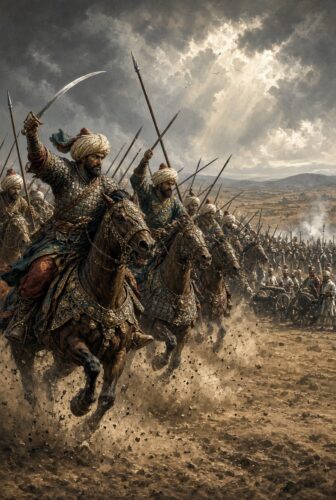
By mid-August the two armies were closing. The Mamluks reached the plain of Marj Dabiq on August 20 and made camp. Contemporary estimates put the Mamluk host somewhere between 60,000 and 80,000, though the true fighting core of trained mamluks was far smaller—perhaps 12,000 to 15,000, of whom only a few thousand were the sultan’s own *julban*. The rest were *awlād al-nās* (sons of mamluks), auxiliaries, Bedouin, and local levies. On the right stood Sibay, governor of Damascus, with veteran troops. On the left stood Khayr Bey (also rendered Khai’r Bey or Hayır Bey), governor of Aleppo. In the center rode the aged sultan under his standard, accompanied by the caliph and the Qur’an-bearers. The Ottomans under Selim numbered around 60,000, but their composition was modern: sipahi cavalry from Rumelia and Anatolia, 8,000–10,000 janissaries with firearms, artillery batteries, and supporting infantry. Ottoman sources and later analysis emphasize the careful placement of cannons on the flanks and musketeers in the center—exactly the formation that had broken Safavid cavalry two years earlier.
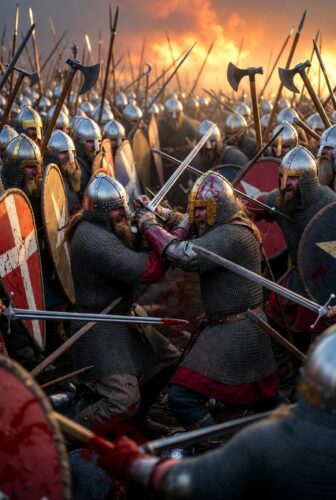
Dawn on August 24 brought the decisive fight. The Mamluks opened with the classic charge that had defined their military culture for generations. Marshal Sûdûn Adjami led the first assault; Sibay’s right-wing veterans followed. For a time it worked. Mamluk horsemen smashed into Ottoman lines, killed several thousand, captured some guns and fusiliers, and forced a temporary Ottoman withdrawal. Dust rose in a thick, unusual fog. The heat was intense. Contemporary Arabic chronicler Ibn Iyas, writing in Cairo from reports that reached him, described the scene with vivid immediacy: the sultan standing under his standard, calling out “Aghas! This is the moment to take heart! Fight, and I will reward you!” No one listened. He called for prayer. Still nothing.
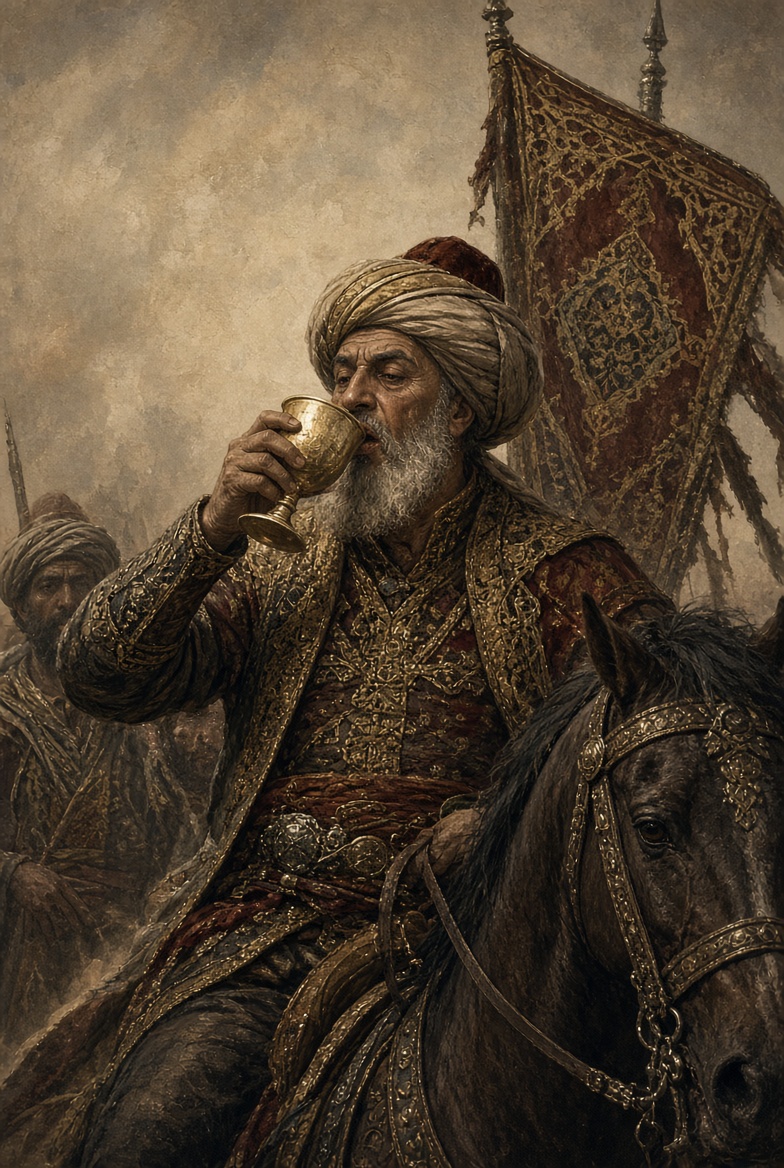
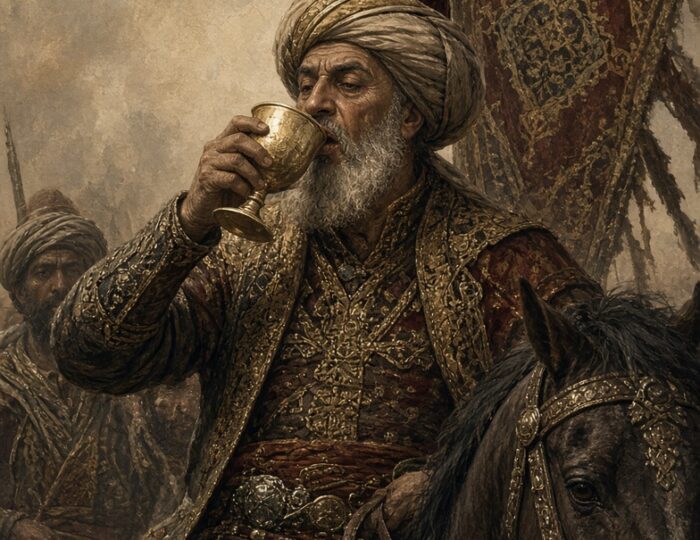
Then the fracture opened. Khayr Bey on the left flank ordered a retreat and spread the rumor that the sultan was already dead. Whether this was pure treachery (he had been in secret contact with the Ottomans) or panic mixed with calculation, the effect was catastrophic. Panic spread. Emir Timur Zardkash lowered the battle standard to protect it and rode to the sultan, telling him the Ottoman army had defeated them and he must flee to Aleppo. Al-Ghawri, according to Ibn Iyas, felt an “unquenchable fire.” Paralysis seized one side of his body; his jaw dropped open. He asked for water. It was brought in a golden goblet. He drank, turned his horse, advanced two paces, and fell from the saddle. He died there on the field. Accounts of the exact manner of death vary—stroke, rupture, possible beheading by a Turkish soldier later pardoned by Selim—but the political result was identical. The center collapsed. The right wing, already bloodied, disintegrated. Survivors fled toward Aleppo and beyond.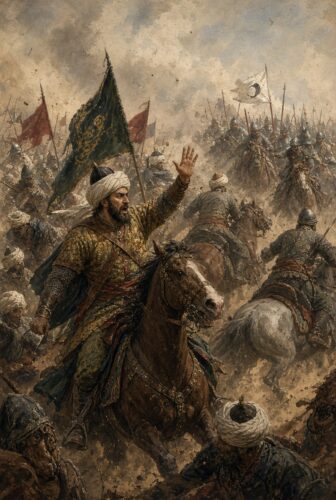
Ottoman casualties were heavy—estimates range from 10,000 to 25,000—but Mamluk losses were far worse, with figures running from 7,000 to as high as 65,000 killed and another 2,000 later executed. Selim entered Aleppo in triumph. The city welcomed him as a deliverer from Mamluk misrule. The Abbasid caliph was received; the Ottoman sultan upbraided the Islamic judges for the previous regime’s failures. Damascus surrendered in mid-October. The remnants of the Mamluk army limped back toward Egypt. The following January, at Ridaniya outside Cairo, the last Mamluk resistance under Tuman Bay was broken. Cairo fell. The sharif of Mecca sent the keys of the holy city to Selim. The Ottoman sultan assumed the title “Servant of the Two Holy Cities.” The Mamluk Sultanate as an independent power was finished. For the next four centuries Syria, Egypt, and the Hejaz would be Ottoman provinces.
The deeper reasons for the defeat were structural. The Mamluks still fought as if the charge of heavily armored horsemen decided everything. The Ottomans combined mobility with firepower and, crucially, exploited internal division. Khayr Bey’s betrayal was not an isolated act of personal greed; it was the logical outcome of a system in which provincial governors held quasi-independent power and the central sultan could no longer compel absolute loyalty. Al-Ghawri’s own *julban* had grown restive over pay and privilege. The slow, ceremonial march north had given Selim time to prepare and to suborn. Technology mattered—Ottoman artillery and janissary volleys could break cavalry that had once been unstoppable—but the decisive edge was the ability to turn the enemy’s own officers against him while keeping one’s own ranks coherent under pressure.
The meadow of Dabiq had long carried apocalyptic associations in Islamic tradition; a hadith spoke of a final battle against the Romans there. In 1516 the “Romans” were not Byzantines but the new gunpowder empire that would dominate the eastern Mediterranean and the Islamic heartlands for centuries. The battle did not merely transfer territory. It transferred the custodianship of the holy cities, the caliphal prestige (however attenuated), and the strategic depth of the Arab lands from a Cairo-centered military aristocracy to an Istanbul-centered imperial system that would last until the twentieth century.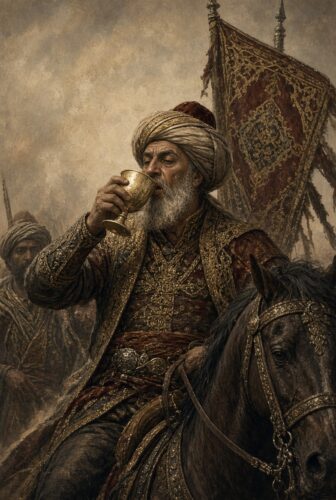
That is the historical fact of August 24, 1516: a single afternoon in which an old military culture met a newer one, a trusted flank commander switched sides, a golden goblet of water marked the end of a sultan’s life, and the map of the Middle East was redrawn for four hundred years.
### The Outcome Applied: A Specific, Non-Generic Protocol for Spotting the Fracture Before the Dust Rises
The lesson is not the usual motivational fluff about “adapting to change” or “building resilience.” Those phrases are available in every airport bookstore. The concrete, historically grounded takeaway from Marj Dabiq is narrower and more actionable: empires (and individual lives) rarely collapse from the front charge alone. They collapse when a critical flank—already under quiet pressure—fails at the exact moment the main effort is committed, and when the commander has no pre-tested contingency for that failure.
Here is a detailed, quick, unique plan built directly from the mechanics of the battle. It is not journaling, vision-boarding, or generic habit stacking. It is a short-cycle audit and stress-test protocol that treats your personal and professional structure the way Selim treated the Mamluk left flank and the way al-Ghawri failed to treat his own.
**The Marj Dabiq Flank Protocol (seven focused days, then quarterly refresh)**
– Day 1–2: Map the actual flanks, not the ceremonial ones. List every person, system, income stream, skill dependency, or relationship that sits on your “left” or “right”—the supporting elements you assume will hold while you charge forward on your main goal. Write them on paper, not a screen. For each, note the last time you independently verified its reliability under mild stress (a delayed payment, a missed commitment, a small conflicting priority). If you cannot remember a verification within the last ninety days, mark it as untested. This is the equivalent of knowing that Khayr Bey controlled Aleppo and the left wing but never forcing a loyalty test before the armies met.
– Day 3: Create one low-stakes, time-bound loyalty or reliability probe for every marked flank. The probe must be concrete and observable within 48–72 hours. Examples: ask a key collaborator for a small deliverable on an accelerated timeline that slightly inconveniences them; route a minor financial or logistical task through an alternative channel that does not rely on the usual person; withhold a routine piece of information or approval for 36 hours and watch the reaction. Record only behavior, not explanations. This mirrors the Ottoman cultivation of the governor of Aleppo long before the battle—quiet, practical tests rather than grand declarations.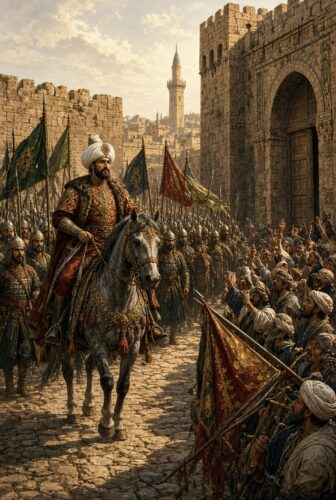
– Day 4–5: Design and physically prepare one “golden-goblet contingency” for each critical flank. If that flank collapses mid-charge, what is the exact next action that keeps the center from total paralysis? Write the action on a physical card and place it where you will see it under pressure (wallet, desk drawer, phone lock screen with a neutral photo). The contingency must be executable without the failed flank’s cooperation and without requiring new resources you do not already control. This is the opposite of al-Ghawri’s moment: when the standard was lowered and the left wing fled, he had only a request for water and two paces left.
– Day 6: Run a single integrated stress rehearsal. Choose one current major effort (project, negotiation, personal deadline). Execute it while deliberately introducing a mild version of the most likely flank failure. Observe where your own decision speed and clarity degrade. Note the exact minute the dust of confusion rises. Adjust the contingency cards accordingly.
– Day 7: Formalize the standing order. Write one sentence that functions as your personal equivalent of “do not lower the standard until the center has already moved to the secondary position.” Keep it short enough to recall under heat and dust. Review the entire map and the contingency cards once every ninety days, or immediately after any real flank wobble.
This protocol is deliberately narrow, physical, and time-boxed. It does not ask you to become a different person or adopt a new philosophy. It forces the same diagnostic the Ottomans performed and the Mamluks neglected: identify the supporting element whose quiet failure will turn a hard-fought engagement into a rout, test it before the decisive day, and pre-position the exact next move so that when the dust rises and the golden goblet is offered, you are already two steps beyond the fall.
The meadow of Dabiq still sits under the Syrian sun. The cavalry charges are long over. The lesson of the golden goblet and the lowered standard remains available to anyone willing to treat their own flanks with the seriousness Selim applied to someone else’s.
Share: