
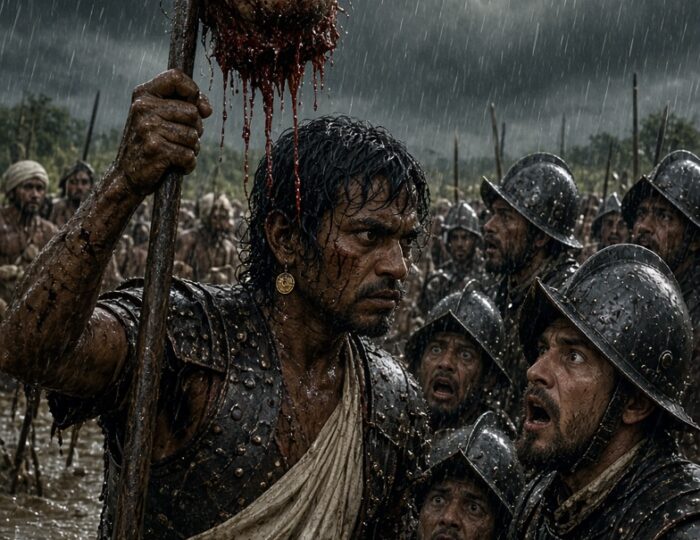
On the morning of August 25, 1630, in the rolling hills and paddy fields near the village of Randeniwela, not far from Wellawaya in the Uva region of what is now Sri Lanka, a Portuguese expeditionary force under Captain-General Constantino de Sá de Noronha found itself surrounded, soaked, and betrayed by the very men it had counted on to carry its banners into the interior. By nightfall the column that had set out weeks earlier with dreams of crushing the last independent Sinhalese kingdom on the island was reduced to a handful of survivors and a dead commander whose head would later be displayed as a trophy. The Kingdom of Kandy, under the aging King Senarat and his energetic youngest son Prince Maha Astana (the future Rajasinha II), had not merely won a battle. It had demonstrated a ruthless practical lesson in how an outnumbered inland power could turn an invader’s own local allies, the weather, and the terrain into weapons more decisive than any cannon the Portuguese could haul up the mountain passes.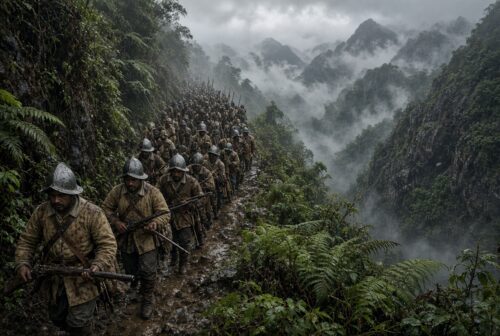
The Portuguese had been on the island for more than a century by 1630. They had arrived in the early sixteenth century as traders seeking cinnamon and strategic ports, then steadily expanded their foothold along the coasts. By the time of de Sá’s expedition they controlled a string of fortresses—Colombo, Galle, and others—and had reduced the lowland Sinhalese kingdoms to client status or outright annexation. Only the central highlands of Kandy remained free, protected by steep escarpments, dense forest, monsoon rains, and a population that knew every ridge and ford. Kandy’s kings had fought a long, grinding resistance. Earlier Portuguese invasions in 1594 and 1603 had already been bloodily repulsed. King Senarat, who had come to the throne in 1604 after a period of internal turbulence, preferred cautious diplomacy when possible, yet he never abandoned the capacity for sudden, crushing retaliation when the Portuguese pushed too far inland.
Constantino de Sá de Noronha was one of the more capable Portuguese officers of the period. He had previously suppressed plots and maintained a precarious hold on the coastal districts. In the summer of 1630 he decided on a major offensive designed to strike at the heart of Kandyan power through the Uva province. The route he chose was deliberately difficult. Rather than the more obvious northern approaches, he marched from the fort at Menikkadawara in early August, moving through Sabaragamuwa, then climbing the steep Idalgashinna Pass into the highlands. The column consisted of roughly 400 to 600 Portuguese soldiers—accounts vary between 400 and something over 600—supported by several thousand Lascarins, local Sri Lankan militiamen who served under Portuguese officers for pay, land grants, or the hope of plunder. Estimates of the Lascarin contingent range from around 4,500 to as high as 13,000 or even 20,000 in some later summaries; the precise number is less important than the fact that they formed the bulk of the force and were expected to do the bulk of the scouting, foraging, and fighting in the hills.
The army advanced slowly. It took roughly fifteen days to reach the high country and then another three to approach Badulla. Along the way the Portuguese burned villages, seized rice stores, and desecrated temples, including the Kataragama Devale. These acts of destruction were intended to demoralize the countryside and deny supplies to any Kandyan force that might gather. They also created a trail of resentment that would matter when the moment of decision arrived. By the time the column reached the vicinity of Badulla, the Kandyans under Prince Maha Astana and his brother Prince Vijayapala were already shadowing the invaders. King Senarat’s strategy appears to have been classic highland defense: allow the enemy to exhaust himself climbing into unfavorable ground, then close the trap once the Portuguese were far from their coastal bases and dependent on local auxiliaries whose loyalty was never absolute.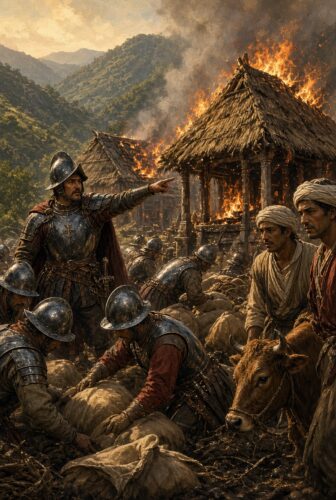
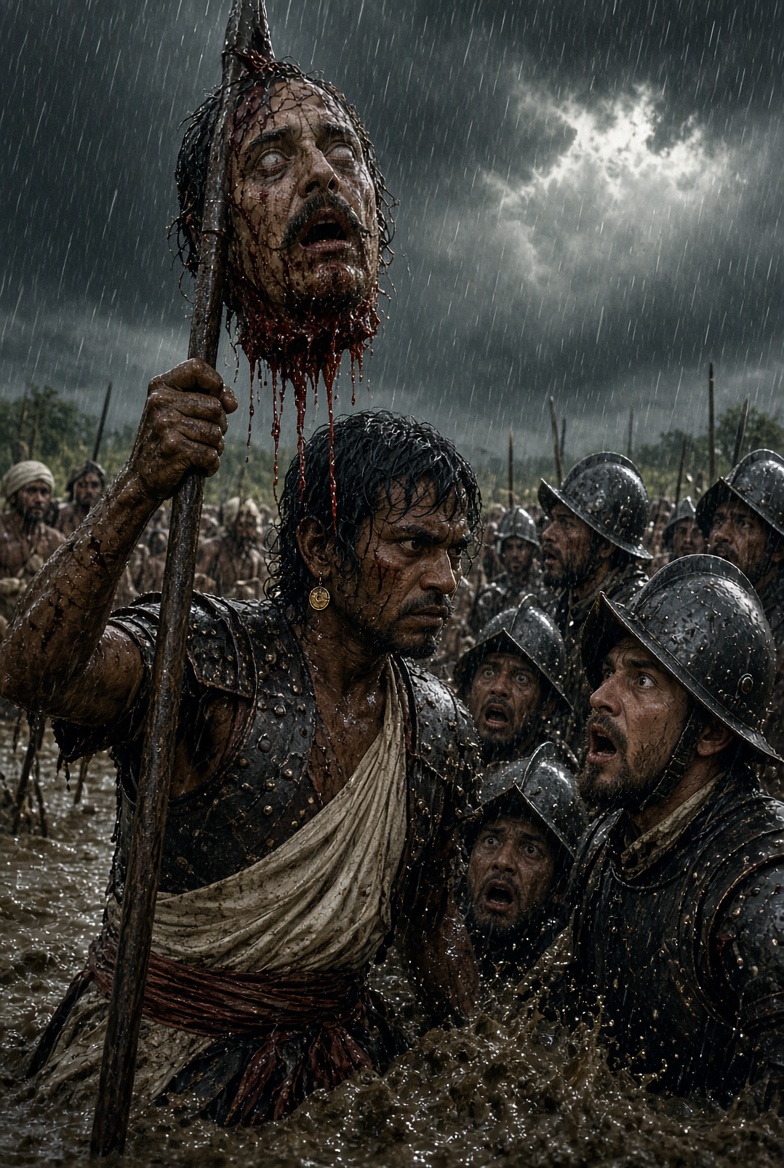
On or about August 22 the Portuguese found themselves increasingly hemmed in. The Kandyans cut off a rear-guard detachment and took prisoners. De Sá attempted to maneuver southeast toward what he hoped might be safer ground near Wellawaya. By August 25 the remnants of the column were in the open fields and paddy lands around Randeniwela. The Portuguese formed up in a three-wing marching order, with Lascarins in the vanguard and rear. The trap sprang as they began to move. One of the Lascarin captains, a man remembered as Dom Cosmo, suddenly drew his sword, struck off the head of the nearest Portuguese soldier, and raised the severed head on his lance. The gesture was both signal and declaration. The entire Lascarin contingent turned. In an instant the Portuguese found themselves fighting their own supposed allies as well as the Kandyan regulars who now closed in from the surrounding hills and forests.
What followed was not a neat set-piece battle of the European type. It was a night of sustained, irregular violence. The Kandyans poured arrows and gunfire into the Portuguese positions under cover of darkness. The invaders could erect no effective breastworks or shelters. Then the monsoon weather that so often decided campaigns in the highlands intervened with decisive force. Torrential rain fell for hours, soaking the Portuguese soldiers and, more critically, rendering their gunpowder and the matches of their arquebuses useless. Firearms that had given the Portuguese a technological edge in open coastal fighting became sodden clubs. The Kandyans, fighting with bows, spears, swords, and whatever dry powder they could keep, continued the pressure through the night.
By the next day the Portuguese position had collapsed. De Sá himself was killed—accounts differ on the precise circumstances, some saying he was shot by archers after an initial capture, others that he fell in the fighting. His head was taken. Of the Portuguese soldiers, the great majority died. Only a small number, perhaps around 50 or a couple of hundred depending on the source, survived to be taken prisoner. The Lascarins who had defected suffered losses of their own, but the net result was the near-total destruction of the invasion force. Dom Cosmo, the captain who had begun the revolt by raising the severed head, was later rewarded by King Senarat with grants of nindagam land and a walauwa residence. The victory was complete enough that Portuguese chroniclers, writing years later in works such as the anonymous *Jornada* of 1635, Queyroz’s *Conquest*, Ribeiro’s *Historic Tragedy*, and Menezes’s *Rebelion*, still struggled to explain how a force that should have held a decisive advantage in discipline and firepower had been erased so thoroughly.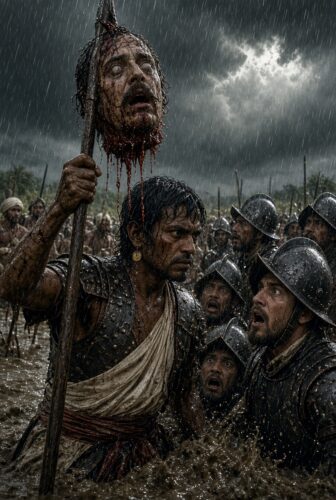
The strategic consequences were immediate and lasting. The Portuguese never again mounted a successful large-scale invasion of the Kandyan heartland. Their dream of conquering the entire island was effectively ended by the combination of this defeat and a later, even more catastrophic reverse at Gannoruwa in 1638. Kandy remained independent for nearly two more centuries, until the British finally absorbed it in 1815. The battle became a touchstone of Sinhalese military memory: an example of how local knowledge of terrain and climate, combined with the carefully timed betrayal of an invader’s auxiliary forces, could neutralize superior technology. The Portuguese had brought cannons and arquebuses; the Kandyans had brought the hills, the rain, and the decision of the Lascarins to remember where their true interests lay once the fighting moved inland.
The background to this moment stretched back decades. After the fall of the Kingdom of Kotte and the fragmentation of lowland power, the Portuguese had tried repeatedly to reduce the highlands by a combination of direct assault, the installation of puppet rulers, and the recruitment of Lascarins. The Lascarins themselves occupied an ambiguous position. Many were drawn from communities that had economic ties to the Portuguese ports or that sought advancement under colonial patronage. Yet their loyalty was transactional. When an expedition moved far into the mountains, cut off from easy reinforcement and exposed to the full weight of Kandyan guerrilla pressure, that loyalty could evaporate. Dom Cosmo’s act was not an isolated impulse; it was the visible expression of a calculation that had been forming among the auxiliaries as the Portuguese position deteriorated. The rain simply accelerated the collapse by removing the one material advantage the invaders still possessed.
Portuguese sources written after the fact emphasize the valor of their own men and the treachery of the Lascarins. Kandyan tradition, preserved more in oral memory and later Sinhalese chronicles, celebrates the coordination between the princes and the defecting captains, as well as the natural allies of monsoon and forest. The physical site today is marked by a modest obelisk near the ninth kilometer post on the Ella–Wellawaya road. The monument stands in a landscape that still shows the same mix of open paddy, low ridges, and forested slopes that shaped the fighting in 1630. Standing there, it is easy to imagine the sound of the rain on sodden uniforms, the sudden shout as Dom Cosmo raised the head, and the long night of arrows that followed.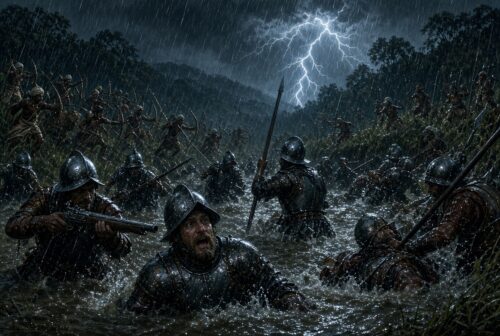
The campaign that ended at Randeniwela had begun with Portuguese confidence. De Sá had assembled what he believed was a sufficient force, chosen a difficult but surprise route, and expected the Lascarins to stiffen his ranks. He underestimated both the speed with which Kandyan forces could concentrate and the fragility of auxiliary loyalty once the column was isolated. The Kandyans, by contrast, had waited for the invader to commit himself fully into unfavorable ground. They did not need to match the Portuguese in open-field drill. They needed only to fix the enemy in place, remove his firepower through weather, and then let the internal fracture among the Lascarins do the rest. When Dom Cosmo struck, the battle was already decided; the remaining hours of fighting were the working-out of a strategic logic that had been set in motion days earlier.
In the years that followed, the Portuguese continued to hold their coastal forts and to trade, but the interior remained closed to them. King Senarat’s successors built on the prestige of the victory. Rajasinha II, the former Prince Maha Astana, would later wage further successful campaigns and even ally temporarily with the Dutch against the remaining Portuguese presence. The memory of Randeniwela served as a standing warning: any power that relied on local auxiliaries while operating far from its base of supply and reinforcement risked seeing those auxiliaries become the instrument of its own destruction. The rain and the darkness merely made the lesson vivid.
The battle also illustrated the limits of early modern European military technology when stripped of the conditions that made it effective. Arquebuses and matchlocks required dry powder and functioning matches. In a tropical highland monsoon those requirements could vanish in a single afternoon of rain. The Kandyans did not need to invent new weapons; they needed only to force the fight into an environment where the existing Portuguese weapons failed. That environmental leverage, combined with the political leverage of the Lascarin defection, produced a result out of all proportion to the numbers formally engaged.
Historians working from the Portuguese chronicles and the thinner Kandyan records have reconstructed the sequence with reasonable confidence. The invasion left the lowlands in early August. It climbed into Uva. It burned and foraged. It found itself shadowed and then surrounded. On August 25 the defection occurred, the rain fell, the night attack continued, and by the following day the Portuguese commander was dead and his army gone. The survivors who eventually returned to the coast carried stories that circulated for decades among the colonial garrisons. The Kandyans, for their part, treated the victory as confirmation that their combination of mobility, local intelligence, and willingness to wait for the decisive moment remained sound.
The wider Sinhalese–Portuguese War had already lasted generations by 1630 and would continue until the Portuguese were finally expelled from the island by the Dutch in the mid-seventeenth century. Yet Randeniwela stands out as one of the clearest single demonstrations that colonial expansion was never a simple matter of superior arms. It required reliable local collaboration, favorable weather, and an enemy willing to fight on the invader’s terms. When any of those conditions failed, the result could be catastrophic. On that August day the collaboration failed, the weather failed the Portuguese, and the Kandyans refused to fight on European terms. The outcome was the near-annihilation of the expedition and the preservation of Kandyan independence for generations to come.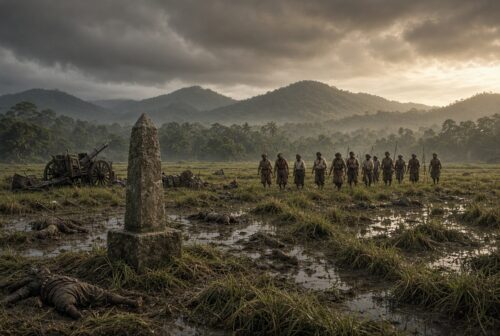
The story of Randeniwela is therefore not merely a tale of one battle on one date. It is a concentrated example of how a smaller, less technologically advanced power can still dictate the conditions of engagement, fracture the cohesion of a stronger opponent, and turn natural forces into allies. The severed head raised on Dom Cosmo’s lance was the visible symbol of a deeper shift: the moment when the invader’s own support structure decided that the hills belonged to the people who lived in them.
**What a person today can take from this and put to immediate use**
The practical core of Randeniwela is simple and rarely repeated in ordinary advice: the decisive blow often comes not from matching an obstacle’s strength but from identifying the elements that currently serve that obstacle and arranging conditions so those elements switch sides at the moment of maximum vulnerability. The Portuguese brought firepower and organization. The Kandyans brought the willingness to wait until the firepower was neutralized by rain and the organization was hollowed out by defection. The result was total.
Here is a concrete, non-generic plan built directly from that sequence. Call it the Randeniwela Flip Sequence. It is designed to be executed in a single focused block of hours rather than as a vague lifestyle change.
– Map the current “Portuguese column” in your own situation: the specific project, habit cluster, relationship pattern, or external pressure that is advancing into territory you care about and that relies on supporting elements you currently tolerate or even feed. Write the list of those supporting elements in plain language—people, routines, assumptions, tools, or environmental conditions that keep the problem mobile and supplied.
– Identify the equivalent of the Lascarin captains: the one or two elements inside that support structure whose loyalty is already transactional and whose defection would collapse the rest. These are never the most obvious opponents. They are the habits that feel convenient, the assumptions that feel realistic, or the small daily arrangements that keep the larger problem fed. Name them specifically.
– Force the equivalent of the highland march. Deliberately move the problem into conditions where its usual advantages weaken. If the problem thrives on speed and distraction, impose a period of enforced slow observation. If it thrives on dry, predictable routines, introduce controlled disruption of those routines for a short, intense window. The point is not permanent lifestyle overhaul; it is a temporary change of ground that makes the supporting elements less comfortable in their current allegiance.
– Stage the Dom Cosmo moment with precision. Choose one visible, irreversible act that publicly (or at least unmistakably to yourself) severs the connection between the supporting element and the problem. The act should be small enough to execute in a single sitting yet clear enough that the rest of the support structure registers the switch. Examples might include permanently deleting a set of enabling files, ending a recurring arrangement that feeds the problem, or rewriting a core assumption in writing and placing it where you cannot ignore it. Do this at the moment when the environmental pressure you created is already at its peak.
– Maintain pressure through the “night.” Once the flip occurs, do not relax. Continue the equivalent of the arrow fire—repeated, low-intensity actions that prevent the problem from regrouping—while the supporting elements are still disoriented. Keep this phase short and finite, measured in hours or a couple of days, not weeks.
– Claim the ground. After the collapse, immediately occupy the space the problem previously held with a simple, durable alternative structure that does not rely on the same fragile supports. The Kandyans did not leave the field empty; they secured it.
The entire sequence is meant to be run once, thoroughly, rather than turned into a repeating motivational ritual. Its power lies in the same combination that worked at Randeniwela: patient positioning, exploitation of temporary environmental weakness, and a single decisive transfer of allegiance by the elements that had been sustaining the opposition. Most modern advice focuses on building more personal strength or more elaborate systems. This plan focuses on subtracting the supports of the obstacle at the moment those supports are already under strain. That is a different and less common approach, drawn directly from the logic that ended a Portuguese invasion on a rainy August day in 1630.
Share: