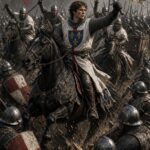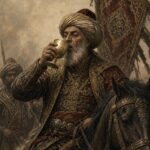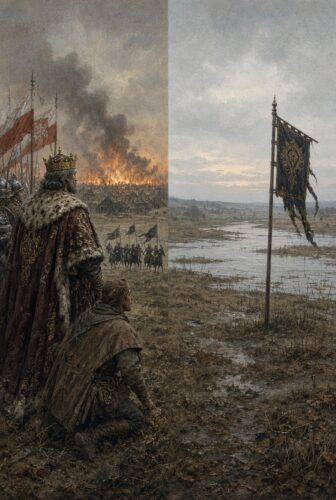

On a sweltering late-summer day in 1595, in a stretch of Wallachian marshland that most travelers would have preferred to avoid, a force that should have been crushed by sheer arithmetic instead forced one of the most experienced commanders in the Ottoman Empire into an undignified scramble. The date was August 23 by the Gregorian calendar (August 13 by the Julian reckoning still used in many Orthodox lands). The place was the low ground south of the village of Călugăreni, where the Câlniștea meets the Neajlov River in a tangle of mud, reeds, and narrow crossings. The man who orchestrated the day’s events was Mihai Viteazul—Michael the Brave—voivode of Wallachia. Facing him was Koca Sinan Pasha, the aged but formidable grand vizier, leading a host that chroniclers of the time inflated to nearly 100,000 and modern estimates still place in the tens of thousands on the field.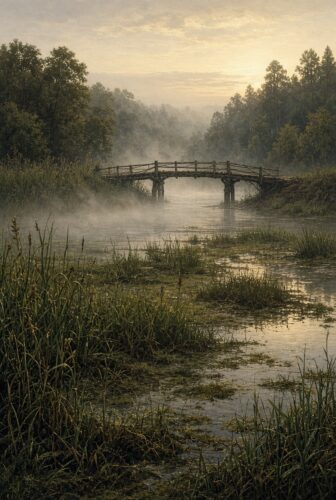
What unfolded was not a clean annihilation of the larger army. It was something more instructive: a tactical masterclass in forcing a superior opponent to fight on ground that canceled his advantages, extracting a heavy price, and then choosing the moment to break contact before the weight of numbers could grind everything down. The Ottomans would still occupy Bucharest and Târgoviște in the days that followed. Michael would still have to withdraw into the mountains and wait for reinforcements. Yet the day at Călugăreni bought him the time, the prestige, and the breathing room that later allowed Christian coalitions to push the invaders back across the Danube. It remains one of the clearest demonstrations in early modern European history of how terrain, timing, and disciplined aggression can convert numerical inferiority into a usable advantage.
To understand why the battle mattered, the context must be reconstructed in full. By the mid-1590s the Ottoman Empire under Murad III and then Mehmed III was locked in the Long Turkish War against a shifting coalition of Habsburgs, Transylvanians, and various Balkan Christian lords. Wallachia, traditionally a tributary principality, had grown restless. Michael the Brave, who had seized the throne in 1593 with a mixture of intrigue and force, refused the usual submission. In the winter of 1594–1595 he had even crossed the Danube, raiding Ottoman strongholds in Bulgaria and capturing several key fortresses along the river. These actions threatened the vital Ottoman supply corridor that fed armies operating farther west in Hungary. The Porte responded by assembling a major punitive expedition under Sinan Pasha, a veteran commander who had already served multiple terms as grand vizier and had a reputation for both administrative skill and battlefield ruthlessness.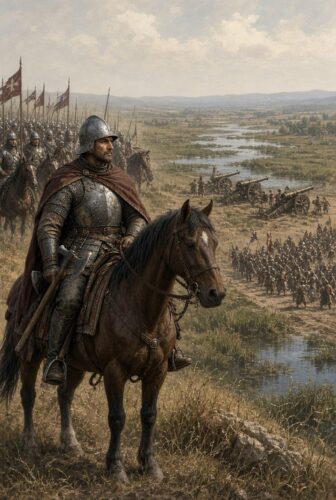
Sinan’s army crossed the Danube near Giurgiu in early August 1595. Contemporary accounts and later reconstructions give wildly varying totals—some Romanian chronicles spoke of 100,000 or even 180,000—but the fighting strength that actually reached the Neajlov was almost certainly between 30,000 and 60,000, with the higher figures including camp followers, irregular akinji light cavalry, and rear-area troops. The core consisted of janissaries, sipahi cavalry, and provincial levies under subordinate commanders such as Tiryaki Hasan Pasha (beylerbey of Rumelia) and Mehmet Satîrgi Pasha. Michael, by contrast, fielded roughly 10,000 to 16,000 men: Wallachian boyar cavalry and infantry, several thousand Székely (Transylvanian Hungarian) troops sent by Prince Sigismund Báthory under the command of Albert Király, and a few hundred Zaporozhian Cossack mercenaries. He also possessed a modest artillery train of about a dozen field guns.
Michael did not attempt to meet the Ottomans in open plain country where their numbers and cavalry would have been decisive. Instead he chose the approaches to Călugăreni with deliberate care. The Neajlov River at that point was bordered by extensive marshes. Forests hemmed the flanks. The principal crossing was a narrow bridge—essentially a forced bottleneck. Any large force advancing from the south had to funnel through this choke point or attempt risky flanking fords and log causeways through the mud. Michael positioned the bulk of his army and most of his guns on the northern bank, south of the village itself. The Székely reserve under Király was held farther northwest to guard against an outflanking move via the Singureni crossing. Scouts and light cavalry screened the approaches.
The battle unfolded in three distinct phases across a single long day.
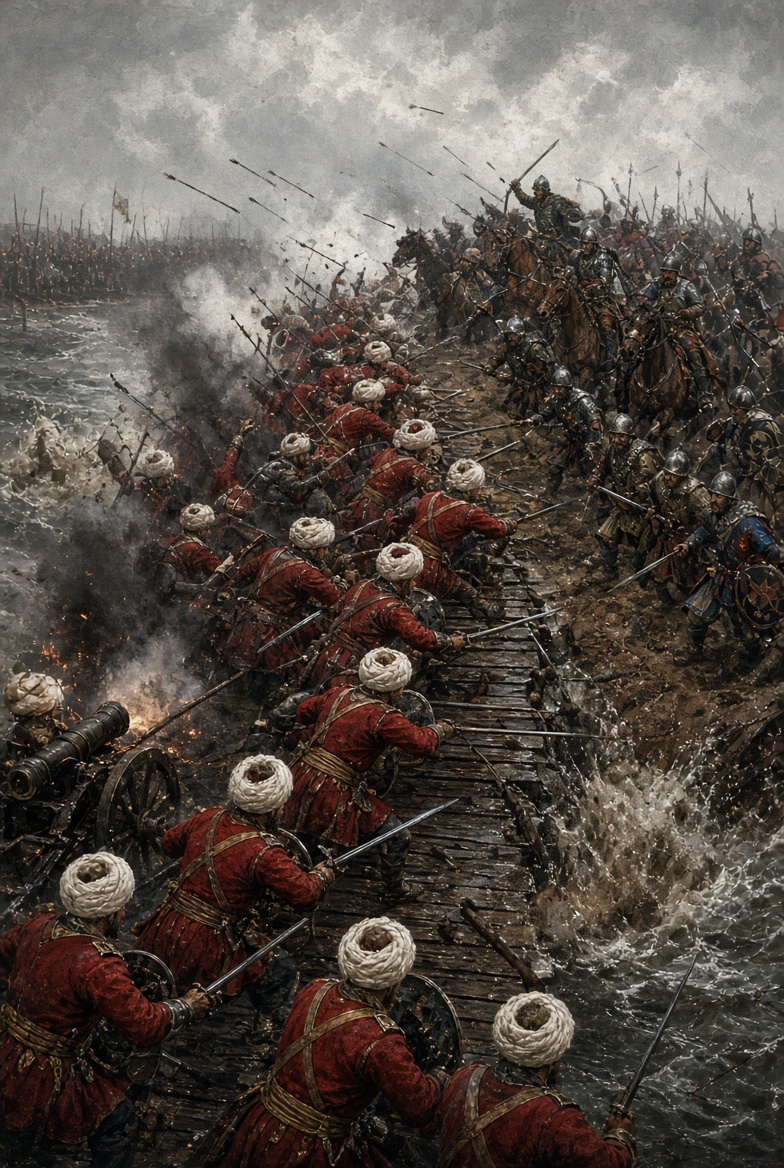
At first light, Wallachian cavalry struck the Ottoman vanguard that had already crossed or was in the process of crossing near the village. The surprise attack drove the akinji and supporting horse back across the Neajlov. Sinan then committed a substantial force—perhaps 12,000—to force the bridge and establish a bridgehead. Michael waited until a significant portion had crossed, then opened with concentrated artillery fire. The guns, positioned to rake the narrow approaches and the marshy ground beyond the bridge, disrupted the Ottoman formation. A fierce Wallachian counterattack followed, pushing the attackers back across the river with heavy loss. The first phase closed as a clear Wallachian success. The narrow bridge and the surrounding mud had already begun to perform the work that numbers alone could not overcome.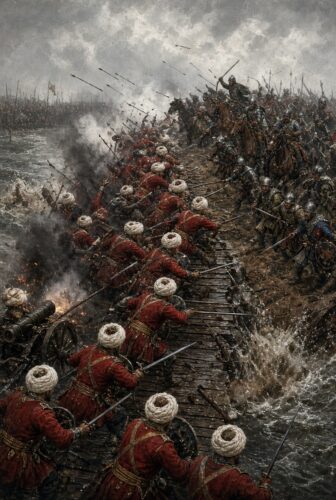
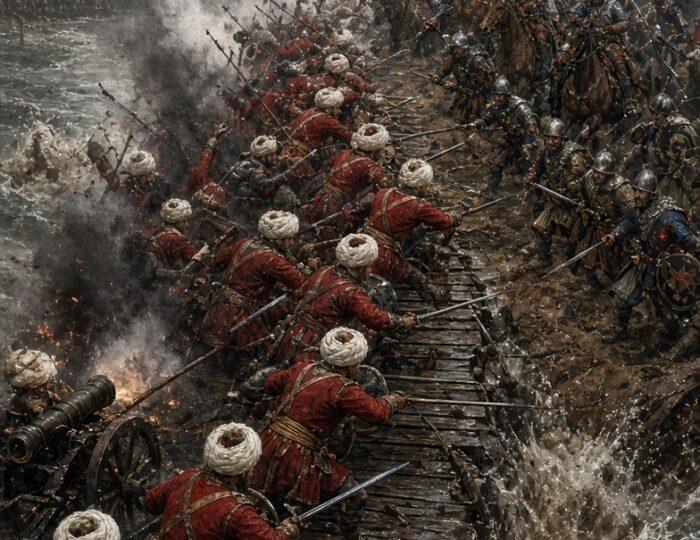
By midday Sinan decided on a more determined effort. He ordered a full assault. Janissaries advanced frontally across the bridge and, with characteristic engineering improvisation, laid logs and planks to create additional paths through the marsh. Simultaneously, flanking columns moved: Mehmet Satîrgi Pasha on the eastern side seeking a ford, and Hasan Pasha on the western side using the Singureni bridge. The pressure told. Wallachian lines bent. Michael ordered a fighting withdrawal north of the village, temporarily abandoning some of the guns. Ottoman cavalry that had forced a crossing threatened to turn the left. For a stretch of time the day looked as if it would end in the predictable Ottoman victory that superior numbers usually delivered.
The third phase reversed the momentum. Michael regrouped, brought fresh troops into the line, and launched a coordinated counterstroke. A contingent of roughly 400 cavalry under Captain Cocea, returning from a scouting mission, struck the Ottoman flank and rear at a critical moment. The main Wallachian force drove forward against the congested Ottoman center. The janissaries and supporting troops, now crowded into the confined space north of the river with the bridge as their only reliable exit, began to lose cohesion. Wallachian gunners recovered several of the abandoned pieces and reopened fire into the packed ranks. Ottoman units attempting to withdraw over the overloaded bridge and through the mud suffered additional casualties from drowning and crushing. Legend, recorded in later Romanian chronicles and embellished by nationalist historiography, holds that Michael himself, axe in hand, closed on Sinan Pasha and unhorsed the grand vizier into the marsh; a loyal slave or soldier pulled the elderly commander free, though not before Sinan lost his remaining teeth in the indignity. Whether the axe episode is literal or literary, the disorder was real. Hasan Pasha’s western flanking force was itself engaged and driven off. Wallachian troops even pressed toward the Ottoman camp near Hulubești before prudence intervened.
As darkness approached, Michael broke contact. He had inflicted disproportionate casualties—estimates of Ottoman dead range from several thousand to more than 10,000, against Wallachian losses of around a thousand—and had captured guns and at least one important standard, the green banner associated with the Prophet. But the bulk of Sinan’s army remained intact farther south, and night brought no guarantee that fresh Ottoman columns would not arrive. Michael conducted a controlled night withdrawal northward, using fires, noise, and even herds of cattle driven with shouting to create the impression of continued presence. By morning the Ottomans found the position empty. Sinan advanced, occupied Bucharest (leaving a strong garrison), and then Târgoviște. He proclaimed Wallachia a directly administered province and began constructing earthworks. Michael established a defensive camp at Stoenești near the mountain passes and waited.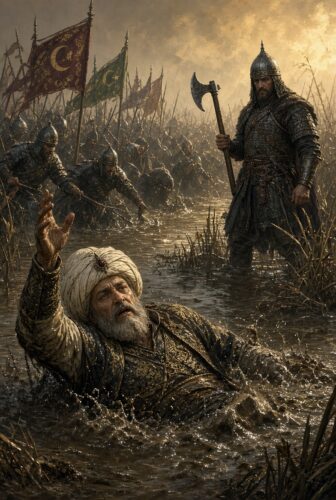
The tactical victory at Călugăreni did not end the campaign. It did, however, delay the Ottoman consolidation long enough for reinforcements to arrive: additional Transylvanian cavalry under Báthory, smaller Habsburg contingents, and even a few Tuscan troops. In October the combined Christian forces struck back, defeating Ottoman garrisons and field forces at Târgoviște, Bucharest, and finally in a decisive engagement at Giurgiu on the Danube. Sinan’s grand design of converting Wallachia into a solid Ottoman province collapsed. Michael’s reputation soared across Christian Europe. In the years that followed he would briefly unite Wallachia, Transylvania, and Moldavia under his rule—an achievement short-lived but symbolically powerful for later Romanian national memory.
The details of the day repay close attention. The choice of ground was everything. Open fields would have allowed the Ottoman cavalry and numerical mass to envelop and crush. The marsh and the single reliable bridge forced sequential commitment, prevented rapid reinforcement of threatened sectors, and turned every Ottoman advance into a traffic jam under artillery fire. Michael’s willingness to absorb the midday reverse, preserve his force by temporary withdrawal, and then strike when the enemy was disordered and overextended showed a grasp of tempo that many larger armies lacked. The use of the Székely reserve and the returning scout cavalry as a mobile counter-flanking element prevented the double envelopment Sinan attempted. Even the decision to break contact after a successful counterattack demonstrated strategic maturity: a Pyrrhic pursuit into the teeth of remaining Ottoman strength would have erased the gains of the day.
Chroniclers on both sides noted the physical conditions. The heat, the stench of the marsh, the difficulty of moving artillery and heavy equipment through soft ground, the exhaustion of men who had fought from dawn until dusk. Ottoman sources later downplayed the setback, treating it as a temporary check before the occupation of the capitals. Romanian and Transylvanian accounts emphasized the heroism and the capture of the banner. Modern military analysis tends to agree that the engagement was a clear tactical success for the smaller force and a classic illustration of defensive economy of force combined with opportunistic counterattack.
The longer shadow of the battle is equally revealing. Călugăreni did not liberate Wallachia by itself. It created the conditions in which liberation became possible a few weeks later. It demonstrated to potential allies that Michael was a commander worth supporting. It imposed costs—in men, morale, and time—that Sinan could ill afford while the wider war against the Habsburgs continued. And it entered the cultural memory of the region as proof that careful use of local knowledge and disciplined aggression could still matter against an empire that seemed otherwise unstoppable.
That historical record supplies the substance. The application to individual life occupies the remaining fraction of attention, and it must stay concrete rather than drifting into vague encouragement.
The core lesson of August 23, 1595, is not that the underdog always wins. It is that a commander who understands the constraints of the ground can compel a stronger opponent to operate under those same constraints, extract a high price for every advance, and then preserve the force for the next necessary action. Translated into personal terms, this becomes a method for handling any sustained pressure—professional, financial, physical, or relational—that arrives with superior resources or momentum.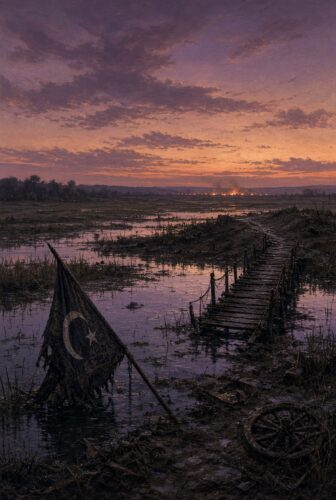
**Specific applications drawn directly from the battle’s mechanics:**
– Identify your personal Neajlov. Every difficult situation contains terrain features that limit the stronger party’s freedom of movement. These may be time constraints the opponent cannot ignore, information asymmetries you control, physical or logistical bottlenecks, or rules of engagement (legal, contractual, social) that both sides must observe. Map them explicitly before the pressure intensifies.
– Force sequential commitment. Do not allow the larger force to bring all its weight to bear at once. Channel the engagement through a narrow point you have prepared—whether that is a single decision criterion, a staged negotiation, a controlled schedule of disclosures, or a physical workspace arrangement that prevents simultaneous multi-front pressure.
– Accept the midday reverse without panic. Temporary loss of ground or initiative is not the end of the engagement. Michael abandoned guns and ground, regrouped, and recovered both. Build recovery mechanisms in advance so that a setback does not cascade into total collapse.
– Time the counterstroke to the moment of enemy congestion. The decisive Wallachian attack came when Ottoman units were crowded, disordered, and overextended. Wait for the equivalent moment—when the opposing pressure has committed resources it cannot easily redeploy—before expending your limited reserves.
– Break contact deliberately when the cost of continued contact exceeds the remaining gain. Michael did not pursue into the remaining Ottoman strength. He preserved the army. Know the exit criteria in advance and execute them without ego.
**The Neajlov Chokepoint Protocol (a 14-day operational plan unique to this historical pattern):**
Day 1–2: Terrain survey. Write a single-page inventory of the current pressure. List every resource the opposing force (employer, creditor, competitor, circumstance) can bring to bear and every constraint that limits those resources. Identify the single narrowest controllable channel through which the pressure must pass. Call this channel the Bridge.
Day 3–4: Position the guns. Prepare three concrete, low-cost actions that can be executed only when the opposing force is committed to the Bridge. These are your artillery: measurable, irreversible once fired, and timed to the moment of maximum congestion.
Day 5–7: Conduct the first-phase probe. Initiate a limited, reversible engagement that forces the opposing force to reveal its sequence and to begin crossing the Bridge. Observe the response without committing the main reserve.
Day 8–10: Absorb and regroup. If the pressure intensifies (the midday reverse), execute a pre-planned temporary withdrawal of non-essential commitments. Move the main effort to a secondary prepared position. Recover any “abandoned guns”—resources or information temporarily conceded—only when conditions allow.
Day 11–12: Execute the third-phase counterstroke. When indicators show the opposing force is congested and overextended on the Bridge, fire the prepared actions in coordinated sequence. Do not improvise. Follow the pre-written order.
Day 13–14: Break contact and assess. Regardless of the immediate tactical result, execute the pre-defined exit to a more defensible longer-term position. Record what the engagement revealed about the true strength and remaining capacity of the opposing force. Adjust the next cycle’s terrain map accordingly.
This protocol is deliberately mechanical and terrain-first. It does not rely on motivation speeches, vision boards, or daily affirmations. It treats every sustained difficulty as a landscape that can be surveyed, prepared, and forced into a shape that favors the smaller but better-positioned force. The historical record of August 23, 1595, shows that such preparation can turn an apparently hopeless numerical disparity into a day that buys the time required for later, more decisive action. The same logic scales to the smaller but no less real pressures of ordinary life. The marsh is still there. The bridge is still narrow. The only question is whether the ground has been studied before the larger force arrives.
Share: