
On the morning of August 5, 1864, the waters at the mouth of Mobile Bay in Alabama looked deceptively calm under a bright summer sky. A gentle southwest breeze stirred the surface. An incoming flood tide pushed steadily landward. To the casual observer it might have seemed a fine day for sailing. To Rear Admiral David Glasgow Farragut and the men of the West Gulf Blockading Squadron, it was the day they would either force one of the last major Confederate ports shut or watch their carefully assembled fleet shatter against a combination of brick, iron, and floating explosives that the Confederates called torpedoes.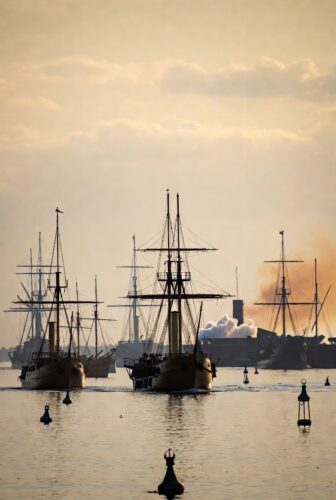
Mobile Bay mattered. By the summer of 1864 the Union Anaconda Plan had largely strangled the Confederacy’s ability to trade. New Orleans had fallen in 1862. The Mississippi River was under Federal control after Vicksburg. Charleston and Wilmington still operated under tight blockade, but Mobile remained the principal remaining deep-water Gulf port east of the Mississippi that blockade runners could still reach. Cotton went out. Arms, medicine, and luxury goods came in. As long as the bay stayed open, the Confederacy retained a vital economic and psychological artery.
The entrance was no soft target. On the eastern shore of the main ship channel stood Fort Morgan, a substantial masonry work mounting roughly forty-six heavy guns and garrisoned by several hundred men under Brigadier General Richard L. Page. Across the channel on Dauphin Island sat Fort Gaines with about twenty-six guns. A smaller work, Fort Powell, covered the western approaches through Grant’s Pass. Between the forts the Confederates had planted rows of underwater mines—wooden kegs or metal cases packed with black powder and fitted with contact primers. These “torpedoes” were anchored in lines marked by buoys. The main channel was deliberately narrowed so that any approaching fleet would have to steam close under the guns of Fort Morgan while skirting or crossing the minefield.
Inside the bay waited a small but dangerous Confederate squadron under Admiral Franklin Buchanan. Buchanan was no ordinary officer. He had commanded the ironclad CSS *Virginia* (the former *Merrimack*) at Hampton Roads in 1862 and had already been wounded once in the war. His flagship was the ironclad ram CSS *Tennessee*, a formidable if imperfect vessel. Her casemate was protected by thick iron plating over heavy timber. She carried six heavy guns and a strong iron prow for ramming. Her weakness was speed and reliability; Confederate industry struggled to produce powerful engines and consistent powder. Supporting her were three wooden gunboats: *Selma*, *Morgan*, and *Gaines*.
Farragut had been waiting for the right combination of ships and conditions. He assembled four ironclad monitors—*Tecumseh*, *Manhattan*, *Winnebago*, and *Chickasaw*—and fourteen wooden steam vessels. The wooden ships were paired and lashed together: a larger sloop or frigate on the starboard side (toward the fort) and a smaller gunboat on the port side. The arrangement allowed the bigger ships to shield the smaller ones from Fort Morgan’s fire and to tow a disabled partner if necessary. Farragut’s own flagship, the steam sloop USS *Hartford*, was lashed to the double-ender *Metacomet*. Captain Percival Drayton commanded the *Hartford*. Captain James Alden commanded the *Brooklyn*, which was to lead the wooden column.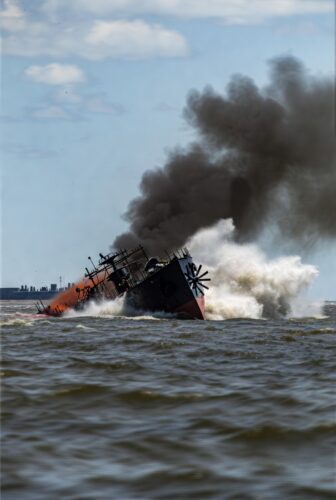
On the night of August 4 Farragut studied his charts and his Bible in the cabin of the *Hartford*. He had already decided that the monitors would steam closest to Fort Morgan to draw and suppress its fire while the wooden ships followed slightly to port. The flood tide would carry damaged vessels into the bay rather than leave them stranded under the fort’s guns. The breeze would blow the smoke of battle into the faces of the Confederate gunners. Everything possible had been calculated. What could not be calculated was the exact location and reliability of every torpedo.
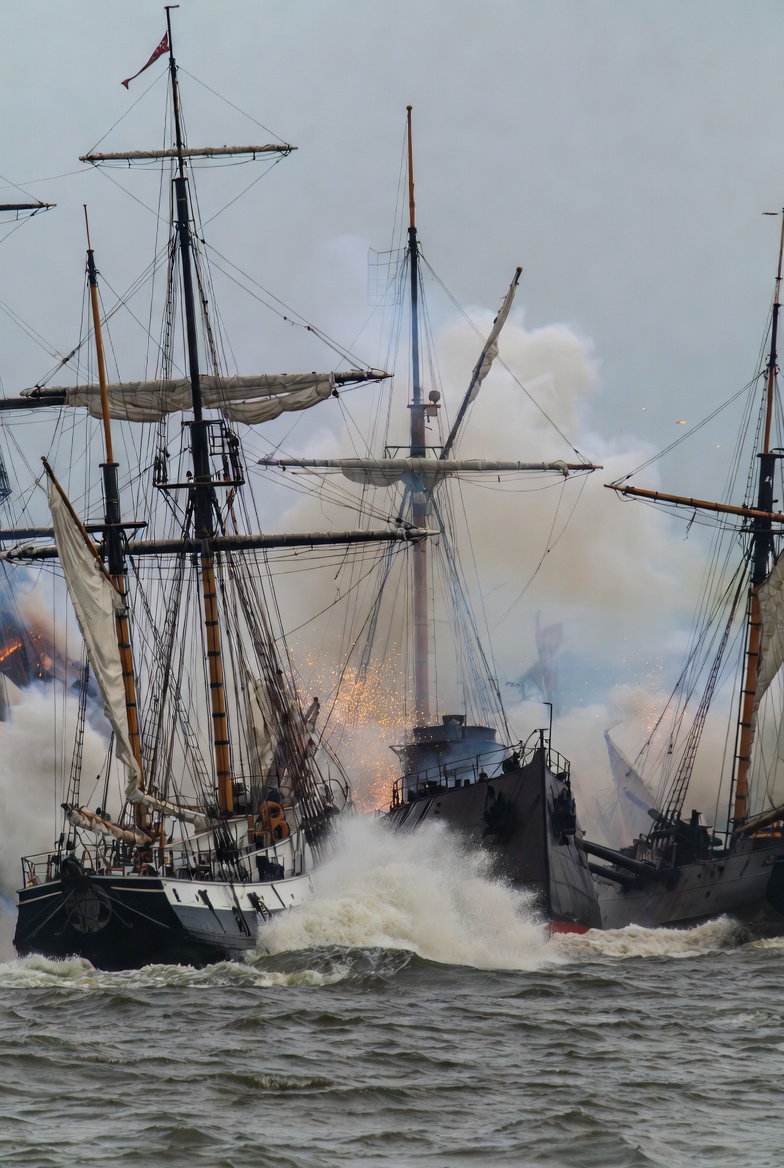
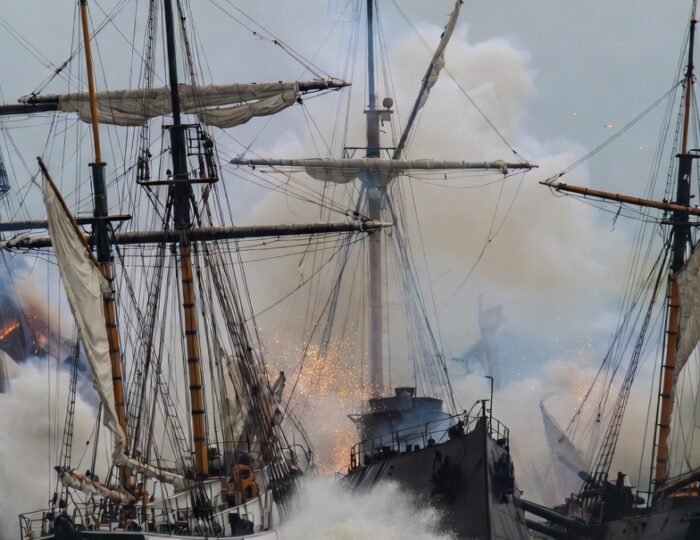
At dawn on August 5 the signal went up. The fleet weighed anchor and formed into two roughly parallel columns. Around 6:00 a.m. the ships began their approach. At approximately 6:22 or 6:47 (accounts vary slightly on the precise minute) the leading monitor *Tecumseh*, commanded by Captain Tunis A. M. Craven, fired the first ranging shots from her pair of fifteen-inch Dahlgren smoothbores toward Fort Morgan. The fort answered. Soon the wooden ships opened with their broadside batteries. Smoke thickened. Shells from Fort Morgan began to fall among the advancing columns.
The *Tecumseh* pressed ahead, aiming to engage the *Tennessee*, which had taken position inside the bay. In her eagerness or through a navigational misjudgment, the *Tecumseh* drifted west of the intended safe line—the easternmost buoy that marked the edge of the densest minefield. At about 7:40 a.m. a torpedo exploded under her. The monitor lurched, her bow rose, her stern lifted, the still-turning propeller flashing in the air for a brief moment, and then she plunged almost vertically. She sank in less than a minute. Of her crew of roughly 114, only the pilot and a handful of men escaped. The rest went down with her. It was the single heaviest loss of life on a United States warship until the twentieth century.
The sight of the *Tecumseh* vanishing stunned the rest of the fleet. The *Brooklyn*, leading the wooden column, stopped and began to back. Behind her the *Hartford* and the other ships closed up dangerously in the narrow channel, still under fire from Fort Morgan. Confusion threatened to turn into catastrophe. Ships could pile into one another. The entire attack could stall within point-blank range of the fort’s guns.
Farragut, who had climbed into the rigging of the *Hartford* to see over the smoke, assessed the situation in seconds. The *Brooklyn* was blocking the intended path. The minefield lay ahead. Stopping meant remaining under fire that was already killing and wounding men. He ordered the *Hartford* to swing out of line, pass the *Brooklyn* to port, and drive straight ahead. When a warning about the torpedoes came across the water, Farragut’s reply—whether the exact words “Damn the torpedoes! Full speed ahead!” or a close variant shouted to Captain Drayton and the *Metacomet*’s commander—became legend. He chose motion over hesitation. The *Hartford* and her consort pushed into the suspected minefield. Sailors later reported hearing the cases of torpedoes bump and scrape along the copper sheathing of the hull. Some primers snapped. None of the remaining mines exploded under the wooden ships. The rest of the fleet followed the *Hartford*’s wake.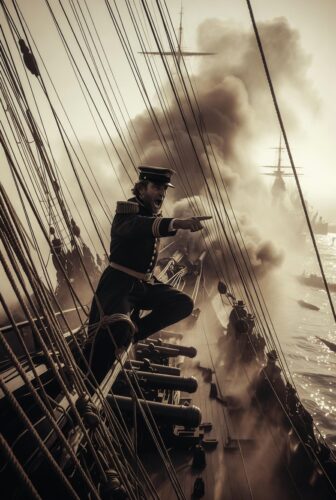
Once past the forts and the minefield, the Union squadron found itself in the wider waters of the bay and out of effective range of Fort Morgan’s heavy guns. The Confederate gunboats attempted to harass the advancing Federals. The *Metacomet* was cast loose and pursued the *Selma*, eventually forcing her surrender. The *Gaines* was heavily damaged and beached; her crew later burned her to prevent capture. The *Morgan* escaped under the guns of Fort Morgan and later reached Mobile.
That left the *Tennessee*. Buchanan, true to his aggressive nature, steamed out alone to confront the entire Union fleet. What followed was one of the most one-sided yet stubborn naval fights of the war. The *Tennessee*’s armor shrugged off many hits. Her guns fired, though the quality of Confederate powder sometimes produced weak charges. Union ships took turns ramming her. The *Monongahela* struck first and smashed her own iron prow. The *Lackawanna* rammed and then, in the confusion, accidentally struck the *Hartford*. The monitors closed in, especially the *Chickasaw* and *Manhattan*, pounding the *Tennessee* at close range. They shot away her smokestack, damaged her steering chains, and jammed some of her gun ports. Admiral Buchanan himself was severely wounded in the leg by a flying fragment. After roughly three hours of combat that had begun with the *Tecumseh*’s first shot, Commander James D. Johnston, acting for the injured Buchanan, ordered the white flag raised. The *Tennessee* surrendered.
With the Confederate squadron neutralized, the forts could not hold indefinitely without naval support or resupply. Fort Powell was abandoned and its guns spiked. Fort Gaines, already under pressure from Granger’s troops who had landed on Dauphin Island on August 3, surrendered on August 8. Fort Morgan endured a formal siege and heavy bombardment until August 23, when Page surrendered. Mobile Bay was closed. The city of Mobile itself remained in Confederate hands until the spring of 1865, but its value as a port was gone.
The human cost on August 5 was significant though not catastrophic by Civil War standards. Union losses ran to roughly 150–170 killed (the majority from the *Tecumseh*) and a similar number wounded. Confederate naval losses were lighter in killed and wounded but included the capture of the *Tennessee* and her crew, plus the eventual surrender of the fort garrisons totaling around 1,500 men. The strategic effect was outsized. One of the last major leaks in the Union blockade was plugged. Combined with the fall of Atlanta later that summer, the victory at Mobile Bay boosted Northern morale at a critical moment and contributed to Abraham Lincoln’s reelection in November 1864. Without that political outcome the war’s conclusion might have looked very different.
Farragut’s decision on the morning of August 5 remains the emotional and tactical center of the story. He did not possess perfect information about the mines. He did not know which primers were still live after months in the water. He saw a subordinate ship stop, the column bunching, the fort still firing, and the possibility of the entire attack collapsing into a traffic jam under enemy guns. He chose forward motion through the unknown hazard rather than the certainty of continued exposure. The gamble worked because most of the remaining torpedoes failed to detonate and because the fleet kept moving as a coherent body once the flagship led.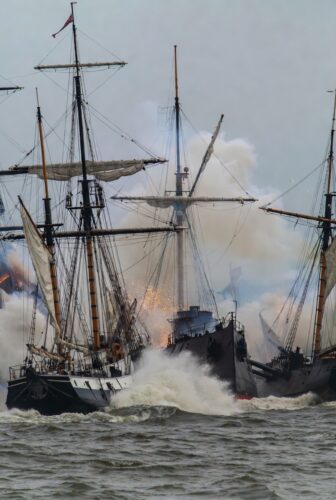
The technology of 1864 makes the episode even more striking. Ironclads were still relatively new. Wooden ships lashed together for mutual support look almost absurd by later standards, yet the arrangement was practical. Contact mines were crude by modern measures—essentially waterproofed barrels of powder with simple primers—yet they were deadly enough to sink the *Tecumseh* in seconds. Navigation relied on charts, buoys, the tide, and the judgment of pilots and captains under fire and smoke. Communication between ships was by signal flag, speaking trumpet, and shouted orders. In that environment Farragut’s ability to read the developing situation from the rigging and impose a decisive course of action stands out.
The battle also revealed the limits of Confederate industry. The *Tennessee* was a remarkable engineering achievement given the South’s constraints, but her slow speed and inconsistent powder left her unable to exploit her armor and ram effectively against a coordinated fleet. Buchanan fought with characteristic determination; the outcome was never really in doubt once the Union squadron was inside the bay.
In the days and weeks that followed, the Union consolidated control of the lower bay. The *Tennessee* was repaired and commissioned into the United States Navy. Farragut received the thanks of Congress and later promotion. The victory entered American naval lore, and the phrase associated with it became a shorthand for decisive action in the face of incomplete information and visible danger.
That is the historical record of August 5, 1864, at Mobile Bay: a carefully prepared combined operation, a sudden and nearly catastrophic loss, a moment of command decision under fire, a successful passage through a minefield, the reduction of an ironclad by concentrated ramming and gunfire, and the subsequent surrender of the covering forts. The port was closed. The blockade tightened. The political and military consequences rippled outward through the final year of the war.
The practical residue of that morning is not a vague call to “be bold.” It is a specific pattern of observation, assessment, and committed motion when a process stalls in the presence of both known and unknown hazards. Most modern obstacles are not literal floating mines, yet the structure of the problem recurs: a planned advance, an unexpected failure that freezes progress, the temptation to remain in a killing zone of delay, and the necessity of choosing a direction and moving before the situation degrades further.
**How the outcome of August 5 benefits a person today**
– The battle demonstrates that incomplete information does not automatically require paralysis. Farragut lacked a perfect map of live torpedoes yet still advanced because remaining stationary carried a higher immediate cost.
– It shows the value of pre-arranged mutual support (ships lashed together) that allows one unit to help another without requiring perfect individual performance.
– It illustrates that a single decisive lead element can unstick an entire column once hesitation sets in.
– It proves that many “mines” lose effectiveness over time or under the stress of actual contact; the majority of the remaining torpedoes simply failed.
– It underscores that armor and determination (the *Tennessee*) are insufficient without mobility and coordination against a larger, moving force.
– It records that political and strategic effects often lag the tactical action by weeks or months; the reelection impact arrived in November, not on August 5.
**The Minefield Momentum Protocol – a unique, non-generic plan derived directly from the sequence of 5 August 1864**
This is not a morning routine, a gratitude journal, or a vision-board exercise. It is a decision protocol for moments when a concrete project or commitment has stalled because an unexpected obstacle has appeared and the people or processes involved have begun to hesitate in a place that is itself becoming dangerous through delay.
- **Map the actual channel and the buoy line before you start.**
On paper or in a single notebook page, draw the equivalent of Farragut’s approach: the objective (inside the bay), the known hard obstacles (the forts—things that will fire on you if you linger), and the suspected soft obstacles (the torpedo field—things that might or might not explode). Mark one clear “eastern buoy” as your preferred safe line. Do this once, before the pressure is high. The act of drawing forces you to distinguish fixed defenses from probabilistic ones.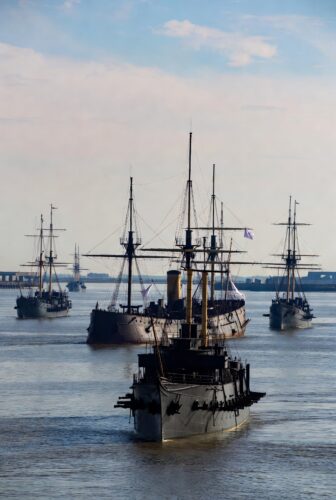
- **Lash your supporting elements in advance.**
Identify one or two concrete “consort” resources—another person, a backup tool, a secondary method, or a time buffer—and formally pair them to the primary effort the way the *Hartford* was lashed to the *Metacomet*. Write the pairing down. The point is not moral support; it is mechanical mutual aid if one element is disabled.
- **When the lead element stops or sinks, treat the next sixty seconds as the critical window.**
The *Tecumseh* went down in under a minute. The *Brooklyn* stopped. The column began to compress. Your equivalent is the first clear sign that the original plan has hit an unexpected failure and forward motion has ceased while you remain exposed to ongoing costs (time, money, attention, reputation). Start a literal sixty-second count. Do not use the time to gather more opinions. Use it only to answer three questions: Am I still under fire from the “fort” (ongoing damage from delay)? Is the path ahead of the stopped element still the only practical channel? Can I swing past the stopped element without requiring its permission?
- **Issue the order to yourself in the exact form of motion, not encouragement.**
Farragut did not deliver a speech. He ordered specific actions: full speed, hard a-starboard, four bells. Your version must be equally concrete and executable in the next action cycle: “I will complete the next physical step of X by time Y, using method Z, regardless of the unresolved status of the obstacle that stopped the previous step.” Write the sentence. Then execute the first physical motion required by it within the same hour if possible.
- **Accept that some primers will snap and most will not.**
As you move past the obstacle zone, expect auditory or psychological “clicks”—warnings, near-misses, anxious projections. Record them briefly after the fact. Do not stop to investigate each one in real time. The historical mines that failed to explode outnumbered the one that sank the *Tecumseh*. Your equivalent is the same statistical reality: most anticipated disasters do not detonate when you actually contact them at speed.
- **Once inside the bay, immediately reduce the remaining mobile threats one by one.**
After the passage, Farragut’s force did not pause for celebration. It dealt with the *Selma*, the *Gaines*, and then concentrated everything on the *Tennessee*. Your protocol requires the same: the moment the primary barrier is behind you, list the secondary problems that can still maneuver against you and assign each a single decisive counter-action with a short deadline. Do not allow them to remain as a fleet-in-being.
- **Close the forts on their own timetable, not yours.**
The naval victory on August 5 did not instantly produce the surrender of Fort Morgan. That required additional days of investment and bombardment. Accept that some supporting structures around your obstacle will take longer to yield. Schedule the follow-up pressure separately; do not let their continued existence convince you that the main passage failed.
- **Archive the actual sequence within twenty-four hours.**
Farragut wrote his official report the same day. You will write a one-page chronological account of what happened, what you observed, what you ordered, and what the results were. This is not reflection for its own sake. It is the creation of a personal chart for the next time a similar channel appears.
The protocol is deliberately narrow. It applies only when you face a stalled advance under continuing cost, with both hard and soft obstacles present, and when a lead element has already failed or frozen. It does not apply to ordinary planning, long-term strategy, or emotional processing. Its power comes from mirroring the actual constraints and decision points of August 5, 1864: limited visibility, incomplete knowledge of the mines, the necessity of keeping the column moving, and the willingness to accept the risk of further explosions in exchange for escaping a worse static position.
That is the usable residue of the morning the *Tecumseh* went down and the *Hartford* went forward. The bay was closed. The torpedoes, for the most part, stayed silent. The rest followed from the decision to move.
Share: