
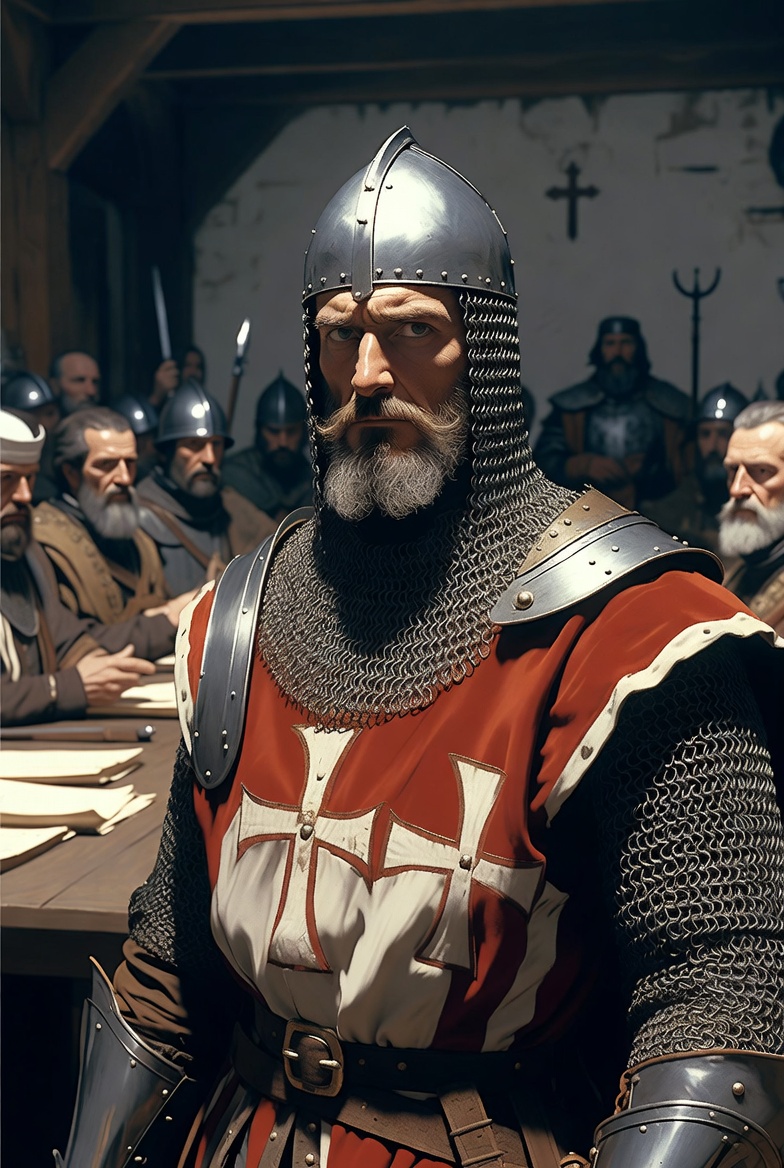
On the morning of August 4, 1265, in the green loop of the River Avon just north of the abbey town of Evesham in Worcestershire, a thunderstorm rolled in like an uninvited witness. Lightning cracked. Rain began to lash the fields. And roughly ten thousand royalist soldiers, many of them still nursing the humiliation of the previous year’s defeat at Lewes, closed in on a smaller baronial army that had nowhere left to run. At the center of that doomed force stood Simon de Montfort, Earl of Leicester, a French-born noble who had spent the better part of a decade trying to force the English crown into something resembling accountable government. By nightfall his body would be mutilated, his head and extremities distributed as grisly trophies, and the chronicler Robert of Gloucester would refuse even to call the slaughter a battle. “Such was the murder of Evesham,” he wrote, “for battle it was none.”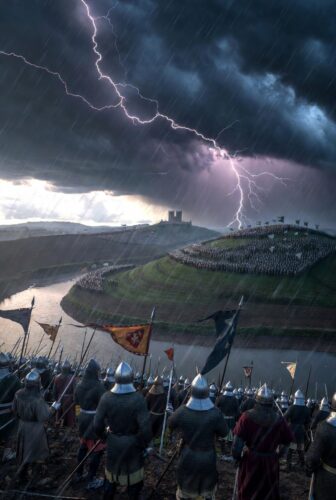
This was not a random skirmish. It was the bloody punctuation mark at the end of the Second Barons’ War, a conflict that had briefly turned England into a laboratory for limited monarchy and representative experiment. Understanding what happened that day requires stepping back into the reign of Henry III, a king whose piety was matched only by his talent for alienating the very men who were supposed to uphold his throne.
Henry III had come to the crown as a child in 1216, inheriting a kingdom still reeling from the chaos of Magna Carta and the civil war that followed it. As an adult he proved devout, cultured, and chronically short of money. He filled his court with foreign relatives and favorites from Poitou and Savoy. He poured treasure into an abortive attempt to place his second son on the Sicilian throne. He repeatedly ignored or diluted the Provisions of Oxford of 1258, a reform program forced on him by a coalition of barons that sought to place royal government under a council of fifteen and to regularize the calling of parliaments. The Provisions were, in essence, an attempt to make the king’s will subject to institutional restraint. Henry treated them as temporary inconveniences.
Simon de Montfort entered this drama as an outsider with impeccable martial credentials and a dangerous sense of destiny. Born around 1208 into a family that had distinguished itself on the Albigensian Crusade, he arrived in England in the 1230s to claim the earldom of Leicester through his grandmother. He married the king’s sister Eleanor, a union that brought him both prestige and lasting suspicion. Montfort was austere, pious in the crusading style, and convinced that God’s justice required the correction of bad rulers. He was also ambitious, occasionally ruthless, and capable of inspiring both fierce loyalty and deep resentment. By the early 1260s he had become the most visible face of baronial opposition.
The crisis sharpened after 1263. Montfort returned from exile, gathered support, and in May 1264 won a stunning victory at the Battle of Lewes. There he captured King Henry, Prince Edward (the future Edward I), and Richard of Cornwall. For roughly fifteen months Montfort governed England in the king’s name. He summoned a parliament in January 1265 that included not only the traditional barons and higher clergy but also two knights from each shire and two burgesses from selected towns. Historians still argue about how radical this assembly truly was, yet its inclusion of commoners marks it as a significant step toward the later English Parliament. Montfort was no democrat in the modern sense; he was a high aristocrat enforcing a vision of ordered Christian kingship. But the machinery he used contained seeds that later generations would cultivate.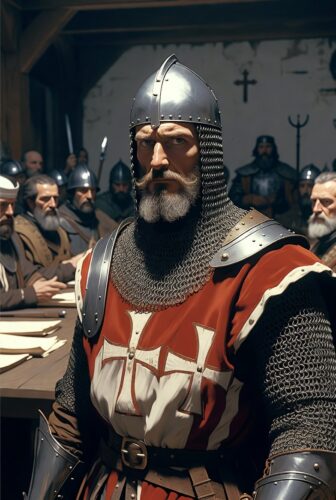
Power proved brittle. Allies defected. Gilbert de Clare, Earl of Gloucester, switched sides. In May 1265 Prince Edward escaped captivity through a combination of luck, horsemanship, and collusion. Once free, Edward proved a formidable organizer. He gathered royalists in the Welsh Marches, coordinated with the Marcher lords who had long resented Montfort’s alliance with Llywelyn ap Gruffudd of Gwynedd, and began systematically isolating the baronial forces.
Montfort’s strategic position deteriorated through June and July. He needed to link up with his son, the younger Simon, who was moving from the southeast with a substantial contingent. The younger Simon reached Kenilworth Castle but moved too slowly. On the night of July 31–August 1, Edward launched a dawn attack on the baronial camp outside Kenilworth, capturing many men and, crucially, their banners. Those captured banners would become the instruments of deception a few days later.
Montfort, accompanied by the captive King Henry (dressed in baronial colors for his own safety or as a deliberate slight, depending on the chronicler), moved toward Evesham, hoping to meet his son. The geography of Evesham is decisive. The River Avon swings in a tight loop around the town, leaving only a narrow neck of land to the north. Once an enemy controlled the high ground on that neck and the approaches, the force inside the loop was trapped. Edward understood this. On the morning of August 4 he arranged his army on Green Hill in three battles, or divisions. He and the bulk of the cavalry held one wing; Gloucester held another. Marcher lords under Roger Mortimer closed off escape routes. The royalists wore red crosses as field signs, reversing the white crosses the barons had used at Lewes.
Montfort’s scouts and lookouts initially mistook the approaching royal host for the younger Simon’s relieving force. The captured Kenilworth banners completed the illusion. When the truth became clear, a barber watching from a tower is said to have cried that they were all dead men. Montfort himself, according to several accounts, remarked on the skill of the advance and observed that the royalists had learned their tactics from him. He then accepted the inevitable with a mixture of fatalism and defiance: their bodies belonged to the enemy, their souls to God.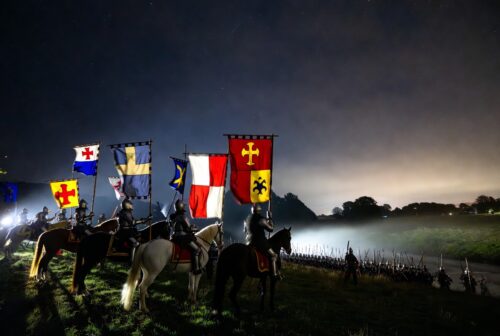
The battle began under a gathering storm. Montfort’s smaller army—perhaps five thousand, including unreliable Welsh infantry—attempted to punch through the royal center. For a brief interval the charge had momentum. Then the Welsh broke and fled. The royal flanks folded inward. What followed was less a contest of arms than a systematic killing. Knights who might normally have been ransomed were cut down. Henry de Montfort, the earl’s eldest son, fell near the banner. Hugh le Despenser, the justiciar, died. Peter de Montfort and a score of other named barons and knights perished in a confined space that later tradition associated with a spring that became known as Battle Well.
Simon de Montfort fought on foot after his horse was killed. Contemporary and near-contemporary accounts describe him surrounded, still striking, until a dagger or lance found a gap. One version has him saying “Dieu, merci” as he went down. What happened next was deliberate desecration. His body was stripped. Head, hands, feet, and genitals were severed. The head, with the testicles reportedly hung beside the nose, was sent to Lady Mortimer at Wigmore Castle as a trophy. Other parts were distributed to enemies. The trunk was eventually recovered by the monks of Evesham Abbey and buried near the high altar. A spring later associated with the site attracted pilgrims who treated Montfort as a quasi-martyr, an ironic afterlife for a man the royalists had tried to erase in the most physical way possible.
King Henry himself nearly died in the melee. Dressed in the colors of the losing side, he was almost cut down by his own men until Roger de Leybourne recognized him and pulled him to safety. The storm that accompanied the fighting—thunder, lightning, sudden darkness—was read by some as divine commentary. Whether the weather was coincidence or literary embellishment, it fixed the day’s atmosphere in memory: a summer morning turned apocalyptic.
The immediate political result was the restoration of royal authority. The September parliament at Winchester began the process of disinheriting rebels. Resistance flickered at Kenilworth and in isolated pockets, but the Dictum of Kenilworth in 1266 offered a pathway back for those willing to pay fines scaled to their level of involvement. By 1267 the war was effectively over. Henry III ruled the remainder of his life in relative peace. Edward, once he became king in 1272, proved a far more effective and systematic monarch than his father, conquering Wales, reforming law, and summoning parliaments that institutionalized many of the representative practices Montfort had experimented with. The man who destroyed Montfort’s body helped preserve and regularize the institutional idea Montfort had briefly embodied.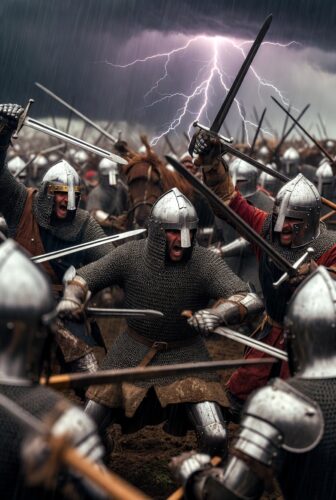
The deeper irony is durable. Montfort’s 1265 parliament is routinely cited in the long genealogy of English representative government. The principle that the community of the realm, or at least a broadened version of it, had a right to consent to taxation and to counsel the king survived the slaughter at Evesham. The “murder” ended one man’s career and one particular coalition, yet it did not erase the constitutional conversation that coalition had forced. England did not become a limited monarchy overnight, but the precedent of institutional restraint and the inclusion of non-noble voices in national assemblies gained a foothold that later crises—the deposition of Edward II, the rise of the Commons, the seventeenth-century conflicts—would expand.
The tactical and human details of the day repay close attention. The river loop was not merely inconvenient terrain; it was a geographic expression of political isolation. Montfort had alienated enough former allies that the circle closed. The deception with the captured banners was a classic piece of medieval psychological warfare: turn the enemy’s own symbols against him. The refusal to grant quarter reflected the intensity of personal and factional hatred after Lewes; ransom, the normal lubricant of aristocratic warfare, was set aside in favor of elimination. The mutilation was not random sadism. In a culture that understood the body as a map of honor and lineage, dismemberment was a statement that this man and his cause were to be unmade. That the abbey still buried the remains and that popular devotion later gathered around the site shows how contested the meaning of the death remained.
Montfort’s own character adds further texture. He was capable of genuine reformist conviction and of self-interested calculation. He enforced the Provisions when it suited him and cut deals with Llywelyn that cost him English support. He could be high-handed with subordinates and moralistic toward the king. None of this makes the royalist vengeance noble; it simply reminds us that the “father of Parliament” was also a thirteenth-century warlord operating inside the brutal logic of his time. The same man who expanded the political community was willing to hold the anointed king as a virtual prisoner and to dress him in the colors of rebellion.
The storm, the trap, the banners, the mutilation, the near-killing of the king by his own side—these elements give the day a darkly dramatic coherence. It is the kind of episode that later generations compress into moral fable, yet the primary sources resist simple moralizing. Royalist chroniclers emphasized treason and just punishment. Montfortian or sympathetic writers leaned toward martyrdom. Modern historians navigate between the constitutional significance of the earlier reforms and the military reality of August 4. The field itself, now partly built over, still carries the memory in place names and local tradition.
What remains most striking is the speed with which a political experiment collapsed once the military balance shifted and the geographic trap closed. Montfort had ridden the wave of baronial discontent, foreign-policy failure, and fiscal overreach. When the wave broke, the same institutions he had tried to bend to reform became the instruments of his destruction. Edward’s subsequent career demonstrated that strong personal kingship could coexist with, and even strengthen, the parliamentary practices that had emerged from crisis. The idea outlived the man who had most dramatically advanced it in the 1260s.
The outcome of August 4, 1265, was therefore double-edged. In the short term it reasserted royal power and ended the most radical phase of baronial reform. In the longer term it left intact, and even indirectly reinforced, the notion that English government required consultation beyond the king’s private circle. The murder of Evesham did not kill the parliamentary impulse; it merely removed one of its more uncompromising champions and forced the impulse to find more durable institutional form under later, more pragmatic rulers.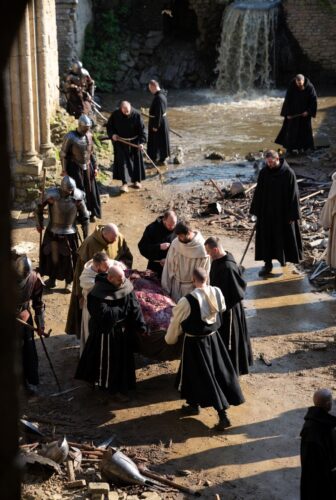
That double outcome—immediate crushing of a specific coalition, longer survival of the underlying principle—offers a precise historical fact that can be carried into individual life without sentimentality or generic uplift. The lesson is not “never rebel” or “always compromise.” It is sharper: when the circle of support narrows, when former allies hold the high ground, when the terrain itself has become a trap, the cost of continuing the same formation rises catastrophically. Recognition of the closing loop, and the willingness to alter course before the flanks complete the encirclement, becomes the practical inheritance of the day.
**Specific benefits available from this historical fact**
– You gain a concrete diagnostic for personal overcommitment: map the actual geography of your current alliances and constraints the way Edward mapped the Avon loop. Identify the narrow neck through which support or resources must still pass. If that neck is already contested or held by former partners, the situation has changed character.
– You acquire a caution against symbolic self-deception. Captured banners fooled Montfort’s lookouts because the symbols still looked familiar. In private life this translates into auditing the signals you accept as proof of continuing support—old promises, residual goodwill, institutional inertia—when the underlying force structure has shifted.
– You receive a reminder that institutional ideas can outlive the coalitions that first advanced them. Montfort’s body was destroyed; the representative practice he had used was not. Personal projects or principles that matter can be separated from the particular configuration of people and timing that first carried them.
– You obtain a visceral illustration of the difference between tactical bravery and strategic position. Montfort fought with recognized courage once the trap was sprung. Courage after the loop is closed is not the same as the earlier decisions that allowed the loop to form.
– You hold a calibrated sense of timing for exit or renegotiation. The window between Edward’s escape and the morning of August 4 was the period when different choices remained possible. After the banners appeared on Green Hill, options collapsed into variations of disaster.
**The Avon Loop Protocol: a unique operational plan derived from the events of 4 August 1265**
This is not a mindset exercise, a gratitude practice, or a vision-board ritual. It is a structured, time-bound reconnaissance and decision sequence that treats your current major commitment or conflict as terrain. Execute it once for any sustained personal or professional entanglement that shows signs of isolation or over-extension. The entire cycle takes fourteen days and produces a written operational picture rather than emotional insight.
Day 1–2: Terrain Survey. Draw or list every material constraint currently surrounding the commitment—financial dependencies, key relationships that control access, physical or schedule bottlenecks, institutional rules that limit movement. Mark the single narrowest point of continuing viability. This is your Avon neck. If you cannot identify it clearly, the survey is incomplete; repeat until the choke point is specific.
Day 3–4: Banner Audit. List every signal you are currently treating as evidence of support or continuing feasibility. For each signal, attach the last verifiable action that confirmed it. Any signal older than ninety days without fresh confirmation is flagged as a potential captured banner. Discard or quarantine flagged signals from further planning.
Day 5–7: Force Ratio Estimate. Assign rough relative strength (not moral worth) to the coalition still actively advancing your position versus the forces, inertia, or opposing interests arrayed against it. Use only observable capacity: time, money, legal standing, number of people who have acted in the last thirty days. If the ratio is worse than 1:1.5 against you and the neck is contested, the situation is already inside the loop.
Day 8–10: Storm Window Decision. Choose one of three pre-defined moves and commit to it in writing before the eleventh day: (a) reinforce the neck with a concrete, time-limited resource injection; (b) negotiate an exit or renegotiation that preserves the core principle while abandoning the current formation; or (c) accept the closed loop and plan the orderly extraction of residual value. No fourth option of “continue as before while hoping” is permitted. The historical record shows that option produces the mutilation phase.
Day 11–14: Execution and After-Action. Carry out the chosen move. On day 14 write a one-page after-action note that records what the terrain actually did when pressure was applied, which banners proved false, and what principle (if any) remains intact after the formation changed. File the note. The protocol is complete.
The protocol is deliberately mechanical and non-therapeutic. It does not ask how you feel about the loop; it asks whether the loop exists and what the force ratio is. It treats symbolic continuity as a liability until proven otherwise. It forces a decision inside a fixed window rather than allowing the gradual closing of options that characterized Montfort’s final weeks. Most self-help frameworks emphasize persistence, reframing, or internal narrative. This one emphasizes geographic and coalition reality, timed exit criteria, and the separation of principle from formation. It is usable precisely because it is borrowed from a day when failure to perform these steps produced a thunderstorm, a massacre, and a head on a pike.
The men who fought at Evesham did not have the luxury of later historical perspective. We do. The river still bends. The high ground still matters. The banners can still lie. On August 4, 1265, one of the more consequential traps in English medieval history sprang shut under a summer storm. The body of the reformer was destroyed. The idea of binding power through broader consultation was not. That is the usable residue of the murder of Evesham.
Share: