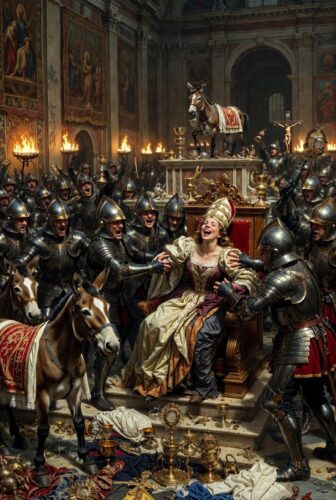

How a Ruined Fortress, a Sultan Who Offered Peace Twice, a Ten-Mile Baggage Train, and One Dust-Choked Defile on 17 September 1176 Ended Byzantium’s Last Serious Bid for the Anatolian Plateau
Picture a dry mountain throat in western Anatolia. Steep, wooded slopes rise on both sides of a single-file track that twists through seven trench-like valleys. The air is already thick with dust and the smell of unwatered animals. Somewhere ahead lie the ruins of a forgotten fortress the Byzantines called Myriokephalon — “Ten Thousand Heads.” On the morning of 17 September 1176 the largest army the Komnenian emperors had assembled in a generation began to pour into that throat.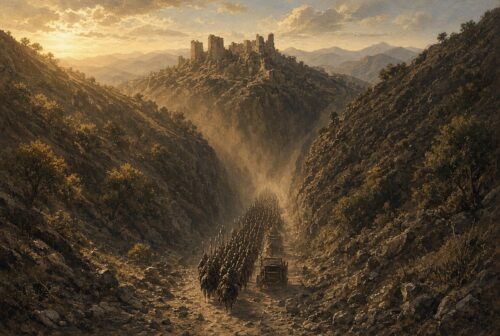
They never came out the same way.
This is not the Battle of Manzikert. It is the quieter, later disaster that made Manzikert permanent. It is the day an emperor who had spent thirty years stitching the empire back together walked his siege engines into a hallway and discovered that the hallway already belonged to someone else.
### The Long Road After Manzikert
In 1071 the Seljuk Turks had shattered a Byzantine army at Manzikert and opened the Anatolian plateau. For the next century the Komnenian emperors — Alexios, John, and then Manuel I — clawed coastal plains and river valleys back toward the interior. They did not reconquer the high plateau. They contained it.
Manuel I Komnenos came to the throne in 1143 looking like a western knight who had wandered into a Greek court. Tall, dark-haired, fond of tournaments, Latin wives, and personal combat, he spent the 1150s and 1160s winning in Hungary, reducing Antioch to vassalage, and recovering Cilicia. In 1161 he even extracted a spectacular piece of theater from the young Seljuk sultan Kilij Arslan II: the sultan came to Constantinople, kissed the emperor’s foot, and accepted the status of imperial vassal. Banquets were held. Gifts were exchanged. The peace looked like a Komnenian triumph.
It was a pause, not a settlement.
Kilij Arslan used the years of peace the way a careful man uses a truce. He swallowed the remaining Danishmend emirates after the death of Nur ad-Din in 1174. He expelled his own brother Shahinshah from Ankara. When the refugees fled to Byzantine protection and Manuel demanded the return of those territories under the 1161 agreement, the sultan declined. The peace cracked.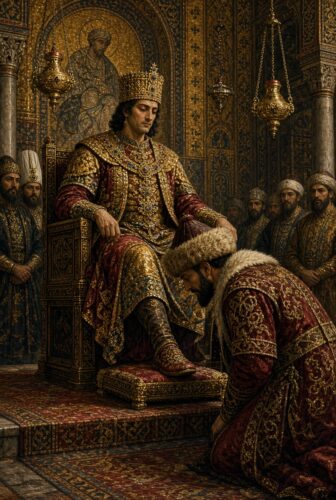
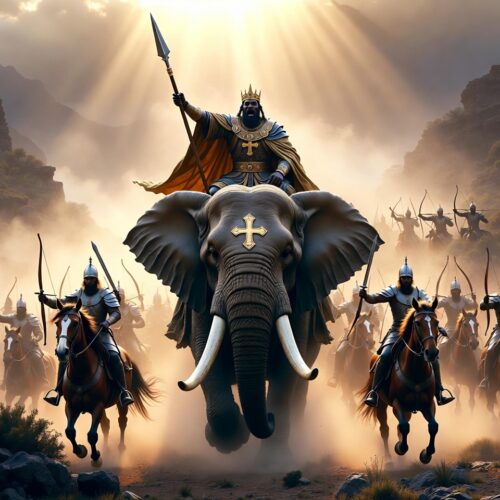
Manuel decided the time had come to finish the work his grandfather and father had started. He would march on Iconium — modern Konya — the Seljuk capital on the plateau, take the city, and reopen the old land route toward the east. In the spring of 1176 he gathered an army at Lopadion that contemporary descriptions stretch across ten miles of road when it moved. Estimates put it between 25,000 and 40,000 men: the eastern and western tagmata, palace infantry, Hungarian allies under Béla III, Serbs, and a large contingent from the Principality of Antioch. Behind them rolled a siege train of perhaps three thousand wagons — torsion engines, stone-throwers, supplies, tents, and the entire portable city an imperial army required.
Kilij Arslan offered terms again. Manuel refused. He was convinced the size of his host made negotiation unnecessary.
That conviction would cost him the campaign before a single stone was flung at Konya’s walls.
### The March That Chose the Wrong Door
The army moved southeast through Laodicea, Chonae, Lampe, Celaenae, and Choma. The Seljuks did not meet it in open battle. They burned crops. They poisoned wells. They let dysentery and thirst do the talking. A separate Byzantine column under Andronikos Vatatzes, sent toward Amasia in the hope that the locals would rise, was ambushed and annihilated. Vatatzes’s head was later displayed on a spear near the very pass the main army was about to enter.
Manuel had a choice. He could try to draw the Turks onto the more open ground near Philomelion, or he could take the direct mountain route through the Tzivritze Pass near the ruined fortress of Myriokephalon. Forage was scarce. Water was worse. The emperor chose the pass.
His experienced officers warned him. The defile was a known killing ground. The sultan already occupied the heights. Manuel waved them off. The army was too large, the engines too precious, the prestige too committed. They would go through.
On 17 September the column began to enter.
The order of march, reconstructed from Niketas Choniates and later analysis, was roughly this: a vanguard of infantry, much of it from the palace regiments; the main body of the tagmata under Constantine Makrodoukas and Andronikos Lampardas; the right wing, heavy with Antiochenes and westerners, commanded by Baldwin of Antioch, the emperor’s brother-in-law; then the vast baggage and siege train; the left wing under John Kantakouzenos; the emperor’s own division; and finally the rearguard under Andronikos Kontostephanos.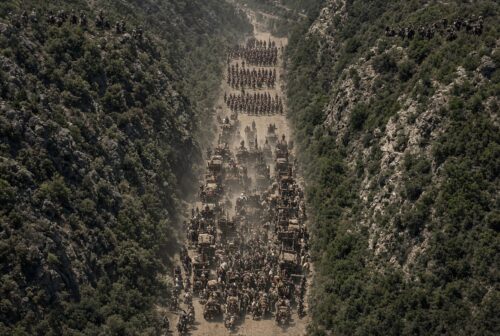
The vanguard and the main body pushed through the first stretches with relatively light loss. They drove some of the Turks up the slopes and began to establish a camp on a hill at the far end of the pass. Behind them the trap closed.
### The Hour the Pass Became a Slaughterhouse
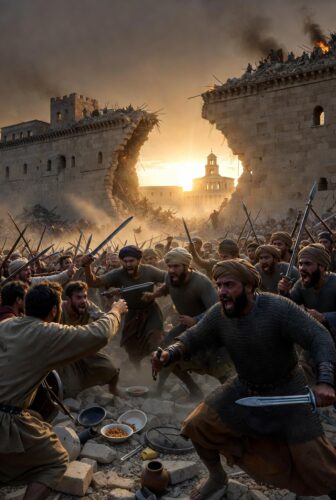
The Seljuks did not need to match the Byzantines in numbers. They needed the heights, the narrowness, and the fact that a ten-mile column cannot fight as a single organism. Mounted archers and irregular Turkomans poured arrows into the right wing. Baldwin of Antioch tried to cut his way out with a handful of riders and was killed. The right wing broke in both directions — some men fleeing forward into the next ambush, others stumbling backward into the baggage. Soldiers who tried to climb a nearby hill slid into a dry ravine and piled up there.
Then the Turks hit the wagons.
Draught animals went down. Carts jackknifed. The roadway itself became a dam of dead horses, splintered timber, and men who could neither advance nor retreat. The left wing under John Kantakouzenos took its own beating; Kantakouzenos himself was cut down fighting almost alone. A dust storm rose, blinding both sides, turning the defile into a choking brown tunnel.
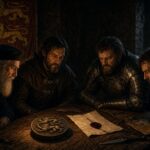
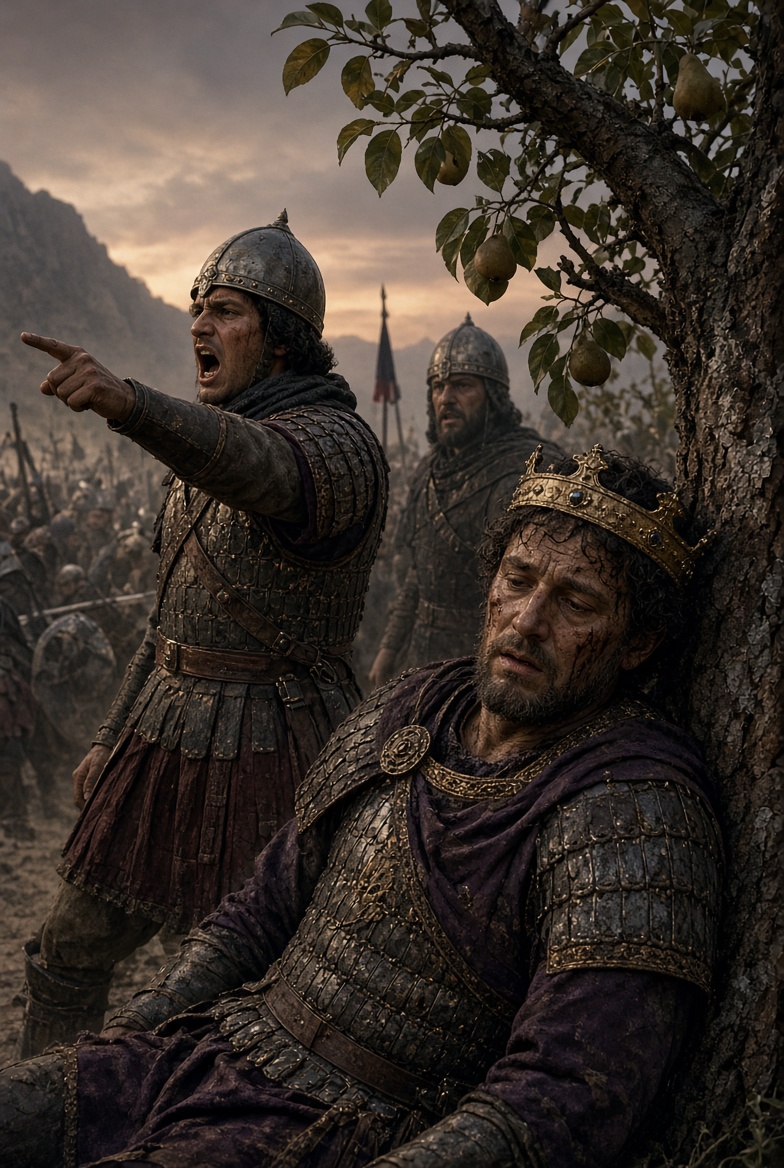
Manuel, still in the rear of the press, sat for a time under a wild pear tree. Choniates records the scene with the kind of detail that only comes from men who were there and later wanted someone to blame. An anonymous soldier — history did not keep his name — shouted something to the effect that it was a shame for an emperor to endure like a woman while his army died. Kontostephanos, arriving with the rearguard, made his disapproval visible. Manuel got up. He reorganized what he could into a defensive knot, pushed forward, and linked up with the vanguard and main body that had already fortified their hill.
The rearguard, coming last, suffered comparatively little. Night fell. Seljuk mounted archers kept probing. The Byzantines held the camp.
The next morning the Turks circled the position with arrows. Manuel sent out limited counterattacks under John Angelos and Constantine Makrodoukas. There was no general battle. There did not need to be. The siege train — the entire reason for the expedition — was wrecked or captured. Without engines there would be no siege of Konya.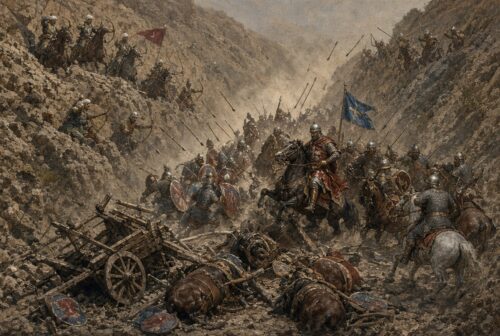
Kilij Arslan sent an envoy from the old Byzantine Gabras family. The terms were simple: the emperor could withdraw unmolested if he demolished the frontier forts at Dorylaeum and Sublaeum. Manuel accepted. On the way back through the pass the survivors saw what the Turks had done to the dead. Bodies had been scalped and mutilated so that circumcised and uncircumcised could not be told apart. Choniates says the point was to prevent either side from claiming a clean tally. Many had fallen on both sides. The victory would not be allowed to become a simple story.
Manuel demolished Sublaeum. He left Dorylaeum standing. The retreat was harassed by Turkoman bands all the way home.
### What the Defeat Actually Meant
Contemporaries and later historians have argued about the scale. Choniates, writing after the catastrophe of 1204 and with every reason to make Komnenian overreach look tragic, paints a picture of slaughter. Modern reconstructions suggest the overall army was not destroyed. Perhaps a quarter of the total force became casualties, with the heaviest losses concentrated on the two wings that were caught in the worst of the ambush and on the baggage personnel. The professional core survived. Manuel even won a sharp follow-up action at Hyelion and Leimocheir in 1177 and negotiated another peace in 1179.
That is not the point.
Myriokephalon was the last time a Byzantine emperor marched into the interior of Anatolia with a realistic chance of taking it back. After Manuel died in 1180 the empire slid into the anarchy that produced the Fourth Crusade. The plateau stayed Turkish. The coastal cities the Komnenoi had recovered would, over the next generations, become the last islands in a sea that no longer answered to Constantinople.
The battle did not destroy the Byzantine army. It destroyed the last plausible strategy for reversing Manzikert. Size, engines, prestige, and an emperor who liked to lead from the front all walked into a pass that had already been chosen by a smaller, more mobile enemy who understood the ground.
Manuel himself compared the day to Manzikert. He was half right. Manzikert opened the door. Myriokephalon slammed it and threw away the key.
The ruined fortress that gave the battle its name — Ten Thousand Heads — was never securely identified by later travelers. The pass itself is still debated. The lesson is not.
### What a Person Can Actually Do With a Nine-Hundred-Year-Old Ambush
The outcome of 17 September 1176 is not a pep talk. It is a diagnostic. An army that looked unstoppable on the map became vulnerable the moment it accepted a route that stretched it into a single file while the other side already owned the high ground. The same pattern appears in individual lives whenever someone tows a three-thousand-wagon siege train of commitments, assumptions, and sunk costs into a narrow situation they have not scouted.
Here is how the fact of that day converts into specific, non-generic action.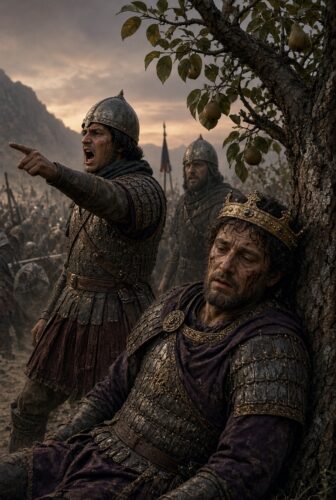
– Treat every large personal “campaign” — a career shift, a financial consolidation, a health overhaul, a creative project that has grown a staff of obligations — as a march that will eventually hit a defile. Identify the defile before you enter it: the moment when your resources are strung out, your options collapse to one path, and someone else already occupies the slopes.
– Inventory your baggage train by weight, not by sentiment. List the slow, expensive, prestige-heavy items you are dragging because you once decided they were necessary for the “siege.” A house you cannot sell, a skill set you refuse to update, a relationship that consumes forage, a public identity that cannot survive a retreat. If it cannot fight and it cannot move fast, it is a wagon.
– Accept the first peace offer that does not require you to burn your actual forts. Kilij Arslan offered terms before the pass. Manuel refused because refusal felt like strength. Strength that ignores the ground is just inertia with a banner.
– Install one anonymous soldier. Give one person in your life — not a cheerleader — the explicit job of saying the unsayable when you are sitting under the metaphorical pear tree while the right wing disintegrates. Their only authority is the sentence: “Endure to fight, not to die like a spectator.”
– After any reverse, walk back through the pass and look at the bodies without letting anyone mutilate the evidence. Count what actually died (time, money, reputation, energy) instead of letting the story become “everyone suffered so it was even.”
### The Tzivritze Protocol
This is not a vision board, a morning routine, or a gratitude list. It is a five-day field procedure derived from the specific failures of 17 September 1176. Perform it once when you are about to commit a large, slow, public effort. Perform it again after any result that felt like an ambush.
Day 1 — Map the pass, not the destination. Draw the actual sequence of constraints you will face in the next ninety days. Name the single-file stretch: the month when cash, attention, or physical energy will be unable to maneuver. Write the name of whoever already sits on the heights (a competitor, an institution, a family expectation, a market condition). If you cannot name them, you are Manuel refusing the second embassy.
Day 2 — Weigh the train. Every commitment that cannot be abandoned in forty-eight hours without legal or social catastrophe gets a number: days of forage it consumes. Anything over fourteen days of forage that does not directly protect a fort (core health, core skill, core relationship that still produces) is marked for demolition or conversion into something that can fight.
Day 3 — Send the scout you should have sent. Spend three hours on the one piece of information you have been avoiding because it might force you to take the longer, less glorious road. A phone call, a records request, a brutal conversation, a walk through the actual terrain. Record what you find in one paragraph. If the paragraph says “the heights are already occupied,” you now know what Manuel’s officers knew.
Day 4 — Pre-negotiate the withdrawal terms. Write the minimum conditions under which you will accept a truce instead of pushing the engines into the defile. The conditions must be specific enough that a stranger could enforce them. Then identify the one fort you will refuse to demolish even if the rest of the campaign fails.
Day 5 — Appoint the soldier and the rearguard. Tell one person they have a standing order to interrupt you if you start narrating your own endurance while the situation deteriorates. Separately, designate the part of your life that will arrive last and therefore take the fewest arrows — the reserve of time, money, or attention that is not allowed to enter the pass until the vanguard has already fortified the far hill.
That is the entire protocol. It takes less time than a weekend seminar and produces a written artifact you can hold against the next tempting, oversized march.
The Byzantines did not lose Anatolia because they lacked courage. They lost the interior because an emperor who had won everywhere else decided that a ten-mile column and a famous name were enough to ignore a sultan who already owned the high ground and had offered, twice, to let him walk away with his forts intact. On 17 September 1176 the pass collected its ten thousand heads, the engines stayed in the ditch, and the last realistic Roman road back to the plateau closed.
The date is still on the calendar. The defile is still there, wearing different names. The only new information is whether you intend to enter it with the same wagons.
Share: