



The late autumn air of Paris in the year of our Lord 1390 did not smell like croissants or romantic strolls along the Seine. It smelled of woodsmoke, damp wool, roasting chestnuts, horse manure, and the creeping, collective panic of a city trying very hard to hold itself together with wet twine. The Black Death had slashed through Europe like a scythe only four decades earlier, the Hundred Years’ War was chugging along in fits of bureaucratic extortion and bloody skirmishes, and King Charles VI had not yet earned his official moniker as “The Mad,” though his mental wheels were already squeaking noticeably.
If you lost something valuable in late fourteenth-century Paris—say, a heavy silver signet ring, a copper cooking pot, or three prized geese—you didn’t file an insurance claim. You didn’t submit an online fraud ticket or track your stolen phone via GPS. You went searching for someone whose eyes looked a little too knowing, someone who lived on the edge of the parish and understood the secret architecture of human behavior. You went looking for someone like Jeanne de Brigue.
On Saturday, October 29, 1390, Jeanne de Brigue was hauled into the foreboding limestone belly of the Grand Châtelet—the fortress, courthouse, and dungeon that guarded the right bank of the Seine. The proceedings that opened that cold morning marked the very first recorded secular trial for sorcery and witchcraft prosecuted by the Parliament and the Provost of Paris.
For centuries before this, church inquisitors had occasionally chased heretics into theological corners, but everyday folk magic was considered peasant stupidity or petty ecclesiastical mischief. A village priest might assign five Hail Marys for consulting a local healer or tossing herbs over a sick cow. But on October 29, 1390, the state took off its gloves. A secular magistrate looked at a woman who merely had better situational awareness, sharper investigative instincts, and a keener grasp of small-town guilt than everyone else around her, and decided that finding lost kitchenware was high treason against the celestial cosmos.
The records kept by the clerks at the Châtelet provide an astonishingly detailed, bizarre, and darkly comic window into what actually happened in that cold stone chamber. More importantly, peeling back the layers of Jeanne’s 1390 interrogation exposes the exact cognitive glitch human beings still suffer from today: when someone systematically out-observes a chaotic room, the group would rather manufacture a supernatural conspiracy than admit their own blind incompetence.
The Detective in the Wool Kirtle
To understand why Jeanne was sitting on a cold wooden bench before the Provost, Jean de Folleville, you have to understand her business model. Jeanne was what medieval records called a divinatrix—a cunning woman, a diviner, or a finder of lost goods. She did not wander through the forests brewing bat eyes in a cauldron. She lived in a society where personal property was scarce, fiercely guarded, and ridiculously easy to misplace or steal.
Locks were crude iron contraptions easily picked by anyone with a nail; inventory records existed only in the heads of illiterate bailiffs; and if your purse slipped out of your tunic at the Sunday fair, it was gone forever into the mud unless someone noticed who picked it up.
Enter Jeanne de Brigue. Jeanne possessed what modern organizational psychology calls high-bandwidth sensory gating and forensic intuition. If a farmer’s best sickle vanished, Jeanne didn’t summon a legion of hellish imps. She walked over to the farmer’s barn, observed who was avoiding eye contact, asked quiet questions about who had recently paid off their alehouse debt, and then announced that if the guilty party did not leave the sickle by the millstone before nightfall, an unseen power would turn their cider sour and wither their left foot.
Nine times out of ten, the sickle magically reappeared by the millstone.
Jeanne was so remarkably good at this informal community detective work that even the local clergy hired her. Roughly six years before her arrest, the parish priest of a neighboring settlement found himself in a frantic, unholy sweat. A valuable ring—or liturgical vessel, depending on which parchment ledger you credit—had vanished from his possession. The good father was terrified of being disciplined by his archdeacon for catastrophic negligence. Did he fall on his knees and pray to Saint Anthony, the patron saint of lost items? He may have started there, but when Saint Anthony failed to produce the goods by sunset, the priest quietly slipped out the back door and hired the local soothsayer.
Jeanne took the job, investigated the household, read the social dynamics of the rectory, and correctly located the missing property. The priest breathed a sigh of relief, slipped her a few sous, and went back to preaching fiery homilies about righteousness.
Everyone was thrilled with Jeanne’s uncanny competence—until things stopped going well.
The Châtelet: Where Common Sense Went to Die
The Grand Châtelet was not a place designed for nuanced philosophical debates. Looming over the Pont au Change, it was a grim, soot-stained Romanesque pile of turrets, murder holes, and damp holding cells with delightfully welcoming names like La Fosse (The Pit) and La Poutrel (The Beam).
When the bailiffs dragged Jeanne de Brigue through its iron gates in late October 1390, the political atmosphere in Paris was turning paranoid and vicious. France was bankrupt, the royal court was split into bitter factions, and a chilling legal reality was setting in: secular courts wanted to assert their power over things previously left to the lenient, slow-moving bishop’s courts. The lawyers of the Châtelet realized that prosecuting the supernatural was the ultimate jurisdictional flex. If a court can claim authority over invisible spirits, unseen curses, and hidden thoughts, there is nothing on earth it cannot govern.
The trial transcript of October 29 opens with the scribes setting down the formal charges. Jeanne was accused of using illicit arts to find stolen property, healing the sick through unapproved incantations, and—inevitably, because human insecurity always demands an inverse—causing healthy people to fall ill whenever she looked at them sideways.
The prosecutors brought in witnesses whose testimony reads like an anthology of medieval sour grapes. Neighbors testified that Jeanne knew things no ordinary human being should know. When a neighbor’s cow stopped producing milk, Jeanne had supposedly muttered something while walking past the ditch. When an unfaithful husband tried to conceal his nocturnal whereabouts, Jeanne had accurately predicted to his suspicious wife that he hadn’t been attending vespers.
Under the sharp prodding of the inquisitorial magistrates, Jeanne’s practical brilliance was methodically re-engineered into dark sorcery. In the legal logic of 1390, you could not simply be observant. You could not simply possess a working knowledge of human nature, plant-based remedies, and rural social politics. To explain an outcome that exceeded the baseline mediocre expectations of the crowd, there had to be an invisible, external entity pulling the strings.
The interrogation records show Jeanne desperately trying to walk a razor-thin line. She admitted to finding things. She admitted to using herbal salves and reciting certain formulas. But under continuous pressure, the script closed around her. The court demanded an origin story that fit their theological demonology. Before long, the scribes were scratching down admissions about an otherworldly mentor who appeared to her, feeding her confidential secrets about where rings were dropped and who was stealing bread from the communal oven.
The trial dragged on, dragging in another woman, Macette de Ruilly, who was similarly swept up in the Châtelet’s widening net for supposedly consulting folk magic to manage domestic abuse and marital disasters. By the time the legal gears finished grinding the following summer, the verdict was set in stone. On August 19, 1391, Jeanne de Brigue was led out to the Place du Marché aux Pourceaux (the Pig Market) and burned at the stake.
The priest who hired her kept his parish. The neighbors who got their stolen items back kept their property. The system eliminated the anomaly that made them feel transparent, vulnerable, and outmatched.
The Ghost of the 1390 Syndrome: Why Competence Scares the Herd
If you strip away the gothic stone arches, the Latin parchments, and the smells of the medieval pig market, the tragedy of Jeanne de Brigue on October 29, 1390, is not a quaint relic of the Dark Ages. It is a terrifyingly accurate mirror of how human tribes react when an individual demonstrates a level of clarity and efficiency that disrupts the tribe’s collective delusions.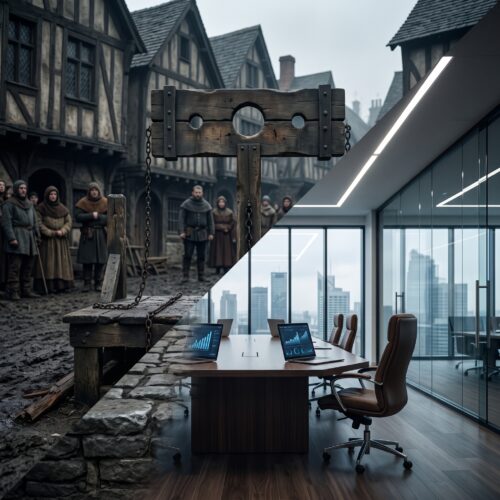
Think about the modern equivalents of the Grand Châtelet:
- The toxic corporate meeting room where someone points out the obvious operational flaw in a multi-million-dollar project that everyone else spent six months pretending was brilliant. The messenger isn’t thanked; they are branded as “not a team player” or “disruptive to culture.”
- The family dynamic where one person stops participating in generational dysfunction, gets financially solvent, or sets firm boundaries. The rest of the family doesn’t congratulate them; they whisper that the person has become “arrogant,” “cold,” or “brainwashed.”
- The social circle that treats discipline, creative ambition, or relentless focus as an indictment of their own stagnation. When you suddenly begin executing at a high level, your results are dismissed as “luck,” “privilege,” or some shady shortcut.
In 1390, Paris couldn’t accept that Jeanne was simply paying attention while everyone else was sleepwalking. To accept her insight would mean accepting their own gullibility, negligence, and lack of perception. It was infinitely more soothing to their collective ego to believe that a demon from the pit of hell had whispered the location of the priest’s missing signet ring than to realize that the priest had carelessly dropped it behind the wine barrel after two cups of vintage Burgundy.
Whenever you operate with razor-sharp clarity, you create an inadvertent spotlight. That spotlight exposes the mess in the corners of everyone else’s mental rooms. If you don’t know how to navigate that dynamic, you will find yourself metaphorically strapped to the Châtelet’s pillory, wondering why your best efforts to solve problems are being met with hostility.
Here is how you extract the raw, forensic insight of Jeanne de Brigue, protect your personal sovereignty against the modern inquisitors of mediocrity, and build an airtight, practical engine for individual progress.
The Anti-Inquisition Protocol: A Radical Blueprint for Everyday Mastery
Most mainstream self-help advice sounds like a lukewarm motivational poster: “Believe in yourself,” “Find your tribe,” “Manifest your destiny.”
Those platitudes would not have survived five minutes in the Grand Châtelet, and they won’t help you navigate the ruthless realities of modern office politics, competitive markets, or personal plateaus.
To turn the lesson of October 29, 1390, into tangible, practical power, we use the Anti-Inquisition Protocol—a four-stage operational system designed to give you supernatural-level competence while building an impenetrable shield around your energy and sanity.
Phase 1: High-Fidelity Forensic Observation (The “Finder” Skill)
Jeanne’s real crime was seeing what others refused to notice. The world is chronically distracted, emotionally reactive, and trapped in narrative loops. When you develop high-fidelity observation, people will assume you have an unfair advantage.
- Perform Daily Friction Audits: Stop asking why you aren’t motivated; start hunting for what is leaking energy. Identify the three smallest, most irritating bottlenecks in your day—a missing password, a disorganized workspace, a recurring miscommunication with a coworker. Fix the physical architecture of the problem immediately instead of trying to out-willpower a sloppy environment.
- Track the “Unseen Ring”: In every complex personal or professional conflict, the stated problem is almost never the real problem. People fight over dishes, tone of voice, or spreadsheet formatting because they are actually terrified of losing control, feeling disrespected, or facing incompetence. Train yourself to look for the emotional asset that has actually gone missing before you enter the argument.
- Practice Environmental De-Noising: Spend thirty continuous minutes every morning with zero algorithmic input—no notifications, no audiobooks, no headlines. Force your brain to process your immediate environment at the speed of reality. If you cannot tolerate your own unfiltered thoughts for half an hour, you will never have the sensory clarity to spot opportunities when they show up.
Phase 2: Decoupled Utility (The Priest Defense)
The fatal mistake of the medieval cunning folk was allowing themselves to become indispensable problem-solvers for people who held all the institutional power without securing contractual protection. When you solve messy problems for people, you absorb their private embarrassment.
- Never Rescue Without Structural Boundaries: If you bail someone out of an operational, financial, or personal crisis, make sure the parameters are defined in writing or clearly delineated in advance. When you rescue someone who was negligent, their initial relief will inevitably morph into resentment toward you for having witnessed their weakness.
- Stop Providing Free Intellectual Scaffolding: If you have developed high-leverage skills, don’t casually hand out the answers to people who haven’t done the foundational work. When you make difficult solutions look effortless, the observers will undervalue your labor and simultaneously fear your capacity. Charge appropriately for your output, or withhold it until the environment demands real respect.
- Camouflage Your Best Mechanisms: You do not need to show everyone your blueprints. Deliver the clean, undeniable result, but keep the proprietary habit, the internal algorithm, or the creative routine private. Let the crowd wonder how you produced the output while you stay quietly focused on execution.
Phase 3: Scapegoat Immunity (Neutralizing the Mob)
When your discipline or output begins to outpace your peer group, you will experience a predictable wave of social friction. The modern witch trial does not involve torches; it involves micro-aggressions, sarcastic comments, excluded invitations, and manufactured drama.
- Refuse the Scribe’s Framing: In 1390, the clerks wrote down their own loaded interpretations of Jeanne’s actions. In modern life, people will try to frame your boundaries as hostility, your focus as obsession, and your refusal to participate in gossip as coldness. Never adopt an adversary’s vocabulary when explaining yourself. State what you are doing in neutral, factual, non-defensive terms, and then stop talking.
- Depersonalize Envy as Metric Feedback: When someone attacks your ambition or minimizes your achievement, recognize that their reaction has zero to do with your character. It is an involuntary nervous-system twitch caused by their own cognitive dissonance. Treat envy like a weather report: acknowledge the rain, put on your raincoat, and proceed directly to your destination.
- Build an Insulated Inner Circle: Jeanne de Brigue was isolated among people who used her services but never truly had her back. Audit your inner circle ruthlessly. You need precisely two or three individuals who value you for your core principles rather than your situational utility—people who don’t flinch when you succeed and don’t abandon you when the environment turns hostile.
Phase 4: The 72-Hour Execution Crucible
Insight without violent, immediate execution is pure intellectual entertainment. Use the following structured steps over the next three days to root out the passive habits that leave you vulnerable to mediocrity:
- Hour 1 to 24 (The Purge of Vague Grievances): Write down the top five complaints you have made about your life, career, or relationships over the past thirty days. Next to each, strip out all blame. Identify the exact physical variable you have neglected to control. If you have been complaining about fatigue, audit your sleep schedule. If you have been complaining about lack of time, calculate your screen-time metrics. Confront the cold data without moralizing.
- Hour 25 to 48 (The Sovereign Asset Recovery): Find the “lost ring” in your personal enterprise. What is the one high-value project, creative pursuit, or financial target you abandoned because someone else criticized it or because the immediate payoff wasn’t obvious? Retrieve it from the dustbin, clear two hours on your calendar, and make measurable, irreversible progress on it before bed.
- Hour 49 to 72 (The Inquisitor-Proof Wall): Identify the relationship or commitment currently demanding the most energy with the lowest return. Draft a clean, polite, completely non-negotiable boundary. Communicate it clearly without over-explaining. Once sent, shut off your phone for three hours to let the boundary settle without giving yourself the chance to backpedal out of nervous guilt.
The Verdict of History
The stones of the Grand Châtelet were demolished in the early nineteenth century during the reign of Napoleon, replaced by a wide, bustling public square where Parisian traffic pulses day and night. The names of the prosecutors who sat smugly in their judicial robes on October 29, 1390, have largely faded into yellowed, brittle parish archives that only tenured medievalists bother to read.
Yet the story of Jeanne de Brigue endures as an eternal warning. She was a working woman who dared to have clear eyes in a century that demanded blindness. She paid the ultimate price for understanding the mechanics of reality better than the frightened bureaucrats who held the keys to the kingdom.
You do not live under the threat of a fourteenth-century wood-pile, but you face the exact same invisible gravity every single day. The world will happily offer you its comfort if you agree to stay confused, unfocused, and dependent on its approval. The moment you decide to pay attention—the moment you choose to solve your own problems, see through cheap social posturing, and track the missing assets of your own life—the herd will call you crazy.
Let them.
Keep your eyes open, keep your counsel private, build your skills with surgical precision, and never apologize for being the only person in the room who knows where the lost ring is buried.
Share: