
Act I: The Great Evacuation and the Fog of Westchester
On the morning of October 28, 1776, the Hudson River valley smelled of wet rot, damp oak leaves, and cheap black powder. To the weary soldiers of the Continental Army, it was the smell of near-total annihilation.
For three straight months, George Washington had been running for his life. The campaign of 1776 had been an uninterrupted catastrophe for the newborn United States. In August, William Howe, the British commander-in-chief, delivered a crushing tactical thrashing at the Battle of Brooklyn. The Americans had been outmaneuvered, flanked through the Jamaica Pass, and saved from utter eradication only by a midnight fog and the miraculous boatmanship of John Glover’s Marblehead fishermen. Then came Kip’s Bay in September, where Connecticut militia broke and bolted so ignominiously that Washington threw his hat to the dirt in disgust, drew his sword, and dared his own fleeing men to run him through. Harlem Heights had provided a brief, bloody defensive stand, but Howe’s amphibious landings at Throg’s Neck and Pell’s Point threatened to sever the neck of Manhattan Island and bag Washington’s entire army like rabbits in a snare.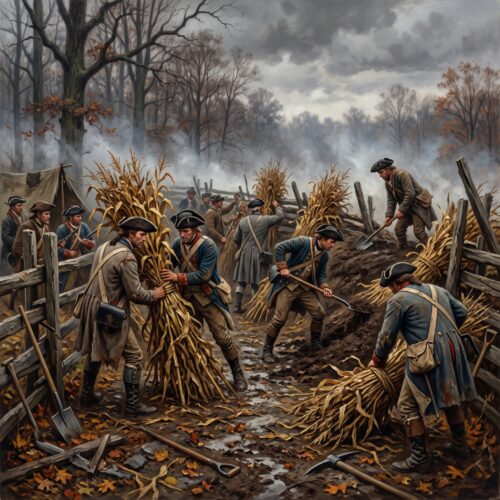
The Americans had retreated northward along the Post Road, their boots literally disintegrating off their feet. Dysentery ravaged the ranks. Men marched with their toes wrapped in burlap rags, trailing crimson splotches on the Westchester mud. By the fourth week of October, Washington halted his bruised, shivering force at the rural village of White Plains, roughly twenty-five miles north of New York City.
White Plains was not a fortress; it was a dispersed, agricultural hamlet of clapboard farmhouses, stone fence lines, and rolling pasture. To make a stand, Washington’s chief engineer, Colonel Rufus Putnam, along with French volunteer engineers, laid out a defensive semicircle of earthworks running across three low hills. But they had a major problem: earth takes time to dig, time was running out, and the soil was freezing and rocky. The soldiers frantically dragged downed rail fences into place, piling dirt and stones against the timber. Where the dirt gave out, they improvised with absurd desperation. Soldiers harvested adjacent stalks from harvested maize fields, binding the dried cornstalks together, piling them into mounds, and throwing a superficial shovelful of topsoil over the sheaves to give the appearance of impenetrable ramparts.
Washington’s line ran about three miles wide. Major General William Heath commanded the left flank on Horton’s Hill; Washington held the center directly straddling the roadway through the village. But across the Bronx River—a modest, swampy waterway winding through the bottomlands—rose an isolated, rounded prominence that towered roughly 180 feet above the valley floor: Chatterton Hill.
Initially, Washington had treated Chatterton Hill as an afterthought, an exterior landmark beyond his main entrenched perimeter. It was a glaring oversight. If the British mounted siege guns on that height, their artillery could deliver an enfilading, plunging fire straight down the throat of the American trenches in the village. Belatedly, on the morning of October 28, Washington realized the hill could become his executioner. He hastily dispatched Brigadier General Alexander McDougall with a patchwork brigade—including Colonel John Haslet’s Delaware regiment, William Smallwood’s elite Maryland line, New York continentals, and inexperienced Massachusetts militia—to scramble up Chatterton Hill, throw up whatever brush walls they could, and hold the crown at all costs.
They had barely unslung their cartridge boxes when the woods to the south began to shimmer in scarlet and brass.
Act II: The Anatomy of Chatterton Hill
General William Howe was not a hurried man. Cultured, deliberate, and fond of massive operational spectacle, Howe moved his army in textbook eighteenth-century European doctrine. Advancing in two grand columns, thirteen thousand British regulars and hardened Hessian auxiliaries emerged from the timber around 9:00 AM on that bright Monday morning.
The visual contrast was staggering. The British center moved forward in crisp ranks of scarlet wool, crossbelts gleaming with pipe-clay, bayonets flashing under the autumn sun. Alongside them marched the regiments of Hesse-Kassel under Lieutenant General Leopold Philip von Heister and Colonel Johann Rall—men clad in deep blue coats, towering brass-fronted grenadier caps, their mustaches waxed dark with shoe blacking, moving with the terrifying mechanical cadence of Frederick the Great’s drill manuals.
Opposing them on Chatterton Hill were sixteen hundred ragged Continentals and frightened farm boys. Alexander McDougall deployed his men behind a low stone boundary fence that cut horizontally across the slope. Colonel John Haslet’s Delaware soldiers—the famous “Blue Hen’s Chicks”—were veteran fighters, but to their right sat raw Massachusetts militia under Colonel Brooks, men who had never witnessed professional field artillery or a cavalry charge.
Howe halted his advance at the sight of the American works. For nearly an hour, British and German officers gathered their spyglasses, observing Washington’s center. Howe examined the mounds of freshly dug earth—unaware that large swathes of the American breastworks were nothing more than bundled cornstalks holding up a dust coat. The sheer theatrical confidence of Washington’s position spooked the British general. Unwilling to repeat the slaughter of Bunker Hill by storming the center head-on, Howe’s eyes drifted rightward, fixating on Chatterton Hill.
Howe brought up twenty heavy brass cannons, unlimbering them in an open field opposite Chatterton Hill. The artillery duel that followed shattered the rural silence of Westchester County. The concussion rattled the windowpanes for miles around, shaking dry yellow leaves from the trees like rain. Captain Alexander Hamilton, a diminutive nineteen-year-old artillery captain from New York, commanded two small six-pounder guns perched on a rocky ledge on Chatterton Hill. Hamilton calmly walked behind his pieces, sighting the barrels himself, returning fire into the mass of British infantry with lethal precision. His field pieces delayed the initial river crossing, but two small brass cannons could not silence twenty heavy pieces.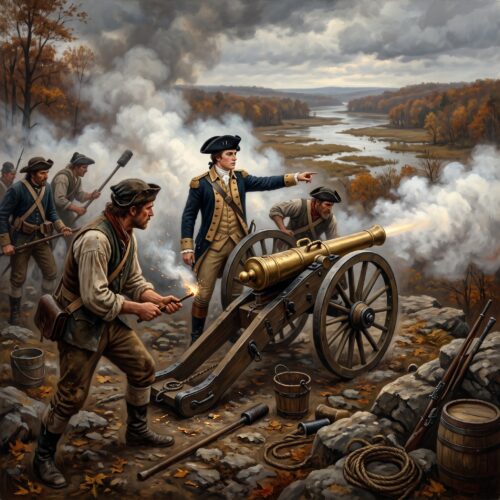
Under cover of this rolling cannonade, the Hessian grenadiers and British light infantry moved toward the Bronx River. The river was swollen from recent rains, roughly twenty to thirty feet wide and waist-deep, its banks lined with tangled brush and slick mud. Colonel Carl von Donop urged his Hessian chasseurs and grenadiers into the icy water. Men slipped, cursed in German, and held their flintlocks and paper cartridges high above their heads to keep the powder dry.
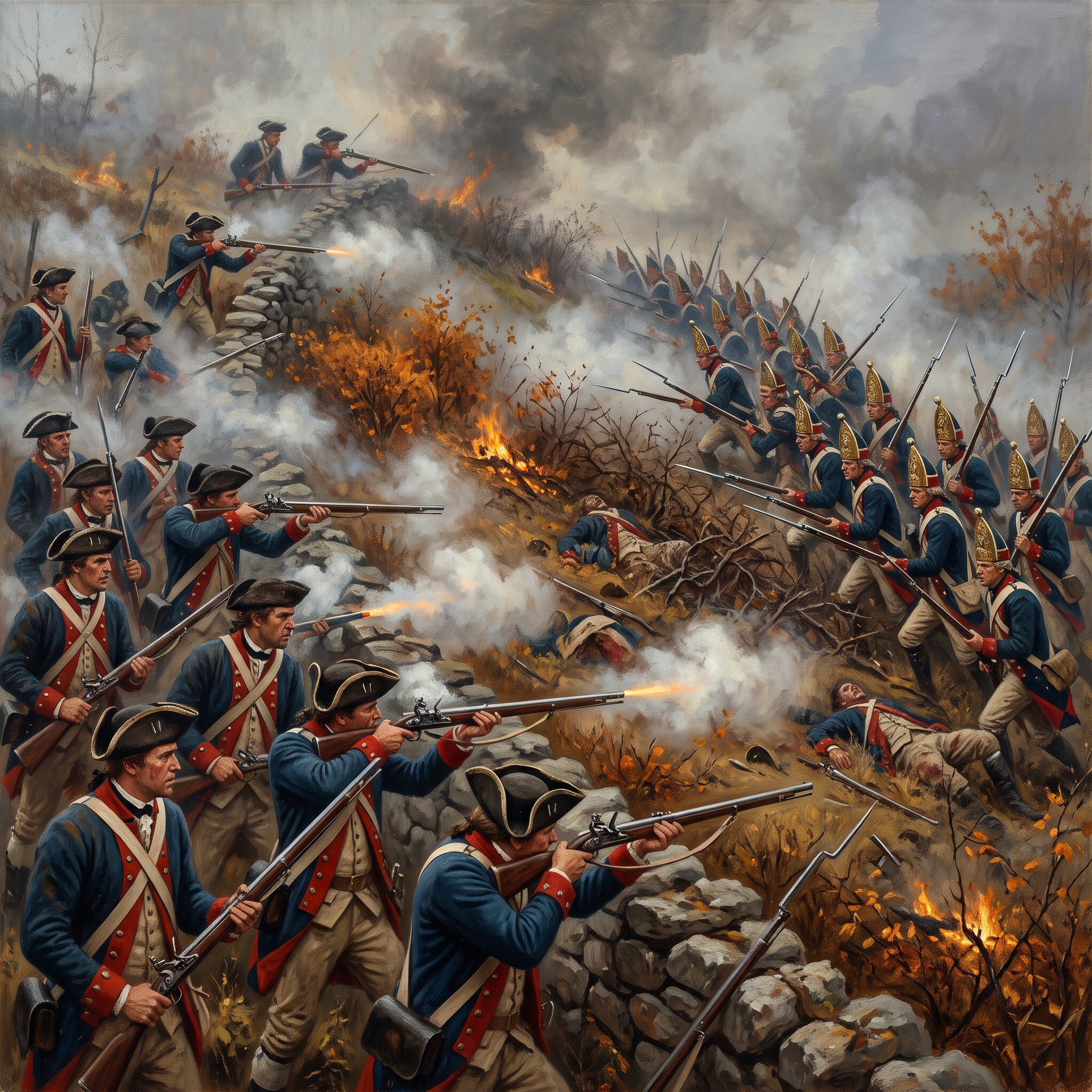
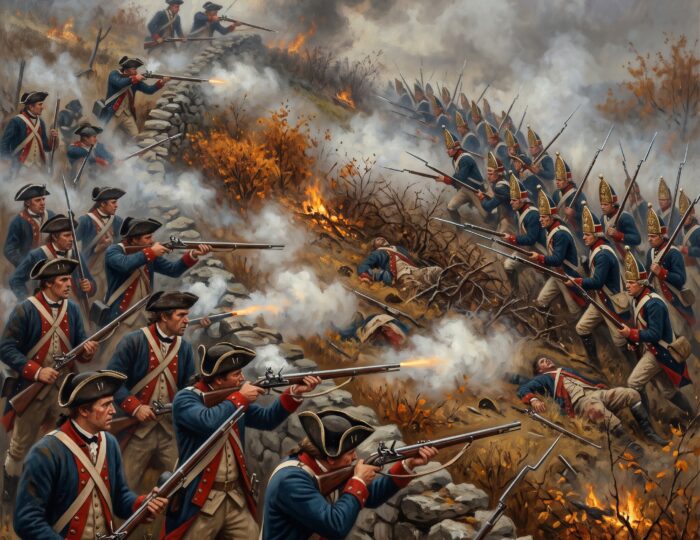
When the Hessian vanguard reached the American side, Haslet’s Delaware troops and Smallwood’s Marylanders rose from behind the stone wall and delivered an ear-splitting rolling volley. Smoke rolled down the hillside, masking the slope in gray sulfur. The German front ranks collapsed into the mud, but their discipline was granite. Under Colonel von Donop and Colonel Johann Rall, the Hessians formed ranks on the marshy bank, fixed three-sided bayonets, and began marching up the 180-foot incline.
Act III: The Crisis of the Flank
As the Hessians plodded uphill through dense briars, Howe unleashed a weapon the American militia feared above all else: the 17th Light Dragoons. The British cavalry rode up the slopes, sabers drawn, shouting curses.
For the Massachusetts militia stationed on the extreme American right, the combination of crashing grapeshot, advancing German bayonets, and galloping cavalry proved unbearable. The militia fired a scattered, ragged volley, broke ranks, and fled down the reverse slope of the hill toward the village. Their panic left the right flank of the Delaware and Maryland regiments completely exposed.
Johann Rall—the very same officer who would lose his life two months later at Trenton—saw the opening and wheeled his Hessian regiments to envelop the exposed American flank.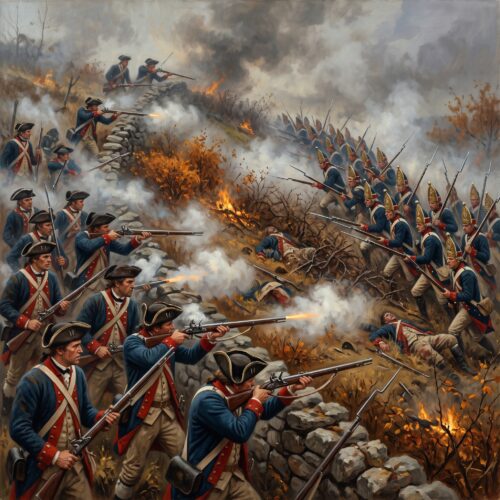
What followed was a brutal, intimate slugfest. William Smallwood was struck twice, taking musket balls through his hip and arm, but his Marylanders refused to break. Haslet’s Delaware men, anchored around the stone wall, loaded and fired with steady, mechanical fury, repelling two successive Hessian assaults. The dry autumn grass on the hillside caught fire from smoldering wads ejected from musket muzzles. Within minutes, the slope was ablaze, with wounded men screaming as they dragged themselves across scorched earth to avoid the advancing wall of flames.
By 4:00 PM, Alexander McDougall realized that holding the hill was no longer tactically viable. The Hessians had outflanked the stone wall; the British light infantry had closed the pincers. McDougall ordered a general retreat.
This was the exact pivot point where armies throughout history have collapsed into disorganized slaughters. But instead of routing, Haslet’s Delaware regiment formed an ironclad rearguard. Backing down the hill step by step, firing disciplined defensive volleys into the smoke, they covered the withdrawal of the wounded, dragged Hamilton’s guns across the river bridge, and made it back behind Washington’s primary lines in the village.
The British had won Chatterton Hill. Around 220 Americans lay dead, wounded, or captured; the British and Hessians suffered nearly 300 casualties of their own. General Howe now held the dominant ground. The textbook European play was to roll forward immediately, attack Washington’s shaken center, crush the makeshift trenches, and bring the American rebellion to a definitive end.
Instead, William Howe stopped.
Looking across the bottomland at Washington’s grimly silent earthen fortifications—those deceptive mounds of rocks, timber, and dirt-covered cornstalks—Howe hesitated. The memories of June 17, 1775, at Bunker Hill still haunted him, where waves of his finest grenadiers had been cut down in swaths by entrenched rebels. The sun was dipping below the horizon. The evening air was bitter cold. Howe announced he would wait for heavy reinforcements from General Percy before launching the final, crushing assault on October 30.
On the night of October 29, a torrential, violent northeastern storm slammed into the Hudson Valley, turning the roads into liquid clay and making muskets impossible to fire. While Howe waited comfortably in his tent for the rain to stop, Washington executed his masterpiece.
Quietly, methodically, in the pitch-black rain of October 31, the Continental Army wrapped the wheels of their gun carriages in rags, stepped out of their trenches, and vanished. They marched five miles north into the nearly impregnable granite crags of North Castle. When William Howe ordered his grand assault on the morning of November 1, his infantry charged forward, bayonets ready, only to burst through empty works, abandoned fire pits, and sodden bundles of cornstalks. The bird had flown.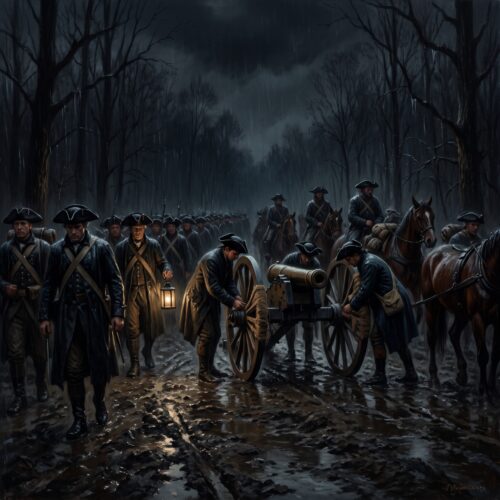
Act IV: The Tactical Autopsy of October 28
The Battle of White Plains was categorized in British military despatches as an undeniable crown victory. They had seized the battlefield, driven the enemy off the high ground, captured artillery, and forced a retreat.
Yet militarily, White Plains was one of the most brilliant strategic survival operations in modern warfare.
Understanding why requires dissecting the psychology of the two commanders. General William Howe was operating under the paradigm of Decisive Field Engagement. In European dynastic wars, victory was attained by seizing the physical terrain, forcing the enemy to surrender their capital, or shattering their army in a single climactic set-piece battle. Howe repeatedly measured success by geographic conquest: capturing Long Island, occupying Manhattan, taking Chatterton Hill.
George Washington, by contrast, had experienced a grueling epistemological awakening. Between August and October 1776, Washington abandoned his romantic notions of winning a grand European-style battle against the British professional war machine. He realized that the United States could lose New York, lose Boston, lose Philadelphia, and even lose nine out of every ten tactical skirmishes—and still win the war. The only way the American Revolution could truly die was if the Continental Army ceased to exist.
Therefore, Washington redefined victory:
- Terrain is expendable; kinetic capacity is irreplaceable. Land could be yielded and re-conquered later. A slaughtered veteran line could never be replaced.
- The illusion of strength purchases operational time. The hastily piled cornstalks in the center created psychological friction in Howe’s mind, paralyzing him for forty-eight crucial hours.
- A disciplined fighting withdrawal is superior to a stubborn, suicidal stand. By sacrificing Chatterton Hill while preserving his rearguard, Washington turned an encirclement into an organized pivot.
Had Washington stubbornly staked the entire war on holding White Plains to protect his ego, the Continental Army would have been shattered, the leadership captured, and the Declaration of Independence reduced to a footnote of failed treason. By absorbing the blow, giving ground, leveraging bluff and friction, and slipping into the night, Washington kept the ember alive long enough to strike at Trenton eight weeks later.
Act V: The White Plains Protocol: Strategic Resilience for Modern Chaos
Most modern personal development advice is hopelessly infected with the “Decisive Field Engagement” delusion. You have heard the platitudes: “Never give up,” “Hold your ground at all costs,” “Failure is not an option,” “Conquer the day by sheer willpower.”
This is toxic advice that leads directly to catastrophic burnout, bankruptcy, and personal exhaustion. When real-world crises hit—corporate downsizings, market collapses, sudden personal betrayals, or systemic resource shortages—attempting to hold every hill against superior force is not courage; it is operational suicide.
The lesson of October 28, 1776, is that tactical retreat in service of preservation is the highest form of strategic mastery. When the odds turn against you, your objective is not to win the current hour; your objective is to ensure you survive with your capacity intact so you can dominate when conditions change.
Here is the exact, actionable, and unique framework derived from Washington’s actions at White Plains: The White Plains Protocol.
THE WHITE PLAINS CYCLE
┌────────────────────────────────────────────────────────────────────────┐
│ │
│ [1. Chatterton Hill Audit] ──> Identify expendable assets/battles │
│ │ │
│ ▼ │
│ [2. Cornstalk Bluff] ──> Project synthetic stability to stall │
│ │ │
│ ▼ │
│ [3. Rearguard Anchor] ──> Form a resilient disciplined reserve │
│ │ │
│ ▼ │
│ [4. Midnight North Castle] ──> Decouple, slip away, reset high ground│
│ │
└────────────────────────────────────────────────────────────────────────┘
Phase 1: The Chatterton Hill Audit (Immediate Asset Decoupling)
Stop trying to defend every single project, relationship, or commitment when you are under severe operational stress.
- Identify Your “Chatterton Hill”: Which project, pride-project, or peripheral obligation are you bleeding emotional and financial energy trying to save, simply because you don’t want to admit you’re losing it?
- Execute Strategic Abandonment: Consciously decide what you will sacrifice. If a venture is draining your cash reserves or health, do not go down with the ship out of stubborn pride. Yield the terrain before it bankrupts the core enterprise.
- Define the Non-Negotiable Core: Washington recognized that his army was the core; the geography was noise. What is your actual core? (Your physical health, your family unit, your primary liquidity). Everything else can be rebuilt from scratch.
Phase 2: The Cornstalk Bluff (Friction-Induced Buffer Building)
When facing acute external pressure or panic, immediate erratic reaction invites immediate destruction. You must create tactical pauses.
- Manufacture Psychological Friction: When a crisis erupts, never reply, concede, or counter-attack within the first four hours. Silence, measured cadence, and structured templates mimic fortress walls. Unhurried calmness makes opponents, competitors, or panicking counterparts hesitate, buying you time to evaluate the board.
- Consolidate Visible Baselines: Assemble simple, tidy representations of order—clear communication, concise logs, tidy work spaces—to signal total command. When people observe structured exteriors, they assume massive reserve strength and slow their offensive tempo.
Phase 3: The Delaware Rearguard Anchor (Disciplined Decoupling)
When retreating from a bad job, a toxic partnership, or a failing trade, people usually panic and run, leaving their assets, reputations, and sanity in ribbons. You must retreat with fixed bayonets.
- Never Exit in Disarray: If you must leave a position, dissolve a contract, or step down, do not burn bridges, throw tantrums, or ghost. Deliver a masterclass in professional closure. Hand over tidy documentation, settle debts cleanly, and close accounts deliberately.
- Form an Internal Reserve: Keep a dedicated 15% reserve of emotional stamina and cash strictly walled off. Never commit 100% of your resources to the frontline fight. When things collapse, your reserve is the rearguard that prevents total ruin.
Phase 4: The Midnight North Castle Maneuver (The Silent Pivot)
The moment your opponent pauses, or the crisis reaches an administrative lull, move your operation quietly.
- Execute in the Quiet Hours: Real structural life changes do not happen with public announcements, social media declarations, or dramatic speeches. They happen under the cover of midnight. Cancel the subscriptions, rewrite the business model, restructure the debt, and secure the new resume quietly.
- Relocate to High Ground: Settle into a position of natural defensibility—low overhead, high margins, quiet routines. When the chaos wakes up expecting to finish you off where you were yesterday, let them discover an empty field. You are already fortified on the granite ridges of your next move.
The Reality Check
The world worships decisive tactical victories: the triumphant product launch, the public award, the spectacular knockout. But real history is not won by people who never get pushed back. It is won by those who know how to absorb a thrashing at breakfast, fight an orderly rearguard action by lunch, build a wall out of cornstalks by late afternoon, and slip away into the hills by midnight—ready to fight again tomorrow.
On this day in 1776, George Washington gave up Chatterton Hill, gave up White Plains, and gave up New York. Two months later, he crossed the ice-choked Delaware River and changed human history forever.
Yield the hill. Save the army.
For a detailed look at the troop movements and terrain that shaped this pivotal engagement, this Battle of White Plains overview examines the strategic clash between the Continental Army and British forces.
Share: