
On the morning of August 16, 1513, the fields and low hills around the village of Guinegate—today called Enguinegatte—in the French province of Artois looked ordinary enough for late summer. Dust rose from the roads. The Lys River still carried its usual summer flow. English and Imperial troops had been hammering at the walls of nearby Thérouanne for weeks, and the French high command decided the moment had come to relieve the garrison with a bold supply run covered by heavy cavalry. What followed was not a grand clash of ordered ranks or a heroic stand that poets would sing about for centuries. It was a short, chaotic, and almost comically one-sided affair that the French themselves quickly nicknamed *La Journée d’Esperons*—the Day of the Spurs—because the only weapons most of their knights truly used that afternoon were the metal points they drove into their horses’ flanks as they fled.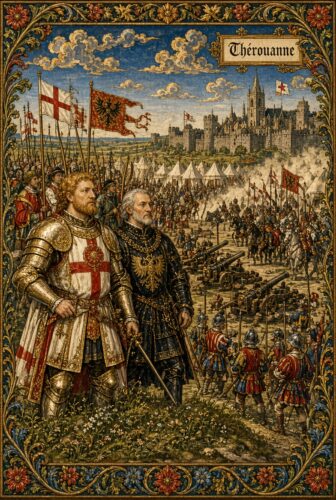
The larger stage for this episode was the tangled War of the League of Cambrai, itself only one chapter in the long Italian Wars that had already dragged half of Europe into endless campaigns over Italian cities, papal influence, and dynastic pride. In 1508 the League had begun as an attempt by Pope Julius II, the Holy Roman Emperor Maximilian I, France, and others to curb Venetian power. Alliances shifted with dizzying speed. By 1511 Henry VIII of England had joined what became known as the Holy League, promising to strike at France. Young, athletic, and hungry for the kind of military glory that would place him among the great warrior kings of Europe, Henry saw the French campaign of 1513 as his chance.
English forces began landing at Calais in May. George Talbot, Earl of Shrewsbury, took command of the early contingents. Charles Somerset, Lord Herbert, led another division. Henry himself crossed in late June with a substantial army that included longbowmen carrying specially hardened arrows designed to punch through plate, artillery pieces with colorful names, German mercenaries, and the usual complement of men-at-arms and light horse. Catherine of Aragon remained behind as governor of the realm. The main objective became the fortified town of Thérouanne, a tough nut that had already frustrated earlier efforts. Shrewsbury’s guns opened fire. Mines were dug. The garrison, a mix of French and German soldiers under Antoine de Créquy, held firm through July. At one point a bold relief column of roughly eight hundred Albanian light horsemen under Captain Fonterailles actually slipped supplies and eighty reinforcements into the town. A second, larger attempt was planned for mid-August.
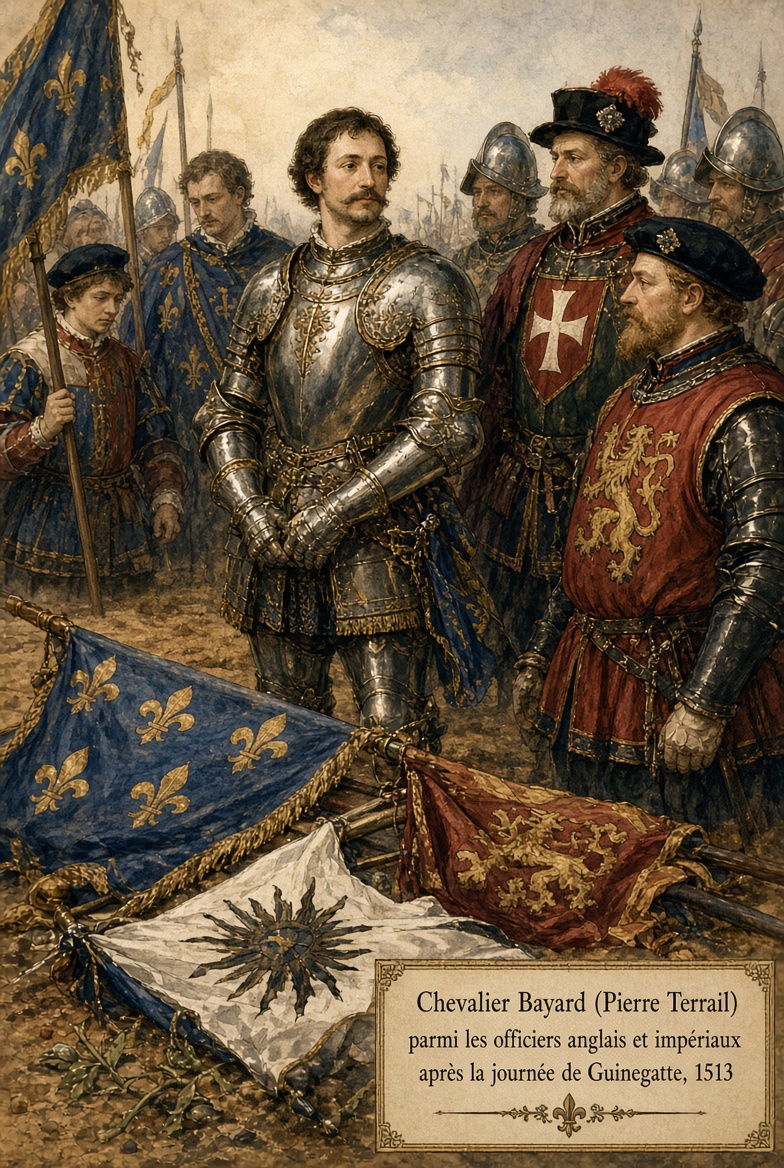
Henry shifted his camp to Guinegate on August 14 and ordered five bridges thrown across the Lys so his forces could move more freely. The French, under the experienced Jacques de La Palice (also known as La Palisse), prepared a coordinated effort. Heavy cavalry would screen a supply convoy while diverting the besiegers’ attention. Estimates of the French force that rode out put it around seven thousand men: gendarmes in full armor, supporting pikemen, and stradiots—light cavalry of Balkan origin who carried bacon and gunpowder among other supplies. Among the French commanders rode Louis d’Orléans, Duke of Longueville, Charles IV, Duke of Alençon, and the celebrated Chevalier Bayard, Pierre Terrail, already a living legend for courage and courtesy.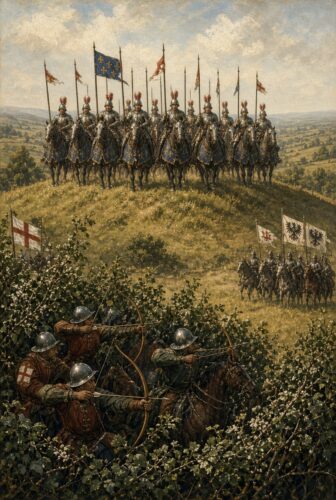
English border prickers—light horsemen skilled at scouting—detected the movement early. The French force encountered English scouts near the village of Bomy, about five miles from Thérouanne. Realizing the English were alert, the French heavy cavalry checked themselves on the edge of a hillside. That pause proved fatal. English mounted archers opened fire from the cover of a hedgerow. A vanguard of roughly eleven hundred English cavalry pressed forward, followed by a much larger body of infantry that never fully needed to close. On one flank Imperial cavalry under Maximilian’s command applied pressure. On another, English guns and further horsemen completed the squeeze. The stradiots, driven off by cannon fire, crashed back into their own heavy cavalry and added to the disorder.
What had been an organized screening force dissolved into a panicked mass. French knights threw away lances, discarded standards, and even shed pieces of horse armor to lighten their mounts. The cry went up to turn and fight, but the momentum of flight was already unstoppable. Pursuit stretched for miles toward Blangy. Alençon’s separate detachment was roughly handled by Lord Herbert’s men and forced back. By the end of the day the field was littered with abandoned equipment and the bodies of those who had been overtaken. Allied casualties were light. French losses ran to roughly three thousand killed, wounded, captured, or missing. More than a hundred men-at-arms were taken, including some of the highest-ranking nobles in the French army. Nine standards fell into English and Imperial hands. Among the prisoners were La Palice himself (who later escaped), the Duke of Longueville, and the Chevalier Bayard.
Contemporary accounts capture the flavor of the rout with a mixture of official satisfaction and wry amusement. The Imperial master of the posts, Baptiste de Tassis, wrote that same evening that the Emperor and the King of England had encountered eight thousand French horse; with only two thousand the Emperor had held them until the afternoon, when they were put to flight, leaving a hundred men-at-arms on the field and more than a hundred of the best men in France as prisoners. Henry’s own letter the following day described the initial French probe against Shrewsbury’s lines, the Imperial maneuver that brought the enemy under the guns, and the subsequent flight. The English chronicler Edward Hall later recorded that the French themselves called the affair the Battle of the Spurs. When some of the captured captains were brought before Henry, the young king allegedly congratulated them on the speed of their horses. The French officers, with the dry humor that sometimes survives even battlefield humiliation, replied that it had been nothing but a battle of spurs—those being the only weapons they had truly employed.
Bayard’s capture became a small legend of its own. Seeing an English knight who seemed insufficiently attentive in the aftermath, the Chevalier reportedly charged him, sword drawn, and demanded surrender or death. The Englishman complied, only for Bayard to discover he had “captured” someone already on the winning side. The knight of France spent several days as a polite prisoner before being allowed to return to his own lines, true to the chivalric code that still governed such exchanges even as the practical realities of gunpowder and massed archery were changing warfare.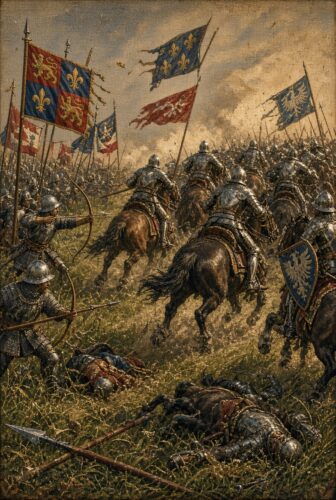
The immediate military consequences followed quickly. With the relief attempt shattered, Thérouanne’s garrison lost hope. The town surrendered on August 22. Shrewsbury received the keys and presented them to Henry. The walls and bastions were systematically demolished so the place could never again serve as a French strongpoint on the frontier. Attention then shifted to Tournai. After negotiations and a short siege that began in mid-September, that city too fell on September 23. Henry entered in triumph, heard mass in the cathedral, and knighted a number of his captains. Tournai remained in English hands until it was returned by treaty in 1518.
For Henry VIII the episode was pure political gold. At twenty-two he had crossed the Channel, commanded an army in the field alongside the experienced Emperor Maximilian, and scored a victory that English propagandists could trumpet across Europe. Woodcuts and official narratives emphasized the meeting of the two monarchs and the capture of famous French names. Maximilian, already in his fifties, had shown remarkable energy, leading cavalry and serving, at least symbolically, under Henry’s standard. The campaign was expensive, the strategic gains temporary, and the Italian Wars continued their bloody course for years afterward. Yet the Day of the Spurs fixed itself in English memory as an early mark of the young king’s martial competence. It also offered a sharp illustration of how quickly even elite heavy cavalry—the traditional aristocrats of the battlefield—could unravel when surprised, poorly positioned, and pressed from multiple directions at once.
The French force that rode out that August morning carried the prestige of generations of chivalric reputation. Gendarmes in full plate, trained from youth, mounted on powerful horses, and led by officers of proven courage should have been a formidable instrument. Instead they found themselves on the wrong side of a hedgerow, under arrow fire, with light troops recoiling into their ranks and enemy cavalry appearing on the flanks. The psychological cascade from confidence to hesitation to full flight took only a short time. Standards that had been meant to rally men became trophies. Lances that had been meant to shatter enemy lines were cast aside so riders could spur harder. The very equipment that defined the knightly class became, for one afternoon, an impediment to survival.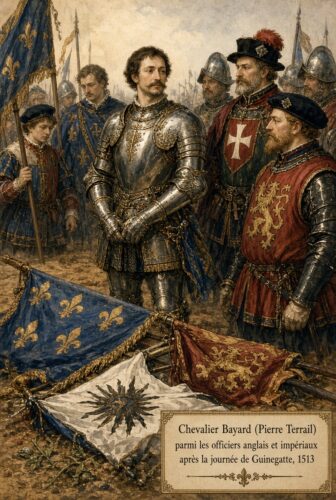
Later generations sometimes dismissed the affair as a mere skirmish inflated by Tudor propaganda. There was no prolonged melee of the sort that decided the great set-piece battles of the age. Yet the practical results were real: a key frontier town reduced, another major city taken, high-value prisoners secured, and a boost to English prestige at a moment when Henry was still establishing himself on the European stage. The name itself—Battle of the Spurs—ensured the story would be remembered with a smile as much as with solemnity. Even the French chroniclers and captains adopted the label, turning potential shame into a kind of shared joke about the unexpected speed of their own horses.
The campaign as a whole revealed the logistical and political complexities of early sixteenth-century warfare. English longbowmen still mattered, their steel-tipped arrows capable of finding gaps in armor. Artillery played a supporting role both in the siege and in the field. Light scouts proved decisive in detecting the French movement before it could achieve surprise. Coordination between English and Imperial contingents, though never perfect, was sufficient to create the multi-directional pressure that broke the French formation. Maximilian’s willingness to fight under Henry’s banner for the day was a diplomatic gesture as much as a military one, underscoring the temporary alignment of interests against France.
In the weeks that followed, Henry’s army moved from success to success in the immediate theater even as news arrived of the far bloodier Battle of Flodden in the north, where the Scots under James IV had been crushed by an English force fighting in Henry’s absence. Catherine of Aragon sent her husband the blood-stained coat and gauntlets of the dead Scottish king, suggesting they might serve as a battle banner or be exchanged for the captured Duke of Longueville. The young English monarch was, for a brief season, the picture of a successful warrior prince.
Yet the deeper pattern visible at Guinegate was older than any single campaign. Elite forces that believe their reputation and equipment will carry the day can still be undone by incomplete information, awkward terrain, and the sudden appearance of pressure on an unexpected flank. The French heavy cavalry did not lack courage. Many individual knights tried to rally. The problem was systemic: once the collective decision tilted toward flight, the weight of armored men and horses made recovery almost impossible. The spurs that were meant to drive a charge home became the instruments of a headlong retreat.
The fields around Enguinegatte have long since returned to ordinary farmland. The walls of Thérouanne were never rebuilt to their former strength. Tournai changed hands again according to the treaties of the following years. Henry VIII went on to a long and complicated reign filled with greater triumphs and greater disasters. Maximilian continued his restless imperial career. Bayard met his end years later in another Italian campaign, still fighting with the same personal bravery. The Day of the Spurs remained a curious footnote—an episode in which the most glamorous arm of medieval warfare discovered that glamour offers little protection against surprise, arrows, and the simple decision of too many men at once that the better part of valor was to ride hard in the opposite direction.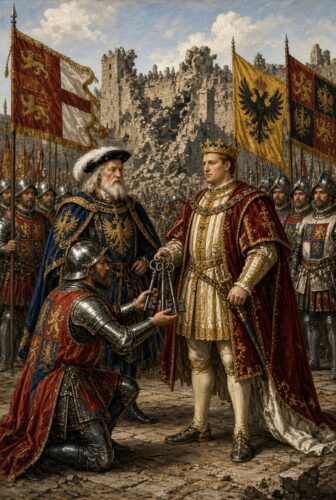
That is the historical core of August 16, 1513: a supply operation that became a rout, a hillside that became a trap, and a nickname that stuck because it told the truth with uncomfortable precision. The flower of French chivalry spurred away from a fight it had expected to dominate, leaving standards, prisoners, and a lasting reminder that even the best-equipped force can lose its coherence in a single afternoon when the conditions turn against it.
The practical residue of that afternoon still matters. The French knights did not fail because they were cowards. They failed because they entered a situation whose true shape they did not fully see, under conditions that favored the side with better scouting, better positioning, and the ability to apply pressure from more than one direction at once. When the moment of decision arrived, the collective impulse to seek safety overwhelmed the individual impulse to stand. The result was a rapid, irreversible cascade.
A person facing modern pressures can extract something more useful than generic advice about courage or preparation. The unique value of the Guinegate episode lies in its demonstration that the critical failure often occurs before the first serious clash—when assumptions about one’s own strength and the enemy’s disposition go untested. The French force assumed the English would be fixed on the siege and that a strong cavalry screen would be enough. Both assumptions collapsed within hours.
Here is a concrete, non-generic plan built directly from the mechanics of that August day. Call it the Spur Audit. It is not a morning routine, a gratitude journal, or a vision-board exercise. It is a deliberate, periodic examination of the commitments and positions in which you are currently “spurring”—moving with force and speed under the belief that momentum itself will carry you through.
Once every two weeks, take a single sheet of paper and list every significant ongoing effort that requires sustained energy: projects, negotiations, habits under strain, relationships carrying unresolved tension, financial or professional positions that feel precarious. For each item, answer three questions in writing, no longer than two sentences each.
First: What is the actual terrain right now? Not the terrain you hoped for or the one that existed when you began, but the visible conditions this week—resources available, information gaps, external pressures that have appeared since the last review. The French missed the English scouts and the hedgerow. Most modern overextensions begin with the same failure to update the map.
Second: Where are the potential flanks? Identify at least one direction from which unexpected pressure could arrive—another person’s decision, a change in external rules, a personal energy limit, a competing demand on time. The Imperial cavalry and the English guns at Guinegate were not the main body; they were the forces that turned a difficult situation into a rout. Name the equivalent pressures in your list.
Third: What would a clean disengagement look like if the flanks close? This is not defeatism. It is the practical counterpart to the French discovery that discarding lance and standard sometimes becomes the only remaining option. Define, in advance, the specific signal that would tell you the current posture is no longer tenable and the smallest concrete step that would reduce exposure without total collapse. The knights who threw away equipment survived to fight another day. Those who clung longest to the original plan paid higher prices.
Perform the audit in one sitting, no more than forty minutes. Do not share the paper. Do not turn it into a public commitment. At the next cycle, compare the new answers with the previous sheet. The goal is not constant retreat. The goal is to notice, earlier than the French did on that hillside, when the combination of incomplete information and multi-directional pressure has already begun to erode coherence. Most people discover the trap only after the cascade has started. The Spur Audit is designed to surface the mismatch between assumed strength and actual conditions while there is still room to adjust posture, reinforce a flank, or, when necessary, spur in a more useful direction.
The historical record of August 16, 1513, is not a morality play about bravery versus cowardice. It is a precise demonstration that elite capability, expensive equipment, and honorable intentions can still produce a rout when scouting fails, positioning is awkward, and pressure arrives from angles the plan did not anticipate. The spurs that gave the day its name were not symbols of shame so much as evidence of a rapid collective recalculation under fire. That recalculation, performed too late, cost the French a town, a city, and a measure of prestige. Performed earlier, the same capacity to recognize a deteriorating position remains one of the most practical habits any person can cultivate.
The fields near Enguinegatte are quiet now. The standards captured that afternoon have long since decayed or disappeared into collections. What remains is the clear outline of a day when assumptions met reality and reality won in a matter of hours. The lesson does not require armor or arrows. It requires only the willingness to examine, at regular intervals, whether the ground under your current efforts still supports the speed at which you are trying to move.
Share: