
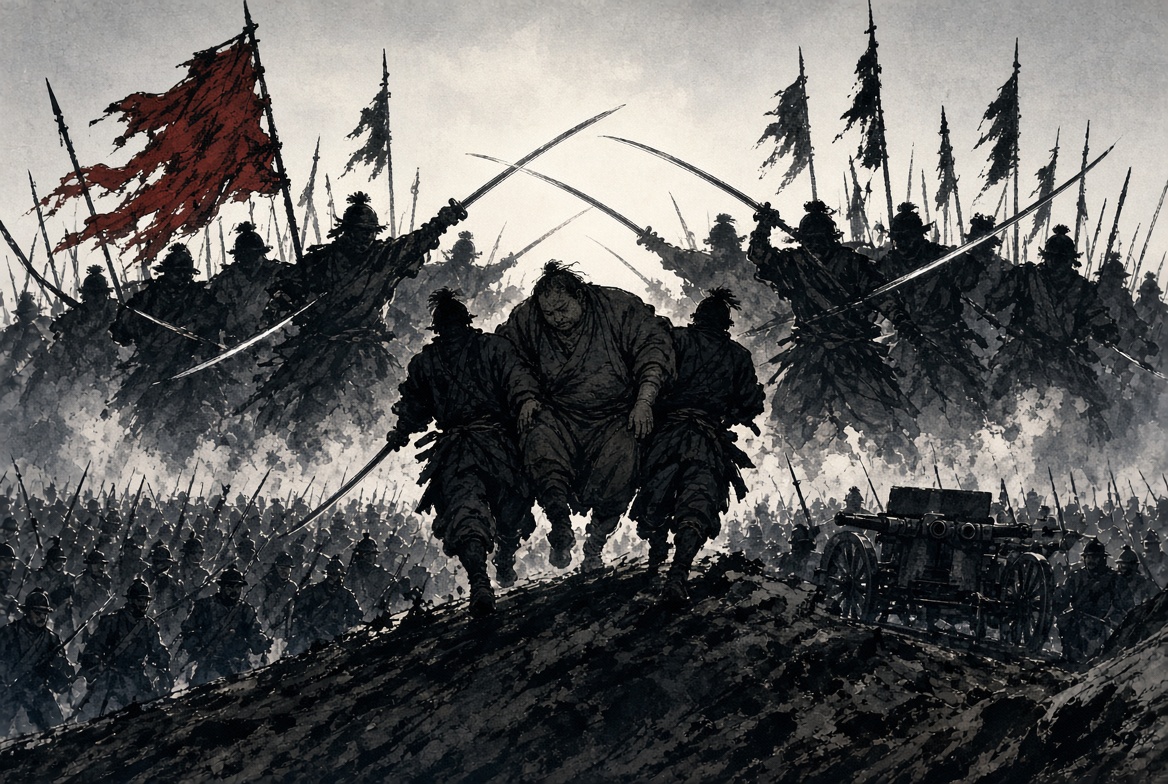
Picture a wooded hill that looks, from the bay, like nothing more than a green knuckle of land rising behind a provincial city. On the morning of 24 September 1877 the hill is called Shiroyama. The city below it is Kagoshima. The men on the hill have been drinking sake since the previous evening. They have almost no cartridges left. Some of the bullets they still possess were cast from melted Buddhist statues. One of their wounded has been treated with a carpenter’s saw. There are perhaps four hundred of them. Below them, in trenches and earthworks that ring the hill like a noose, stand thirty thousand soldiers of the Imperial Japanese Army, backed by warships in the harbor whose guns have already spent the night turning the summit into rubble.
At four in the morning the infantry comes up the slopes.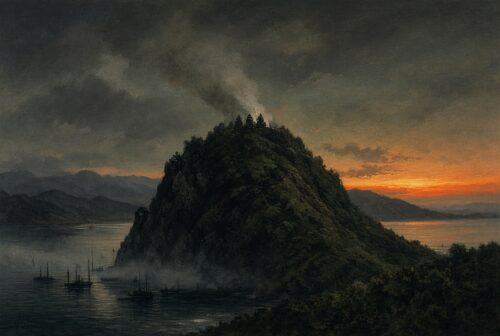
That is the event. It lasts a few hours. By six o’clock almost no one on the hill is still standing. The man who led them, Saigō Takamori, is dead. The Satsuma Rebellion is over. The samurai class, as a political and military force that had defined Japan for seven centuries, is finished. Japan will never again fight a major internal war with swords against rifles. The country that walks off that hill will, within a generation, defeat China, then Russia, and announce itself as a modern power. The men who charged downhill that morning did not live to see any of it.
This is not a story about noble defeat in the abstract. It is a story about a specific group of men who had already helped invent the new Japan, then discovered they could not live inside it, and chose to die rather than become something else. The details are stranger, funnier, and more precise than the movie version.
Saigō Takamori was born in 1828 in Kagoshima, the castle town of Satsuma domain, the southernmost of the great tozama domains that had never fully trusted the Tokugawa shoguns in Edo. He was a low-ranking samurai from a family that kept the domain’s accounts. He was large, even by later photographs: broad, heavy-featured, with a presence that made people remember him in rooms. As a young man he studied Confucian texts and seemed destined for clerk work. Then the world arrived in black ships.
Commodore Perry’s squadron appeared in 1853. The shogunate signed treaties it could not enforce. Domains argued over whether to expel the barbarians or use their guns. Satsuma, which had already been trading through the Ryukyus and experimenting with Western gunnery and shipyards, produced some of the men who would eventually topple the shogunate. Saigō attached himself to the reforming daimyo Shimazu Nariakira. When Nariakira died in 1858, Saigō was so undone he tried to drown himself with a monk named Gesshō; they were pulled out of the water. He spent years in exile on remote islands, writing poetry and waiting. By the mid-1860s he was back, allied with Chōshū, and one of the principal architects of the Boshin War that ended Tokugawa rule in 1868.
Here is the first joke history plays on him. Saigō helped create the Meiji state. He commanded imperial forces. He sat in the new government. He was a field marshal. Then the government he had helped build began to do exactly what a modern state does: it abolished the domains, commuted samurai stipends into bonds that promptly lost value, forbade the wearing of swords in public, created a conscript army of farmers and townsmen, and sent missions abroad to copy railroads, factories, banks, and rifle drill. The slogan that had justified the Restoration — revere the emperor, expel the barbarians — quietly dropped the second half. The barbarians’ methods were now official policy.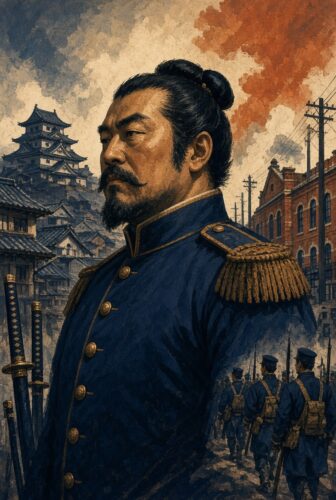
Saigō wanted a war with Korea in 1873, partly as a way to give unemployed samurai a purpose and partly from a conviction that Japan should not wait to be humiliated again. The government, with half its leaders still abroad on the Iwakura Mission, rejected the plan. Saigō resigned. He went home to Kagoshima and founded private academies, the shigakkō, that taught young men the old military arts alongside a heavy dose of loyalty to the emperor and contempt for the politicians in Tokyo. The academies looked, to Tokyo, like a private army. In January 1877 the government sent a ship to seize the arsenals in Kagoshima. Local samurai, many of them Saigō’s students, drove the sailors off and looted the weapons themselves. Fifty police officers who had been sent south with vague instructions that sounded a great deal like an assassination plot against Saigō were captured and, under interrogation, said as much.
Saigō was hunting when the news reached him. He came back furious at the hotheads, then equally furious at Tokyo. He agreed to lead. On 15 February 1877 an army of perhaps twelve to twenty thousand men — numbers wobble in the sources — marched north out of Kagoshima in a snowstorm. They carried banners that read, in effect, “New government, rich virtue.” Saigō wore his old imperial uniform. He insisted he was not rebelling against the emperor; he was marching to petition him against the corrupt men around the throne. The distinction mattered to him. It did not matter to the men who would have to shoot him.
They laid siege to Kumamoto Castle. The garrison held. Imperial reinforcements arrived. At Tabaruzaka in March the rebels fought a grinding, modern battle of rifles and artillery and lost. From that point the campaign became a long, shrinking retreat across Kyushu. Deserters peeled away. Ammunition ran short. By late summer Saigō had a few thousand men left, then a few hundred. In late August imperial forces under Yamagata Aritomo, Saigō’s old comrade from the Restoration wars, nearly trapped them on Mount Enodake. Saigō slipped away in fog and, on 1 September, walked back into Kagoshima with roughly four hundred survivors. They climbed Shiroyama, the hill that overlooks the city and the bay, and dug in.
Yamagata did not rush. He had thirty thousand men and the navy. He ringed the hill with trenches and earthworks so complete that escape was no longer a serious option. He issued an order that any imperial unit falling back under rebel pressure was to be fired on by the neighboring units. Friendly casualties were acceptable; another escape was not. On 23 September Admiral Kawamura Sumiyoshi, who was married to one of Saigō’s aunts, sent an ultimatum: surrender by five in the afternoon, hand over Saigō, and lives would be spared. Two rebel officers walked down under a white flag to talk. They were sent back with a letter from Yamagata urging Saigō to see reason.
Saigō did not answer. That night he and his officers drank sake. They sang. They wrote poems. They knew what the morning would be.
They were already improvising like men who understood they were living in the last hour of an old technology. Ammunition was so scarce they melted metal statues from nearby temples and cast bullets. Wounds were dressed with whatever was at hand; one account mentions a carpenter’s saw used as a surgical instrument. They still had some Snider-Enfield breechloaders and a handful of artillery pieces they had dragged or captured earlier, but the math was finished. Thirty thousand men with modern rifles, field guns, naval bombardment, and Gatling guns against four hundred men whose highest skill was the sword.
After midnight the guns opened. Warships in the harbor joined the land batteries. The hill shook. At four in the morning on the 24th the infantry attack began from every side at once.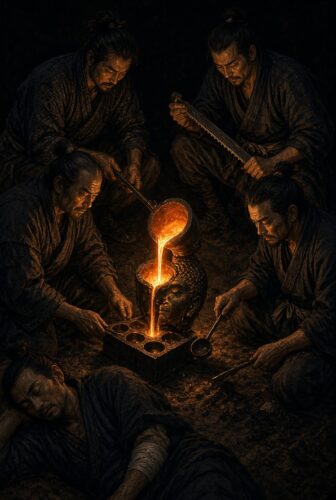
For a short time the samurai line held. When the imperial conscripts — farmers’ sons and townsmen who had been drilled for a few years — closed to sword range, the old training showed. The first ranks buckled. Hand-to-hand, a man who has spent decades with a katana is still dangerous against a man who has spent months with a rifle. It did not last. Numbers and firepower reasserted themselves. The rebels were pushed back up the slope.
Saigō was hit in the femoral artery and the stomach. He could no longer stand. Beppu Shinsuke, one of his closest retainers, carried him downhill looking for a quiet place. The traditional story, the one that became legend, is that Saigō asked Beppu to be his kaishakunin, faced east toward the imperial palace, and committed seppuku. Beppu then cut off the head in one stroke and hid it so the enemy would not take it as a trophy. A laborer later found the head because some of the hair had been left attached in the haste. An autopsy performed afterward found no abdominal wound consistent with a proper seppuku cut. Saigō was probably already dying from the bullets and too crippled to perform the ritual. Beppu finished it anyway, then led the last charge himself and was shot down.
By six in the morning perhaps forty men were still alive. They drew their swords, ran downhill into the imperial lines, and were killed by rifle and Gatling fire. The battle was over. Every rebel on the hill was dead. Imperial losses were light enough that the official figures barely register beside the rebel total.
The government spent a fortune putting the rebellion down — hundreds of millions of yen, enough to force Japan off the gold standard for a time and to print paper currency. Land tax was cut to ease the burden. The samurai stipend system was already dead; Shiroyama buried the cultural argument that the old warrior class was still necessary. The conscript army of commoners had beaten the last professional swordsmen in open fight. From that morning forward, Japan’s wars would be fought by a national army that did not care who your grandfather had been.
Saigō was posthumously pardoned in 1889. Statues went up. In Ueno Park in Tokyo he sits with his dog, looking like a kindly uncle rather than the man who melted Buddhas for bullets. Popular prints and later films turned him into the tragic last samurai, the man who died for honor while the country raced into the future. The reality is less tidy and more useful. He was not a reactionary who had never seen a railroad. He had helped build the new state. He simply could not accept that the new state no longer needed the kind of man he had spent his life becoming. The hill did not kill a cartoon of tradition. It killed a specific, highly skilled, highly proud identity that had outlived its military and economic function.
The carpenter’s saw and the melted statues are the details that refuse to stay in the museum. They are the sound of men who still believed the old tools could be made to work if they just tried harder, later, with more spirit. They could not. The Gatlings did not care about spirit.
That is the history. It is long, bloody, particular, and finished. The question it leaves is not “Would you have charged?” Everyone says yes in a comfortable chair. The question is what you are still charging with that the world has already surrounded with trenches and modern weapons.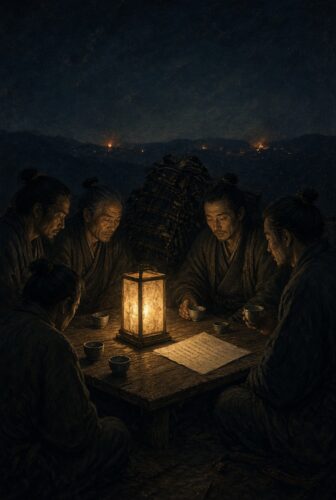
Most people are not going to die on a hill. They are going to spend years defending a job title, a skill set, a family role, a political identity, a way of making money, or a story about who they are that was adaptive in 2010 or 1998 or 1985 and is now being shot to pieces by cheaper, faster, more numerous alternatives. They melt their equivalent of temple statues — time, savings, relationships, health — to keep firing the same old rounds. They treat wounds with the equivalent of a carpenter’s saw and call it resilience. They drink the last sake and tell themselves the dawn charge is noble.
It is not noble. It is late.
Here is how the morning of 24 September 1877 applies without turning into another sermon about “embracing change.”
– The samurai on Shiroyama were not ignorant of rifles. They had used them. They simply refused to accept that the rifle-plus-conscript-plus-industrial-logistics combination had made their highest skill a secondary one. Identify the thing you are still treating as primary that the market, the technology, or the institution around you has already made secondary.
– They melted sacred objects to keep the old fight going a few more hours. That is the definition of a sunk-cost spiral with religious overtones. Name one resource you are currently converting from a “sacred” use (identity, status, comfort) into ammunition for a fight you cannot win.
– Yamagata’s order to fire into retreating friendly units is the most cold-blooded detail on the hill. It is also the most modern. Organizations, markets, and even friend groups will sacrifice the people still loyal to the old method in order to prevent the old method from escaping and causing more trouble. Do not be surprised when your own side shoots you for moving too slowly.
– Saigō’s head was hidden so the enemy would not display it. Dignity in exit is not the same as winning. It is the last thing you still control. Decide in advance what “hiding the head” looks like for you: the letter you will not send, the rant you will not post, the meeting you will not storm out of, the version of the story you will let other people tell.
– The conscripts who killed the samurai were not better men. They were more numerous, better supplied, and fighting for a system that could replace them. Moral superiority is not a force multiplier against scale.
The plan that follows is not a morning routine, a journal prompt, or a vision board. It is a seven-day conversion drill built from the actual logistics of the last week on Shiroyama. Call it the Melted Statue Protocol. It has one purpose: stop feeding a last stand and turn the remaining metal into something that works in the world that already exists.
Day 1 — Name the hill. Write one sentence that begins “The version of me that is currently surrounded is the one who…” Be brutally specific. Not “the old me.” The title, the method, the audience, the tool, the self-image. If you cannot name it in one sentence you are still pretending the trenches are not there.
Day 2 — Count the ammunition. List every hour, dollar, relationship, and calorie you spent in the last thirty days keeping that version alive. No moralizing. Just the inventory. This is the melted-statue ledger.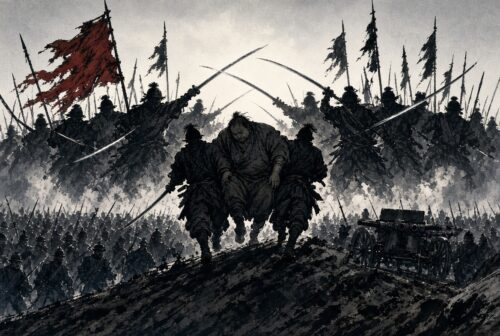
Day 3 — Identify the carpenter’s saw. What crude, painful, temporary fix are you using right now because you will not admit the proper tool no longer exists for this fight? Write it down. Then write the sentence “This is not medicine. This is delay.”
Day 4 — Send the letter you will not send. Yamagata’s ultimatum was refused. You do not have to accept anyone else’s terms. You do have to stop negotiating with a reality that has already stopped negotiating with you. Write the surrender note you will never mail — the honest version of why the old fight is over — then burn or delete it. The point is to hear yourself say it once.
Day 5 — Cast one new bullet. Take one item from Day 2’s ledger and convert it, this week, into a tool for a different fight. Sell the equipment. End the subscription. Reassign the time block. Learn the unglamorous new skill that the conscripts already have. The conversion must be visible and slightly uncomfortable. Melting a statue should sting.
Day 6 — Hide the head. Decide the single image, sentence, or posture you will not let the old world take from you on the way out. Protect it. Everything else can look messy.
Day 7 — Walk off the hill before the four a.m. assault. Do one small, irreversible action that makes returning to the old position more expensive than staying on it. Cancel, resign, publish, move, sell, enroll, delete. Not a gesture. A fact on the ground.
That is the entire plan. It is short because last stands that last for years are the ones that kill you slowly. Saigō’s men had already lost by the time they climbed Shiroyama. They spent their final days making the loss look like a choice. You do not have to.
The hill is still there. Kagoshima is a modern city. Tourists walk the paths. The statues of Saigō look peaceful. The carpenter’s saw and the melted Buddhas are not on the postcards. They are the part worth keeping. They are the sound of a world ending while the people inside it are still trying to win the previous war with better spirit.
On 24 September 1877 the swords ran out of time. The rifles did not. The useful question is not whether you would have charged with them. The useful question is whether you are still standing on a hill that the rest of the country has already left.
Share: