

Picture a river town that has already seen too many emperors.
Worms sits on the left bank of the Rhine where the current slows enough for barges and bad decisions. In late September the air is still warm enough that a man in a wool cloak sweats under it. The streets are packed. Princes, bishops, clerks with ink-stained fingers, grooms holding horses that have come from Saxony and Swabia and the Palatinate, papal legates who have ridden hard from Italy — they have all arrived because fifty years of argument have finally run out of other rooms.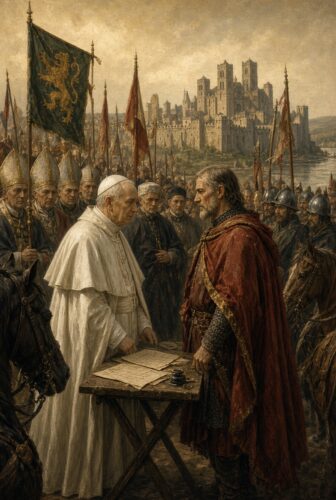
On 23 September 1122 they finish the argument.
Two documents change hands. One is written in the name of Henry, by the grace of God august emperor of the Romans. The other is written in the name of Calixtus, bishop, servant of the servants of God. They are not the same length. They are not even addressed to the same audience. Henry’s charter is offered to God, to Peter and Paul, and to the holy Catholic Church. Calixtus’s charter is offered personally to Henry. That difference is not an accident. It is the whole point.
What they are dividing is not land. It is a pair of objects.
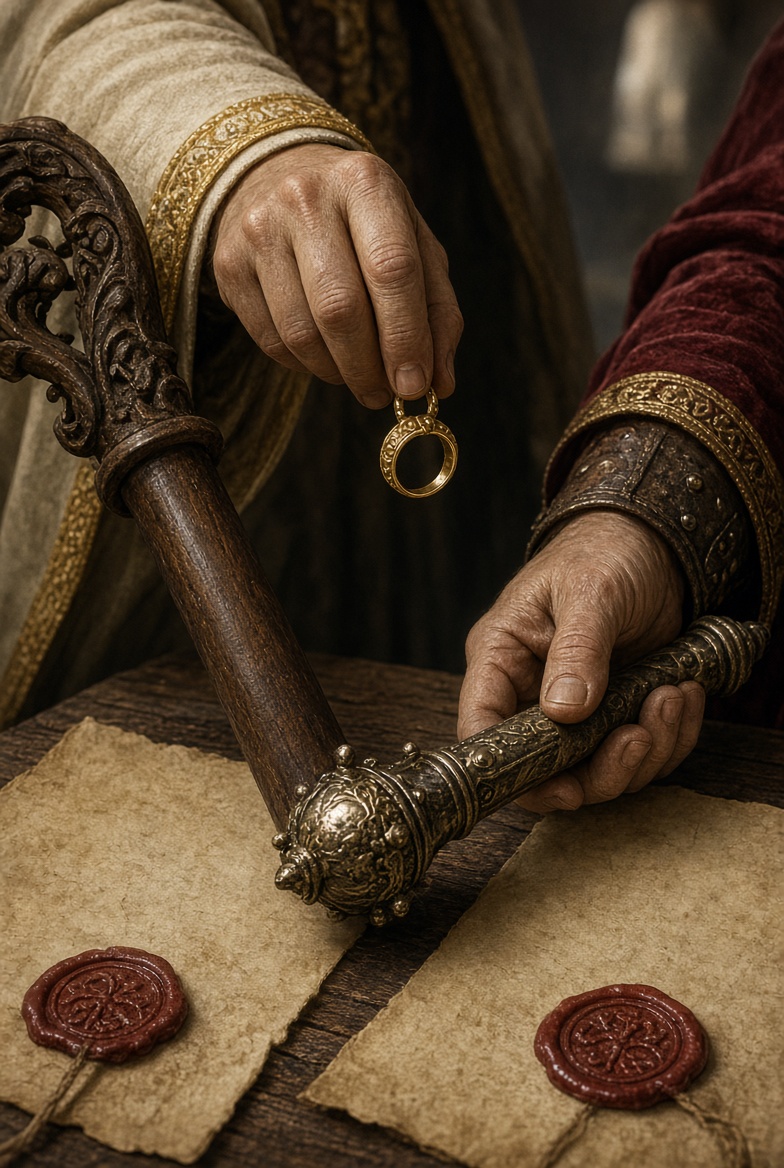
For generations an emperor or a king who wanted a new bishop did not wait for an election. He handed the man a ring and a staff — the ring for the marriage of the prelate to his church, the staff for the shepherd’s authority over the flock — and then, almost as an afterthought, the temporalities that came with the office: the estates, the tolls, the right to hold court, the soldiers the bishop could raise. The ring and the staff said: this man is mine in both worlds. The Church had spent half a century screaming that the two worlds were not the same.
On that September afternoon the emperor agrees to stop handing over the ring and the staff. He will hand over a sceptre instead. The sceptre means the lands and the courts and the soldiers. It does not mean the soul of the diocese.
It sounds small. It was not small. It ended the longest running constitutional crisis in medieval Europe.
The fight had a name: the Investiture Controversy. It began, in public, in 1075, when a short, fierce Tuscan monk named Hildebrand — now Pope Gregory VII — issued a set of propositions later called the Dictatus Papae. The propositions were not circulated as a pamphlet. They did not need to be. They said, among other things, that the pope alone could depose an emperor, that the pope could be judged by no one, and that only the pope could invest a bishop. Henry IV of Germany, who was twenty-five and already used to treating bishops as a kind of royal civil service, treated the propositions as a personal insult.
Henry wrote a letter that still startles. He called Gregory a false monk. He signed it “Henry, king not by usurpation but by the holy ordination of God.” He convened German bishops and had them declare Gregory deposed. Gregory answered by excommunicating the king and releasing every subject from the oath of loyalty. In an age when an oath was the only glue holding a kingdom together, that sentence was dynamite.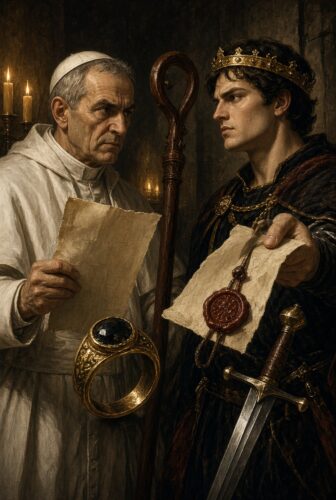
The German princes, who had their own grievances and a talent for smelling weakness, rebelled. Henry’s position collapsed so fast that in January 1077 he crossed the Alps in winter, stood outside the castle of Canossa for three days in the snow, barefoot, wearing a hair shirt, and begged Gregory — who was a guest of the formidable Countess Matilda of Tuscany — to lift the ban. Gregory made him wait. The image of the emperor in the snow became the most famous political photograph of the Middle Ages, even though no one had a camera. It did not settle anything. Gregory lifted the excommunication. The German princes elected a rival king anyway. The war resumed.
It went on and on. Antipopes appeared. Rome was besieged. In 1084 Henry finally entered the city, installed his own pope, and had himself crowned emperor while Gregory huddled in Castel Sant’Angelo. The Normans came to Gregory’s rescue, sacked Rome for their trouble, and escorted the old pope south, where he died in exile the next year muttering that he had loved justice and hated iniquity and therefore died far from home.
Henry IV lasted another twenty years. His own son, the future Henry V, finally rebelled against him, imprisoned him, and forced an abdication in 1105. The son inherited the same problem his father had never solved: how do you run an empire when the men who administer a third of your territory — the prince-bishops — owe their spiritual identity to a man in Rome who thinks you are a usurper?
Henry V tried force. In 1111 he marched into Italy, extracted a desperate bargain from Pope Paschal II at Sutri (the Church would surrender its temporalities if the emperor would stop investing clergy), then watched the deal explode in St. Peter’s when Roman crowds howled that the pope was giving away the patrimony of Peter. Henry arrested the pope and a clutch of cardinals, extracted a different concession under duress, and rode home crowned. The concession was repudiated the moment the hostages were free. Excommunications flew again. An antipope was produced. German nobles, especially in Saxony and along the Lower Rhine, began to treat their emperor as a man who could not finish a sentence.
By 1119 a new pope sat in Rome: Calixtus II, a Burgundian aristocrat who had been archbishop of Vienne and who understood both courts. He was not a monk-firebrand like Gregory. He was a man who had watched the controversy eat two generations and who had decided that a live compromise was better than another dead antipope. Negotiations flickered and failed at Mouzon. Calixtus excommunicated Henry again at Reims. Then the German princes, led by the formidable Adalbert of Mainz — a man who had once been Henry’s prisoner and had not forgotten it — made it clear that they would not fight another decade of civil war so their emperor could keep handing out rings.
In February 1122 Calixtus sent a letter that contained the sentence the whole settlement would rest on: let the Church obtain what is of Christ, and let the emperor have what is his own.
They met at Worms because Worms was large enough, old enough, and imperial enough. The diet itself had already been sitting for two weeks. The city could not hold everyone. On 9 September Henry received the papal legates outside the walls. The lead legate was Lamberto Scannabecchi, cardinal-bishop of Ostia, a future pope himself. They argued the wording for another fortnight. They argued about Germany versus Italy and Burgundy. They argued about whether the emperor’s presence at an election was a courtesy or a veto. They argued about the order of operations: does the man receive the lands before he is consecrated, or after?
The final bargain, dated 23 September 1122, split the difference with a jeweler’s precision.
In the German kingdom, elections of bishops and abbots would take place in the emperor’s presence, without simony and without violence. If the electors deadlocked, the emperor, advised by the metropolitan and the other bishops of the province, could tip the scale toward the worthier candidate. The man elected would then receive the regalia — the temporalities — from the emperor by the sceptre, and would do the homage those lands required. Only after that would the Church give him the ring and the staff.
In Italy and Burgundy the order reversed. Consecration came first. The new bishop had six months to come and receive the sceptre. The emperor’s hand was weaker south of the Alps, which was exactly what the papacy wanted.
Henry surrendered “all investiture through ring and staff.” He promised to restore property seized from the Roman Church during the long war. He promised peace to Calixtus and everyone who had stood with him. A list of princes signed as witnesses: Adalbert of Mainz, the archbishop of Cologne, the bishops of Regensburg, Bamberg, Speyer, Augsburg, Utrecht, Constance, the abbot of Fulda, four dukes, two margraves, two counts palatine, a count. The archbishop of Cologne, as arch-chancellor, recognized the imperial charter.
Calixtus, for his part, granted the emperor a true peace and the right to be present at German elections. He did not grant him the ring.
They celebrated with a Mass. The cardinal-bishop of Ostia gave the emperor the kiss of peace. Someone struck up the Te Deum. Then the documents were copied and sent across Europe so that no one could later claim the wording had been different in another room.
The First Lateran Council confirmed the settlement the following March. Nearly three hundred bishops and six hundred abbots sat in the same city where Gregory VII had once hurled his thunderbolts and agreed that the thunderbolts could now be put away. Henry V died in 1125 without a son. Later emperors tried to stretch the Concordat. Popes tried to shrink it. The text itself stayed on the books until the Holy Roman Empire itself dissolved in 1806.
What the Concordat actually did was teach a continent a distinction it had been killing people to avoid. Spiritual authority and temporal power can occupy the same man. They cannot occupy the same gesture. The ring is not a fief. The staff is not a tax roll. When you treat them as the same object, you get fifty years of excommunications, rival kings, sacked cities, and emperors standing in snow. When you separate them, you get a working truce that lasts for centuries.
That is the historical fact. It is not a metaphor that was waiting for a blog. It is a legal settlement written on parchment that still exists in the Vatican archives, stained by moisture, dated to the day.
The modern application is narrower than the usual sermon about “boundaries.” Most advice about boundaries is a request that other people behave better. The Concordat is about which symbol you are allowed to hold in your own hand.
Every role you occupy is either a ring or a sceptre.
A ring is an authority that cannot be delegated without destroying the thing it authorizes: your judgment about what work is honest, your refusal to pretend a bad idea is a good one, the maintenance of your own body as the only instrument you actually own, the promises you made to yourself when no one was watching. If someone else invests you with that ring — if a title, a platform, a family script, or a paycheck is allowed to tell you what your conscience is for — you have recreated 1076. You will spend years in a war that looks like loyalty and feels like exile.
A sceptre is everything else: the job description, the calendar other people control, the credential that opens a door, the rent, the institutional rule you did not write. You can receive a sceptre from someone else. You can even do homage for it. You cannot let it become the ring.
The unique plan is not a morning routine, a gratitude list, or a digital detox. Those already exist in industrial quantities. This is a twenty-three-day Double Investiture, one day for each September date, built only from the logic of Worms.
Day 1. Write every current role on a single page: employee, parent, patient, creator, debtor, neighbor, whatever is actually true. No aspirational titles.
Days 2–4. Mark each role R or S. Be ruthless. If losing the external recognition would not change the inner standard, it is a ring. If the role exists only because an institution or another person conferred it, it is a sceptre.
Day 5. Circle the one ring you have been letting someone else hand you. The most common modern version is letting a metric, a manager, or an audience decide whether the work was good. That is lay investiture of the soul.
Day 6. Write a one-sentence abdication of that ring. Not a journal entry. A sentence you could read aloud in a room with a witness. Example form: “I relinquish the ring that says my worth is identical to [the external thing]. The staff of that judgment returns to me.”
Day 7. Perform the sentence once, privately, then destroy the paper. The Concordat was not a feeling. It was a public act with witnesses. You need the act.
Days 8–12. Identify the one sceptre you have been refusing because you confused it with a ring. The promotion you will not request because you think asking is spiritually impure. The conversation with the gatekeeper you keep postponing because you want the relationship to remain unofficial and therefore “authentic.” The formal credential you dismiss as paperwork. Receive it. Do the homage. Take the lands. Do not pretend the sceptre is a sacrament.
Days 13–18. For every mixed role — and most roles are mixed — write the exact order of operations the Concordat used. In Germany the temporalities came first, then the consecration. In Italy the consecration came first, then the temporalities. Decide which order your mixed role actually requires and stop reversing it. If the job pays the rent, take the sceptre first and keep the ring unentangled. If the craft is the point, consecrate the work first and collect the temporalities afterward without apology.
Days 19–22. Practice the kiss of peace with one person who has been on the other side of your private investiture war. Not a grand reconciliation. A short, specific cessation of hostilities: “I will stop treating your sceptre as if it were my ring. I expect the same.” Then stop talking about it.
Day 23. Read the two original sentences that closed the war. Henry: I remit all investiture through ring and staff. Calixtus: let the Church obtain what is of Christ, and let the emperor have what is his own. Copy them once in your own hand. Date the page. Put it where you will see it when the next person tries to hand you a ring that does not belong to them, or when you try to seize a sceptre that was never going to save your soul.
That is the entire plan. It is quick because the Concordat itself was the product of two weeks of exhausted men who had already tried every other method. It is unique because it does not ask you to “find balance.” It asks you to stop performing two incompatible ceremonies with the same piece of jewelry.
The men at Worms were not trying to become better people. They were trying to stop a war that had already lasted longer than most of them had been alive. They succeeded by admitting that some symbols are not interchangeable. The ring stayed with the Church. The sceptre stayed with the empire. Both sides kept their dignity and lost their favorite weapon.
You do not need an emperor or a pope. You need the same admission. Some things you may receive from other people. Some things you may never let them place in your hand. The afternoon they finally wrote that down was 23 September 1122, outside a crowded city on the Rhine, after fifty years of pretending the difference did not exist.
The staff left the emperor’s fist. The world did not end. It just became possible to live in again.
Share: