
On the nineteenth day of August in the year we now call 14 AD, in a villa at Nola in Campania, the man who had reshaped the Roman world drew his last breath. He was seventy-five years old, thirty-five days short of seventy-six. The hour was the ninth, roughly three in the afternoon by our reckoning. The consuls of the year were two men both named Sextus—Pompeius and Appuleius. And, in a detail that still feels almost scripted, he died in the same room of the same house in which his biological father, Gaius Octavius, had died decades earlier.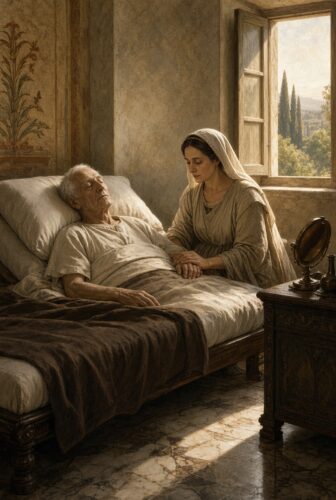
Gaius Octavius Thurinus, later Gaius Julius Caesar Octavianus, finally Imperator Caesar Divi Filius Augustus, had spent more than four decades as the dominant figure in the Roman state. He had ended a century of civil war, constructed a system of government that looked republican while concentrating real power in one man, and inaugurated an era of relative internal peace that later generations would call the Pax Romana or Pax Augusta. He claimed, in the document known as the Res Gestae Divi Augusti, that he had found Rome a city of brick and left it a city of marble. The boast was not empty. Temples were restored or rebuilt by the dozen. The Forum of Augustus rose with its Temple of Mars Ultor. Aqueducts, roads, and administrative reforms stretched across the Mediterranean. The army was professionalized, the frontiers stabilized after the disaster of the Teutoburg Forest in 9 AD, and the cult of the emperor himself began to take institutional form.
Yet on that August afternoon the marble man still had to leave the stage.
The last days had been ordinary in the way that the endings of long lives often are. Augustus had been traveling in Campania with Tiberius, his adopted son and designated successor. He fell ill at Astura, recovered enough to spend four days on Capri watching young men exercise and distributing gifts, then deteriorated again at Nola. Tiberius was summoned back from his journey toward Illyricum. Ancient accounts differ on whether the two men held a long final conference or whether Tiberius arrived only after the end; what is clear is that the succession machinery was already in motion.
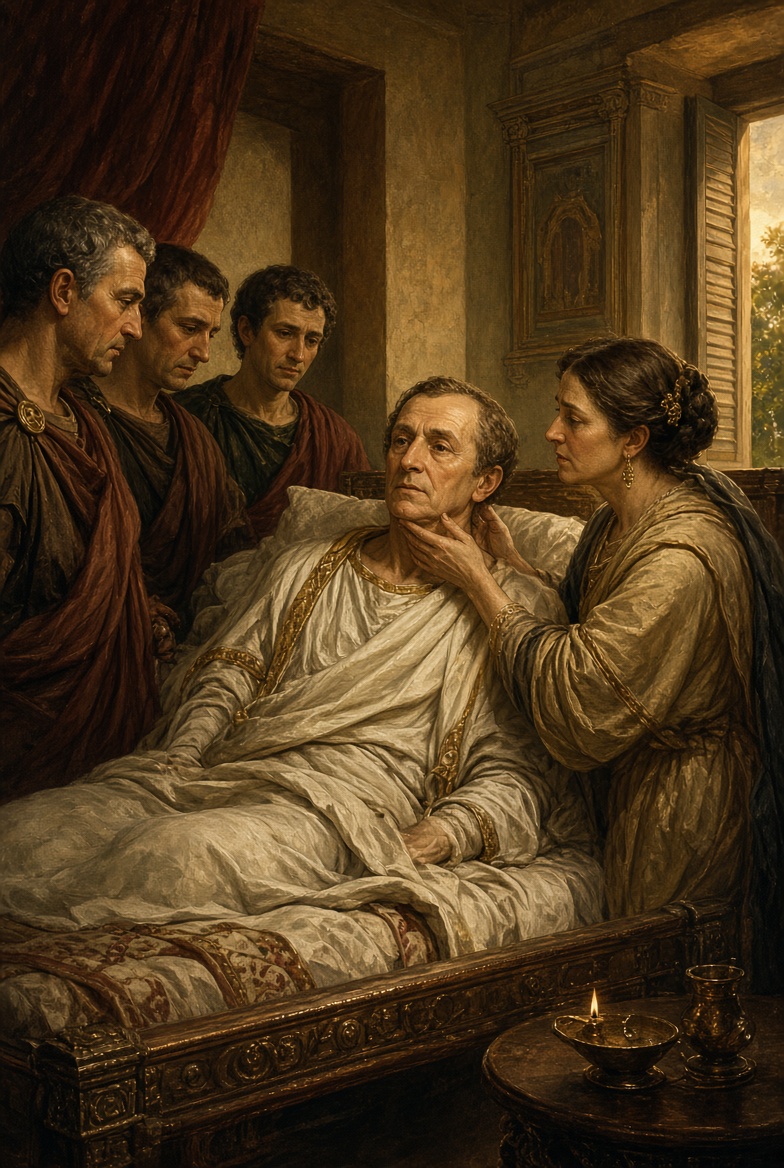
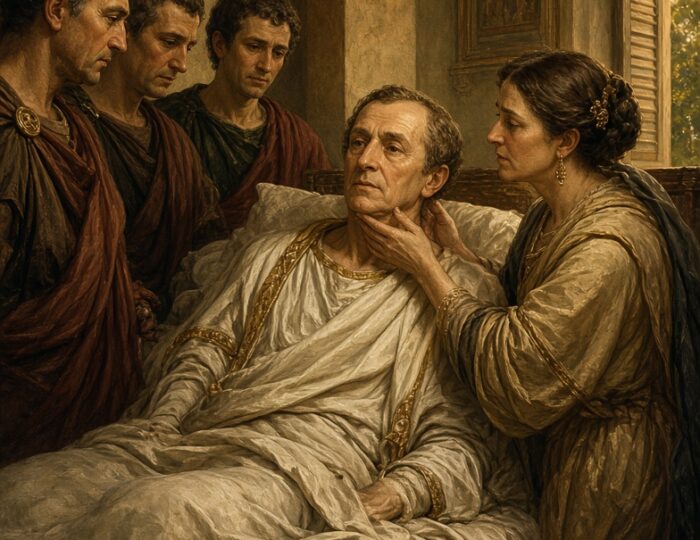
Suetonius, writing a century later with access to imperial archives and court tradition, gives the most vivid deathbed scene. On the final day Augustus repeatedly asked whether any disturbance had arisen in Rome on account of his illness. He called for a mirror, had his hair combed, and had his sagging jaw set straight—an old man’s small vanity or a final performance of dignity. Then he summoned friends and asked whether it seemed to them that he had played the comedy of life fitly. He added the theatrical tag, rendered in Greek in some versions and in Latin paraphrase in others: roughly, “Since I have played my part well, all clap your hands and dismiss me from the stage with applause.”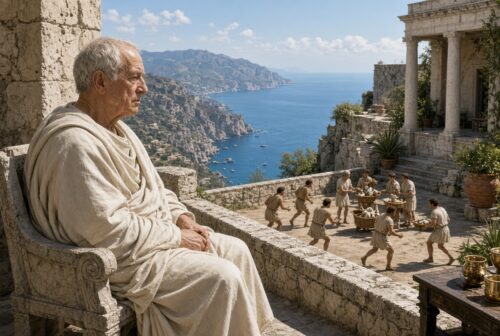
He dismissed them. When new visitors arrived from the city he inquired about the health of a granddaughter of Drusus who was ill. Then, kissing Livia, he spoke his last recorded words: “Livia, live mindful of our marriage, and farewell.” He died easily, the kind of swift and painless death he had long hoped for and had called by the Greek term *euthanasia*. Only once did his mind appear to wander: he cried out in sudden terror that forty young men were carrying him off. Suetonius notes that this was less delirium than premonition, for exactly that number of Praetorian guards would later bear his body.
Rumors, of course, swirled. Some later writers, Tacitus among them, entertained the possibility that Livia had hastened the end with poisoned figs to secure Tiberius’s position. The story is colorful and almost certainly apocryphal; the quieter truth is that an aging man of indifferent health finally reached the limit of a long life. Cassius Dio records that the death was kept quiet for several days while arrangements were completed. The body was then carried north along the roads from Nola toward Rome, traveling by night because of the summer heat, resting by day in the basilicas or principal temples of successive towns. Municipal senators and local magistrates took turns bearing the bier. At Bovillae the equestrian order met the cortege and brought it into the city.
The funeral followed the pattern Augustus had himself shaped for public ceremony. Eulogies were delivered. A senator swore he had seen Augustus’s spirit ascending to heaven from the pyre—an eyewitness convenience that smoothed the path to formal deification. On September 17 the Senate enrolled him among the gods of the Roman state. Tiberius, already holding tribunician power and proconsular imperium coextensive with Augustus’s own, assumed the practical direction of the empire. There was hesitation, public reluctance, senatorial debate—the carefully maintained fiction that the principate was not a hereditary monarchy—but no civil war. The system held.
That holding is the historical core of the day. Augustus had spent years preparing it. Earlier preferred heirs—Marcellus, then the grandsons Gaius and Lucius Caesar—had died young. Agrippa Postumus had been sidelined and would soon be eliminated. Tiberius, Livia’s son by a previous marriage, experienced general, reluctant politician, had been adopted in 4 AD and gradually invested with the powers that made the transfer workable. By 13 AD the two men essentially shared the highest authority. When the founder died, the machinery did not seize. The armies did not fragment. The Senate did not dissolve into competing factions strong enough to restart the civil wars of the previous century. The first imperial succession succeeded.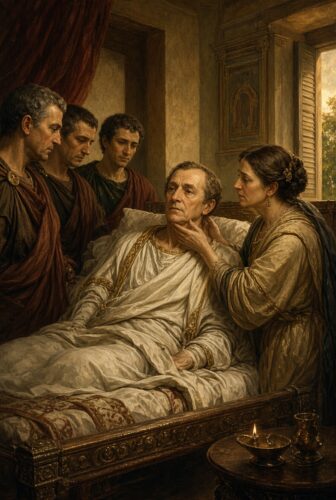
The longer consequences unfolded over decades and centuries. The Julio-Claudian house continued through Tiberius, Caligula, Claudius, and Nero. The institutional framework of the principate—the concentration of military command, tribunician power, and moral authority in one person while preserving republican forms—proved durable enough to survive even the worst emperors. The Pax that Augustus had enforced, imperfect and often brutal on the frontiers, gave the Mediterranean world two centuries of relative internal stability in which trade, urban life, and cultural production flourished on a scale previously unseen. Roads, law, language, and administrative habits outlasted the dynasty that created them. The man who had begun as a teenage political operator after Caesar’s murder in 44 BC, who had climbed through the Second Triumvirate, the defeat of Antony and Cleopatra, and the careful construction of the principate, left behind something larger than his own lifespan.
The theatrical quality of the exit is hard to miss. A man who had spent a lifetime managing appearances—restoring temples while accumulating power, calling himself princeps while holding imperium maius—ended by asking whether the performance had been satisfactory and requesting applause. The coincidence of the room, the same physical space in which his obscure father had died, undercuts any pure mythology of destiny. The premonition of the forty carriers, the careful concealment of the death, the staged deification—all of it feels like the final act of a political artist who understood that power is as much about the story told afterward as about the force applied in the moment.
Yet the deeper fact is simpler and more stubborn. Even the most successful system-builder in Roman history still had to transfer control. The marble city, the reformed army, the network of loyal officials, the carefully cultivated image of restored republican virtue—none of it would have survived the founder’s death without deliberate preparation of a successor and of the institutional habits that made succession thinkable. The civil wars of the late Republic had shown what happened when that preparation failed. Augustus’s final achievement was not the marble itself but the fact that the marble did not immediately crack when the man who ordered it was gone.
That is the historical event of August 19, 14 AD: not a battle, not a sudden revolution, but the quiet, carefully managed end of the man who had reinvented Roman power, and the successful passage of that power to the next pair of hands. The sources—Suetonius, Dio, the fasti that marked the day as *dies tristissimus*, the Res Gestae itself—converge on the same outline. The details of hair combed, jaw set, theatrical tag spoken, last kiss given, body carried night by night toward the capital, spirit declared ascended, successor installed without open war, remain the most human and most revealing record we possess of how the first emperor left the stage.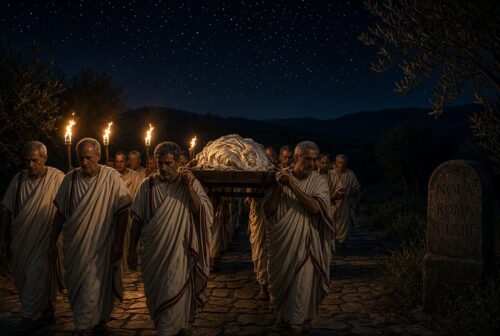
The outcome that matters for anyone living long after is the demonstration that even an empire built by one extraordinary will requires a deliberate hand-off if it is to continue. Systems that depend entirely on the founder’s presence collapse when the founder leaves. Systems that have been designed, tested, and staffed to operate under a successor have a chance. Augustus spent the better part of two decades solving the succession problem after earlier candidates died. He did not solve it perfectly—later Julio-Claudians would prove the limits—but he solved it well enough that the structure outlived him by generations.
Apply that fact directly. The benefit today is the hard recognition that whatever you are building—whether a body of work, a set of skills, a household order, a professional reputation, or a private discipline—will face its own August 19. The question is whether the structure has been prepared to survive the exit of its central figure.
Specific applications, drawn strictly from the mechanics of the historical hand-off:
– Map the actual centers of control in your daily operations the way Augustus mapped provinces and commands. Identify every recurring decision, resource flow, and point of failure that currently runs only through you. Write them down without romantic language.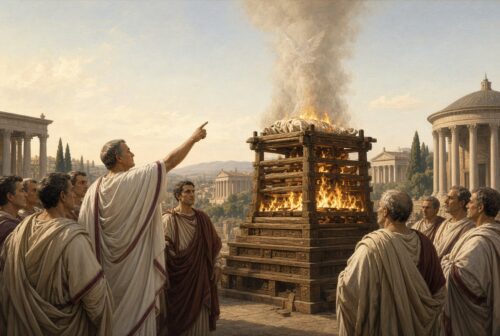
– Designate a concrete successor function for each center, even if the “successor” is a documented process, a trained second person, or a timed review rather than a human heir. Tiberius was not an afterthought; he was invested with parallel powers years in advance.
– Conduct a live transfer test on a small, reversible scale every quarter. Hand one complete responsibility to the designated mechanism for a fixed period and observe what breaks. Augustus’s gradual sharing of tribunician power and imperium was itself a series of live tests.
– Prepare the public and private narrative of the transfer in advance. The theatrical request for applause and the managed announcement of death were not vanity; they were control of the story that would otherwise be written by rumor and panic.
– Record a short, factual account of what has been built and why the structure should continue—your private Res Gestae—updated annually. The original was both propaganda and institutional memory.
– Accept that perfect continuity is impossible and plan for the version of continuity that is achievable. The principate survived mediocre and disastrous emperors because the underlying administrative and military habits were stronger than any single personality.
– Treat the physical and temporal details of exit as real rather than abstract. Augustus died in a specific room at a specific hour after a specific decline. Build the habit of reviewing your own “Nola readiness”—the practical state of documents, relationships, and systems—on a fixed calendar date each year.
The unique plan that follows from these points is the **Ninth-Hour Protocol**. It is deliberately narrow, timed, and non-therapeutic. It is not a journal, a vision board, or a general life-audit. It is a three-hour annual exercise conducted on or near August 19, or on any fixed anniversary you choose, structured exactly like the final documented hours at Nola.
Hour one: the mirror and the jaw. Alone, review the previous twelve months of operational control points. List every function that still depends solely on your presence. Combed hair and set jaw equal clear, unsentimental inventory—no encouragement language, only facts of dependence.
Hour two: the friends and the tag. Bring in one or two people who already share partial responsibility, or, if working alone, open the written process documents. Ask the explicit question Augustus asked: has the performance of this system been adequate to the purpose? Require a concrete answer in writing. Then rehearse the hand-off language: the specific sentences or checklists that would allow the system to continue for thirty days without you. This is the applause request made operational.
Hour three: the kiss and the carriers. Finalize one small, irreversible transfer—move one responsibility permanently into the successor mechanism. Update the short Res Gestae paragraph that states what has been built and the minimum conditions for its continuation. Close by noting the equivalent of the forty carriers: the actual people, files, or routines that would have to move the work forward the next morning. End the session at a fixed clock time. No extension.
Repeat the Protocol every year. The historical force of August 19, 14 AD is that the man who had done more than any single Roman to concentrate power still treated the end of his own concentration as a problem requiring deliberate, staged solution. The marble remained because the hand-off had been prepared. The same discipline, scaled to ordinary life, is the only historically grounded method for making whatever you construct outlast the afternoon when your own curtain drops.
Share: