
On the morning of September 8, 1380, a field of sandpipers and oak groves south of the Don River went quiet. The birds that gave Kulikovo Field its name—kuliki, the little wading birds that nested in the marshy folds between the Don and the Nepryadva—had the good sense to leave. What replaced their calls was the sound of tens of thousands of men tightening straps, kissing icons, and waiting for the fog to lift so they could kill one another.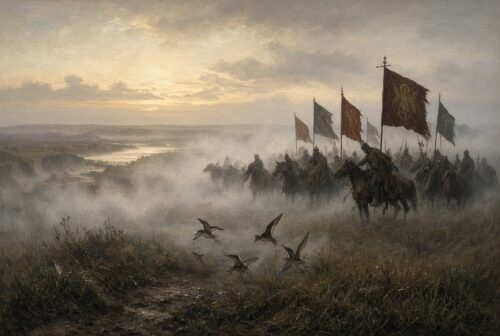
Grand Prince Dmitry Ivanovich of Moscow had already burned his boats, or rather his bridges. The night before, he had ordered his army across the Don. Behind them now stood a steep bank and a river. There would be no tidy retreat to the walls of Moscow. The prince who would soon be called Donskoy had chosen the ground so that his own men would have to fight as if the only way home was through the Horde.
This was not supposed to happen. For 140 years the Russian principalities had lived under the “Tatar yoke.” In 1237–1240 Batu Khan, grandson of Genghis, had smashed the divided Rus’ lands with a thoroughness that still shocked chroniclers a century later. Cities burned. Princes knelt. The Golden Horde collected tribute, appointed or confirmed rulers, and punished defiance with fire. Moscow itself had risen not as a rebel capital but as a useful tax farmer for the khans. Its princes collected the Horde’s “vykhod” and kept a cut. That arrangement made Moscow rich and despised in equal measure.
By the 1370s the arrangement was cracking. The Golden Horde was tearing itself apart in civil war. Mamai, a powerful emir who was not even a descendant of Genghis, ruled the western half of the Horde through a puppet khan. In the east, Tokhtamysh, backed by the rising power of Tamerlane, claimed the legitimate throne. Mamai needed a big victory and a fat tribute payment to keep his coalition of Tatars, Circassians, Alans, Cumans, and even Genoese mercenaries from the Crimean ports from drifting away. In 1378 he sent a force under Begich to collect. Dmitry met them on the Vozha River and wrecked them. It was the first clear field victory of a Russian prince over a Horde army in living memory. Mamai took it personally.
He assembled a larger host and marched north in the summer of 1380. Lithuanian Grand Duke Jogaila promised to join him. Prince Oleg of Ryazan, whose lands sat directly in the path, played both sides with the enthusiasm of a man who expected to be eaten either way. Dmitry, meanwhile, sent out the call. Not every prince answered. Some remembered that Moscow had grown fat as the Horde’s collector. Some calculated the odds and stayed home. Still, men came from Serpukhov, Beloozero, Yaroslavl, Rostov, and other towns. Warrior-monks arrived from the Trinity Monastery of Sergius of Radonezh. The sources later claimed the saint himself blessed the campaign and sent two schema-monks, Alexander Peresvet and Rodion Oslyabya, both former boyars who had taken the habit. Whether the blessing happened exactly as later icons show it is debated by historians; what is not debated is that the idea of a holy war against the “godless” had already taken root.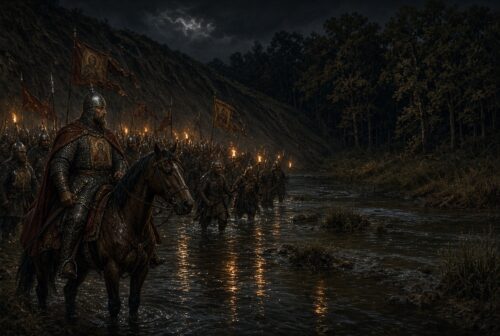
Dmitry moved south. He crossed the Oka, then the Don. On the night of September 7–8 his scouts and the prince himself, accompanied by the experienced Volhynian voivode Dmitry Bobrok, rode the ground. The field was a patchwork of ravines, low hills, oak copses, and wet ground that would bog down a wide cavalry sweep. The Nepryadva protected one flank. The Don protected the rear—if you ignored the fact that it also blocked escape. Dmitry arranged his army in the traditional Russian system of “polki,” or regiments: a patrol regiment out front, a forward regiment, the Great Regiment in the center, the Regiment of the Right Hand, the Regiment of the Left Hand (always the more dangerous and less prestigious posting), a private reserve, and, hidden in the Green Oak Grove (Zelenaya Dubrava) on the left, the Ambush Regiment.
The Ambush Regiment was the entire point. It was not a leftover. It was the best heavy cavalry Dmitry could spare, placed under his cousin Prince Vladimir Andreyevich of Serpukhov and the cool-headed Bobrok. Their orders were simple and almost unbearable: do not move. Watch the battle go badly. Watch friends die. Wait until the enemy has committed everything and overextended. Then hit them from the flank and rear.
Fog covered the field at dawn. When it lifted, the two lines faced each other. The chronicles, which inflate numbers with the cheerful abandon of medieval accountants, speak of hundreds of thousands. Modern estimates are far more modest—perhaps 15,000 to 60,000 on the Russian side against a Horde force that may have been comparable or somewhat larger. The exact figures matter less than the fact that this was a genuine pitched battle in open country, not a raid or a siege. The Rus’ had not won one of those against the steppe cavalry in generations.
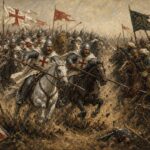
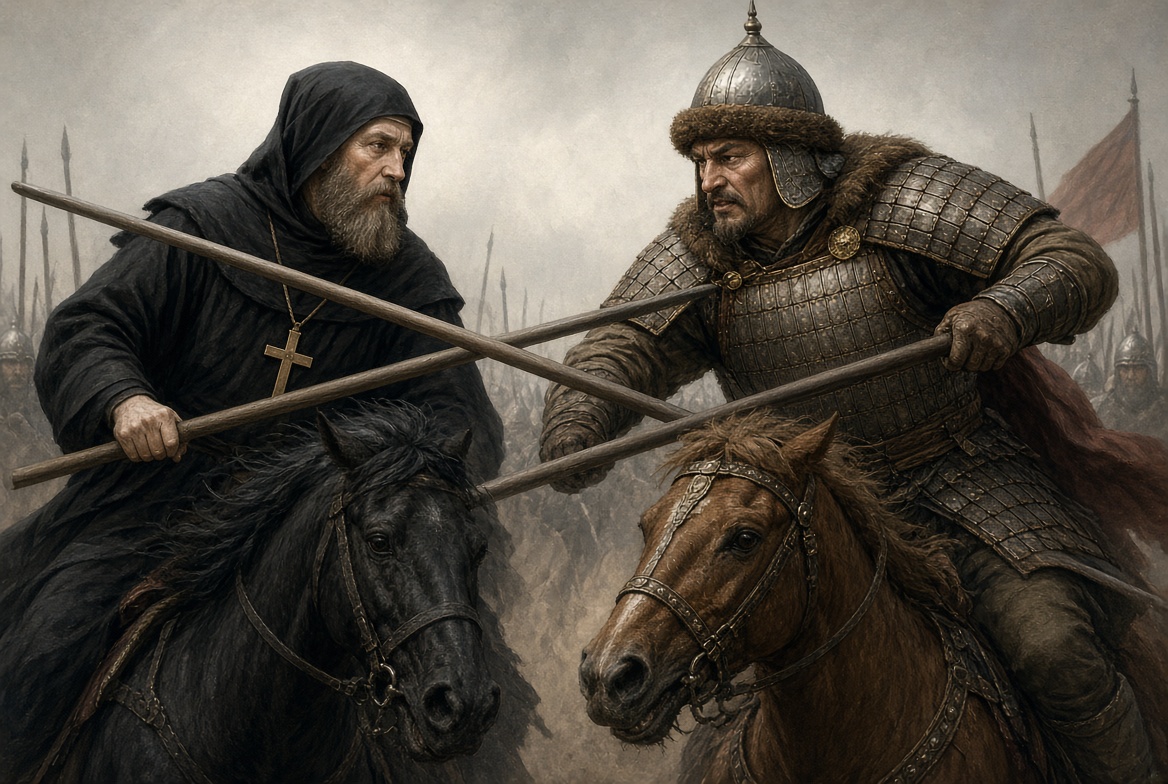
The battle opened with the ritual that both sides understood. A champion rode out from each army. From the Russian side came Alexander Peresvet, the monk in a schema, lance in hand, no armor but the cross on his chest. From the Horde side came Chelubey (or Temir-murza in some tellings), a giant of a man famous for winning these duels. They spurred. The lances met. Both men were killed in the first pass, their bodies remaining upright in the saddles for a moment before the horses carried the corpses back toward their own lines. The chronicles love this scene. It is almost certainly embroidered, but it is the kind of embroidery that tells you how the people who lived through the day wanted the story to begin: two worlds colliding at full gallop, both dying, neither yielding.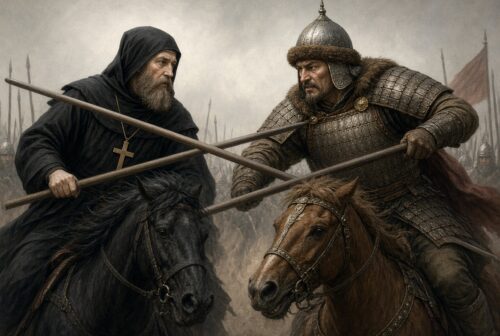
Then the real killing started.
The Horde cavalry smashed the forward regiment and rolled into the Great Regiment. The left flank, as expected, began to buckle. Mikhail Brenok, a Moscow boyar who had put on Dmitry’s armor and ridden under the prince’s banner so that the Tatars would hunt the wrong man, went down. The banner wavered. Dmitry himself was somewhere in the press, fighting in ordinary armor, taking wounds. Later search parties would find him either unconscious under a pile of bodies or sitting dazed in a nearby grove, depending on which source you prefer. For hours the Russian line bent but did not quite break. The right held better because the ground rose against the attackers. The center bled. The left was close to collapse.
In the oak grove, Vladimir Andreyevich kept asking Bobrok if it was time. Bobrok kept saying no. The voivode was watching the rhythm of the fight the way a man watches a river for the exact second the current changes. He waited until the Tatar cavalry, sensing victory, poured through the gap on the left and presented their own rear and flank to the hidden woods. Only then did he give the order.
The Ambush Regiment came out of the trees like a second army that had been invented on the spot. Fresh horses, untouched men, the shock of an attack no one in the Horde line had seen coming. Panic is contagious in a cavalry fight. Units that had been winning minutes earlier suddenly found enemies behind them. Mamai’s formation disintegrated. The emir himself fled the field. The Russians pursued for miles, some accounts say as far as the Mecha River, cutting down men whose horses were already blown.
It was a butcher’s bill on both sides. Chronicles claim the dead were buried for eight days. Dozens of princes and hundreds of boyars from the Russian host never came home. The Horde lost its field army and, more importantly, Mamai lost the political argument inside the steppe. He limped back to Crimea and was soon murdered by men who had grown tired of backing a loser. Two years later Tokhtamysh, now dominant in the Horde, rode north, burned Moscow, and forced Dmitry to resume tribute. The yoke was not broken in a single afternoon.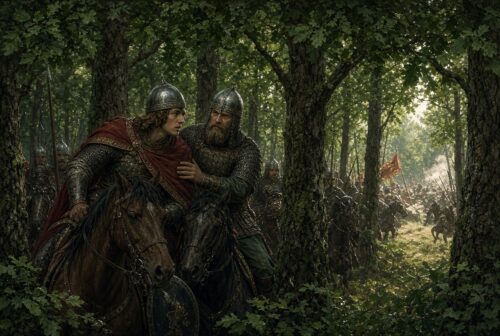
And yet something irreversible had happened. For the first time in a century and a half, a coalition of Russian princes had met the steppe army in the open, refused the option of flight, and won. The psychological spell of invincibility cracked. Moscow, the former collaborator, now owned the story of resistance. Dmitry received the name Donskoy. The battle entered the language through the poetic “Zadonshchina” and later the more elaborate “Tale of the Rout of Mamai.” Icons, chronicles, and eventually national memory turned September 8 into a founding moment: the day the divided principalities began to remember they could be one people. It would take another century and the stand on the Ugra in 1480 before the tribute stopped for good. But the first loud crack in the edifice was the charge that came out of the Green Oak Grove.
The details that survive are a mixture of hard military fact and the kind of storytelling a culture tells itself when it finally has a victory worth embroidering. The armor swap, the monk’s duel, the saint’s blessing, the exact size of the armies—all of these grew in the telling. What did not need embroidery was the decision to cross the Don, the placement of an unused elite force in the woods, and the discipline required to keep that force unused while the main line was being carved up. That combination—commit so completely that retreat is impossible, then still hold something back until the precise instant the enemy has spent his last advantage—is the part that does not get old.
**The Ambush-Regiment Protocol**
Most advice about persistence tells you to keep grinding with the same tools until the wall falls. Kulikovo suggests the opposite timing. You put your main effort into the fight that everyone can see. You accept that this visible effort will take damage, look like it is losing, and cost you people and pride. At the same time you keep one high-value, completely unused asset in reserve—not as a rainy-day fund you dip into early, but as a force that is forbidden to move until the situation has already revealed the other side’s full commitment.
Identify your Green Oak Grove asset this week. It should be something you have not yet spent on the current problem: an unused professional relationship, a skill you have practiced privately but never deployed, a block of time you have protected, a piece of work you have finished but not released, a financial reserve you have treated as untouchable, or a physical capacity you have trained but not yet tested in the real arena. Write it down in one sentence. Then write a second sentence that forbids you from using it until two conditions are met: (1) your main, visible effort has already absorbed the first serious beating, and (2) the opposing pressure has clearly overextended—missed a deadline, revealed a weakness, spent its best argument, or shown that it has no more reserves of its own.
Run the protocol on one live challenge for the next 21 days. Every morning ask only two questions: Has the main regiment taken enough damage that the other side believes it is winning? Has the other side committed its last fresh resource? If either answer is no, the grove stays closed. If both answers become yes, you release the unused asset in one concentrated move, not a trickle. After the move, you do not immediately restock the grove with the same thing. You note what the charge actually accomplished and decide whether the next reserve needs to be a different kind of force.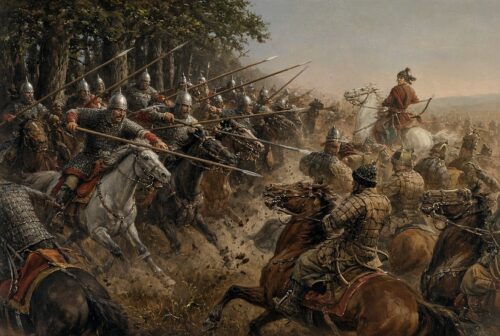
The uniqueness is in the delay, not the existence of a backup. Most people spend their best card too early because the visible fight feels desperate. Dmitry’s commanders spent hours watching their friends die before they spent theirs. That is the part worth stealing. The field at Kulikovo did not reward the first man who charged. It rewarded the man who still had an unused regiment when everyone else thought the battle was already decided.
Share: