
Picture a skinny finger of Maryland dirt sticking into the Chesapeake like a dare. On one side, Bear Creek. On the other, a tidal trickle so unimpressively named that history itself seems to be joking: Bread and Cheese Creek. Down the middle runs a farm road the locals called Long Log Lane. At three in the morning on September 12, 1814, that peninsula started filling with the most dangerous infantry in the Western world.
They came off the boats in the dark. Veterans of the Duke of Wellington’s campaigns against Napoleon. Men who had marched across Spain, stood in squares at Salamanca, and three weeks earlier had scattered American militia at Bladensburg and then set fire to the public buildings of Washington. Their commander, Major General Robert Ross, was the sort of officer other officers trusted with the ugly jobs. He led from the front. He ate breakfast in other people’s houses. He had already told a captured American that he did not care if it “rained militia.”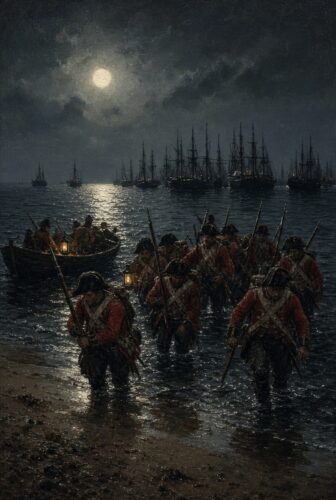
It was about to rain militia. Just not the way he expected.
This is the story of a battle the British technically won and strategically lost, of two teenage leather-apprentice riflemen who may or may not have fired the shot that changed the war, of cannons stuffed with nails and horseshoes, and of a city that bought itself twenty-four hours and used those hours to keep a flag in the air long enough for a lawyer on a truce ship to write a song. It is also, if you will sit still for the long version, a working manual for anyone whose life is currently being marched on by something bigger, better trained, and convinced it will be eating dinner in your house by nightfall.
Most of what follows is the history. The last stretch is the part you can steal.
## The City That Built Privateers and Then Had to Live With the Consequences
Baltimore in 1814 was not a sleepy county seat. It was a commercial knife pointed at British shipping. From Fell’s Point, privateers slipped out to snap up merchantmen. The city had grown rich on grain, flour, and the legalized piracy that wartime letters of marque made respectable. The Royal Navy had spent a year in the Chesapeake burning farms, seizing tobacco, and encouraging enslaved people to walk toward the Union Jack. About five hundred of those men would fight as Royal Colonial Marines. Rear Admiral George Cockburn — the name is pronounced Co-burn, which never stopped Americans from pronouncing it as if he were a rooster — had made himself the most hated man in Maryland. He liked bonfires. He liked making examples. After Washington burned on August 24, Baltimore was the obvious next prize: shipyards, warehouses, a political humiliation that would look even better than a gutted Capitol.
The British plan was a pincer. Ross would land roughly five thousand soldiers, sailors, and marines at North Point, the northeastern tip of the Patapsco Neck, and march northwest into the city from the landward side. The fleet would work up the Patapsco and smash or silence Fort McHenry, the star-shaped brick work that guarded the harbor. Squeeze the city between regulars and bomb ships and watch it fold the way Washington had folded.
Washington had folded because the American force at Bladensburg had been a muddle of militia, regulars, and political spectators who discovered, under Congreve rockets, that they preferred the road to Georgetown. Ross had watched militia break after a volley or two. That memory sat in his head like a comfortable chair. He would sit in it one more time, at a farmhouse table, and it would cost him his life.
## The Man Who Had Been Digging for a Year and a Half
Opposite Ross stood a different kind of soldier. Major General Samuel Smith of the Maryland militia was a Revolutionary War veteran, a merchant, a senator, and a man who understood that Baltimore would not be saved by speeches. For eighteen months he had been spending other people’s money and his own reputation on dirt. Earthworks on Hampstead Hill, east of the city. Batteries at Lazaretto Point. Fort Covington and Fort Babcock up the Ferry Branch. A line of barges chained across the approaches to create kill zones. Fifty-six heavy guns at Fort McHenry under Major George Armistead. Citizens with shovels. A committee that passed the hat. Smith’s theory was simple and unheroic: bend, do not break. Make the enemy pay for every mile. Make the final mile look so expensive that a cautious colonel will decide not to buy it.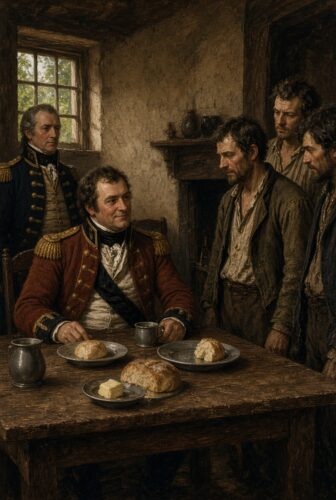
Smith guessed the landing site. North Point is the place you put troops ashore if you want a dry march of about fourteen miles into Baltimore. On the evening of September 11, with the British fleet visible at the mouth of the Patapsco under a full moon and a heavy dew, Smith sent Brigadier General John Stricker and the 3rd Brigade — the City Brigade — down the peninsula to meet them.
Stricker was another Revolutionary leftover who had also ridden through the Whiskey Rebellion. He had about 3,200 men: the 5th, 6th, 27th, 39th, and 51st Maryland militia regiments, a thin cavalry screen, a rifle battalion of volunteer companies, and a handful of six-pounder guns under Captain John Montgomery, who in civilian life was the state’s attorney general and therefore possibly the only lawyer in American history whose most famous work product was grapeshot. Many of these men had been at Bladensburg. They knew what rockets smelled like. They also knew what running felt like. Smith and Stricker were determined they would not do it twice in the same month.
By nightfall on the 11th, Stricker’s column had reached a Methodist meeting house near Godley Wood, roughly seven miles from the city and halfway to the point. Here the peninsula pinches. Bear Creek covers the right. Bread and Cheese Creek and a swamp cover the left. The road — Long Log Lane — runs down the spine. If you are going to pick a place to make a larger army walk through a meat grinder, this is the place. Stricker sent riflemen and a few horsemen forward to sting whatever came off the boats. Then he waited in the dark while the most professional army in the world climbed out of the water.
## Three in the Morning, and the Boats Keep Coming
The landing began about 3:00 a.m. on September 12. It was not a movie landing. It was a long, wet, cursing shuttle of boats from a fleet of more than thirty warships and transports, covered by gun-brigs anchored close enough to the beach to swat anyone foolish enough to contest the sand. Nearly 4,700 men eventually stood on Maryland soil: British infantry from the 4th, 21st, and 44th Foot, Royal Marines, sailors formed into a naval brigade, sappers, and those Colonial Marines who had every reason to fight hard. Ross and Cockburn came in with the first wave. Colonel Arthur Brooke of the 44th stayed to hurry the rest.
They pushed inland. Five miles up the peninsula they stopped at the Gorsuch farm and demanded breakfast. Three American prisoners were dragged in. Ross wanted numbers: how many guns in Baltimore, how many men. One prisoner, whether from panic or low cunning, said twenty thousand, mostly militia. Ross, full of toast and the memory of Bladensburg, delivered the line that Maryland schoolchildren would still be repeating a century later. He did not care if it rained militia.
He should have cared about the weather report.
Impatient with the slow unloading, Ross left Brooke to chivvy the rear and rode forward with an advance party. Two miles on, the lane narrowed again and the trees closed in. Waiting there were two companies of the 5th Maryland and Captain Edward Aisquith’s sharpshooters from the 1st Rifle Battalion. The meeting was not a battle yet. It was a collision in the woods. Muskets cracked. Ross turned in the saddle to call up support.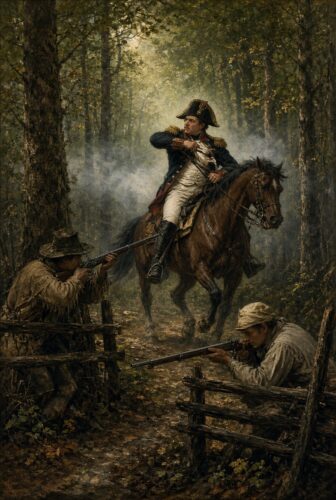
A ball took him through the right arm and into the chest.
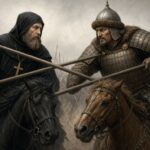
What happened next has been argued in Baltimore barrooms for two hundred years. The popular version, polished by a three-act play in 1859 called *The Boy Martyrs of Sept. 12, 1814*, gives the shot to Daniel Wells, nineteen, and Henry Gough McComas, eighteen, leather-trade apprentices who had enlisted in the city and already smelled powder at Bladensburg. They fired, the story goes, almost together. British return fire killed them both. A third claimant, twenty-four-year-old Aquila Randall, has his own small monument near the spot where Ross fell. Historians shrug and say the record is thin. What is not thin is the effect. Ross came off the horse. Cockburn reached him. The general understood the wound was mortal, handed over his watch and a message for his wife, and was carried back toward the fleet. His riderless horse, streaked with blood, trotted rearward through the column. Men who had followed Ross through Spain saw the animal and understood, before any official word arrived, that the officer who made the machine run was gone.
Ross died on the way to the ships. Command of the landing force passed to Colonel Arthur Brooke — a competent regimental officer who had never before directed anything larger than a regiment, and who had not been briefed on whatever plan Ross kept in his head. Brooke did the cautious thing. He waited until the rest of the army was ashore. He reorganized. He lost hours. Those hours are the entire point of September 12.
## The Line Across the Lane
Stricker heard the firing and pulled his advanced parties back to the meeting-house ground. He laid his brigade across Long Log Lane like a bar across a door. Montgomery’s four six-pounders sat in the road itself, muzzles toward the southeast. The 5th Maryland, Lieutenant Colonel Joseph Sterrett commanding, about 550 men, plus a company of Pennsylvania volunteers, took the right, from the lane to Bear Creek. The 27th Maryland, Lieutenant Colonel Kennedy Long, similar strength, took the left, from the lane to the swamp on Bread and Cheese Creek. Half a mile back, the oversized 51st waited on the right rear. The 39th, stiffened by Captain Quantrill’s Hagerstown volunteers and a company from Hanover, Pennsylvania, sat behind the 27th. The 6th Maryland waited farther back at Cook’s Tavern as the rally point if the front line had to give.
This was not a Napoleonic masterpiece. It was a militia general using water, mud, and a fence line because he did not have Wellington’s infantry. The flanks were not theoretical. A British regiment trying to slide around the American right would find itself swimming in Bear Creek. A slide around the left meant the swamp. The only honest way through was up the lane and into the mouths of four small guns and two regiments that had decided, this time, not to run at the first rocket.
Around 1:00 p.m., Stricker got word that the British had halted to eat and that sailors were already looting farms. He did not want a night attack on an unready line. He sent Major Richard Heath forward with 250 men and one gun to pick a fight and drag the British onto the prepared ground. Heath found the pickets. The noise brought Brooke’s army up in earnest.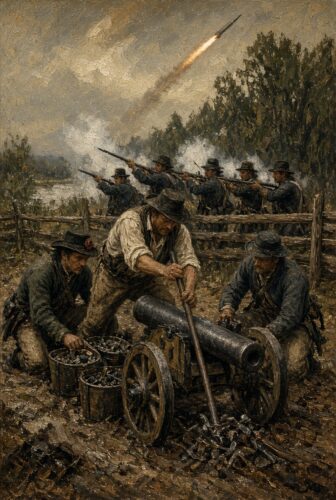
At about 3:00 p.m., the real battle opened.
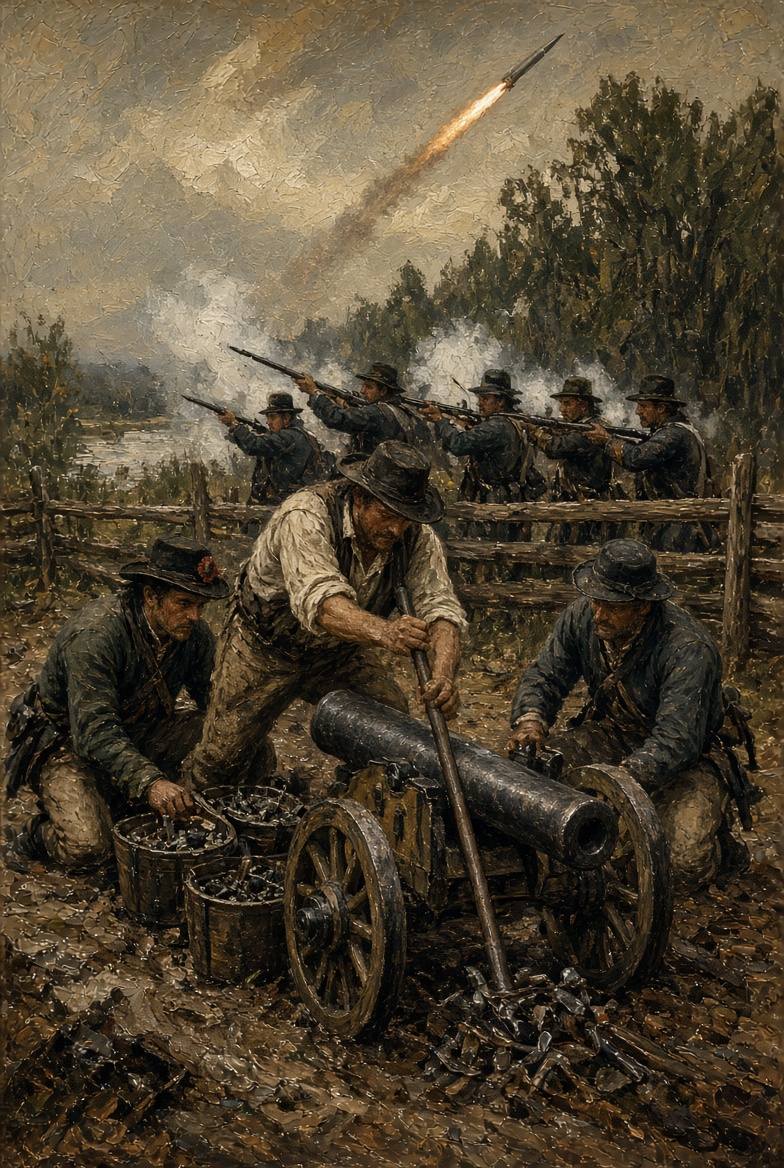
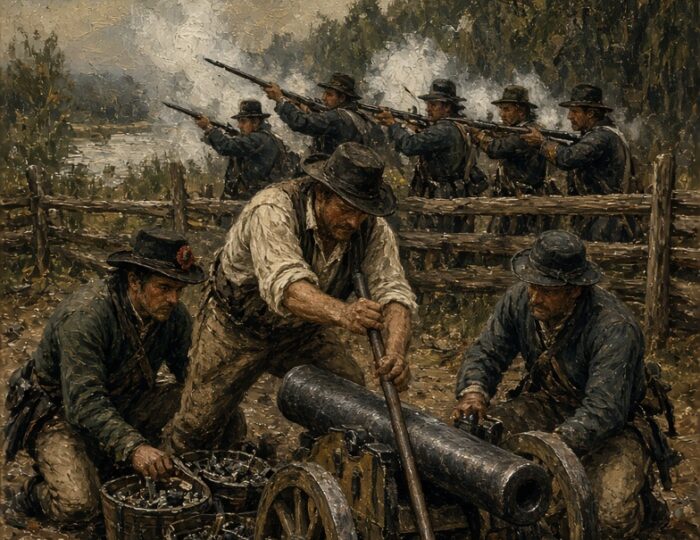
Brooke used his three field guns and Congreve rockets to pin the American front while the 4th Regiment tried to work around the flank and two other regiments plus the naval brigade punched the center. The Americans answered with musketry from the fence line and with something that would have made a regular artillery instructor weep. Montgomery’s gunners, short on proper canister, loaded broken gunlocks, nails, scrap iron, and horseshoes. The six-pounders became shotguns. At a hundred yards — the practical limit of a smoothbore musket — the lane filled with the kind of metal you find in a blacksmith’s sweepings.
The 5th Maryland on the right took rocket fire and did not break. The 27th on the left did the same. The 51st, the biggest regiment in the brigade, and parts of the 39th did what militia sometimes do when the noise gets personal: they came apart. Stricker, watching the right hold and the left-rear wobble, began an organized withdrawal. This is the part textbooks flatten into a sentence. It was not a rout. The 5th and the 27th fired, stepped back, fired again. They were the last off the ground. Corporal John McHenry of the 5th later wrote that his regiment carried off the praise for that reason. One American gun was lost. The rest of the battery rolled away. British units blundered into woods and the wet edges of the creeks. One British commander went down in the confusion. Brooke had the field. He also had a butcher’s bill and a dead general and a late afternoon and no clear picture of what waited behind the next belt of trees.
He did not press.
That decision — the Brooke Halt — is as important as the shot that killed Ross. A bolder man might have driven the militia into Baltimore before dark. Brooke looked at his wounded, at the swampy creeks eating his formations, at the absence of the officer who was supposed to be deciding these things, and he stopped. The Americans fell back to the main works on Hampstead Hill. Night came. Then the rain came. British soldiers who had left their greatcoats with the boats spent the night wet, with damp powder and the knowledge that tomorrow they would have to assault a city that had been digging for a year and a half.
American losses on the 12th ran about 24 killed, 139 wounded, and 50 captured. British losses were higher: something like 39 to 46 killed and 250 to 300 wounded, depending on which return you trust and whether you count the Marines separately. Among the American dead were Wells and McComas, if you accept the legend, and Aquila Randall, whose stone still argues the other side of the story. Among the British dead was the only general on the peninsula who had already captured an American capital.
## The Day After the Delay
On September 13, Brooke moved up and finally saw Hampstead Hill. Estimates vary, but he was looking at something on the order of 10,000 to 12,000 militia and a thicket of cannon behind fresh dirt. He asked the navy to silence a water battery called Rodgers’ Bastion so a night assault might have a chance. The navy had its own problem. Vice Admiral Alexander Cochrane’s bomb vessels and rocket ships spent twenty-five hours throwing 1,500 to 1,800 projectiles at Fort McHenry. Four Americans died inside the fort. Twenty-four were wounded. The star fort did not open a gate. A boat-borne attempt to slip 1,200 men past the fort in the dark ran into Forts Babcock and Covington; rockets meant to light the way only lit the attackers for the gunners. At dawn on the 14th, Armistead’s garrison ran up a garrison flag thirty feet by forty-two feet, big enough to be seen from the truce ship where a Maryland lawyer named Francis Scott Key had spent the night watching the explosions and wondering whether the flag was still there.
It was still there.
Brooke called off the land assault before sunrise on the 14th. The infantry marched back to North Point and climbed into the boats. The fleet eventually left the Patapsco. Baltimore stood. The privateer yards stood. The young United States, which had just watched its capital burn, had a victory it could point to and a song that would outlive every man who fought for it.
None of that happens if Stricker’s brigade is brushed aside in the morning of the 12th and Brooke is in the eastern streets of Baltimore before the earthworks are fully manned. The Battle of North Point is scored as a British tactical win. The scoreboard is a liar. The militia did not hold the lane forever. They held it long enough. They removed the opposing commander. They imposed a casualty rate that made the next decision feel expensive. They retreated in an order good enough to thicken the real line. Then they let rain, distance, and a brick fort finish a fight they were never going to win in a single afternoon.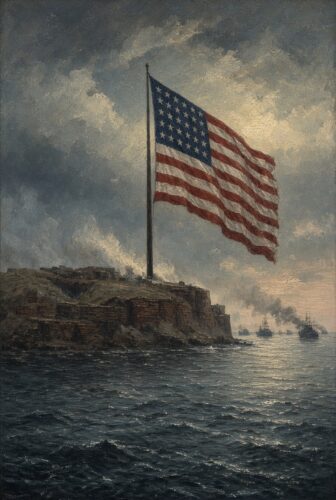
That is the whole machine. Not glory. Delay with teeth.
## What the Lane Actually Taught
The useful lesson is not “stand your ground no matter what.” Stricker did not stand his ground no matter what. He chose ground that favored him, provoked a fight on that ground, accepted that some of his regiments would fail, insisted that two of them would be last to leave, and then refused to turn a successful delay into a doomed counterattack. Ross’s fatal error was the Gorsuch breakfast: treating the enemy’s strength as a joke because the last sample had been a joke. Brooke’s fatal error, from the British point of view, was hesitation; from the American point of view, it was the gift that made the rest possible.
Two teenagers who may have fired one important shot did not win a war. A city that had spent a year moving dirt won a war. The shot and the dirt needed each other. The lane without the hill behind it is a grave. The hill without the lane in front of it is a target that gets hit too soon.
If you want to steal this, steal the whole sequence, not the statue.
## The North Point Delay Doctrine
Every generic plan on the internet tells you to attack your problems at dawn, visualize the win, and never retreat. That is Bladensburg thinking dressed up in a gym membership. The North Point Delay Doctrine does the opposite, on purpose, and it is built only from what happened on that peninsula.
You are not trying to destroy the thing that is marching on you in one heroic afternoon. You are trying to make it lose its general, lose a day, and arrive in front of your real defenses too tired, too wet, and too unsure to pay the final price.
### The seven pieces, used in order, never as a buffet
**1. Draw the peninsula before you draw the goal.**
Take one sheet of paper. Draw the thing that is advancing on your life as a column coming up a road. Then mark the narrowest place in the next seven days where that column has to pass — a single calendar block, a single conversation, a single bill, a single health appointment, a single unfinished page. That choke point is your Long Log Lane. Everything you do this week is either thickening that lane or wasting powder on the open beach where they land for free.
**2. The Gorsuch Breakfast Rule.**
You will not explain your full strength to the opposing force. No announcement of the grand plan. No confession of how scared you are or how many reserves you actually have. When asked how ready you are, you give a number that is either boring or slightly inflated and then you change the subject. Ross died because he believed a prisoner and his own last victory. Do not feed the next Ross.
**3. The Ross Hunt — one shot, not a campaign.**
Identify the single commander-equivalent in the problem. Not the whole army. The one piece whose removal makes the rest hesitate: the app you open first, the person you over-explain yourself to, the subscription that quietly funds the chaos, the hour after dinner when the good intentions dissolve. You get one sharp action this week aimed only at that commander. You do not try to defeat the entire habit stack. You try to knock the officer off the horse.
**4. The Horseshoe Load.**
Montgomery’s gunners did not wait for manufactured canister. They fired the contents of a junk drawer. Pick one ugly, improvised tool you already own and use it on the choke point within forty-eight hours. A paper calendar instead of a perfect app. A fifteen-minute walk instead of a redesigned training program. A handwritten script for the hard phone call instead of the perfect mood. If the tool looks slightly embarrassing, you are in the right century.
**5. Name your 5th Maryland.**
Write one sentence: “If everything else breaks, I will be last off the ground on _____.” Fill the blank with a single duty — the workout you will not skip, the page you will not leave blank, the evening you will not give to the scroll, the person you will not strand. That is the regiment that covers the retreat. You are allowed to have a 51st that panics. You are not allowed to have no 5th.
**6. The Brooke Halt.**
After the delay action works even a little — after the officer-equivalent is disrupted, after the day is bought — you stop. You do not turn the small win into a weekend overhaul. You do not chase the routed pieces into the swamp. You fall back to the prepared line you already have and you let weather, friction, and the other side’s logistics work. Most self-help dies here, in the victory lap that recreates the original exhaustion. Brooke’s caution saved Baltimore. Your caution after a clean delay is the same weapon.
**7. The twenty-five-hour flag.**
Once the lane has done its job, the only visible signal that matters is the one on the inner line: one piece of evidence, produced on a schedule you already own, that the position still stands. Not a transformation. A flag. A completed hour. A sent message. A closed kitchen. Something a person standing offshore could see at dawn and have to admit is still there.
### The seventy-two-hour version, timed to the original clock
– **Hours 0–12 (the landing you cannot prevent):** Do not contest the beach. Let the opposing force come ashore in your life — the workweek, the craving, the bill, the loneliness. Use the time to finish marking the choke point and loading the ugly tool.
– **Hours 12–24 (the Gorsuch breakfast):** Refuse the full briefing. Take the Ross Hunt shot.
– **Hours 24–36 (Long Log Lane):** Fight only on the narrow ground. Use the Horseshoe Load. Be last off that one piece of ground.
– **Hours 36–48 (the rain):** Brooke Halt. No new campaigns. Sleep, water, the ordinary line.
– **Hours 48–72 (the bombardment you survive by already being dug in):** Raise the one flag. Then stop and look at the water. If the fleet is still there, you repeat the doctrine next week on a new lane. You do not invent a new personality.
This will feel too small if you have been trained to want a montage. Good. Montages are what you get after someone else has already bought you the day. Stricker’s men did not look like a montage at 4:00 p.m. on September 12. They looked like a militia brigade backing up a muddy road with one gun missing and two teenage apprentices already dead in the woods. The montage happened over the fort, two nights later, because the muddy road had done its unphotogenic work.
Baltimore’s anthem is a poem about a flag that survived a night. The flag survived the night because a lane survived an afternoon. The lane survived the afternoon because someone had spent a year and a half moving dirt and because two or three ordinary people with ordinary muskets made an expensive officer fall off an ordinary horse.
You do not need a different character. You need a narrower road, one junk-drawer volley, one regiment that leaves last, and the discipline to treat a tactical loss as the cheapest way to purchase the only thing that ever actually changes a campaign.
Time.
That is what September 12, 1814, sold to a city that was supposed to burn. It is still for sale. The price is the same as it was on Long Log Lane: you agree, in advance, that you will not win the field. You will only make the field cost more than the man on the horse is ready to pay.
Share: