
If you are having a bad Tuesday, take a deep breath and remember that at least you are not Robert, Lord Maxwell, Warden of the Scottish West March, standing up to your thighs in freezing Cumbrian peat sludge on November 24, 1542, trying to explain to several hundred furiously damp noblemen why an army of eighteen thousand heavily armed soldiers just got steamrolled by three thousand borderers and a suspiciously deep swamp.
History loves to dress itself up in velvet robes, marble busts, and dramatic oil paintings where everyone looks sternly toward the horizon while pointing a sword at an unseen destiny. We are taught to believe that the fate of nations is decided by grand chess masters—kings and generals moving gleaming pieces across meticulously mapped boards with cold, calculating brilliance.
And then there is the Battle of Solway Moss.
On the cold, gray morning of November 24, 1542, the course of British history—and by extension, the modern world—was permanently altered not by a masterstroke of tactical genius, nor by a revolutionary new weapon, nor by an inspiring speech that brought grown men to tears. It was altered because an entire army marched into a dead-end swamp without checking the map, got into a screaming match over who was actually in charge of the meeting, panicked at the sight of a few hundred guys on horses, and surrendered to local farmers rather than walk back through the mud. It was a military catastrophe so spectacularly self-inflicted that it literally broke the heart of a thirty-year-old king, accidentally handed the crown of Scotland to a six-day-old baby girl named Mary, and set off a century of dynastic chaos that eventually united England and Scotland under a single ruler.
Grab a warm beverage, keep your boots dry, and pull up a chair. We are heading back to the boggy, lawless borderlands of the sixteenth century to witness the greatest organizational trainwreck in Renaissance warfare—and to extract the exact, unvarnished blueprint for how you can stop trapping yourself in your own personal peat bogs today.
Act I: A Family Feud With Broadswords
To understand how eighteen thousand Scotsmen ended up sinking into an English marsh on a brisk November morning, you first have to understand the absolute dumpster fire that was Tudor-Stuart family dynamics in the early 1540s.
In the red corner, sitting on the throne of England, we have King Henry VIII. By 1542, Henry was fifty-one years old, roughly the size of a prize-winning Berkshire hog, nursing a chronically ulcerated leg that smelled like a tannery in July, and deeply entrenched in his mid-life crisis—which, because he was an absolute monarch, meant he had broken away from the Roman Catholic Church, declared himself Supreme Head of the Church of England, dissolved the monasteries, and executed anyone who disagreed with his marital math. Henry was paranoid, volcanic, and obsessed with securing his northern border so he could go pick a fight with France without worrying about being stabbed in the back.
In the blue corner, sitting on the throne of Scotland, we have Henry’s nephew, King James V. James was thirty years old, dashing, stubborn, fiercely Catholic, and blessed with the distinct pleasure of being Henry’s living nightmare. James had spent his youth dodging kidnappings by his own unruly nobility, and once he finally grabbed the reins of power, he ruled with a velvet glove packed with wet cement. He taxed the church, squeezed his lords for cash, and flatly refused to play along with his uncle Henry’s Protestant makeover.
Henry, being a man of legendary subtlety, tried to bully James into compliance. In 1541, Henry traveled all the way up to York—a massive, expensive royal progress involving thousands of courtiers, tapestries, silver plate, and enough roasted meats to feed a small province—specifically to meet James and pressure him into breaking with Rome. Henry sat in York waiting. And waiting. And waiting. James simply never showed up. He stood up the King of England at a summit Henry had spent months organizing, leaving the Tudor monarch fuming in northern England like a guy whose blind date ghosted him at a five-star restaurant.
Henry did not take the ghosting well. By the summer of 1542, the diplomatic pleasantries were over, and the border between England and Scotland—a wild, lawless buffer zone known as the “Debateable Lands,” where professional cattle rustlers called Border Reivers treated property laws as mild suggestions—erupted into open warfare.
In August 1542, Henry sent an English raiding force under Sir Robert Bowes into Scotland. It went terribly for England. At the Battle of Hadden Rig, a Scottish force under the Earl of Huntly ambushed Bowes, crushed his troops, and captured hundreds of English gentlemen. When news of Hadden Rig reached London, Henry VIII nearly had an apoplexy. He immediately ordered Thomas Howard, the 3rd Duke of Norfolk—a ruthless, aging warhorse who had spent his entire career crushing rebellions—to assemble a massive punitive expedition.
In October 1542, Norfolk marched north with over twenty thousand men and burned his way across the Scottish borders, reducing towns, farms, and abbeys like Kelso and Roxburgh to smoking rubble before running out of beer and supplies and marching back south.
James V was incandescent with rage. He wanted revenge, and he wanted it immediately. He summoned the Scottish host to muster at Boroughmuir, outside Edinburgh, intending to march south and teach his bloated uncle a lesson.
There was just one tiny problem: James’s own nobility hated his guts, were exhausted from border skirmishes, had zero interest in invading England in the freezing mud of late autumn, and politely told the King to go pound sand. At Fala Muir, the Scottish lords staged a sit-down strike and refused to cross the border. James was humiliated. Calling his nobles cowards, he stormed back to Edinburgh, determined to prove that if the great earls wouldn’t fight for him, he would scrape together a force on the western border and strike England anyway.
Act II: The Most Dysfunctional Road Trip in History
If you want to understand why Solway Moss turned into a slapstick tragedy, look at the logistics of the Scottish counter-invasion in November 1542. It had all the hallmarks of a group project assembled at 11:45 PM the night before it was due.
King James V decided to launch a surprise raid into the English West March—specifically targeting Carlisle and the surrounding countryside—while the bulk of Henry VIII’s northern army was stationed miles away on the eastern border at Berwick. On paper, the strategy wasn’t completely insane. Hit them where they aren’t looking, burn a few villages, grab some cattle, restore royal prestige, and be home in time for Advent.
To pull this off, James turned to Robert, Lord Maxwell, the Warden of the Scottish West March. Maxwell was a seasoned border lord who knew the terrain, knew the local clans, and offered to raise an army and lead the assault into England himself. Surviving muster orders show that men from Dumfries, Peebles, Selkirk, and Hawick were summoned to gather at the Kirk of Morton before dawn on November 22, 1542.
Slowly, begrudgingly, an enormous force began to coalesce. By the time they moved toward the border, between fifteen thousand and eighteen thousand Scotsmen were on the march, dragging ten heavy brass field guns—precious royal artillery—along muddy, rutted tracks.
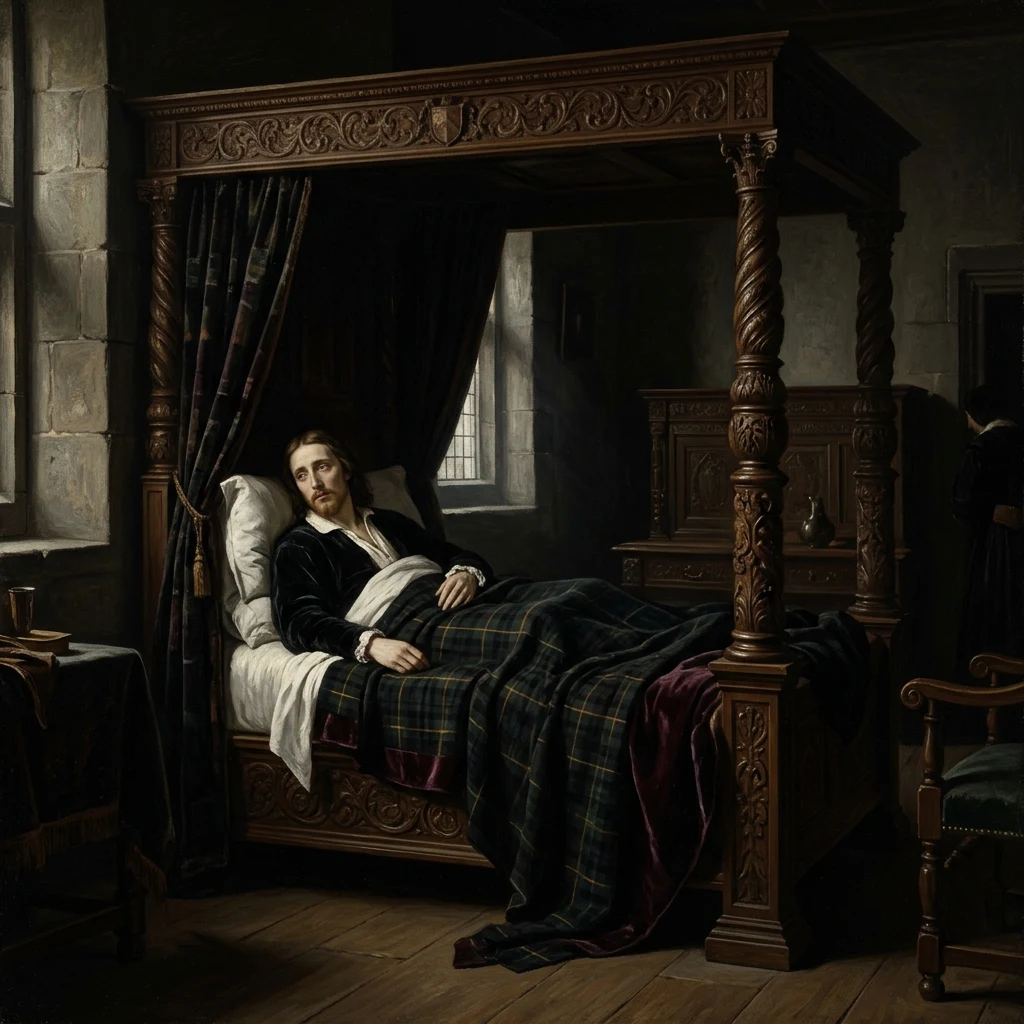
Meanwhile, King James V planned to ride at the head of his troops to guarantee their loyalty and oversee the triumph. Instead, as he rode south, the thirty-year-old king collapsed with a violent, debilitating fever. Unable to stay in the saddle, James was forced to halt at Lochmaben Castle, miles behind the front lines, shivering under woolen blankets while his massive, fractious army trudged forward into the gloom without him.
And here is where James V committed the single fatal error that doomed the entire expedition: he failed to establish a clear chain of command.
Lord Maxwell had organized the muster and assumed he was the supreme commander. The powerful border earls and barons—men like the Earls of Cassilis and Glencairn, and Lords Fleming, Somerville, Oliphant, and Gray—assumed they were operating as a traditional council of noble peers.
However, James V didn’t fully trust Maxwell or the great lords after the mutiny at Fala Muir. So, before collapsing into his fever bed at Lochmaben, James handed a sealed royal warrant to his personal court favorite, a relatively low-ranking nobleman named Sir Oliver Sinclair of Pitcairns. Sinclair was not a seasoned border warlord; he was a royal administrator and a palace insider whose primary qualification was that the King liked drinking with him. James’s secret instruction was that once the army crossed the border into England, Sinclair was to open the warrant and assume supreme command of the entire host.
Picture the scene. It is the pre-dawn darkness of November 24, 1542. Eighteen thousand cold, hungry, cranky Scotsmen have just splashed across the icy River Esk into English territory. Smoke is already rising from a few burning English farmsteads. The proud, touchy, heavily armed Scottish aristocracy—men whose families have been killing Englishmen along this exact river for three hundred years—are gearing up for battle.
Suddenly, trumpets blow. Two tall soldiers hoist Sir Oliver Sinclair up onto their shoulders on a makeshift platform of crossed spears. Sinclair unrolls a piece of parchment and loudly announces to the assembled nobility that by order of King James V, he is now the Lieutenant-General of the Scottish Army, and everyone needs to shut up and take orders from him.
The reaction was instantaneous, visceral, and utterly predictable.
Lord Maxwell looked at Sinclair like he had just sprouted a second head. The Earls of Cassilis and Glencairn went purple with rage. To these hardened border magnates, taking military orders from a jumped-up palace clerk was an intolerable insult. Within seconds, the Scottish command structure didn’t just crack; it vaporized. Noblemen began screaming at Sinclair, screaming at Maxwell, and screaming at each other. Clans refused to move into formation. Men milled around in confusion, leaning on their pikes while their leaders held an impromptu, furious HR dispute in the middle of an active war zone.
And while eighteen thousand Scots were busy arguing over org charts, someone else was watching them from the ridge above.
Act III: Enter Sir Thomas Wharton and the Geography Trap
That someone was Sir Thomas Wharton, the English Deputy Warden of the West March.
Wharton was the exact opposite of Oliver Sinclair. He was a shrewd, relentless, deeply pragmatic borderer who knew every ditch, ford, stone wall, and patch of quicksand within fifty miles of Carlisle. When scouts galloped into Carlisle with news that a colossal Scottish host was crossing the Esk, Wharton didn’t panic, even though he had a grand total of roughly three thousand men at his disposal—a mix of local garrisons, light border horsemen, and hastily mobilized yeomen.
Outnumbered roughly six to one, Wharton knew that a traditional, head-on pitched battle would get his three thousand men slaughtered before lunchtime. So he decided not to fight a traditional battle. Instead, he used the terrain as a vice.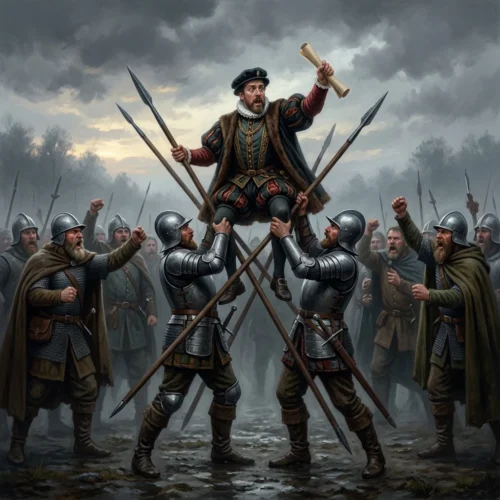
Wharton positioned his small force on the high ground near Hopesike Hill and Arthuret Howes, blocking the main road south toward Carlisle. From this vantage point, Wharton could look down into the river valley and see the massive Scottish host milling around in complete chaos. He could hear the shouting. He could see banners waving aimlessly and formations collapsing. Wharton realized immediately that the Scots weren’t advancing—they were imploding.
Then, Wharton looked at the geography behind and beside the Scottish army, and a slow, cold smile must have crossed his face.
The Scots had marched into a literal geographic cul-de-sac.
- To their north and east lay the River Esk, swollen with November rains and rapidly rising with the incoming Solway tide.
- To their south stood Wharton’s English infantry and heavy cavalry, occupying the high ground and blocking the road.
- And directly to their west, stretching for miles between the river and the sea, lay Solway Moss.
To a modern reader, the word “moss” sounds quaint, like something soft you might find growing on a garden stone or in a fairy tale. In sixteenth-century Cumbria, a “moss” was a vast, treacherous, treeless expanse of waterlogged raised peat bog. Beneath a deceptive crust of heather, sedge, and bright green sphagnum moss lay ten to twenty feet of freezing, acidic, semi-liquid organic soup. A man in leather boots could barely pick his way across it on a sunny July afternoon if he knew the secret sheep paths. A horse in iron shoes, or a soldier wearing thirty pounds of plate armor and carrying a sixteen-foot ash pike, wouldn’t just get stuck in Solway Moss—he would sink like a dropped anvil and vanish without a bubble.
The Scots had marched straight into the narrow funnel between the swollen River Esk and the bottomless peat bog, and then stopped to argue about middle management.
Wharton didn’t wait for them to finish their meeting. He unleashed his light border horsemen—men like Sir William Musgrave and Jack Musgrave of Bewcastle, seasoned border raiders who rode agile, tough little horses trained to navigate rough ground.
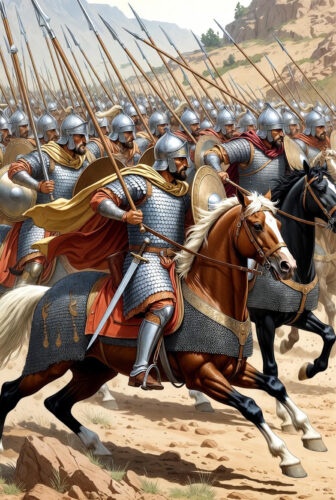
The English cavalry charged down the slope from Oakshawhill, blowing trumpets, shouting war cries, and raising as much dust and noise as three thousand men could possibly generate. Because of the low ridges, the mist, and the sheer audacity of the attack, the disorganized Scots assumed Wharton’s three thousand men were merely the vanguard of the massive Duke of Norfolk’s twenty-thousand-man royal army returning from the south.
Panic hit the Scottish lines like an electric shock.
Without a recognized commander to issue orders, without a battle line formed, and without anyone bothering to check how many Englishmen were actually charging them, the Scottish army broke before a single serious melee could even develop. Men threw down their pikes and ran. The problem was, there was nowhere to run.
Act IV: Drowning in Mud and Surrendering to Milkmaids
What followed over the next two hours was less a military engagement and more an industrial-scale mud-wrestling disaster.
Driven backward by Wharton’s aggressive cavalry charges, the panicked Scottish host was herded straight toward the Sandy Ford at Arthuret mill dam—the only viable crossing back over the River Esk. Unfortunately, eighteen thousand terrified men cannot cross a narrow river ford at the same time, especially when the tide is coming in and the water is freezing.
The bottleneck at the ford became a crush of screaming men and panicked horses. Hundreds of soldiers were pushed off the banks into the deep, icy currents of the Esk, weighed down by their padded jacks, steel helmets, and weapons, and drowned.
Realizing the river crossing was jammed, thousands of Scots veered west, hoping to skirt around the obstacle and head north toward the border. Instead, they ran headlong into Solway Moss.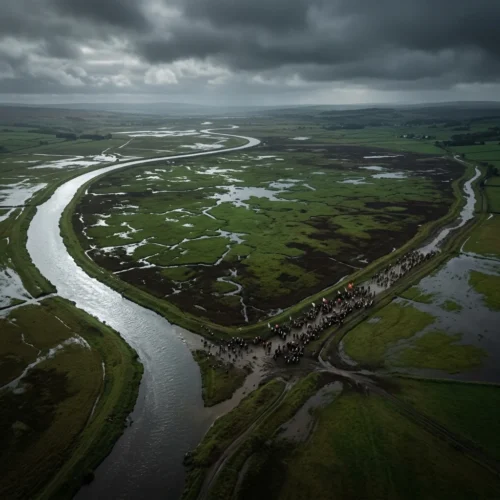
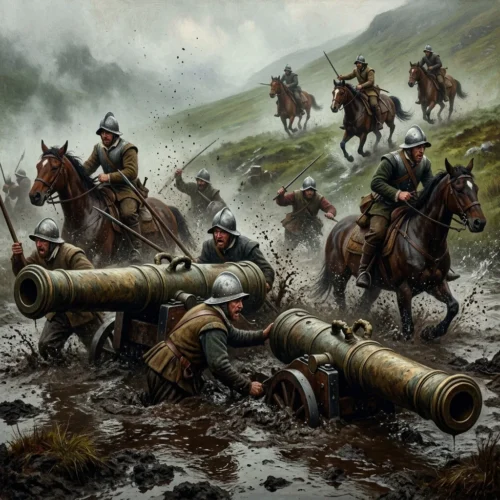
The front ranks hit the deceptive green turf at a dead sprint—and instantly plunged up to their waists in freezing black peat. Behind them, thousands more kept running, piling into the bog before they realized the ground had turned to liquid. Horses screamed as their legs snapped or sank to their bellies. The ten heavy royal cannons were abandoned in the muck, sinking slowly into the earth. Centuries later, Victorian peat-diggers cutting turf in Solway Moss uncovered the preserved skeleton of a sixteenth-century Scottish trooper still sitting astride the skeleton of his horse, both encased in rusted armor where they had sunk straight down into the mire.
For the Scottish nobility, the situation was uniquely humiliating. Weighted down by expensive plate armor, dismounted on the slippery riverbanks, and surrounded by swift English horsemen who could pick them off at leisure, the proud lords of Scotland realized they had two choices: drown in a bog or surrender.
They chose surrender—and they did it with breathtaking speed.
Lord Maxwell, the man who had promised to lead the glory charge, dismounted and handed over his sword. Sir Oliver Sinclair, the King’s beloved favorite who had triggered the entire command meltdown two hours earlier, was captured without striking a blow. Two earls (Cassilis and Glencairn), five barons, and over twelve hundred Scottish gentlemen and soldiers surrendered to Wharton’s tiny force. Contemporary chronicles note with dry amusement that English border horsemen were riding back to Carlisle herding four or five high-ranking Scottish nobles apiece like sheep. In one particularly absurd incident recorded in local lore, a group of exhausted, mud-caked Scottish fugitives wandered out of the marshes so demoralized and terrified of the border reivers that they formally surrendered themselves to a handful of local Cumbrian women who had come out to watch the commotion.
Let’s look at the final box score of the Battle of Solway Moss on November 24, 1542:
- English Army: ~3,000 men.
- Scottish Army: ~15,000 to 18,000 men.
- English Casualties: Seven men killed. Not seven hundred. Seven.
- Scottish Casualties: Roughly twenty killed by weapons, several hundred drowned in the river and bog, over 1,200 taken prisoner (including the cream of the Scottish aristocracy), 10 royal artillery pieces lost, and the King’s personal royal banner captured.
It was one of the most lopsided, humiliating military collapses in European history. And its aftermath reshaped the world.
Act V: “It Cam Wi’ a Lass, It’ll Gang Wi’ a Lass”
When messengers covered in mud rode into Lochmaben Castle to tell King James V what had happened at Solway Moss, the young king’s mind simply snapped.
Already weakened by a raging fever and dysentery or cholera, James was devastated not just by the loss of his army, but by the sheer, agonizing absurdity of how it happened. His nobles hadn’t died heroically on their shields; they had surrendered en masse without a fight, his favorite Oliver Sinclair was in an English dungeon, and his royal standard was being paraded toward London as a trophy for his insufferable uncle Henry VIII.
James retreated to Falkland Palace, took to his bed, turned his face to the wall, and refused to eat or speak. According to observers at his bedside, he lay in a feverish delirium, muttering endlessly about Oliver Sinclair and the capture of his banner at Solway Moss.
Two weeks after the battle, on December 8, 1542, a courier arrived at Falkland Palace with news from Linlithgow Palace: James’s French queen, Mary of Guise, had just given birth. James desperately needed a healthy son to secure the Stewart dynasty and rally the kingdom. He weakly asked whether the child was a boy or a girl.
When he was told it was a daughter, the dying king gave a bitter sigh and uttered one of the most famous lines in Scottish history, referencing how the Stewart dynasty had originally acquired the crown through Marjorie Bruce, daughter of Robert the Bruce: “It cam wi’ a lass, and it’ll gang wi’ a lass.” (“It came with a girl, and it will go with a girl.”)
Six days later, on December 14, 1542, James V died at the age of thirty. His six-day-old daughter became Mary, Queen of Scots.
Think about the domino effect of that one soggy morning in November:
- Because eighteen thousand men panicked in a swamp, Scotland was left with an infant queen.
- Henry VIII immediately tried to force Scotland to marry baby Mary to his young son Edward, launching a brutal eight-year war known as the “Rough Wooing.”
- To protect Mary from the English, the Scots shipped her off to France, turning her into a French-educated Catholic queen who would later return to Scotland, get tangled in explosive political scandals, flee to England, and spend nineteen years imprisoned by Queen Elizabeth I before being beheaded in 1587.
- And because Elizabeth I died childless in 1603, the English crown passed to Mary’s son—James VI of Scotland, who became James I of England—finally uniting the two crowns of Great Britain.
Every time you look at the Union Jack, or read about Mary, Queen of Scots, or trace the lineage of the modern British monarchy, you are looking at the direct downstream consequence of eighteen thousand guys marching into a dead-end mud puddle without agreeing on who was in charge.
Why Your Modern Life Looks Exactly Like Solway Moss
Now, let’s pause the sixteenth-century history lesson and look at your calendar, your inbox, and your life right now.
You probably haven’t marched across the River Esk with ten brass cannons lately, nor have you surrendered to a Cumbrian milkmaid. Yet if you look closely at the anatomy of your biggest career stalls, your most exhausting personal burnouts, and the projects that mysteriously die on the vine every year, you will recognize the exact three mistakes that destroyed the Scottish host on November 24, 1542:
- You Bring Massive Force to Ambiguous Authority: Like King James V assembling eighteen thousand men without clarifying whether Lord Maxwell or Oliver Sinclair was actually running the show, modern people throw massive amounts of effort, hours, apps, and hustle at their goals while leaving internal “command” completely fractured. Part of you wants to build a business, part of you wants to rest, part of you is taking secret orders from a “palace favorite” (like social media validation or someone else’s definition of success), and when pressure hits, your internal committees start screaming at each other instead of moving forward.
- You March Into Geographic Cul-de-Sacs: The Scots didn’t lose because the English were stronger; they lost because they walked into a narrow triangle bordered by a rising river and a bottomless peat bog with zero exit strategy. In modern life, we routinely walk into “Solway Mosses”—over-leveraged financial commitments, bloated schedules with zero buffer time, toxic client relationships, or rigid all-or-nothing routines. Everything looks fine while you’re standing still, until a minor stressor hits and you realize you have nowhere to retreat except straight into the mud.
- You Mistake Noise for an Army: Sir Thomas Wharton had three thousand men, not twenty thousand. He won because he stood on high ground and made enough noise to convince an unorganized crowd that the end of the world was charging down the hill. Every single day, you surrender your focus, your confidence, and your momentum to “Wharton’s horsemen”—minor inbox emergencies, loud critics, market fluctuations, or sudden self-doubt—simply because you haven’t organized your mental lines enough to count how small the threat actually is.
Most self-help advice online tells you to “muster more troops.” It tells you to wake up at 4:30 AM, drink green sludge, buy another planner, hustle harder, and bring twenty thousand soldiers to the border. Solway Moss proves that sheer size and effort without structural clarity and terrain awareness just gives you more people to drown in the bog.
To apply this historical disaster directly to your individual life, you don’t need another morning routine. You need The Solway Audit—a ruthless, anti-bog tactical protocol designed to keep you out of dead-end traps and stop you from surrendering to imaginary armies.
The Solway Protocol: A Tactical Plan to Stop Sinking in Your Own Mud
Forget vision boards, five-year manifestation journals, and bloated productivity systems. This is a fast, 20-minute tactical reset built strictly on the lessons of November 24, 1542. Execute it once today, and repeat it whenever you feel overwhelmed, stuck, or ambushed by life.
Phase 1: Purge the “Oliver Sinclairs” (Establish Single-Thread Command)
The Scottish army collapsed in five minutes because two different leaders claimed authority at the exact moment of contact. In your life, you are constantly sabotaged by competing priorities pretending to be equally urgent.
- Identify your “Lord Maxwell” (The True Frontline Commander): Pick the one primary objective for the next 30 days that actually moves the needle in your career, health, or finances. Write it down in ten words or fewer. This is the only commander allowed to issue orders this month.
- Execute your “Oliver Sinclairs” (The Palace Favorites): List every shiny distraction, vanity metric, people-pleasing obligation, or “urgent” side-quest currently demanding your attention because it feels comfortable or flatters your ego. Strip them of command immediately. If a task does not serve Lord Maxwell, it does not get hoisted onto spears in the middle of your workday.
- Enforce the Lochmaben Rule: King James V tried to micromanage a battle from a sickbed miles away via secret notes. Stop making rules for your future self based on idealized fantasies. Set your daily execution plan based on the actual energy and resources standing on the field today, not what you wish you had.
Phase 2: Map the Peat Bog (Eliminate Geographic Cul-de-Sacs)
Wharton didn’t have to defeat eighteen thousand men; he just had to nudge them until the river and the bog did the killing for him. Look at your current commitments and spot where you have boxed yourself in between a rising tide and a swamp.
- Audit your “River Esk” bottlenecks: Where in your week do you have zero margin for error? (e.g., back-to-back meetings with zero transition time, living paycheck-to-paycheck with zero cash buffer, or relying on a single client/income stream). Widen the ford before the tide comes in: block a mandatory 90-minute “firebreak” on your calendar every Wednesday and Friday that no one—including you—can book over.
- Spot the “Deceptive Green Turf”: What looks like an easy shortcut or a lush opportunity right now that actually has twenty feet of freezing peat underneath it? (e.g., taking on a high-paying project with terrible boundaries, financing a lifestyle upgrade you can barely afford, or saying “yes” to a commitment just to avoid an awkward five-minute conversation). Walk around the moss. Never sprint across soft ground just because you are in a hurry.
- Pre-designate your retreat route: Before you launch any major project, difficult conversation, or financial risk, write down your exact exit trigger—the specific condition under which you will calmly pull back while the ground is still solid, rather than waiting until your boots are stuck in the mud.
Phase 3: Count Wharton’s Horsemen (Reality-Test the Panic)
When Wharton’s three thousand borderers charged down Oakshawhill blowing horns, the Scots assumed twenty thousand men were behind them and surrendered on the spot. Half the crises that ruin your week are just three thousand borderers making a lot of noise on a foggy morning.
- Run the 60-Second Headcount: The exact second you feel a spike of anxiety, dread, or overwhelm—whether from a cryptic email from your boss, an unexpected bill, or a sudden wave of imposter syndrome—freeze. Do not run toward the bog. Ask yourself: “Am I looking at an actual twenty-thousand-man invasion, or am I looking at three loud guys on ponies?”
- Separate Terrain from Threat: Write down the literal, physical facts of the problem in one sentence, stripped of all adjectives and catastrophic predictions. You will almost always discover that the actual threat is tiny, and 90% of your panic comes from the fact that you have trapped yourself in a cluttered, unorganized mental formation.
- Never Surrender to Milkmaids: When things go sideways, do not compound a minor setback by throwing away your dignity, abandoning your standards, or quitting your long-term goals out of sheer embarrassment. Take the muddy boots off, clean the peat off your armor, laugh at how ridiculous the ambush was, and march back across the border intact.
History doesn’t repeat itself, as the old saying goes, but it certainly rhymes—and sometimes it rhymes in the key of a sixteenth-century bagpipe slowly sinking into a Cumbrian marsh. Today is November 24. Somewhere out there, thousands of people are marching into muddy cul-de-sacs, arguing over who holds the warrant, and surrendering their best ambitions to imaginary armies.
You don’t have to be one of them. Keep your command clear, watch where you step, count the horsemen before you run, and stay the heck out of the moss.
Share: