

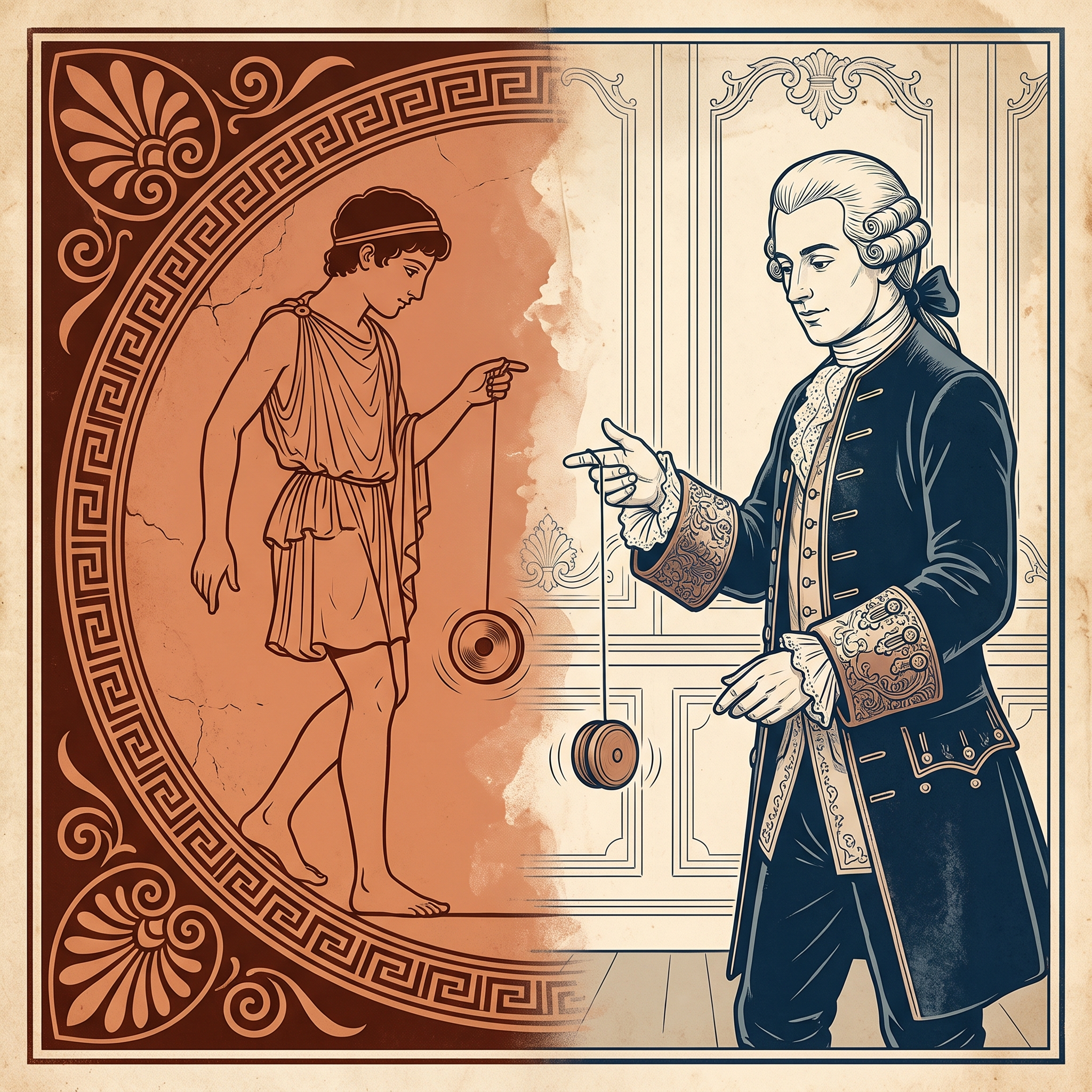

On Tuesday, November 20, 1866, inside the sprawling, marble-columned halls of the United States Patent Office in Washington, D.C., a clerk dipped a steel nib into an inkwell and affixed a signature to Letters Patent No. 59,745. Outside the building, the nation was nursing a colossal, agonizing hangover. The American Civil War had ended roughly eighteen months earlier. President Andrew Johnson was locked in bitter, trench-warfare politics with Radical Republicans over Reconstruction. Railroads were stitching the continent together with sweat, dynamite, and dubious accounting practices, and industrialists in New York and Chicago were busy inventing the modern corporation. Meanwhile, inside that quiet patent room, the federal government officially granted two men from Cincinnati, Ohio—James L. Haven and Charles Hettrick—exclusive rights to an “improved construction of the toy, commonly called a bandelore”.
History books tend to skip right past November 20, 1866, in favor of flashier November dates, or they fixate on another patent issued on that exact same day to a French immigrant named Pierre Lallement for a bone-rattling, pedal-cranked velocipede. Even on archival sites and daily history roundups—including a thorough sweep across the entire catalog of historyhabits.com, which has left this particular Cincinnati triumph completely untouched—the saga of Patent No. 59,745 remains buried in the dusty margins of nineteenth-century Americana. Yet what James Haven and Charles Hettrick accomplished on that crisp November Tuesday in 1866 is far more than a cute piece of trivia about a childhood toy. It is a masterclass in post-war reinvention, metallurgical audacity, rotational physics, and the bizarre ways human beings find rhythm in the middle of industrial chaos.
To understand why two grown men in post-Civil War Ohio decided to engineer a heavy-metal yo-yo, you first have to understand Cincinnati in 1866, the absurdly ancient pedigree of the “bandelore,” and the peculiar partnership between a forty-five-year-old foundry magnate and a young craftsman whose very name the federal government managed to misspell on the official parchment.
Cincinnati, “Porkopolis,” and the Age of Iron
In 1866, Cincinnati was not a sleepy Midwestern river town. It was the sixth-largest city in the United States, a roaring, smoke-belching industrial juggernaut perched on the north bank of the Ohio River. Known affectionately—and somewhat pungently—as “Porkopolis” because of its massive meatpacking industry, Cincinnati was also the undisputed manufacturing powerhouse of the American interior. During the Civil War, the city had served as a vital Union supply depot and staging ground, churning out cannons, steamboats, uniforms, hardtack, and iron hardware at a relentless, feverish pace.
When Robert E. Lee surrendered at Appomattox in April 1865, thousands of Northern factories suddenly faced an existential crisis: what do you make when nobody is buying artillery shells anymore?
Enter James L. Haven. Born around 1821, Haven was a classic mid-nineteenth-century Cincinnati industrialist—a man who smelled of coal smoke, machine oil, and ambition. His firm, James L. Haven & Co., operated a sprawling foundry and hardware manufacturing operation in the heart of the Queen City. If it could be cast in iron, stamped in brass, or bolted together with rivets, Haven’s foundry made it. His catalogs boasted an astonishingly eclectic inventory: architectural hinges, ornate wall sconces, apple cider presses, grain mills, steam furnaces, carriage parts, and early freight elevators. Haven was not a whimsical toy maker; he was a man who dealt in tonnage, molten metal, and heavy machinery.
Working alongside him—and living in a bustling rooming house at 134 West Seventh Street in downtown Cincinnati—was the Hettrick (or Hettrich) family. Historical records from the Cincinnati city directories reveal a fascinating wrinkle behind the second name on Patent No. 59,745. While the patent specification lists “Charles Hettrick,” local researchers digging through nineteenth-century tax rolls and business directories uncovered Charles Hettrich Sr., an employee connected to Haven’s manufacturing orbit, and his twenty-year-old son, Charles Hettrich Jr., a precision jeweler employed by the Duhme Company, Cincinnati’s premier jewelry and silverware firm. Whether the inspiration came from the foundry floor, the jeweler’s bench, or a father-son collaboration refined in Haven’s machine shop, the synergy between heavy iron casting and fine metalworking is written all over the blueprint of Patent No. 59,745.
Why would a foundry owner and a metalworker turn their attention to a spinning disk on a string? Because in 1866, America was desperate for distraction, and every machinist in the country was obsessed with mechanical efficiency. They looked at a toy that had been around since the Bronze Age and thought, Honestly, the physics on this thing are terrible. Let’s fix it with cast metal.
A Brief, Ridiculous History of the Bandelore Before 1866
Before Haven and Hettrick got their hands on it, the device had gone by dozens of names across millennia, none of which were “yo-yo” (a term that wouldn’t enter the American lexicon until the twentieth century via the Philippines, despite persistent playground myths claiming it was an ancient Filipino hunting weapon used to bonk wild boars from tree branches—a story that collapses the instant you try to picture retrieving a missed throw in dense jungle brush).
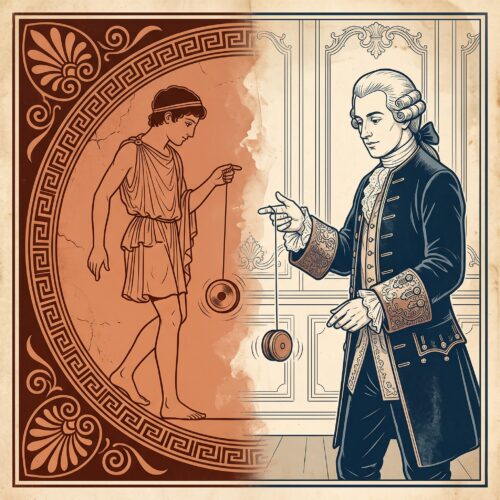
In ancient Greece around 500 B.C.E., children and adults played with painted terracotta disks attached to strings, depicted clearly on red-figure vases preserved in the National Archaeological Museum in Athens. When Greek youths came of age, they ceremonially dedicated their childhood toys—including their spinning disks—to the gods, which is arguably the earliest recorded instance of someone dramatically quitting a hobby.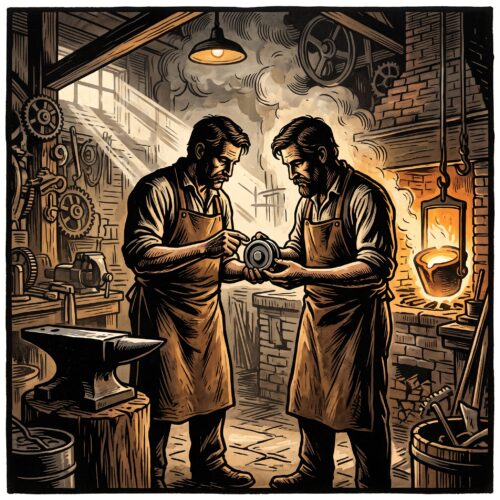
By the late eighteenth century, the toy had resurfaced in Europe as an aristocratic craze. In France, it was called the émigrette or incroyable, and during the French Revolution, terrified nobles awaiting execution—or fleeing to the borders—obsessively spun ivory and wooden disks to calm their nerves. In England, where the Prince of Wales (the future King George IV) was famously addicted to playing with one in public, it became known as the bandalore (or bandelore), as well as the quiz and the Prince of Wales’ toy.
Here was the fundamental engineering flaw of every ancient Greek terracotta disk, every French émigrette, and every Georgian wooden bandalore: they were light, fragile, and terrible at holding angular momentum.
If you carve a bandalore out of wood or bake it out of clay, its mass is relatively low and distributed unevenly. When you flick your wrist downward, gravity accelerates the disk, converting potential energy into rotational kinetic energy. Once it reaches the bottom of the string, however, a lightweight wooden disk lacks the rotational inertia to keep spinning smoothly against the friction of the string. It wobbles. It dies at the bottom. It refuses to climb back up unless you yank it like you are starting a stubborn lawnmower. Furthermore, tying a string directly around a wooden axle meant the string either gripped too tightly (preventing the disk from spinning freely at the bottom, a trick modern players call “sleeping”) or slipped hopelessly when the wood wore down.
In other words, for more than two thousand years, the bandalore was a charming, temperamental novelty that broke easily when dropped on cobblestones and frustrated anyone who lacked the delicate wrist flick of a French aristocrat.
Inside Patent No. 59,745: Metallurgy Meets Playtime
When James L. Haven and Charles Hettrick sat down to draft their patent application in Cincinnati in 1866, they approached the bandalore with the exact same engineering rigor they applied to steam furnaces and freight elevators.
Let us look at the actual language of Letters Patent No. 59,745, dated November 20, 1866. The specification begins with no-nonsense nineteenth-century legal prose:
“Be it known that we, JAMES L. HAVEN and CHARLES HETTRICK, of Cincinnati, in the county of Hamilton and State of Ohio, have invented a new and useful Improvement in Bandelores; and we do hereby declare the following to be a full, clear, and exact description thereof, reference being had to the accompanying drawings…”
What did they actually change? They made three deceptively brilliant mechanical upgrades that transformed a fragile parlor trinket into a precision kinetic machine:
- All-Metal Construction for Maximum Momentum: Instead of wood, ivory, or baked clay, Haven and Hettrick formed the body out of two heavy disks of cast or stamped metal. In the patent text, they explicitly stated their physics-driven motive: “By means of the above construction we are enabled to make the bandelore of metal, and thus secure in a high degree the momentum which is essential to easy operation of the toy.” By shifting the mass to dense metal disks, they dramatically increased the moment of inertia. Once you dropped Haven and Hettrick’s bandalore, that heavy metal flywheel wanted to keep spinning with the stubborn determination of a locomotive wheel.
- Interlocking Central Bosses and Rivet Coupling: Earlier two-piece wooden bandalores were glued together or joined with a simple wooden dowel, meaning that if you missed a catch and slammed it into a brick wall or an oak floor, the halves split apart like a walnut. Haven and Hettrick engineered each metal disk with a raised, hollow central hub—which they termed an “interlocking boss” (labeled E in their technical drawings)—and joined the two halves permanently through the center with a solid metal rivet (F). This created a virtually indestructible structural core that maintained dead-center alignment, eliminating the wobble that plagued hand-turned wooden toys.
- The Offset String-Anchor Hole: Rather than merely looping the string loosely around the central axle—which caused erratic slippage—or gluing it in place, Haven and Hettrick drilled a small, dedicated anchor hole (G) through one or both disks just outside the central boss. The string (H) passed through this hole and was knotted securely, ensuring consistent tension transfer from the rim of the hub to the outer perimeter of the disks.
Look at the sheer comedic contrast of this moment in American history. In 1866, Congress was debating the Fourteenth Amendment, Alfred Nobel was busy stabilizing nitroglycerin in Europe to invent dynamite, and two hardened Ohio ironworkers marched down to the U.S. Patent Office to ensure that children and bored factory clerks could execute flawless vertical drops without splitting their bandelores in half.
Even more amusing is what happened to the name. While the formal patent text called the device a “bandelore,” the Patent Office’s internal indexing and contemporary press accounts referred to Haven and Hettrick’s contraption as a “Whirligig”. In 1866, “whirligig” was a wonderfully elastic English word used for everything from spinning tops and pinwheels to merry-go-rounds and dizzying bursts of activity. Calling a heavy cast-iron yo-yo a “Whirligig” makes it sound less like a stocking stuffer and more like a Victorian siege weapon—which, if you swung Haven’s foundry-grade metal prototype over your head by its cotton cord, it very nearly was.
The Strange Afterlife of the Cincinnati Bandelore
Like so many pivotal inventions in American patent history, Patent No. 59,745 did not immediately turn James Haven and Charles Hettrick into the Rockefeller and Carnegie of the toy aisle. In fact, the commercial trajectory of the yo-yo is one of the great delayed-reaction stories in business history.
Haven went right back to casting hinges, cider presses, and iron storefronts in Cincinnati. His foundry prospered for decades, supplying the booming architectural and agricultural markets of the Midwest. Patent No. 59,745 quietly lived out its seventeen-year statutory lifespan, expiring on November 20, 1883, without triggering a nationwide bandelore mania. Other inventors filed incremental tweaks—like Albert B. Cottrell’s 1876 improvement in “bandilure toys” (Patent No. 179,377)—yet the device remained a modest regional pastime.
Then, more than sixty years after Haven and Hettrick’s November 1866 patent, the seeds they planted in metal physics detonated into a global cultural phenomenon.
In 1928, a Filipino immigrant named Pedro Flores opened the Yo-yo Manufacturing Company in Santa Barbara, California, introducing the looped-slip-string design (which allowed the disk to “sleep” freely at the bottom of the string) and bringing the Tagalog name yo-yo into mainstream American pop culture. Shortly thereafter, an ambitious entrepreneur named Donald F. Duncan Sr. spotted Flores’s spinning disks in California, bought out the company and trademark, and unleashed one of the most aggressive, genius marketing blitzes of the twentieth century. Duncan hired touring Filipino demonstrators to dazzle crowds outside department stores, partnered with William Randolph Hearst’s newspaper empire to sponsor massive citywide contests, and sold millions upon millions of units during the darkest depths of the Great Depression.
Why did Duncan’s yo-yos work so reliably when kids tried tricks like “Walk the Dog” and “Around the World”? Because generations of toy engineers had absorbed the exact mechanical lesson James Haven and Charles Hettrick put on paper in Cincinnati on November 20, 1866: you must concentrate dense, balanced mass into symmetrical disks around a precision central hub so that angular momentum does the heavy lifting for you.
By 1985, a descendant of Haven and Hettrick’s humble Cincinnati bandelore literally left the planet. On April 12, 1985, aboard Space Shuttle Discovery (mission STS-51-D), NASA astronaut S. David Griggs pulled out a yo-yo in microgravity as part of the “Toys in Space” educational program. In zero gravity, without Earth’s downward pull to accelerate the disk along the string, Griggs demonstrated that a yo-yo will still roll down the string if thrown—converting linear push into angular momentum—though it refuses to “sleep” at the end because there is no gravity pulling taut against the axle. From a dusty foundry in post-Civil War Cincinnati to low-Earth orbit, Patent No. 59,745 traced a 119-year arc of pure rotational physics.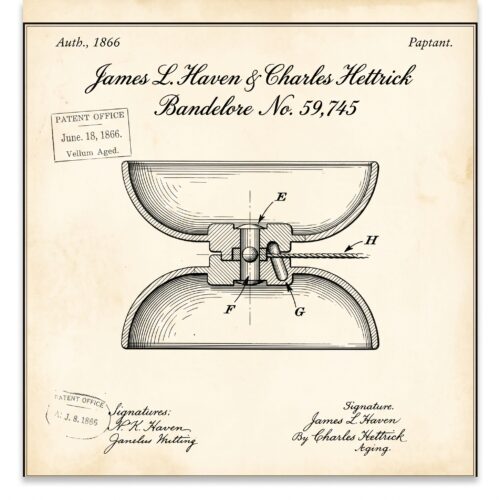
Why This Obscure 1866 Patent Matters More Than Any Modern Productivity App
Step back and look at what Haven and Hettrick actually solved on November 20, 1866.
Before their patent, using a bandalore was an exhausting, micromanaged chore. Because the wooden disk lacked mass and structural integrity, the user had to constantly fight friction, wobble, and gravity. Every single rotation required anxious, twitchy wrist adjustments. If you stopped paying hyper-vigilant attention for half a second, the string tangled, the disk died at the bottom, and the whole operation collapsed into a knotted mess.
Sound familiar? That is an exact description of how most people live their modern lives.
We operate like fragile, underweight wooden bandalores. We wake up, check three screens before our feet hit the floor, and spend sixteen hours frantically jerking our own strings—answering trivial pings, reacting to manufactured emergencies, trying to force momentum through sheer anxious willpower. Because we have no structural mass, no heavy flywheel of focused intention, the moment we hit the bottom of an energy cycle, we stall out, wobble, and crash.
Haven and Hettrick didn’t tell people to “try harder” or “flick their wrists with a better mindset.” They changed the hardware. They built a heavy, balanced flywheel with an interlocking core so that one clean release generated enough stored momentum to carry the system all the way down and smoothly back up again.
Modern self-help culture is obsessed with adding more friction, more trackers, more morning routines, more guilt, and more twenty-seven-step habit matrices. It treats human beings like spreadsheets that just need tighter rows. Haven and Hettrick offer the exact opposite philosophy: build a heavier flywheel, lock your center with a single rivet, and stop yanking the string.
The Cast-Iron Bandelore Protocol: A 15-Minute Anti-Self-Help Operating Plan
Forget vision boards, 4:30 AM ice baths, and color-coded Notion dashboards. This is a fast, brutally practical, zero-fluff personal operating system modeled directly on U.S. Patent No. 59,745. You can install the entire thing in 15 minutes today.
- Step 1: Scrap the Terracotta and Cast Your Iron (Minutes 1–5)
-
- The Historical Principle: Wooden and clay bandalores failed because their mass was too light and scattered to sustain spin. Haven and Hettrick replaced fragile materials with dense metal disks to maximize rotational momentum.
-
- Your Action: Take a blank index card or a single sticky note. Write down the two heavy metal disks of your current life—the only two pursuits, projects, or responsibilities that actually carry real weight and move your life forward over the next 90 days. Everything else on your to-do list is lightweight clay. Put every minor task, committee, side-hustle distraction, and “quick favor” onto a separate sheet and immediately defer, delegate, or delete at least half of them. You cannot spin twelve paper plates; you can only spin two iron disks.
- Step 2: Install the Interlocking Boss and Rivet (Minutes 6–9)
-
- The Historical Principle: Haven and Hettrick prevented their two disks from splitting apart on impact by joining them at dead center with interlocking bosses (E) and a single structural rivet (F).
-
- Your Action: Define one non-negotiable daily anchor (your rivet) that locks your two primary goals together so they never wobble out of alignment. For example, if your two heavy disks are deep career craft and physical vitality, your single rivet might be: “Phones stay locked in a drawer from 7:30 AM to 9:30 AM while I do my hardest creative work, followed immediately by a 30-minute walk outside before checking messages.” One rivet holds both halves together. No complex habit stacking—just one mechanical fastener.
- Step 3: Drill the Offset Anchor Hole (Minutes 10–12)
-
- The Historical Principle: Instead of wrapping the string loosely around the axle where it would slip endlessly, Haven and Hettrick drilled a dedicated hole (G) just outside the hub to knot the cord securely.

- The Historical Principle: Instead of wrapping the string loosely around the axle where it would slip endlessly, Haven and Hettrick drilled a dedicated hole (G) just outside the hub to knot the cord securely.
-
- Your Action: Eliminate “slippage” in your daily start-up. Pick the single task you always procrastinate on tomorrow morning, open the exact file, document, or tool needed for it right now, and leave a blunt, two-sentence instruction on your screen or desk telling your future self exactly where to start. When you release the string tomorrow morning, tension catches immediately—zero warm-up, zero scrolling, zero slippage.
- Step 4: Execute the Clean Drop and Stop Yanking the String (Minutes 13–15)
-
- The Historical Principle: Once a heavy metal bandalore is dropped cleanly, angular momentum carries it to the bottom of the string and returns it to your hand with minimal effort. Yanking the string mid-drop kills the spin and tangles the cord.
-
- Your Action: Set a single 50-minute timer during your peak energy window today. During those 50 minutes, commit to a single uninterrupted drop: work exclusively on Disk #1 with all notifications killed and browser tabs closed. When the timer rings, stop yanking the string. Step away completely for 10 full minutes—no “quick email checks,” no podcast multitasking, no guilt. Let the flywheel return cleanly to your hand before you throw it again.
- Step 5: Run the Friday Foundry Inspection (2 Minutes Weekly)
-
- The Historical Principle: A foundry machinist inspects the rivet for wobble and checks the string for fraying before the wheel flies off the axle.
-
- Your Action: Every Friday afternoon, spend exactly 120 seconds asking two questions: “Did my two iron disks actually spin this week, or did I get tricked into juggling clay?” and “Where did my string fray?” Tighten the rivet, replace any frayed boundaries, and walk into the weekend with your hands completely empty.
Share: