
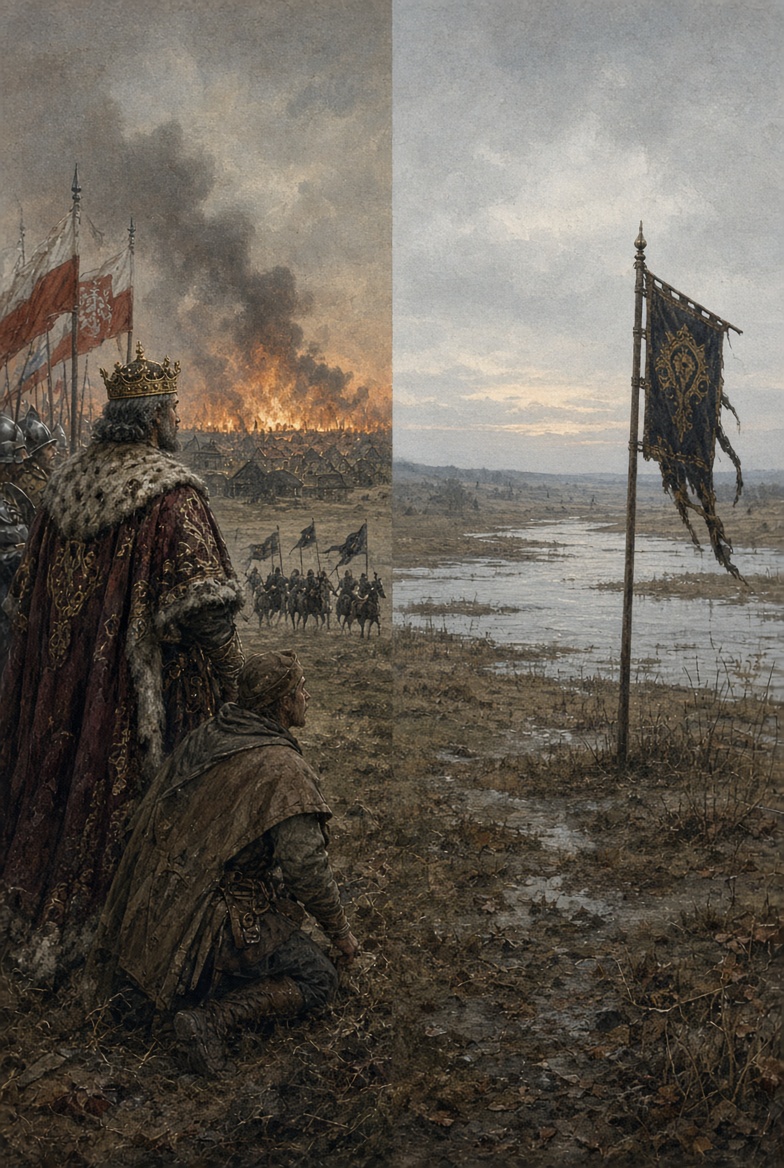
At one o’clock on the afternoon of Sunday, 8 October 1480, the Ugra River stopped being a boundary and became a weapon.
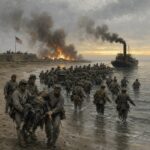
The river is a western tributary of the Oka, itself a tributary of the Volga, running through what is now Kaluga Oblast, a little more than a hundred miles southwest of Moscow. In October it is wide enough in places to measure a hundred and twenty to a hundred and forty meters from bank to bank, cold, brown, and moving. On the southern bank that afternoon sat the largest Tatar army assembled in the fifteenth century, the host of Akhmat Khan of the Great Horde, the last serious fragment of the old Golden Horde still pretending to collect rent on the Russian lands. On the northern bank stood the regiments of Ivan Ivanovich, called Ivan the Young, the twenty-two-year-old son of the grand prince, and Andrei Vasilievich, called Andrei the Younger, the grand prince’s brother. They had muskets, bows, and a “fiery outfit” of cannon. The Horde had bows, horses, and inflated skins.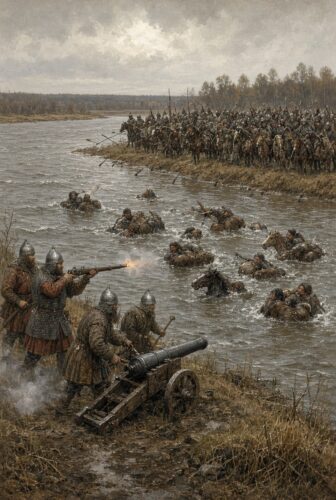
The skins were the first thing to fail.
A Tatar crossing in that season meant men and horses pushed into water that already bit, some of them clinging to wineskins lashed together as floats. Russian shot, stone, and buckshot reached them while they were still in the channel. Iron and stone went through the skins. A punctured float does not argue. Men went under. Horses went under. The arrows coming back the other way had already spent themselves. A composite bow that could kill at two hundred paces on the steppe lost its punch across a hundred-plus meters of open water and a rising bank. The chronicle writers, who are not shy about divine intervention when they can get it, still bother to record the mundane reason: the river was wide enough that Tatar arrows arrived tired.
The fighting that started at one o’clock did not stop that evening. It ran, in several places at once, for nearly four days, out to about 11 October, along roughly five kilometers of bank measured west from the Ugra’s mouth. Akhmat could not take the bank. He pulled back two versts — about two kilometers — to a place the Vologda-Perm Chronicle calls Luza. He then tried to slide his army quietly toward a crossing near the settlement of Opakov. The movement was seen. The crossing was blocked. After that, the two armies mostly looked at each other.
That looking lasted a month. It ended a tribute that had been paid, with interruptions and humiliations, since the thirteenth century. No great field was heaped with the dead. No city fell. A nineteenth-century historian, Nikolai Karamzin, later described the finish with the driest line in Russian military history: it should have been an odd image, two armies running away from each other, not pursued by anyone.
He was not wrong. He was also not describing a draw.
## The rent
To understand why a failed river crossing in 1480 mattered, you have to sit with the invoice it cancelled.
In the winter of 1237–38, Batu, grandson of Chinggis, brought the western tumens of the Mongol Empire into the Rus principalities. Ryazan fell. Vladimir fell. In December 1240 Kiev fell, and the old center of the Rus lands stopped being a political capital in any practical sense. What followed was not a permanent occupation by steppe garrisons in every town. It was worse for bookkeeping and better for the Horde’s logistics. The khans issued a yarlyk, a patent, to whichever Rus prince they found useful. The prince ruled at home. He also collected. The tribute — the vykhod — went to Sarai on the lower Volga, and later to whatever camp held the khan’s seal. Princes traveled to the Horde to beg the patent, sometimes to die there. In 1327 a Tatar tax collector, Chol Khan, was killed in an uprising in Tver, and the Horde used Moscow’s prince, Ivan I Kalita, to smash Tver as punishment. Moscow’s rise was not a fairy tale of resistance. For a long time it was a franchise.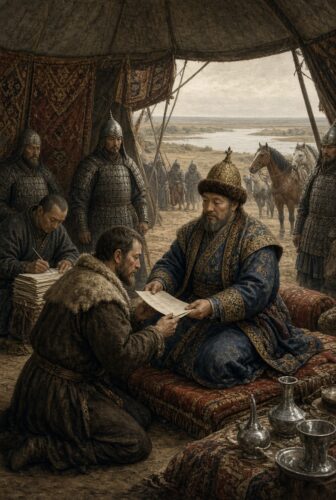
The arrangement was stable enough to last. The Golden Horde peaked, then cracked. In the fifteenth century the cracks became successor states: Kazan, Crimea, Astrakhan, the Nogai, and the Great Horde, which kept the old grazing grounds between the lower Volga and the Dnieper and kept the claim to be the senior house. Akhmat Khan, Ahmed in many Western spellings, a son of Küchük Muhammad, held that claim. He was not a raider passing through. He was a man trying to collect an old debt from a debtor who had started answering letters with silence.
Ivan III Vasilievich had been grand prince of Moscow since 1462. He was not romantic, and the chronicles that scold him later are scolding a man who preferred ditches to duels. He had already absorbed Novgorod in the 1470s, ending the last great rival republic in the north. He had married Sophia Palaiologina, niece of the last Byzantine emperor, in 1472, which gave Moscow a useful imperial costume and a stream of Italian engineers. None of that cancelled the Horde’s invoice by itself. What cancelled the habit was a decision, conventionally dated to 1476, to stop paying.
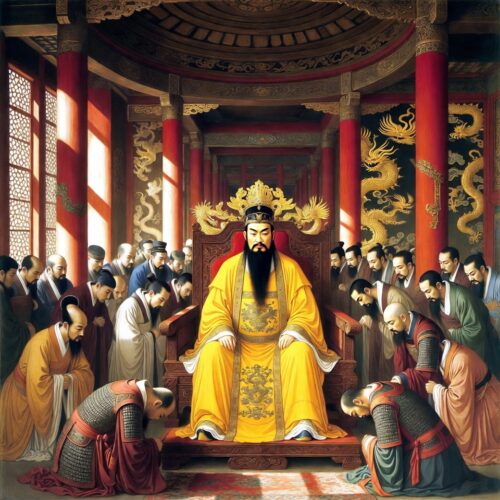
The story that grew up around the decision is almost too neat, which does not mean the decision was soft. An embassy from Akhmat arrived in Moscow. Ivan refused the customary full prostration. In one later telling he took the khan’s basma, the plaque of authority, and threw it down. Whether the plaque actually hit the floor is less important than the account book. The vykhod stopped. Akhmat had already come once, in 1472, and had been turned at Aleksin on the Oka when his men found the fords held and the opposite bank unfriendly. He went home. He did not forget.
By the spring of 1480 he had something he had not had in 1472: a promise.
## The ally who never crossed his own border
Casimir IV Jagiellon was king of Poland and grand duke of Lithuania, which in that century meant he held a huge belt of Orthodox East Slavic land — Kyiv, Smolensk, the old Rus west — and a Catholic kingdom on the Vistula. He and Akhmat had a use for each other. Casimir did not enjoy watching Moscow thicken. Akhmat did not enjoy an empty treasury. The bargain was simple. The Great Horde would come up from the steppe. Lithuania would come from the west. Moscow would be caught between a river line and a second army.
Ivan’s answer was not a speech. It was a second bargain. Mengli Giray, khan of Crimea, had his own quarrel with the Great Horde and no love for Casimir. Moscow and Crimea found each other useful. When the campaigning season of 1480 opened, Mengli Giray did what Ivan needed more than he needed another regiment on the Oka: he raided into Podolia, the southern edge of Casimir’s world. A king who is defending his own villages does not march to a rendezvous on the Ugra. Casimir never came. He did not send the force he had promised. Akhmat would spend October learning what a verbal alliance weighs when the other man’s barns are on fire.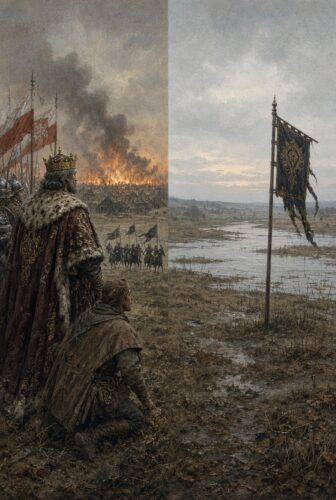
There was a second crack, and this one was inside Moscow.
Ivan’s brothers Andrei the Elder, prince of Uglich, and Boris of Volotsk had spent the year in open sulk over appanage land and the way the grand prince handled Novgorod’s spoils. Medieval Russian politics ran on brothers the way the Horde ran on cousins: indispensable, and one insult away from a second front. In the summer of 1480 the two of them were not reliably in the army. Clergy and boyars spent weeks on the repair. The quarrel was settled around the end of September. Their troops did not appear on the river that week. They appeared later, at Kremenets, after the first blood on the Ugra had already been spilled. Akhmat, counting on a divided Moscow and a Polish king, got neither on time. He got the son and the younger brother, dug in on a cold bank, with guns.
## The long screen
News of the coming invasion reached Moscow in late May 1480. In June Ivan pushed troops south to the Oka, the traditional stop-line against a steppe army that did not want to fight through forests. His son Ivan the Young went to Serpukhov. His brother Andrei the Younger went to Tarusa. Ivan himself moved to Kolomna. Tatar scouts were soon reported south of the river. The Oka line ran, in intention, from Kaluga east toward the lower approaches, a screen measured later by one modern estimate at something like sixty versts of watched bank. A verst is roughly a kilometer. Sixty kilometers of river is not a wall. It is a bet that the enemy will try a ford you have already disliked for him.
Akhmat did not oblige. He slid west, past the strongest part of the Oka screen, making for the Ugra, which joins the Oka near Kaluga from the southwest. On the Ugra he would be closer to Lithuanian territory and closer to the king who was supposed to meet him. Russian outposts caught the direction. Regiments shifted west. Forces from Tver, Moscow’s old rival and now a client, moved toward the same river. The defense thickened where the attack was actually going.
Around 30 September Ivan rode back to Moscow to sit with bishops and boyars. The argument in the capital was not heroic. Part of the court wanted him to buy time with concessions. Vassian Rylo, bishop of Rostov and a hard man in a cassock, wrote the letter later called the Epistle to the Ugra, telling the grand prince, in substance, not to be the prince who handed back what the river was in the process of keeping. The treasury and the grand prince’s household were sent north to Beloozero, a lake town far enough that a disaster on the Oka would not also be a capture of the government. This is the detail that keeps Ivan from turning into a poster. He evacuated the books and the family. He was willing to win ugly.
He also opened a second door in Akhmat’s rear. Vasily Nozdrevaty, with the exiled Crimean Nur Devlet, was sent east and then down the Oka and the Volga to strike at the Horde’s own camps while the khan was busy on the Ugra. A steppe army lives on the animals it has brought and the grass it can still find. A raid into the rear is not a battle. It is a rumor that the barn at home is no longer safe, which is sometimes more useful than a rumor that the enemy is brave.
On 3 October Ivan moved to Kremenets, a position back from the river from which he could feed the bank without standing on it. Akhmat, having waited at Vorotynsk just south of the Ugra-Oka junction for a Lithuanian banner that did not appear, gave up on patience. On 6–8 October he brought his main body up to the Ugra.
## Four days in the water
The first clash is timed by the chronicles to one o’clock on 8 October. Not dawn. Not a surprise. An afternoon attack on a bank the defenders had already decided to dislike.
The Horde tried the crossings in more than one place. This was not a single heroic ford out of a painting. It was a series of pushes along the five kilometers west of the mouth, cavalry and foot driven at the water, arches of arrows coming up from the south bank, and Russian missiles coming down into the channel. The chronicles are specific about the tool that mattered. Cannonballs, shot, and buckshot hit men in the water and ruined the wineskins they were using as floats. The arrows that cleared the river arrived without the force to punch armor or, often, to matter at all. Akhmat sent them again. The bank held.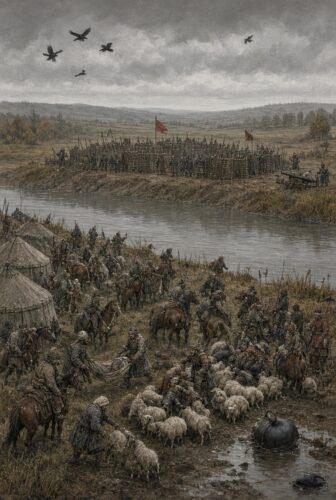
He pulled off two versts to Luza. A withdrawal of two kilometers is not a rout. It is a man discovering that the obvious crossing is a butcher’s bill. From Luza he tried the cleverer move, a quiet shift toward Opakov, looking for a ford the Russians had not weighted. The shift was detected. The new crossing was refused on the same terms as the old one. By 11 October the attempt to force the river was over. What remained was the thing the episode is actually named for: the Great Stand.
Ivan opened negotiations. They went nowhere, which was the point. Every day of talk was a day in which his brothers’ regiments could finish their march, a day in which the Volga raid could become a fact instead of a plan, and a day closer to weather the Horde could not farm. Akhmat still hoped for Casimir. Casimir was still not coming. Mengli Giray had done his job without ever seeing the Ugra.
Both camps settled into the dull work of a staredown. The Russian line was long and, the grand prince knew, thin. The Horde’s horses and sheep ate what the south bank offered. October on that river is not a place you winter a steppe army if the enemy declines to come out and be shot in the open. The khan needed either a ford, an ally, or a freeze.
## The freeze that frightened both banks
The freeze arrived as a problem, not as a miracle.
Hard frost set in around 26 October. A frozen Ugra is not a moat. It is a road, wide, flat, and no longer interested in puncturing wineskins. Ivan did not wait to find out whether Akhmat would test it. He ordered the bank abandoned on purpose. His son, his brother, and the voivodes pulled the regiments back from the water, northeast to Kremenets, then east toward Borovsk, where the army could sit in one mass across the roads to Moscow instead of strung out for sixty versts waiting to be pierced at a single point. Concentration is less cinematic than a last stand on a riverbank. It is also how you avoid being the thin line that a frozen river makes irrelevant.
Akhmat watched the bank empty and did not read it as an invitation. The Russian sources say there was fear on both sides, each afraid of the other, which is the sort of sentence chroniclers write when neither general wanted to be the man who discovered, at the cost of his army, that the other man had been bluffing. The khan had no Casimir. He now knew the quarrelsome brothers had rejoined the grand prince. His animals were eating down the forage. Disease was reported in the camps. A steppe commander’s best weapon is the raid against a scattered enemy, not a frontal attack into a prepared host that has just refused him four days of crossings. On 8 November he began to leave. Word of the retreat reached Ivan on 11 November.
He did not leave empty-handed, and he did not leave in the direction of his ally. On the way south he sacked a dozen Lithuanian towns, Mtsensk among them. His son Murtaza peeled off and raided villages south of the Oka until Russian troops shoved him away. The king who had promised an army received, instead, a bill for neutrality. It is the most honest review a no-show ally has ever been given.
Ivan reentered Moscow on 28 November. The city that had sent its treasury to Beloozero got its grand prince back without having paid the vykhod.
## The khan who did not get a second autumn
Akhmat did not get a rematch. In January 1481, near his winter camp, he was killed by Ibak, a khan of the Nogai linked to the Siberian line, in a quarrel that had nothing to do with the Ugra and everything to do with the fact that a defeated claim does not protect a man on the open steppe. The Great Horde stumbled on for another generation. In 1502 the Crimean khan Mengli Giray finished it. The tribute to Sarai was already a memory.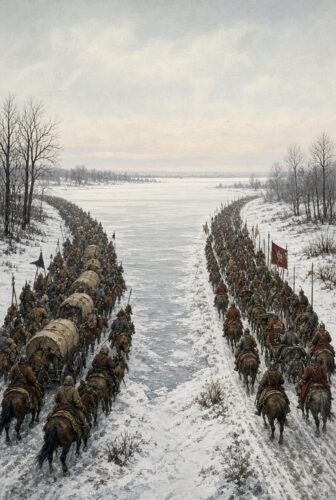
What ended in November 1480 was not the Tatar world. Crimea would burn Moscow itself in 1571 under Devlet Giray, a reminder that “the yoke is over” was a political fact and not a weather report. What ended was the specific arrangement in which a grand prince of Moscow needed a khan’s patent to be legitimate, and in which the absence of that patent could be corrected by an army coming up the Oka to collect. After the Ugra, no Moscow prince rode to the Horde to beg the yarlyk. The chronicles of the next century, especially the Kazan History of the 1560s, would call this the lifting of the Muslim yoke and the slavery that went with it. Later historians have argued, fairly, that the stand was less a battle than a refusal, and that Ivan’s hesitation in September looks unlovely beside Vassian’s letter. The argument does not restore the tribute. A debt that cannot be collected has already changed owners.
The mechanics are what make the episode stranger than a victory parade. Moscow won by not crossing. The Horde lost by arriving on time to a meeting the other guest skipped. The guns mattered most while the enemy was in the water and least once both armies were on dry ground staring. The decisive reinforcements were not a secret weapon. They were two offended brothers who had to be talked back into the family before they would stand on a riverbank. The decisive foreign policy was a Crimean raid in Podolia, a hundred miles and more from the ford. And the retreat that sealed it was mutual, unpursued, and, if you read only the casualty list, almost polite.
Karamzin’s odd image holds. Two armies left. Only one of them had stopped paying.
## What the bank still knows
The Ugra is a poor mascot for ordinary encouragement. Nobody on that river found his passion. Nobody visualized the crossing. The grand prince evacuated his cash, patched a family quarrel he had helped create, hired a rival khan to burn the enemy’s ally, put his son on the water with guns, and then, when the freeze made the water useless, gave the water up and stood where the roads actually ran. The khan did the opposite. He waited for a man who had already chosen his own barns, spent four days feeding a river that punished floats, and went home to be killed by a different nomad in January.
That is the usable part. Not the icon. The sequence.
A modern life collects tributes the way Moscow collected the vykhod: not always because the collector is strong, but because the payment has a date, a posture, and an audience that expects the bow. The tribute is rarely a horde. It is a standing transfer of money, hours, or deference to a demand that continues mostly because it has not yet been met with a bank. The Ugra’s lesson is hostile to the usual advice, which is either to charge the ford or to wait until you feel ready. Ivan did neither. He made the ford expensive, fixed the split inside his own camp, and refused to chase a retreating claim into winter.
The practice below is built only from that sequence. It is not a mindset. It is a four-day hold with a before and an after, named for the river because the river did the discriminating.
**The Ugra Hold**
Do this once, for one tribute, on a calendar you can actually keep. Not for your whole life. For one collector.
– Write the tribute on one line: the exact recurring payment. A sum that leaves on a date, an hour block that belongs to someone else’s emergency, a weekly explanation you give to a person who has not earned the explanation. If you cannot name the amount or the hour, it is not yet a tribute. It is a mood. Moods do not get a river.
– Name the missing Casimir. This is the ally, the raise, the apology, the perfect month, or the second person’s permission you have been waiting for before you stop paying. Write the name. Then write the last date that person or condition actually moved toward the ford. If the date is not on this month’s calendar, the ally is in Podolia. Stop reserving a seat.
– Reconcile one brother before you touch the bank. Pick the single internal split that keeps half your force off the river: the unpaid invoice you are also the creditor of, the habit that raids your own camp, the agreement with yourself you break by Wednesday. Settle it in the seventy-two hours before the hold, in one concrete act, not a promise. Andrei and Boris were useless until they were in the camp. A plan that starts while you are still divided is Akhmat’s plan.
– Run one rear raid on day zero. A small, real action against the collector’s expectation, done before the hold starts: the automatic payment paused in the bank’s own interface, the recurring meeting declined in writing, the number silenced, the key returned. Nozdrevaty’s Volga ride did not win the Ugra. It made going home look worse than staying. Your raid should be small enough to finish in a day and visible enough that the old arrangement cannot pretend nothing changed.
– Hold the bank for four days, the length of the actual fight, from a Sunday one o’clock to the Thursday after, or whatever four-day block you can defend. During it you do not cross. Crossing means reopening the negotiation that restores the old sum, answering the provocation that drags you into the water, or “just this once” on the exact payment you named. You also do not chase. If the demand retreats two versts — a delay, a softer email, a sudden silence — you do not wade after it to explain yourself. Luza is not an invitation.
– On the morning after the four days, do the Borovsk move. Leave the thin line. Put the defended thing in one place you can actually watch: one account, one hour, one sentence you will repeat without decoration. A freeze is any change that makes your old defense useless — a new request, a social occasion, a billing cycle rolling over. When it comes, you concentrate. You do not try to guard sixty versts of maybe.
The hold fails in one specific way, and the chronicles already recorded it. It fails if you spend the four days waiting for Casimir. The king does not come. The brothers, if you have not already fetched them, do not appear out of guilt. The river only works for the side that has decided the crossing will be expensive and that the tribute will not be paid in order to make the expense stop.
Ivan went back to Moscow on 28 November with the same title he had left with. The difference was that nobody on the south bank could still sell him the patent for it. That is a smaller triumph than the paintings suggest. It is also the kind that survives January.
Share: