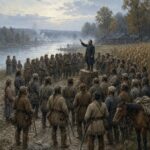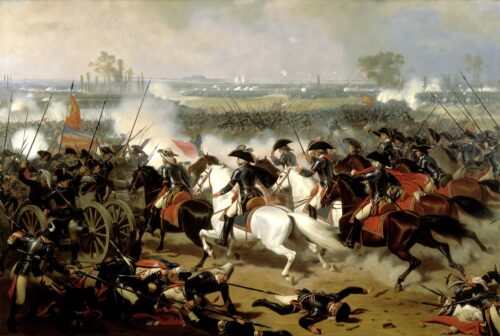

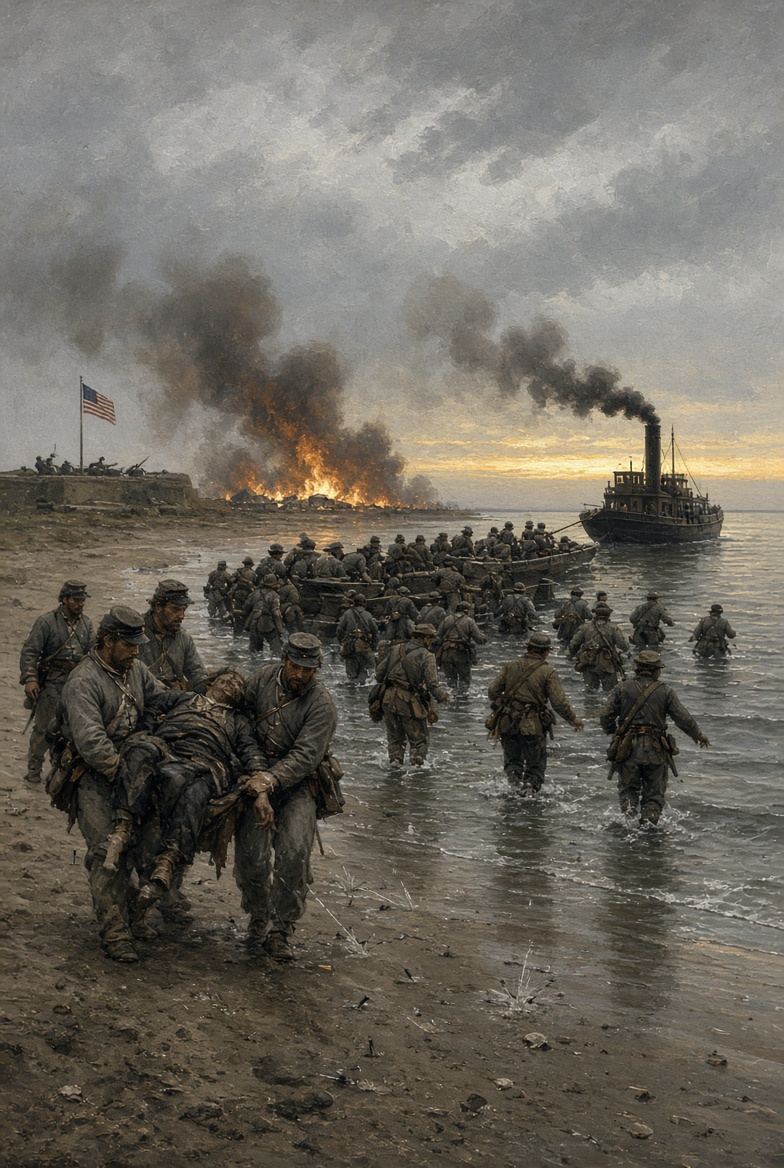
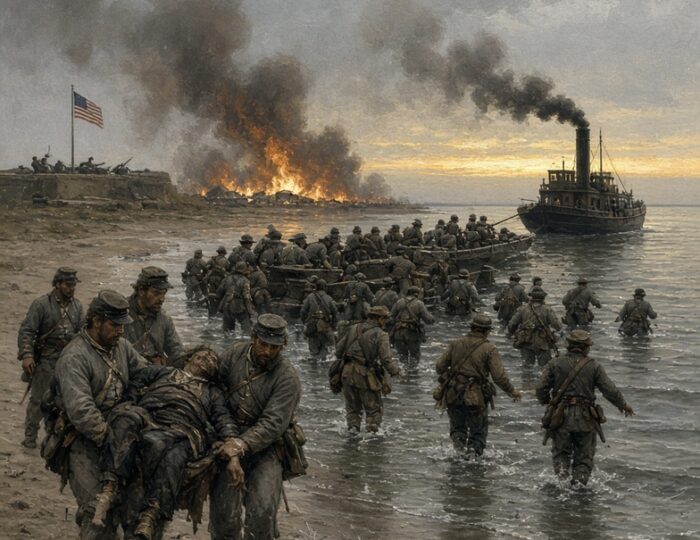
Before first light on Wednesday, October 9, 1861, Santa Rosa Island smelled like salt, pine resin, and wet canvas. The island is a long, thin barrier of white sand off the Florida panhandle, roughly forty miles from end to end, with the Gulf on one side and Pensacola Bay on the other. At its western tip sat Fort Pickens, a brick pentagon the United States still held. A mile or so east of the fort, outside the range of its heaviest guns for ordinary camp life, the 6th New York Volunteer Infantry had pitched its tents in the dunes and scrub. They called the place Camp Brown, after the officer who commanded the whole Union force on the island, Colonel Harvey Brown of the 5th U.S. Artillery. The New Yorkers were Zouaves. Their jackets were short and loud. Their trousers were baggy. Many of them had been recruited in the city from the same streets that produced fire companies and street gangs. They were not regulars. They were sleeping when the Confederates came ashore.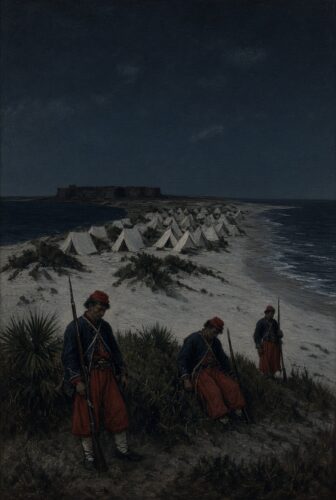
The men who came ashore had left the mainland after dark on the night of October 8. Brigadier General Richard Heron Anderson, acting on orders from Braxton Bragg, who commanded the Confederate forces around Pensacola, put about twelve hundred infantry onto two small steamers and a collection of flats and barges. The steamers towed the barges across the bay. The crossing was supposed to be quiet. It was not perfectly quiet. Delays piled up. By the time the boats grounded on the north beach of Santa Rosa Island, roughly four miles east of Fort Pickens, it was already well past midnight and closer to two in the morning. Anderson divided the landing force into three columns so the attack could come in from more than one direction and so a demolition party could wreck whatever guns or stores they found outside the fort itself.
The first battalion, under Colonel James R. Chalmers, drew men from the 10th Mississippi and the 1st Alabama. The second, under Colonel J. Patton Anderson, mixed companies of the 7th Alabama, the 1st Louisiana Regulars, and the 1st Florida. The third, under Colonel John K. Jackson, came largely from Georgia units, including a detachment of the 5th Georgia. A small demolition team under Lieutenant James H. Hallonquist went with them to spike or burn anything that looked like a battery. Homer’s artillery company sent a lieutenant along. The naval side of the operation used the steamer CSS Neaffie among the towing vessels. None of this was a grand army. It was a night raid built to punish, to burn, and, if the luck held, to rush the fort before the garrison could man the walls.
The reason for the raid sat in the weeks just before it. In September, Union sailors and marines from the blockading squadron had slipped into the Pensacola Navy Yard and burned the Confederate schooner Judah at her moorings. Bragg wanted an answer. Fort Pickens had been a problem for the Confederacy since the first days of secession. In January 1861, when Florida left the Union, the fort’s garrison was tiny: Company G of the 1st U.S. Artillery, under Lieutenant Adam J. Slemmer. The senior officer, Major John H. Winder, was absent and sympathetic to secession. Slemmer moved what men and guns he could into Pickens, refused demands to surrender, and held the brick fort through the spring while both sides stared at each other across the bay. By autumn the Union had reinforced him. Regulars from the 1st, 2nd, and 5th Artillery and the 3rd Infantry sat inside or near the fort under Harvey Brown. The 6th New York, Colonel William Wilson commanding, camped outside. The fort controlled the entrance to one of the best harbors on the Gulf. As long as the United States flag flew over Pickens, Confederate Pensacola was a harbor with a gun pointed at its throat.
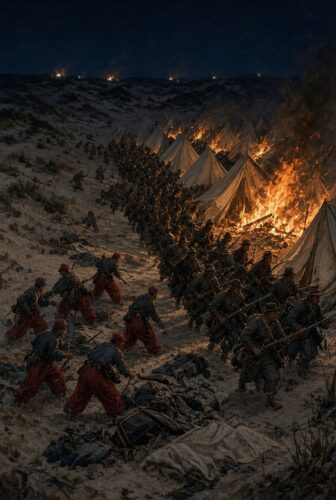
Anderson’s orders were practical. Surprise the camp east of the fort. Destroy it. If the garrison came out in confusion, hit them. If a chance opened against the fort itself, take it. Do not get caught on the beach at daylight. The columns formed on the sand and moved west through the dunes and the low maritime woods. Pickets from the 6th New York were the first to hear them. Around 3:30 in the morning the firing started. Muskets cracked in the dark. The picket line folded back toward Camp Brown. Inside the tent city the New Yorkers came awake to shouting and the sound of men already inside the lines. Companies scrambled. Some formed. Some did not. The Confederates drove them. Chalmers’s men and the other columns pushed through the camp, flushed the volunteers toward the fort, and then did what night raids usually do when they find an empty tent city: they rummaged. Knapsacks were cut open. Blankets were taken. Then the tents were set on fire. Canvas burns fast when it is dry. By the time the first gray showed over the Gulf, Camp Brown was a line of burning cones and the 6th New York was no longer a formed regiment in its own street.
That was the moment the raid looked won. The outer camp was in Confederate hands. The volunteers had been routed. Prisoners were already being collected. Major Israel Vogdes of the 1st Artillery, who had come out with a detachment to see what the firing was, was captured in the confusion. Captain Richard Bradford of the 1st Florida Infantry was killed, the first Florida officer to die in the war. A teenager in the 6th New York, Private Paul Gillings, fell in the fighting; his commander later wrote the boy’s sister that he had fallen like a true soldier. For a few minutes on the sand it was possible to believe the night had belonged to Anderson.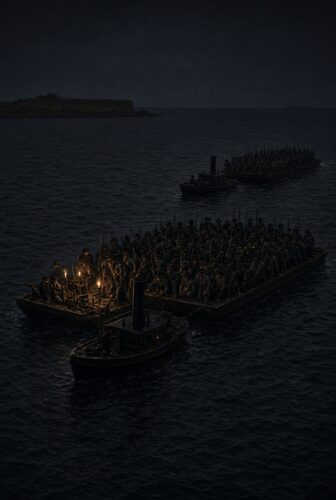
It had not. Harvey Brown, inside Fort Pickens, did not wait for a full report. He ordered the guns manned and sent reinforcements out of the fort toward the sound of the fight. Companies of regulars under officers such as Captain John McLaren Hildt of the 3rd Infantry and Captain James M. Robertson of the 2nd Artillery moved into the dunes. Major Lewis Golding Arnold’s command came with them. The ground between the fort and the burned camp was not open parade ground. It was sand hills, palmetto, and wet low spots. Units broke into smaller clumps in the dark. Men fired at muzzle flashes. The Confederates, who had stopped to burn the camp and who had been told to entice the Federals into a disadvantageous fight, now found the Federals coming anyway, and coming from the direction of the fort they had not taken. Anderson himself was badly wounded. The clock was against the raiders. Daylight was close. A force that has to re-embark under fire on a narrow beach does not get to choose its hour.
Anderson ordered the withdrawal. The columns fell back toward the landing place, still skirmishing. Union bullets followed them onto the sand. One of the boats grounded and had to be worked free while men waded and fired. The steamers and barges took the survivors off before the sun was fully up. They crossed back to Pensacola. Behind them the tents of Camp Brown continued to burn. In front of them Fort Pickens still flew the United States flag, and its guns had not been silenced.
The casualty lists that came in over the next day were ugly for the size of the fight. The Union reported 14 killed, 29 wounded, and 24 captured or missing, 67 in all. Confederate returns, given by Bragg and by a lieutenant on the spot, put their own killed and wounded between 30 and 40; a newspaper account later claimed a much higher number that was probably inflated. Anderson’s wound removed him from the immediate scene. Bradford’s death gave Florida a name it would put on a county before the year was out: New River County was renamed Bradford County that December. Both commanders claimed a kind of success. Bragg could say the camp had been destroyed and the Zouaves punished for the burning of the Judah. Brown could say the fort had never been in danger and the raiders had been driven into their boats. The ground told a plainer story. The outer camp was ash. The fort was not.
The larger position did not change that morning, and that was the point. Fort Pickens remained the Union anchor on the Gulf coast of Florida. In November, Union gunners across the water opened a two-day bombardment that threw thousands of rounds into Fort McRee and the navy yard and left the Confederate works on the mainland badly hurt. Pensacola would stay in Confederate hands for months yet, but the harbor was never secure while Pickens held, and in the spring of 1862 Bragg’s army left the city for the western theater. The night raid of October 9 had burned every tent it could reach and had still failed at the only object that mattered.
The details of that failure are worth sitting with, because they are specific. The landing was late. The three columns did their first job. The 6th New York, Companies C, D, F, H, K, and G among those noted in the returns, broke under a surprise they had not posted enough men to stop. The raiders then spent the precious dark minutes on the tents. Fire is visible. Fire feels like a result. It is also a signal. Brown’s regulars did not need a perfect picture of the battlefield. They needed the direction of the flames and the order to move. Vogdes was captured because he came forward into a fight already in motion. Bradford died because the 1st Florida was in the assault. Gillings died because the picket line and the camp were the same fight. None of those facts canceled the other fact: when the boats shoved off, the brick fort was still armed, still garrisoned, and still commanding the channel. A burned tent city is not a captured fort. The hour that decided the raid was not the hour the canvas caught. It was the hour before sunrise, when the counterattack reached the beach and the raiders had to choose between the boats and the daylight.
That distinction travels. Most of what gets celebrated in a hard week is Camp Brown. The inbox cleared. The awkward meeting survived. The workout happened. The draft got sent. The tent burned, and the burning is real. It is also the outer camp. The fort is the thing that still has to be held when the light comes: the account that has to be reconciled, the skill that has to be practiced when no one is watching, the relationship that does not improve because a single hard conversation occurred, the body of work that is not finished because one section was deleted and rewritten. Anderson’s men did not lose because they lacked courage. They lost the object of the raid because they treated the visible destruction as the victory and stayed among the tents long enough for the garrison to come out.
The useful translation is not a slogan about resilience. It is a clock. The raid had a landing window, a burning window, and a withdrawal window. The middle window felt like success and consumed the third. A person who wants the outcome rather than the ash can borrow the same three windows and refuse to spend the middle one on anything that does not move the fort.
Here is the plan, built only from that morning, and unlike the usual advice to visualize, journal, or break goals into quarters.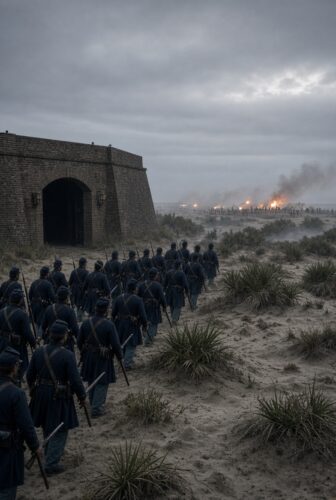
Tonight, name the fort in one sentence on a single card: the one position that, if it is still yours at sunrise, means the day was not a raid that failed. Not the mood. Not the tent. The fort. Examples that fit the rule include the page that must exist, the payment that must clear, the set of reps that must be done, the boundary that must be said out loud. Write it so a stranger could check it at dawn.
Set two alarms only. The first is the landing: the minute you will start the work that touches the fort, not the minute you will prepare to start. The second is the withdrawal: a hard stop forty minutes before you intend to sleep, at which point you either have the fort or you write, in one line, the exact next action that re-embarks you. No third alarm. Anderson’s delay on the beach was the third alarm he did not mean to set.
During the middle window, ban the tent-burning. Tent-burning is any visible act that can be finished without securing the fort: reorganizing the desk, rewriting the title, answering the message that is not the work, counting the steps. If it can be photographed and posted, it is probably a tent. Leave it. The 6th New York’s camp was full of objects worth taking. None of them held the channel.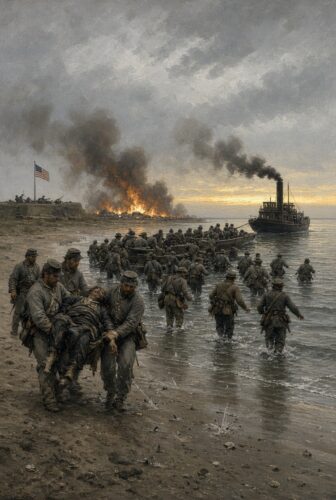
At the withdrawal alarm, stand up and do the re-embark. Close the file. Send the one message. Put the weight down. If the fort is not taken, do not extend the raid into daylight and call the extension strategy. Write the single next action on the same card, under the fort sentence, and stop. The boats left. The men who stayed would have been captured by sunrise.
In the morning, score only the fort. Ash does not count. A burned tent is a note in the margin. The question is whether the position you named is still in your hands. If it is, the raid worked even if the camp looks messy. If it is not, the raid failed even if the tents made a fine fire. Do this for five nights. On the sixth morning, keep the card that names the fort you actually held, and throw away the rest. That is the whole mechanism. It is short because the beach was short. The men who understood the hour made the boats. The men who stayed to count the canvas did not change who held Pensacola Bay.
Share: