
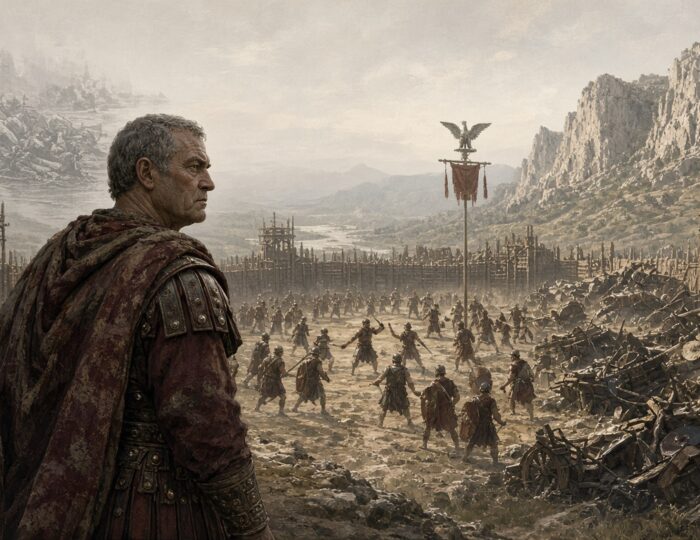
Picture the Rhône in early October, wide, cold, and the color of wet slate, sliding past a Gallic market town the Romans called Arausio and the locals already knew as a place where roads met the river. The modern name is Orange, in the Vaucluse, and if you stand on the east bank today you can still see why a general who hated his colleague would have liked the water. It is a moat you do not have to dig. On the morning of 6 October 105 BC it stopped being a moat and became a wall. Two Roman armies, camped so they would not have to look at each other, died between that wall and a migrating people who had not come to found a kingdom. They had come because the north had flooded, or failed, or simply run out of room, and the richest thing in their path was a republic that could not agree which of its own generals was in charge.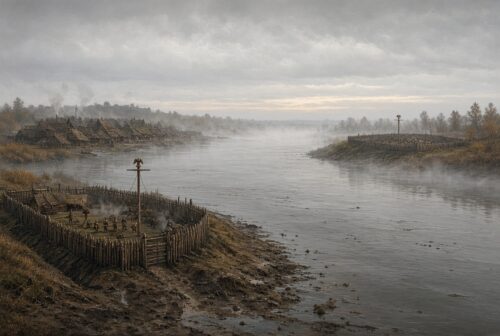
The day is fixed, which is rare for a Republican battle. Granius Licinianus, a later epitomizer who had access to better books than we do, puts the fight on the day before the nones of October. In the Roman calendar the nones of October fell on the seventh. The day before the nones is the sixth. Plutarch, writing the life of Lucullus more than a century and a half later, uses the same marker. When Lucullus fought Tigranes of Armenia near Tigranocerta, he did it on purpose on the day before the nones of October, because by then every Roman officer knew what that date meant. It had been entered in the black list. A dies ater. An unlucky day. Rome did not mark days black for ordinary embarrassments. It marked them black for mornings when the state looked into a river and could not find its army.
The numbers that came back from that morning are the kind ancient writers inflate when they are frightened, and they are still too large to wave away. Livy’s summary, drawing on Valerius Antias, gives 80,000 soldiers and 40,000 servants and camp followers dead. Orosius repeats the pair of figures. Granius Licinianus, citing Rutilius Rufus — a man who was consul that same year and stayed in Rome to raise the next army, so he had a professional reason to count — gives 80,000 regular and light troops. Two sons of the consul died on the field. One later writer says ten men came out of one of the camps. That last figure is the sort of round horror a survivor tells, and it should be held loosely. The 80,000 should not. Even if the clerks rounded up, Arausio sits above Cannae in the Roman memory of self-inflicted loss. Cannae was genius on the other side. Arausio was a quarrel.
To see how a quarrel becomes a catastrophe you have to walk backward about fifteen years, to a cold coast most Romans had never pictured.
The people the Romans called Cimbri came, as far as the geographers could tell, from the northern peninsula later called Jutland, from a district whose name still sounds like theirs. They were not a state. They were a moving people: warriors, families, wagons, herds, and the kind of political structure that elects a war-leader when the road gets dangerous and argues the rest of the time. Ancient writers bundled them with the Teutones and the Ambrones, and the sources for Arausio itself cannot agree who was actually on the field. Orosius and Eutropius name Cimbri, Teutones, Tigurini, and Ambrones. The summary of Livy, Granius Licinianus, and Cassius Dio speak only of the Cimbri. Plutarch gives Cimbri and Teutones. The careful modern reading is that the Teutones and Ambrones were the hammer of 102, not of 105, and that the Tigurini had already done their killing two years earlier. What matters on the river is that the Cimbri were there in strength, under a young king or war-chief named Boiorix, and that they had already beaten Rome three times without bothering to march on Rome.
The first beating was at Noreia in 113 BC, in the eastern Alps, where the consul Gnaeus Papirius Carbo tried to trap them after pretending to negotiate and was himself trapped. The second was in 109, against Marcus Junius Silanus. The third, in 107, was not even the Cimbri proper. A branch of the Helvetii called the Tigurini caught the consul Lucius Cassius Longinus near Burdigala, killed him, and sent what was left of his army under the yoke — the old Gallic humiliation of making soldiers duck beneath a spear held crosswise, armor off, in front of the people who had just beaten them. Rome could absorb a yoke. Rome had absorbed worse. What Rome could not absorb was the idea that the yoke was becoming a habit.
In 106 the Senate sent a man who looked, on parchment, like the cure. Quintus Servilius Caepio was a patrician of an old line, consul for that year, the sort of nobilis who assumed command the way other men assumed weather. His province was the Gallic south. His first notable act was at Tolosa, modern Toulouse, which had slipped out of Roman hands in the turbulence the migration kicked up. Caepio took it back. Inside the city, or in the sacred pools beside it, his men found a hoard that broke the ordinary rules of plunder.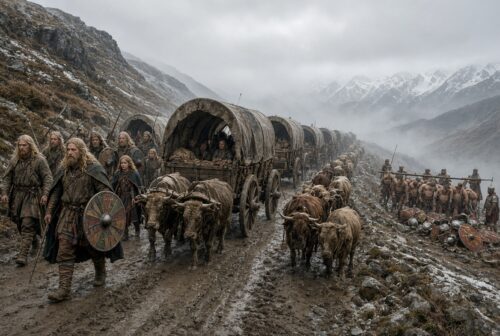
The story the Greeks told, and that Posidonius passed to Strabo, was that this was the gold of Delphi. In 279 BC a Gallic war-band under a chief the Greeks also called Brennus had reached the sanctuary of Apollo, been driven off by weather, earthquake, and the usual miracle apparatus, and carried away whatever they could lift. Some of that treasure, the tale ran, had ended in the southwest of Gaul, in a temple pool at Tolosa, untouchable because it was cursed and untouched because it was heavy. Orosius later priced the haul at 15,000 talents of gold and 15,000 of silver, a number so large it functions as a gasp rather than an audit. Strabo is cooler and more damaging. He says the important part of the treasure never reached Rome. Soldiers stole it on the road. Wagons vanished. A detachment escorting the gold was ambushed, or said it was ambushed, and the state received a story instead of a deposit.
Romans gave the missing metal a name. Aurum Tolosanum. The gold of Tolosa. It became a proverb for wealth that eats the man who carries it. Whether Caepio pocketed it, lost it, or merely failed to stop other men pocketing it, the political fact was the same. He arrived at the Rhône in 105 already suspected of having stolen a curse. He also arrived convinced that no novus homo was going to give him orders.
The novus homo was Gnaeus Mallius Maximus, consul for 105. New man meant exactly what it sounded like. No consul in the family. No wax masks in the atrium. Mallius had won the election anyway, because the voters were frightened and the old families had not covered themselves in glory against these wagons. By law and by custom a sitting consul outranked a proconsul. Mallius was the senior officer on the Gallic front the moment he crossed into the province. Caepio declined to notice.
They split the country along the river. The sources do not even agree who took which bank, which is itself a portrait of the command. Mallius, worried, asked for a junction. Caepio refused the junction and then did something worse than refusal. He crossed the Rhône into Mallius’s water, camped between Mallius and the Cimbri, and sat there as a cork in the bottle. Anyone who wanted to talk to the senior Roman had to talk past the junior one. Anyone who wanted to fight the Cimbri had to fight through a colleague who would not share a watchword.
That is the whole mechanism. Not barbaric ferocity. Not a brilliant envelopment sketched in the sand. A man of good birth camping on the wrong side of his own senior so that a victory, if it came, would have his name on it, and a defeat, if it came, could be blamed on the new man behind him.
The Cimbri opened the conversation the way migrating peoples often did, with an embassy. They sent speakers to Mallius, the man with the legal rank, to ask for land and a road. Caepio treated the embassy as an insult. Some accounts have him nearly attacking the envoys. Negotiation, in his reading, was a thing the new man would use to steal the credit for peace. Better a battle he started than a treaty he did not sign.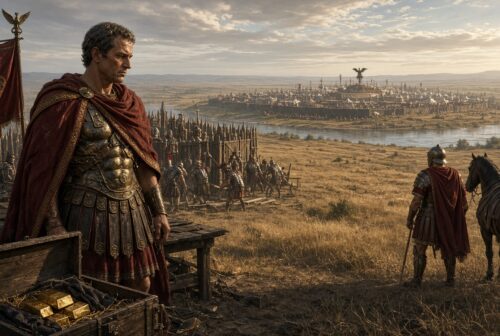
Before the armies collided there was a smaller killing that told both sides what kind of week they were in. Marcus Aurelius Scaurus, a former consul serving as legate under Mallius, was out with an advanced force, feeling for the enemy the way Roman doctrine said you should. The Cimbri found him. His command was cut up. Scaurus himself was taken alive and walked into the Cimbric council, which is the sort of scene Roman writers loved and probably did not invent, because the ending is too inconvenient. Offered his life, and by one account offered a kind of command if he would change sides, Scaurus told Boiorix and the circle of chiefs to turn around. Do not enter Italy. The Republic will destroy you. He was killed for the speech. One tradition gives the blow to Boiorix himself, young enough that executing a Roman consular was still a proof of nerve rather than a policy. Scaurus bought nothing with the warning except a line in the epitomes. He did establish the tone. This was not an enemy looking for a client relationship. This was an enemy that had already decided the talking was over.
Mallius, hearing that a former consul had been taken and killed, asked again for the camps to merge. Caepio crossed, camped forward, and still would not take the senior’s orders. The Senate had already sent word that the proconsul was to cooperate. Distance made the order theoretical. On the river it was two palisades, two sets of passwords, two quartermasters, and a few thousand paces of October grass.
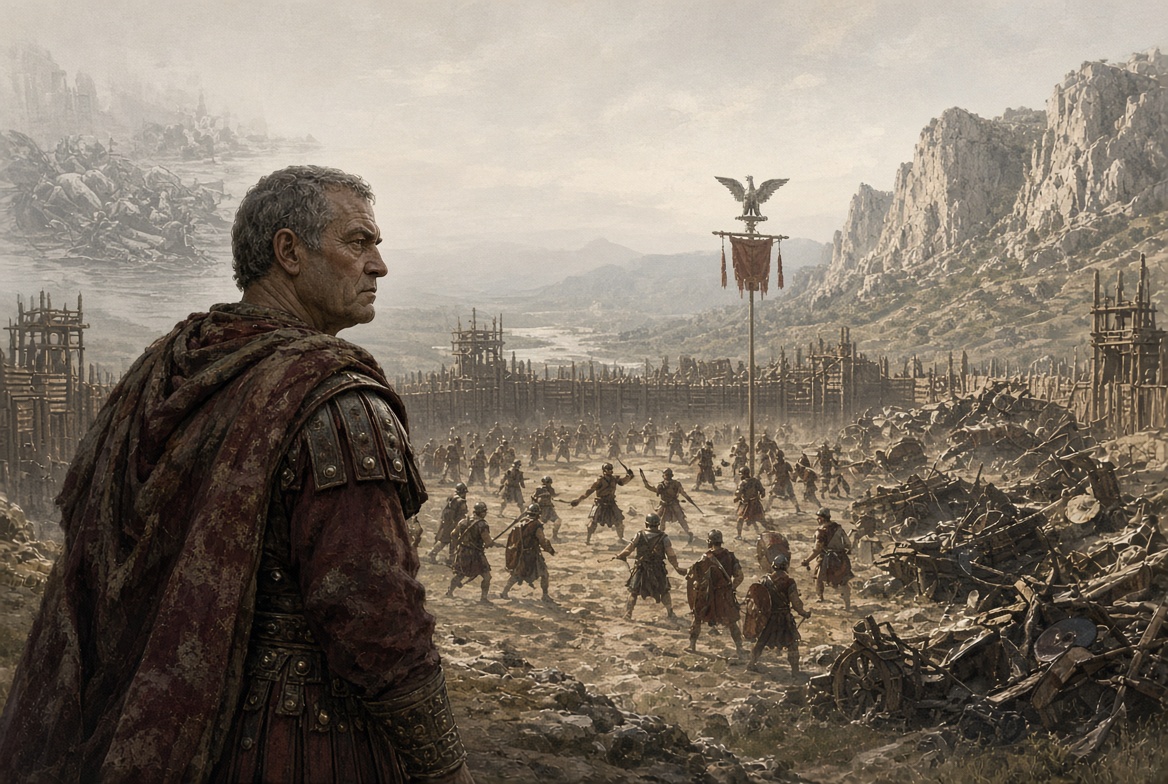
The fight itself is a hole in the sources, which is normal, and a shame, because the hole is the size of a legion. No surviving author gives a clear sequence of maniples, a named ridge, a decisive cavalry charge. What the fragments agree on is the order of ruin. Caepio attacked alone. He went for the Cimbric camp or wagon-park without waiting for Mallius, either because he thought surprise would make the new man irrelevant or because he could not stand another day of watching envoys ride to the other Roman. The attack went in tired, unsupported, and angry. It was swallowed. His camp, left thin, was taken behind him. He got away. A great many of his men did not.
Then the Cimbri turned on the second army.
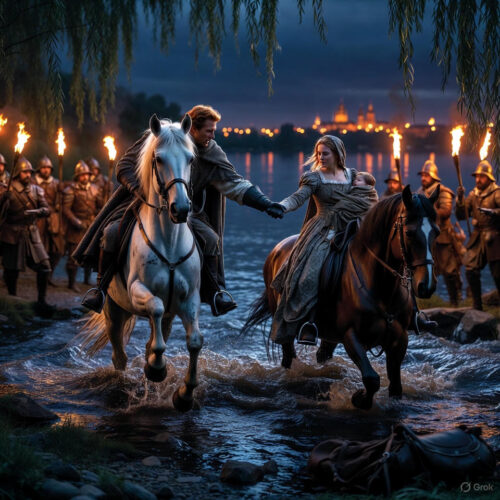
Mallius’s soldiers had already watched the first Roman force come apart. They were camped with the river at their backs, which is the position you occupy when you are guarding a bank and the position you die in when you lose. Flight meant armor in cold water. Standing meant a crowd of wagons, long iron, and men who had just taken one Roman camp and wanted the other before dark. The ancient writers describe the killing as a press rather than a battle: men trampled at the waterline, servants cut down among the mule lines, officers’ sons dead beside the eagles. Sertorius, still young, still unknown, later the man who would run a private Roman state in Spain against the Sullan government, got out by swimming the Rhône in his breastplate with his shield on his back. Plutarch saves that detail because it is the kind of fact that explains a later career. Most of the men in the water did not have a later career.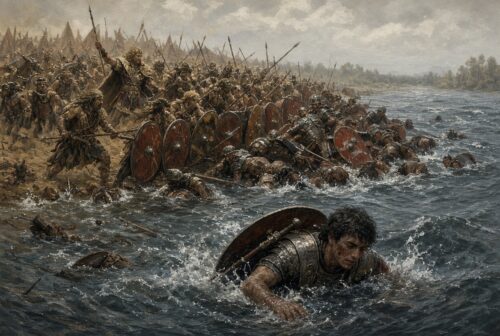
What the victors did with the camps is the strangest paragraph in the whole story, and it comes largely from Orosius. They did not behave like an army stocking a magazine. Clothing was slashed and thrown aside. Breastplates were hacked. Horse trappings were ruined. Gold and silver went into the river. Horses were driven into the current. Prisoners were hanged from trees with nooses. It reads like a ritual spoiling, a refusal to become the people they had just robbed. It also reads like a people who did not yet want a province. They wanted the road clear and the omen right. A commander who has just lost 80,000 men can take small comfort from the enemy’s theology, but the practical result was the only piece of luck Rome got all year. The Cimbri did not turn east for the Alpine passes. They quarreled with the Arverni, drifted toward the Pyrenees, and spent the next seasons in Spain and western Gaul. Italy stayed uninvaded because the winners went looking for a different road.
Rome did not know that yet. Rome knew that the passes were open, that the levies of two years were gone, and that the officer who had caused it was a patrician with a missing treasure wagon in his recent past.
The political explosion was delayed just long enough to be useful. The other consul of 105, Publius Rutilius Rufus, had stayed in the city. He was a friend of Gaius Marius, a serious soldier, and the man whose count of the dead Licinianus trusted. With the field armies gone he did something unromantic and decisive. He raised a new force and trained it with instructors borrowed from the gladiatorial schools, men who actually knew how to teach close killing to recruits who had never held a shield. It was an admission that the old militia drill was not going to be enough. It was also an admission that the next commander would not be Caepio.
Marius was in Africa, finishing the war against Jugurtha. The law said a man could not hold a second consulship inside ten years. The voters and a frightened Senate set the law down, elected him in absence for 104, and then kept electing him — 104, 103, 102, 101, 100 — until the migrating peoples were destroyed. Five consulships in a row for a man from Arpinum whose enemies liked to mention that his family had calluses. The Republic did not do this because it had fallen in love with Marius. It did it because Arausio had made the alternative look like drowning.
The reckoning for the two generals was ugly in the way popular politics is ugly when the casualty list is long enough. Lucius Appuleius Saturninus, tribune and ally of Marius, drove the prosecution of Caepio for perduellio, the old charge of treason against the state, in front of the assembly rather than a senatorial jury. The gold of Tolosa walked back into the indictment beside the dead of the Rhône. Caepio was stripped of imperium, condemned, and hit with the interdiction of fire and water, the formula that made a man legally unhoused inside Roman jurisdiction. His property was confiscated. A fine was named that nobody expected to collect, because the point of the fine was the curse, not the treasury. He ended, by the likelier account, in exile at Smyrna, a citizen of a Greek city on the coast of Asia, which is a long way from a patrician atrium. Mallius was condemned and exiled as well. The new man and the old man left by different gates and arrived at the same place: outside.
The military moral was slower and more argued, and a careful reader should hear the argument. Later Romans, and a long line of modern textbooks, bundled a set of changes under the name Marian reforms and dated the bundle to the panic after Arausio: enlistment of the capite censi, the men without property who had been shut out of the legions; equipment issued by the state rather than brought from home; the cohort instead of the maniple as the working unit; the eagle as the single standard a soldier would die under; a longer, harder, more professional service. Some of that was already in motion. Some of it was Marius finishing what the casualty list had started. The clean textbook version is too clean. The political version is not. After 6 October 105 BC the Republic could no longer pretend that a citizen militia led by men who refused to share a camp was a match for a people that moved as one wagon-train. The recruits who had no farms to go back to would, in time, belong to their general more than to the Senate. Arausio did not invent the late Republic. It signed the requisition.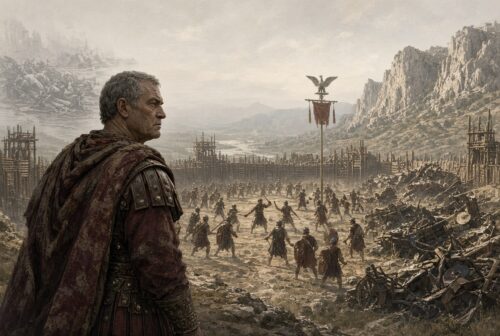
Marius used the time the Cimbri gave him. In 102, at Aquae Sextiae under the limestone ridges near modern Aix-en-Provence, he caught the Teutones and the Ambrones and broke them so thoroughly that the women in the wagon-fort, by the Roman account, killed their children and themselves rather than be taken. In 101, on the Raudine Plain near Vercellae in the north of Italy, Marius and Quintus Lutatius Catulus met the Cimbri, who had finally come around through the Brenner and down into the Po valley. Boiorix died there. The migration that had begun on a cold northern coast ended in a flat Italian field, and the prisoners went to the slave markets, and the eagles that had been lost on the Rhône were, in the official story, replaced by eagles nobody would abandon twice.
None of that undid the morning of the sixth. The black day stayed on the calendar. When Lucullus, decades later, drew up against Tigranes on the day before the nones of October, his own officers flinched at the date. He fought anyway and won, which is how a republic tries to edit an omen: by spending another army on the same square of the calendar until the square changes color. It never fully changed. Arausio remained the example teachers used when they wanted a cadet to understand that the enemy is sometimes the second most dangerous thing in the province.
The geography is still there if you want to be pedantic about it. Orange sits on the east side of the Rhône corridor, under a hill, with a Roman theater later emperors dropped on the town as if to prove the place had been domesticated. The battle was not in the theater. It was on the flat between the town and the water, in a season when the river is still full from the Alps and the banks are soft. A man in armor who goes into that water in October is making a bet with the current. Sertorius won his bet. The two sons of Mallius did not. Caepio won his in the most expensive way available, by not being present for the second half of the disaster he had arranged.
If you want the human scale, ignore the talent-counts and take the servants. Forty thousand camp followers is a number that includes muleteers, cooks, armorers, enslaved grooms, freedmen who handled the paperwork of a legion, and the women who lived at the edge of every Roman march whether the regulations admitted it or not. They died in the same press as the hastati. A defeat that kills the supply train is not a lost battle. It is a lost season. Rutilius Rufus, back in Rome with his gladiator-drill instructors, was not replacing a legion. He was replacing a small city that had been walked into a river by two men who would not use the same password.
The funny part, if the word can be used without lying, is how small the fatal decision was. Caepio did not betray the Republic to Boiorix. He did not sell the eagles. He did not even lose a fair fight against a better plan. He camped a little forward of the man he disliked, refused a meeting, and attacked on his own timetable so that a new man would not get to write the dispatch. Every officer in the Roman system had been trained to want the dispatch. The system assumed that wanting it would make them brave, not that it would make them split the army in half and dare the enemy to eat the halves in order. On 5 October the assumption was still standing. On 6 October it was in the Rhône with the payroll.
Rome’s recovery is the part posters like, and it is real, but it was not a comeback montage. It was a law bent, a patrician prosecuted by a tribune who would later be murdered in the Senate house himself, a training camp run by men who taught people to die for applause, and a five-year hold on the consulship by a soldier the old families despised. The Cimbri’s refusal to march on Italy was a gift the Romans had not earned. They used it. That is the whole of their virtue in this story. They used the year they were given, and they stopped sending two commanders to do one job.
Which is the part worth carrying out of the Vaucluse.
The morning of 6 October did not fail for lack of courage, numbers, or even a plan. It failed because the force was divided by a man who would rather lose separately than win under someone else’s name. The benefit, for anyone who has a job, a household, a company, a band, a parish committee, or a two-person project with a shared deadline, is brutally narrow. Before you attack anything external, you close the gap between your own camps. Not with a retreat, not with a vision, not with a slogan about synergy. With a single camp: one timetable, one password, one person who can order the other to wait.
Here is the procedure. It is short on purpose. Caepio had weeks. He used them to build a second palisade.
– Tonight, name the Rhône. Write down the one live split in your work: two inboxes, two bosses, two versions of the budget, a partner who will not attend the meeting, a department that camps between you and the people you are supposed to be fighting for. If you cannot name it in a sentence, you are already Mallius, asking for a junction you have not located.
– Tomorrow morning, make the request Mallius made, in writing, with a time on it. One camp. One call. One shared list of what will not be done until the camps join. Send it to the Caepio in the arrangement, even if the Caepio is you on your other project. A request that is not dated is an embassy the other bank can ignore.
– If the answer is a forward camp instead of a junction — activity that looks helpful and still will not take your timetable — treat that as the attack order Caepio gave himself. Stop. Do not launch the solo assault to get your name on the dispatch. The Cimbri are not required to be stupid just because your colleague is proud.
– Give the junction forty-eight hours. That is the whole window. Scaurus did not get a second week. If the other camp will not cross, you have learned what Rome learned from the gold of Tolosa: a resource you cannot bring to the field is not a resource. Cut it out of the plan in one stroke, the way Saturninus cut Caepio out of the state, and spend the next season the way Rutilius spent his — training the force you actually have, with instructors who have done the close work, instead of rehearsing the victory you would have won with the army that will not show up.
– On the third day, move once, with whatever is inside the single camp. One standard. Marius did not beat the Teutones with the men who drowned in 105. He beat them with the men he trained after he stopped pretending the drowned men were coming back.
That is the whole plan. No streak. No identity. No public announcement. A named split, a dated request, a forty-eight-hour wait, a cut if the wait fails, and one move under one standard. The Republic tried pride first. The river kept the change.
Share: