
Before sunrise on Wednesday, October 5, 1864, the Western and Atlantic Railroad disappeared into the earth. North of the little Georgia depot called Allatoona, the track dropped into a man-made gorge cut through a ridge of the Allatoona Mountains, a slot roughly 180 feet across and about 65 feet deep, with rock walls close enough that a man standing on the eastern rim could hear a voice from the western rim and still not reach it without going down and up again. The cut was not a scenic feature. It was a choke point. Anything that wanted to move between Atlanta and Chattanooga on that railroad had to pass through it, and in the autumn of 1864 that railroad was the spine of William Tecumseh Sherman’s army.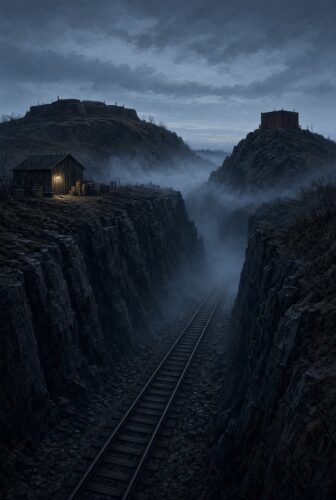
On the lips of the cut sat two earthen forts. The stronger of them, west of the track, had been shaped with projecting angles and was already called the Star Fort. East of the cut, on a knoll beyond the Tennessee Road, stood a second redoubt. Between and around them ran infantry trenches. Inside the warehouses near the pass lay something like a million rations, bread and meat and coffee stacked for an army that ate by the trainload. The garrison that watched those warehouses in the last days of September was small, a few hundred men under Lieutenant Colonel John Tourtellotte of the 4th Minnesota, later reinforced enough that the pre-dawn strength before the Rome train arrived sat somewhere under a thousand. They had dirt, height, and a railroad cut that worked like a dry moat. They did not yet have the man who would answer a surrender note in the time it took to dip a pen.
This is the story of a fight that lasted a morning, killed and wounded men at a rate that belongs with the famous three-day battles, protected a pile of food the winning general would soon decide he did not need, and produced a hymn whose central promise was more generous than the orders actually sent. It is also the story of a five-minute deadline that was refused on the spot, and of a general who lost part of his face and spent the next day bragging that he could still whip all hell.
The railroad that made the morning matter had been finished in the 1850s as a state project of Georgia, climbing from Atlanta through the ridge country toward Chattanooga. Allatoona Pass was one of the expensive places. Engineers chose to cut rather than tunnel. The result was a slot deep enough that artillery on the hills could not easily rake both forts at once, and narrow enough that an attacking column coming up the railroad itself walked into a shooting gallery. In the spring of 1864, during the Atlanta campaign, Sherman had already fought Joe Johnston through this country. The Battle of Allatoona Pass is not that earlier maneuver. By October the war had moved on, Atlanta had fallen, and the pass had been turned into a depot.
Atlanta surrendered to Sherman on September 2, 1864. The city was a rail junction, a factory town, and a symbol, and its loss did not end the Army of Tennessee. John Bell Hood, who had replaced Johnston in July and then bled his army in frontal attacks at Peachtree Creek, Atlanta, and Ezra Church, took what remained and marched north. His idea, urged on him by the strategic situation and by his own impatience, was to break the Western and Atlantic, Sherman’s supply line back to Chattanooga, and force the Union army either to retreat or to come out of Atlanta and fight on ground Hood chose. Between October 2 and October 4, Hood’s columns struck the railroad at several points. Alexander P. Stewart’s corps drew the work of wrecking track and attacking the small posts that guarded it. At Big Shanty and Acworth the damage was real. The next prize on the line was Allatoona, with its warehouses and its cut.
Hood wanted the pass taken and the Etowah River bridge burned farther north. Stewart gave the pass to Samuel G. French, a division commander with three brigades: Claudius Sears, Francis M. Cockrell’s Missourians, and William Hugh Young, who was leading Matthew Ector’s brigade. French’s strength that morning is usually given at about 3,276 men. He had been marching. His guide knew the country. His artillery would have to be placed in the dark.
Sherman, watching from the high ground around Kennesaw, read the movement correctly enough. On October 4 he signaled the posts along the line that the enemy was moving on Allatoona and thence toward Rome. He ordered Brigadier General John M. Corse, whose brigade was at Rome, to get on the cars and join the garrison. Corse loaded roughly a thousand men, the heart of his command from the 4th Division of the XV Corps, onto about twenty railcars and rolled south and east through the night. He reached Allatoona around one in the morning on October 5. With Tourtellotte’s men he had something over two thousand soldiers. The National Park Service summary later put the Union force at one brigade of 1,944; other counts, including the Georgia historical marker, say 2,137. Wikipedia’s consolidated figure is 2,025. The honest range is a little under or a little over two thousand, against a little over three thousand. Corse expected more. They did not come in time.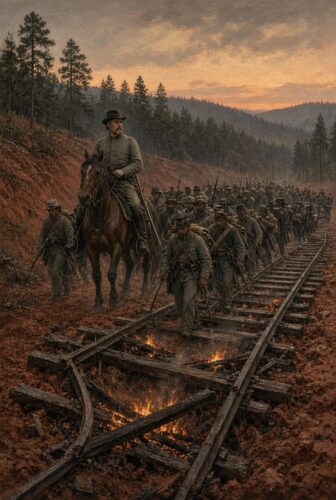
The forts themselves were the work of Sherman’s chief engineer, Orlando Poe, who had spent the late summer turning vulnerable depots into dirt strongpoints. The Star Fort on the west side of the cut was the key. It held infantry and guns. Trenches ran west from it along the north face of the ridge. The eastern redoubt covered the other rim and the road. A man attacking one fort could not simply stroll to the other. He had to descend into the cut or go around it, and both options were visible from the parapets. Many of the Illinois men in the garrison, especially in the 7th Illinois, carried Henry repeating rifles, sixteen-shot lever-actions that turned a company into something closer to a battery of small arms. A single-shot rifle musket against a Henry in a fort is not a fair argument. French did not know, in the dark, how unfair it was going to be.
French came up in the early hours. He later wrote that nothing could be seen but one or two twinkling lights on the opposite heights, and nothing heard but the occasional shot between his advanced guards and the garrison pickets in the valley. He had no good map of the works. He put his guns on the hills south and east of the railroad by lantern light and waited for day. At about seven in the morning the artillery opened. For roughly two hours shells walked across the forts and the warehouses. Dirt flew. Men in the Star Fort kept low. The million rations sat under bombardment and did not catch in any way that settled the issue.
Then French sent a note.
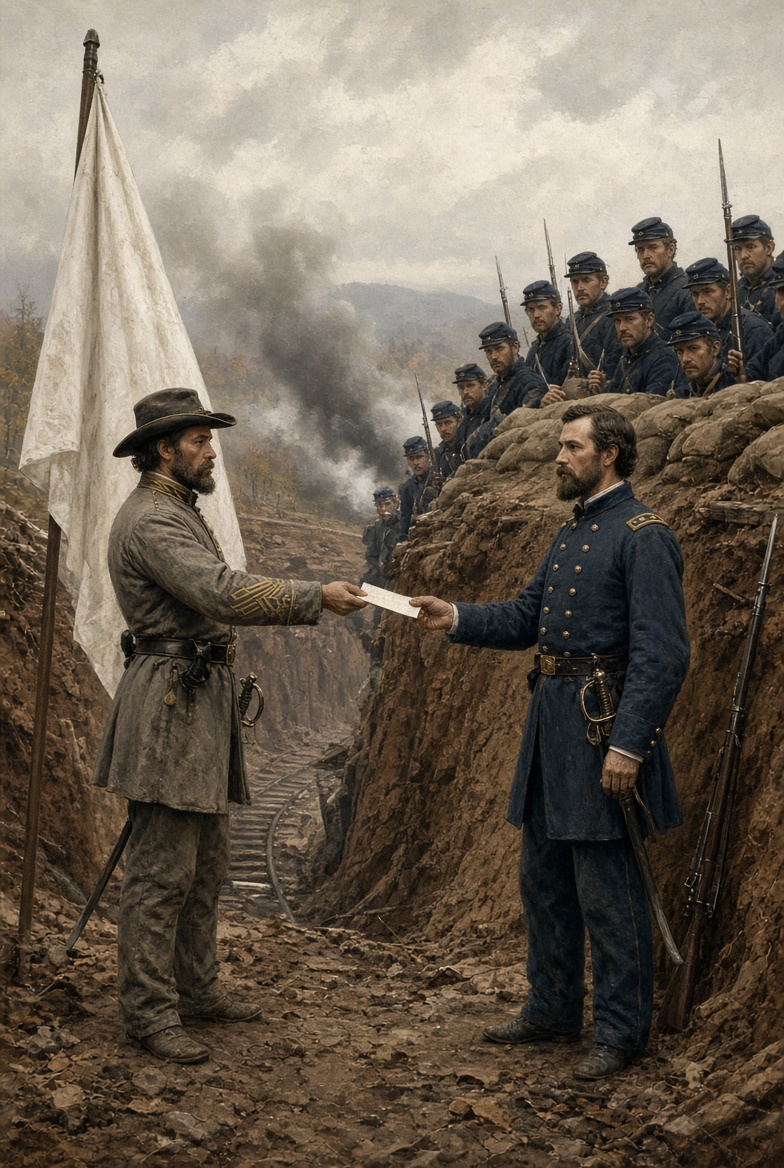
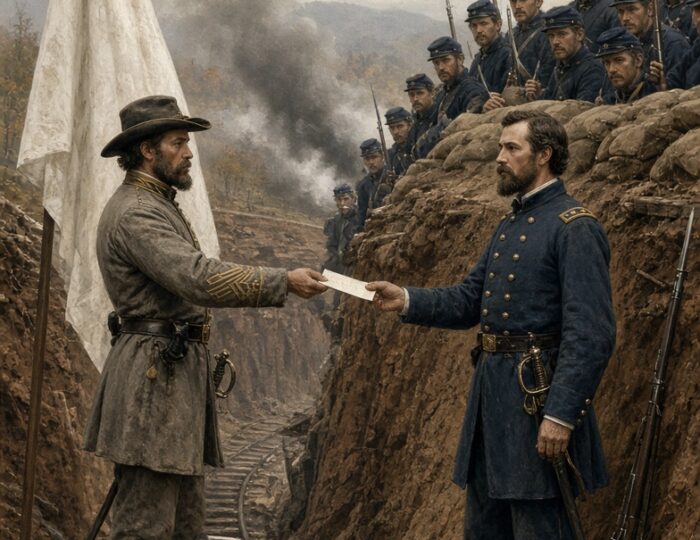
The wording was the formal music of nineteenth-century surrender demands. He told Corse that the forces under his command had been placed so that the garrison was surrounded, and that to avoid a needless effusion of blood he called for an immediate and unconditional surrender. Five minutes would be allowed to decide. If Corse accepted, his men would be treated in the most honorable manner as prisoners of war. It was the standard offer. It was also a clock. Five minutes is not a negotiation. Five minutes is a test of whether the man receiving the note has already decided.
Corse had already decided. His reply came back at once. He acknowledged the demand and said, in substance, that he and his men were prepared for the needless effusion of blood whenever it was agreeable to the other side. There is a dry nastiness in that sentence that belongs to the period. He did not grandstand about the flag. He handed the phrase “needless effusion of blood” back across the ditch and invited French to start the effusion on his own schedule. The five minutes expired unused.
French attacked. Sears came in from the north, against the rear and flank of the western works. Cockrell’s Missouri brigade, with Young in support, came from the west, straight at the face of the Star Fort. This was the fight. For about two hours the western fort took the weight of the assault. Confederate infantry got into the outer trenches. The Union line bent. On the parapet the Henrys mattered: a defender who did not have to reload from a cartridge box after every shot could keep a length of ditch empty longer than the arithmetic of the charge expected. The cut itself did part of the work. Men who spilled toward the railroad found themselves in a stone slot under fire from both rims, with the eastern fort still in Union hands and Tourtellotte able to see what was happening on the far side.
Corse was hit. A shell fragment took him in the face, destroying part of his cheekbone and ear and knocking him out of the fight for a stretch. Tourtellotte, who had held the place before the Rome train arrived, took the command and pulled men from the eastern redoubt across to stiffen the Star Fort. The east side thinned. The west side held. Corse came back to consciousness, face wrecked, and resumed direction. The wounded general on the parapet is the kind of detail paintings like, and in this case the medical result was real: the next day he would signal that he was short a cheekbone and one ear and still able to whip all hell. Sherman, reading that later, would tell him his head was worth more than a dozen he had to spare. The compliment was sincere and also slightly grim. Corse’s head had just been aerated.
By late morning the Star Fort had not fallen. French’s brigades had taken heavy losses getting into the ditches and had not been able to stay there. Ammunition in the attacking division was running down. Around noon French’s cavalry reported a Union force approaching from the direction of Acworth. He did not have the men or the cartridges to sit in front of a fort he had not taken while a second column came up the railroad behind him. At about two in the afternoon he pulled off, marched to rejoin Hood, and left the cut, the forts, and the warehouses in Union hands. His own later regret was specific. He had not taken the garrison, he had not taken the cut, and he had not burned the million rations.
The butcher’s bill was out of proportion to the size of the fight and exactly in proportion to the closeness of it. Union losses came to 706, of whom about 142 were killed, 352 wounded, and 212 missing, the missing including men captured when outer lines gave way. Confederate losses are given as 799 on the Georgia marker and 897 in the consolidated modern count, with one breakdown at 122 killed, 443 wounded, and 234 missing. Either figure means both sides lost around a third of the men they brought to the pass, in a fight measured in hours rather than days. Gettysburg’s casualty rate across three days sits in the same neighborhood. Allatoona did it before lunch was properly over. Grant, writing years later, praised the stand. Sherman issued General Orders No. 86 on October 7, using Allatoona as the lesson that fortified posts should be held to the last regardless of the numbers outside, because the time gained was the thing the rest of the army could spend. He named Corse, Tourtellotte, and Colonel Rowett, and he told every other post commander on the railroad to hold to the last minute.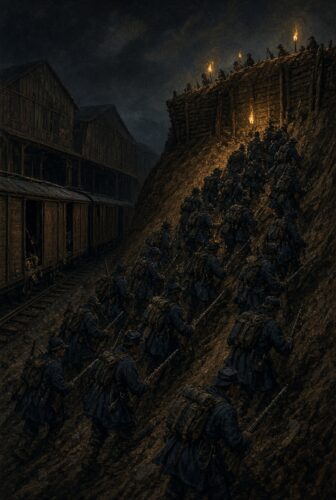
That order is the clean military moral. The popular moral was messier, and more interesting.
From Kennesaw Mountain, eighteen miles or so to the south, Sherman’s signal officers had been talking to Allatoona with flags. The messages that actually went up the line on October 4 and 5 were plainer than the hymn. One, signed through a staff officer, told the commanding officers that Sherman was moving in force and to hold out. Another said assistance had been sent. The press, and then the revival tent, compressed this into “Hold the fort, for I am coming.” In 1870 Philip P. Bliss, a Chicago evangelist and song writer, turned the compressed version into a gospel hymn. The chorus traveled farther than French’s division. For a century afterward, people who could not have found Allatoona on a map knew the line, and used it for every situation in which a person was told to endure because help was already on the road.
The road was less crowded than the chorus suggested. Sherman did intend to move against Hood, and he did order Jacob Cox’s XXIII Corps in ways meant to threaten French’s connection to the main Confederate body. He later remembered the demonstration more vividly than the clock supports. Orders and signal logs show Cox’s men still passing Marietta on the afternoon of the 5th, and a brigade not actually reaching Allatoona until about eleven in the morning on October 7, two days after French had gone. Sherman did send cavalry toward the pass, then reduced the order when it was clear the garrison had held. The fires and marches north of Atlanta were real. They were not a relief column arriving at the ditch while the Missourians were still in it. French withdrew because of a report, because of ammunition, and because the fort had not cracked. He was not pushed off the parapet by the men the hymn promised.
This is the part of the day that the song smoothed over. Corse held because the dirt was already piled, because the Rome train had arrived in the dark, because repeating rifles punished the ditches, because Tourtellotte shifted men across the cut at the moment the Star Fort sagged, and because a five-minute note was answered in the negative before the attack began. He did not hold because Sherman walked over the ridge at noon with a fresh corps. The signal mattered as permission and as morale. It did not matter as a timetable.
Hood did not get his rations and did not get his clean break of the railroad at the pass. He continued north, fought at Franklin in November, and wrecked what was left of his army at Nashville in December. Sherman, having discovered that he could not both chase Hood and keep the Western and Atlantic, did the thing Allatoona had been built to prevent him from needing to do. In mid-November he cut loose from the railroad, burned his own depots, and marched to the sea. The million rations French failed to burn were part of a supply system Sherman abandoned on purpose a few weeks later. The pass was held. The strategic premise of holding it expired. That does not make the morning pointless. A post that falls on October 5 hands Hood food, a victory, and a hole in the line while Sherman is still deciding. A post that holds until October 7 hands him nothing but casualties and a clock. Sherman spent that clock. French did not get to.
The ground is still there. The cut remains, deeper in the memory of the railroad than in the memory of the war, because the war preferred Gettysburg and the March. The Star Fort’s trace is on the western rim. A Georgia historical marker on Old Allatoona Road gives the numbers and the hymn in the same breath, which is how the day prefers to be remembered and not quite how it was fought.
What the morning actually demonstrated, under the hymn, is a narrow set of mechanics.
The position was prepared before the threat arrived. Poe’s dirt was piled in September, not on the morning of the attack. The Henry rifles were already in the Illinois companies. The warehouses were already inside the trace. Nothing important was improvised except the movement of Tourtellotte’s men from east to west after the face of the Star Fort came under the heaviest pressure.
The reinforcement that counted came before the demand, not during it. Corse’s train arrived at one in the morning. French’s note arrived after sunrise. The men who changed the odds were asleep, or trying to sleep, in the fort when the artillery opened. Help that is still on the cars when the five minutes start is a rumor.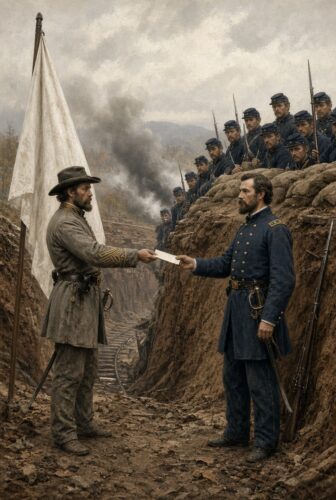
The refusal was immediate and specific. Corse did not ask for terms, did not request an hour to count cartridges, and did not send a counteroffer about the warehouses. He returned the attacker’s own phrase and started the clock on the other side. The attack then had to be paid for at full price.
The loss that looked decisive was not the loss that decided the post. A shell fragment removed part of the commander’s face and put him down. The fort did not change owners during the minutes he was out. Command moved one level down, to the officer who had already been there, and moved back when Corse could stand. The position was not the same thing as the face of the man commanding it.
The reported rescue was audited against the clock. French believed a column was coming up from Acworth. A column was, in a loose sense, moving. It was not at the pass. He left anyway, because belief plus low ammunition plus an untaken fort is enough. The garrison that stayed did not need the column to be real at two o’clock. It needed the fort to be untaken at two o’clock.
That is the usable residue of October 5, once the hymn has been set down.
The benefit is not “never give up.” Never-give-up is how posts get surrounded and eaten. The benefit is a way of telling a real hold from a performed one, and of spending a short, ugly interval on the work that is already inside your own parapet instead of on the army you have been told is marching.
A person under pressure usually does one of two wasteful things. They open negotiations with a threat that has not yet closed the ring, and they call the negotiation prudence. Or they freeze because the version of help they want is still a signal flag on a distant mountain, and they call the freeze faith. Allatoona separates those errors. The five-minute note is the threat asking you to do its work. The hymn is the help asking you to believe a timetable it has not earned.
The plan that follows is built only from those mechanics. It is not a morning routine, not a gratitude list, and not a request that you visualize a corps coming over the ridge. It is a single-position drill for the next time a demand arrives with a short clock attached.
The Allatoona Interval
Run it once, on a real pressure, within the next seven days. Pick one position you already occupy: a piece of unfinished work, a boundary with a person who keeps reopening a closed question, a sum of money you have decided not to spend, a skill you are in the middle of and have started explaining instead of practicing. One position. Not a life overhaul.
Before the clock starts, do the Poe hour. Spend one hour, once, putting the dirt where the attack will actually come. That means the physical or documentary trace of the position, not a mood. If it is work, the files are in one place and the next irreversible step is written in a single sentence. If it is a boundary, the sentence you will send is already drafted and does not ask the other person to agree that you are reasonable. If it is money, the transfer or the non-transfer is already set so that saying yes requires a new action from you, not the continuation of an old one. The fort is the part that exists before the note. If you build it after the note, you are Tourtellotte’s garrison before the train, and the numbers are worse.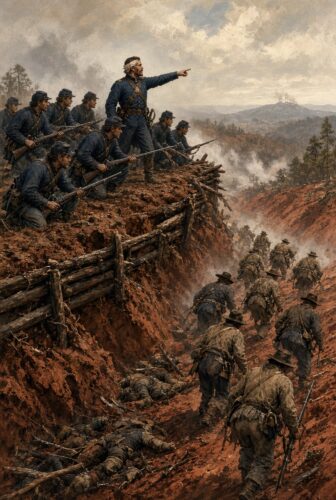
When the demand comes, use the five minutes as a refusal window, not a debate window. The demand will sound like French: a claim that you are surrounded, a warning about needless cost, a short deadline, a promise of honorable treatment if you quit. Answer once, in the attacker’s own currency, and stop. The answer names the position and declines to hand it over. It does not explain your childhood, your workload, or your hope that they will understand. Corse did not attach a memoir to his reply. Then do not reopen the channel for the length of one attack, which in ordinary life is two hours. Two hours of not renegotiating. Phone down, thread closed, document open only to the next step that was written in the Poe hour. The Henrys at Allatoona worked because the men did not stop to parley between shots.
At the end of the two hours, do the cheekbone audit, on paper, in four lines. What did you actually lose in the interval, as opposed to what you feared you would lose. What is still in the fort. Who is your Tourtellotte, the person or the system that can run the position for the minutes you are hit, and did you tell them before the shell arrived. What signal you have been treating as a timetable, and what time that help is actually scheduled to appear. If the help is a feeling, it is a hymn. If it is a person who has not moved, it is Cox’s corps still south of Marietta. Write the real arrival time or write “not coming.” Either answer is allowed. Pretending the chorus is an order of march is not.
Then make one transfer across the cut. Tourtellotte’s useful act was not a speech. It was moving men from the eastern redoubt to the face that was failing. Pick one resource you have been saving on the quiet side of the problem and move it to the side that is taking the fire: an hour from a low-stakes task, a sum from a category that is not under attack, a draft you have been polishing sent to the person who can act on it. One transfer. The cut is there so that you cannot pretend both rims are the same fight.
Close the drill by deciding, in one sentence, whether you are holding until a real column arrives or holding because the position is yours either way. Sherman’s garrison did the second, and that is why French’s report of a column did not have to be true for the warehouses to survive. If you discover you are only willing to hold if the hymn is accurate, you do not have a fort. You have a request. Rewrite the sentence until it describes a position you can keep at two in the afternoon without the Acworth road producing anyone.
Do the interval once, completely, and keep the four-line audit. The second time a five-minute note arrives, you will already know the difference between the message that was sent and the song that got famous. The pass did not care which version people sang. It cared whether the parapet was still occupied when the attacking division ran out of cartridges and decided the rumor was enough.
Share: