
Picture a freshwater sea the color of weak tea, low from a summer that forgot to rain. Lake Poyang, in what is now Jiangxi, is not a polite pond. In a wet year it is the largest lake in China, a breathing lung of the Yangtze, swelling and shrinking with the monsoon until whole counties disappear under it and whole counties come back as mud. In the late summer of 1363 it was shrinking. Sandbars that had been rumors in June were facts by August. And on those bars sat the most ridiculous navy the fourteenth century had managed to build: tower ships painted red, decks stacked like inns, hulls so deep they could carry horses, and chains running from bow to stern so the whole armada would advance as one floating city.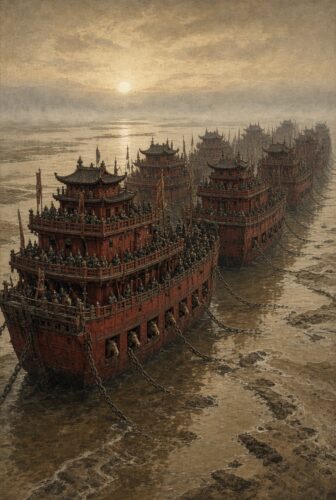
On the morning of 4 October 1363 that city tried to leave. It did not leave. An arrow found the man who had ordered the chains. The lake kept the rest.
That morning is not a footnote to the fall of the Mongol Yuan. It is the hinge. The man who won it had been a novice monk, a beggar, and a river pirate. Five years later he was the Hongwu Emperor, founder of the Ming, and China spent the next 276 years living inside the decision the shallow water made for him.
## A dynasty that could not feed its own river
To understand why two Chinese rebel fleets were trying to murder each other on a lake while a Mongol emperor still sat in Dadu, you have to go back to a river that changed its mind.
The Yuan had been a conquest, not a conversation. Kublai Khan proclaimed the dynasty in 1271, took the Southern Song’s last holdouts by 1279, and ruled a Chinese majority through a ranked system that put Mongols first, then Central Asian and Western auxiliaries, then northern Chinese, and Han southerners last. For a while the machine worked. The Grand Canal moved grain. The postal relays moved orders. The census counted people the tax office could find.
Then the sky and the river stopped cooperating. The 1340s brought floods on the Yellow River that wrecked the Canal, famine that the court answered with corvée labor, and plague that walked the same roads as the grain barges. Secret societies that had been mumbling about the coming of Maitreya, the future Buddha who would end the age, stopped mumbling. In 1351 the Red Turbans rose. They tied red cloth around their heads, preached a new age, and burned Yuan offices from the Huai River to the Yangtze. The court did what failing courts do. It hired Chinese generals to fight Chinese rebels, then suspected the generals, then lost both.
By the early 1360s the Yuan still owned the name of China and a shrinking slice of the north. The south was a knife fight between warlords who had all once claimed to be Red Turbans and now claimed to be emperors. Three mattered. Upstream, Chen Youliang, who had murdered his way to a throne and called his state Han. Downstream, Zhang Shicheng, salt smuggler turned prince of Wu, rich, cautious, and sitting on the grain of the delta. Between them, at Yingtian — the city that would become Nanjing — a pockmarked former monk named Zhu Yuanzhang, who called his piece of the river Western Wu and had not yet decided he was allowed to call himself anything grander.
The lake was the door between them.
## The monk who outlived his temple
Zhu Yuanzhang was born in 1328 in a village near Zhongli, in modern Fengyang, Anhui. His people were tenant farmers. In 1344 drought, then locusts, then plague took his father, his mother, and most of his brothers in a single season. He was sixteen. The neighbors were too poor to bury the dead properly, so he did what the desperate did and asked a Buddhist monastery to take him. Huangjue Temple shaved his head. Then the temple ran out of food too, and the monks sent the novices out to beg. For three years Zhu walked the Huai plain with a bowl, learning the faces of hungry counties. When he came back the temple was still there and the rebellion was louder. In 1352 he joined the band of Guo Zixing.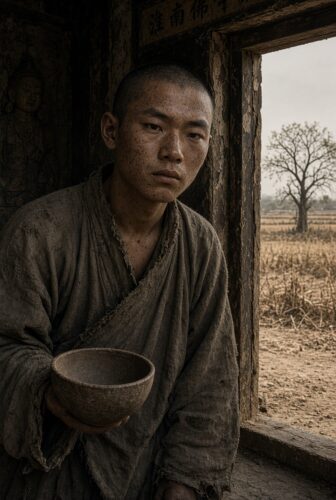
Guo was not a genius. He was a local strongman who had married his adopted daughter, the woman history knows as Empress Ma, to the ugly recruit who kept winning small fights and not getting his own men killed for nothing. Contemporaries were unkind about Zhu’s face. Later court painters, working for a man who could have them shortened by a head, discovered he had dignified cheekbones. The early record is closer to the truth: a heavy jaw, a pocked skin, protruding brows, the look of a man who had missed several meals and remembered each one. Ma, who had not missed the character underneath the jaw, became the only person in the army allowed to tell him he was wrong. He listened to her more than he listened to anyone else alive. That is not romance. That is personnel policy, and it kept him from becoming Chen Youliang.
He took towns. He took boats. He took the Yuan naval officers who were tired of being the dynasty’s last honest employees, including the water-camp commander Kang Maocai, who came over with his ships and his shipwrights. By 1356 Zhu held Yingtian. He did not proclaim himself emperor. He repaired walls, registered households, and forbade his officers from treating conquered cities as personal piggy banks. This was unusual enough to be a strategy.
Chen Youliang took the other road.
## The man who chained his own fleet
Chen came off the water too, but from the fishing families of the middle Yangtze, not from a failed monastery. He rose under Ni Wenjun, then under Xu Shouhui, the Red Turban figurehead who had called himself emperor of Tianwan. Chen’s talent was for the moment after the victory, when the man above him was tired. He killed Ni. In 1360 he killed Xu Shouhui, dropped the religious costume, and proclaimed himself emperor of Han at Jiangzhou, modern Jiujiang, right where the lake meets the great river. He was, by the standards of a civil war, a professional. He built ships the way a man builds an argument he does not intend to lose: bigger.
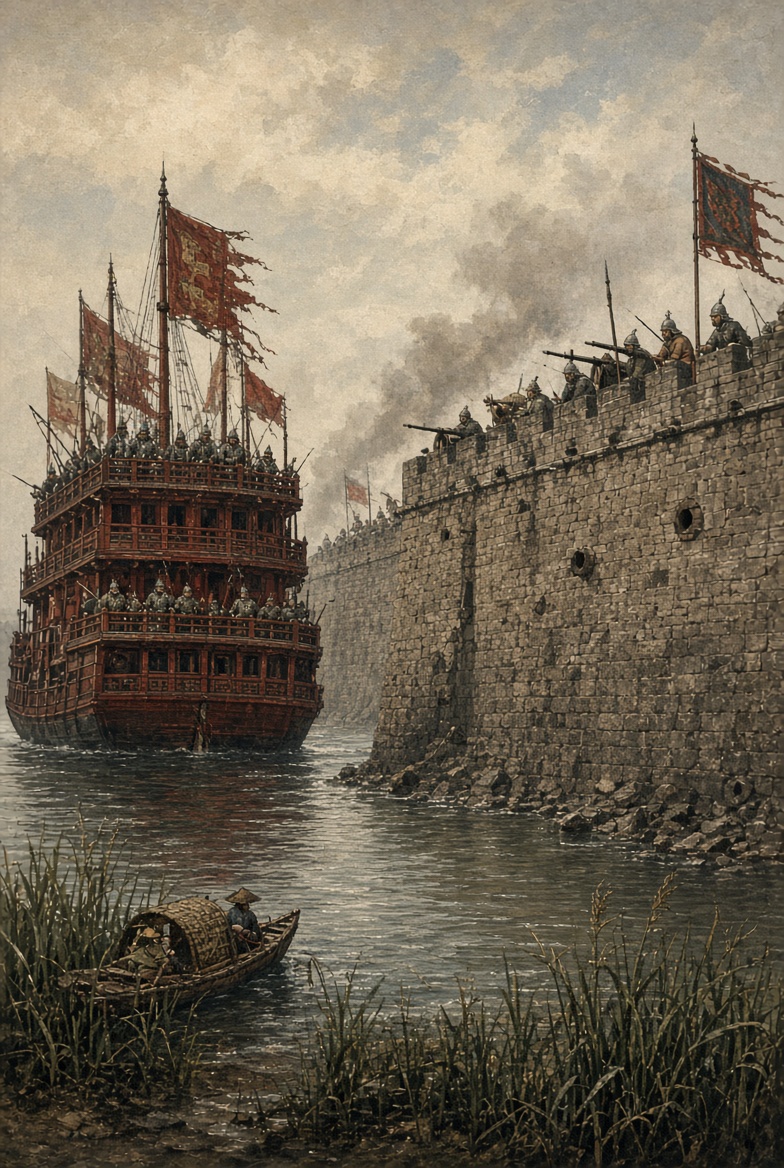
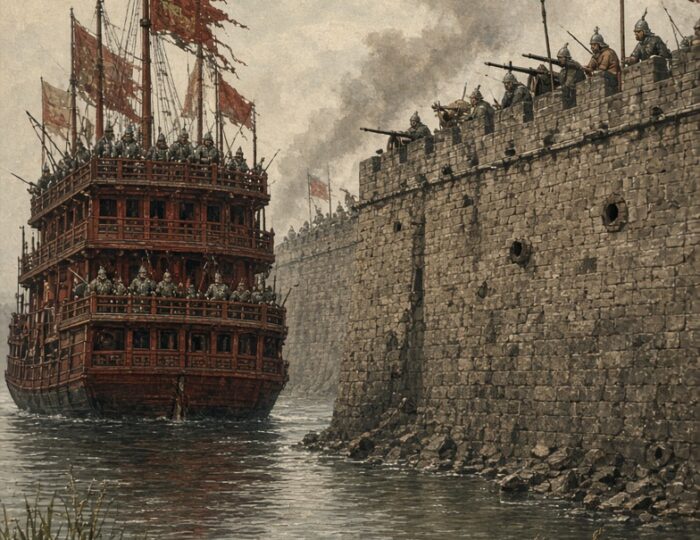
The Han tower ship, the lou chuan, was a floating fortress. Ming sources, which had every reason to inflate the monster they had slain, speak of vessels that could hold two thousand men, even three thousand, with multiple decks, cabins for horses, armored upper works, and early cannon. Even if you cut those numbers in half and then cut them again, you are still looking at ships that dwarfed anything afloat in Europe that year. Chen painted them red. He chained many of them bow to stern, so a line could not be peeled apart by a faster enemy. It was the same idea as a phalanx, moved onto water. It works until the ground — or the lake — stops being flat.
In 1360 he took that fleet downriver against Yingtian and ran into an ambush at Longwan. Zhu had hidden a force, let the Han marines land, and then closed. Chen escaped upstream. He did not forgive the embarrassment. In the spring of 1363, while Zhu’s best troops were busy with Zhang Shicheng’s cities to the east and with a relief on the northern bank, Chen emptied his kingdom into the lake. The announced figure, repeated in the Ming Veritable Records, is sixty myriads — six hundred thousand men. Edward Dreyer and every sober naval historian since have treated that number as a parade, not a muster. What is not in dispute is the shape of the effort. Chen brought the tower ships, the marines, the horses, and a siege train, and he pointed all of it at Hongdu.
Hongdu is Nanchang. It sits at the south end of the Poyang system, on the Gan River, and whoever holds it holds Jiangxi. Zhu’s nephew Zhu Wenzheng and the general Deng Yu held it for Western Wu. They had done something dull and brilliant before Chen arrived. They had pulled the city wall back from the shoreline and built it higher. Chen’s favorite trick, practiced at Taiping, was to bring a tower ship alongside a river wall so the upper deck became a bridge and the marines simply walked into the city. At Hongdu the upper deck now looked at open water and a higher wall. The trick was a plank to nowhere.
Chen attacked the gates in person. The defenders answered with cannon and stone. He lost the assault, settled in for a starvation siege, and waited for the monk to come and be crushed in the open lake, where size would finally mean what Chen had always believed it meant.
## The fishing boat
Sieges talk. This one talked for something like eighty-five days. Cannon against cannon, mining against countermining, arrows enough to thatch a roof. The message that mattered left in a small fishing boat, the sort of hull a patrol does not bother to stop because it looks like dinner. The boat got out of the lake, down the Yangtze, and into Yingtian with the news that Hongdu was still holding and would not hold forever.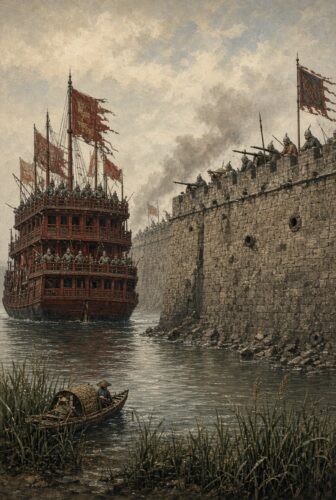
Zhu had a choice that will sound familiar to anyone who has ever been busy with the wrong emergency. Zhang Shicheng was a real problem. The northern bank was a real problem. Hongdu was the problem that ended the war. He gathered what ships he had — captured Yuan sea-boats, rebel “fast boats,” nothing that could stare a Han tower ship in the eye and win a shoving match — and he went upriver. Later retellings give him a thousand hulls and a hundred thousand men, or two hundred thousand. The Ming archival voice gives Chen three times Zhu’s strength. Believe the ratio more than the census. He was outbuilt. He was not out-thought.
He reached Hukou, the mouth where the lake drains toward the Yangtze, around 24 August 1363. He put men and early shore guns on the narrows. He sent an overland column south toward the city. Then he took the fleet into the lake. On 30 August Chen lifted the close siege and came north to meet him. The largest naval battle in the history of inland water was about to be fought in a drought.
## The orders, and the sandbar
Zhu’s instruction to his squadron commanders, preserved in the Ming Shilu, is the least poetic and most useful sentence of the war. When you close with the enemy boats, first fire the gunpowder weapons, then the bows and crossbows, and only when you are on them do you board and use short weapons. It is a sequence, not a mood. The armory behind that sentence was already stranger than a European chronicle of the same decade knew how to describe. Ming accounts list fire bombs, fire guns, fire arrows, fire seeds that were probably grenades, large and small fire lances, large and small “commander” fire-tubes, iron bombs, and rockets. They also list a device with a name that belongs in a comedy and a nightmare at once: the mei naihe, “there is nothing to be done about it,” or “no alternative.” A reed mat about seven feet long, pasted with paper, bound with silk and hemp, stuffed with powder, bullets, and smaller charges, hung from the foremast on a pole. At the moment of boarding you lit the fuse and cut the rope. It fell into the other ship and became the argument.
Guns were present. They were not yet the point. The point was fire, and the willingness to get close enough to deliver it.
On the first day Chen’s tower ships sat in a mass, picket boats around them, and let Zhu’s squadrons tire themselves against a wooden hill. Zhu’s own flagship ran onto a sandbar. For a horrible interval the future emperor of China was a stationary target in the middle of his own battle. The wakes of ships fighting around him lifted him off, which is the sort of luck you only get to spend once. He spent it learning. The Han ships drew more water. The lake was falling. A formation that could not turn without grounding was not a fortress. It was a bonfire that had not been introduced to a match.
## Seven boats and a wind that changed its mind
The next day the wind came around toward the Han line. Zhu sent burning ships into it. The versions differ on the count and agree on the method. The vivid one, loved by later tellers because it is too specific to be a general’s boast, says seven boats, stuffed with reeds and powder, crewed by straw men in armor with weapons stuck in their straw hands, so that from a deck they looked like a boarding party that had not yet decided to die. Crews lit them, aimed them, and got off. The chained Han ships could not open lanes. Picket boats dodged and then discovered that dodging was not the same as protecting. Fire took the towers. Ming writers speak of several hundred vessels burned and of Chen’s brothers among the dead. A loyalist tale, too strange to omit and too neat to swear to, says the officer Ding Pulang was hit so many times that when his head finally left him his body stayed on its feet with the weapon still in its hands. Believe the fire. The fire has better evidence.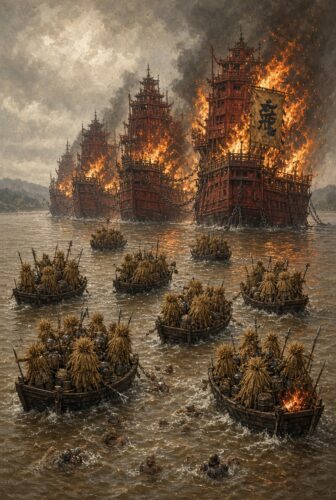
Naval historians, Edward Dreyer among them, have been careful not to let the fireworks eat the lesson. The Han fleet was built to attack cities, to come alongside a wall and stay there. The Western Wu squadrons were built to fight other ships, to split a line, to come back tomorrow. On a falling lake, versatility beat displacement. More than a hundred Han vessels went down in that attack in one telling; the Ming casualty list that survives for Zhu’s side is almost comically precise by comparison — 1,346 dead, 11,347 wounded — which is what a staff writes when it expects to be audited, set against a rival’s “six hundred thousand,” which is what a staff writes when it expects to be believed.
The overland column, meanwhile, walked into the siege lines Chen had left behind at Hongdu and kicked them apart. South was closed. The narrows at Hukou were closing. Chen still had the larger fleet. He no longer had a map.
## The month the lake became a pantry
After a sharp fight on 2 September, in which Zhu’s lighter boats cut individual tower ships out of the mass and butchered them in detail, both fleets paused. Zhu did not need a second miracle. He needed Chen to get hungry. For about a month the Western Wu squadrons held the exits, and the Han crews ate what they had brought to a siege they had expected to end with a parade. A tower ship is a terrible place to discover that the grain is low. Horses drink. Men drink. Powder gets damp. Officers who had chained their ships together so they could not be separated now discovered that the chain also meant they could not leave one at a time.
Chen waited because waiting had always been the privilege of the bigger man. The lake did not care about privilege. By the first days of October the choice was breakout or slow ruin.
## 4 October, and the arrow
He chose the breakout. On 4 October 1363 the red towers moved for the Hukou narrows and the Yangtze beyond. Zhu was waiting with the weapon that had already worked: fire ships set adrift, this time with the current of the great river as an accomplice once the Han line reached open water. The chained formation scattered into clusters. Clusters can be fought. A city cannot. Boarding actions sparked up and down the line, far enough apart that Chen could no longer see his own battle.
Ming archers found the flagship. An arrow struck Chen Youliang in the head — through the eye, in the version that sailed into the Naval Institute’s later retelling, into the skull in the shorter Chinese notice. He died where he stood. The Han line did not die with him in a single minute. It died over the afternoon, by fire, by surrender, by flight upstream of the few captains who still had a hole to run for. Hundreds of ships were taken or burned. Dozens were taken whole, horses still in the holds, which is the sort of capture that turns a victor’s next campaign from a theory into a schedule.
Chen’s son Chen Li was proclaimed in what was left of the Han. He lasted into 1364 and then surrendered. Zhang Shicheng lasted longer, and then he did not. In January 1368 Zhu stopped pretending he was a duke with a good navy and proclaimed the Ming, era name Hongwu, “vastly martial.” That autumn his generals took Dadu. The last Yuan emperor rode for the steppe. A dynasty that had begun with Kublai’s census ended with a former beggar’s quartermasters counting captured horses on a riverbank.
## What the shallow water actually decided
It is tempting to file Poyang under “underdog wins” and go home. That filing is lazy, and the lake will not support it. Zhu was not a small man who believed in himself. He was a smaller fleet that refused to fight the battle the larger fleet had built. Chen’s strength was real. The tower ship was a serious weapon against a city that had been rude enough to leave its wall at the waterline. Against a wall that had been walked backward, it was a very expensive balcony. Against a falling lake, it was a coffin with a view. Against a commander who would spend a month letting hunger do the work of a charge, it was a warehouse.
The numbers are a second lesson, and a funny one. Six hundred thousand men is a story Chen’s enemies were happy to tell, because it made their fire ships into legends. The audited Ming butcher’s bill on the other side is four digits of dead. Both can be propaganda. The physical facts do not need either figure. A deep hull in a drought grounds. A chained line cannot open a lane for a fire ship. A flagship that everyone can see is a flagship an archer can find. A siege that cannot walk its marines onto the wall becomes a siege that can be relieved. None of that requires a miracle. It requires a man willing to measure the water before he measures the enemy.
Zhu’s later reign is not a poster. The Hongwu Emperor became suspicious, then murderous, toward the generals who had won his war. The purges of Hu Weiyong and Lan Yu are not redeemed by a good day on a lake. Empress Ma died in 1382, and the court got worse. The point of 4 October is not that the winner was pure. The point is that the decision was correct on the day it was made, in the water it was made in, with the tools he actually had. History is allowed to be that local.
The weapon with the comic name belongs in the same drawer. “No alternative” was not a slogan. It was a reed mat full of powder that you dropped when you were already too close to pretend you had another plan. Most of the battle was won before anyone cut that rope: by a wall moved inland, by a fishing boat, by a sequence of fire-then-bow-then-board, by a month of not attacking. The mat was for the last ten feet. People remember the mat. The month won the war.
## The hour the chains become the enemy
So the outcome, stripped of the red paint, is this. A man with more ship than water lost to a man with less ship and a better map of the bottom. The loss was not moral. It was draft. Chen had chained his advantage to itself so it could not be surprised, and the chain became the surprise. Zhu had spent the years before the lake collecting other people’s boats, other people’s officers, and one person who could tell him he was wrong. On the day, he did not try to become Chen. He waited until Chen had to move, and then he made the move expensive.
That is the part that still fits in a week.
The usual advice, the kind that multiplies online like chained tower ships, tells you to add deck. Wake earlier. Add a system. Stack a habit on a habit until the formation is so impressive it cannot turn around. Poyang is the counter-advice, and it is older than the habit apps. Measure the depth first. If the thing you have built can only win by being larger than the room it is in, the room is the enemy. Unchain one boat. Send seven small ones you can afford to burn. Spend the month. Take the shot only when the flagship is in the open.
## The Seven-Boat Week
This is not a mindset. It is a seven-day drill named for the fire ships, and it only works if you pick one real formation in your life that is currently chained bow to stern. One project. One offer. One household mess. One skill you keep “scaling” instead of finishing. Not five. Chen brought the whole kingdom and died of it.
Day 1, name the tower ship. Write, in one sentence, the oversized thing you have been adding to because adding felt like progress. Then write the chain: the other commitments lashed to it so it cannot move without them. If you cannot list the chain, you are not ready to fight the lake. You are still painting the hull red.
Day 2, sound the shoal. The shoal is the constraint that makes size a liability. At Poyang it was drought and a wall that had been moved. In a life it is a date, a budget, a body, a person whose yes you do not actually have, a market that does not want the larger version. Write the depth in numbers or in a named fact. “I have six evening hours this week.” “The buyer already said no to the big package.” “The knee does not do the long version.” No metaphor left on the page. Zhu’s officers could point at a sandbar. So can you.
Day 3, pull one wall back. Choose a single preparation the enemy — the deadline, the other side, your own fatigue — does not expect, because it looks like retreat. Hongdu’s garrison gave up the shoreline to make the tower ships useless. You cancel one visible piece of the performance so the real defense sits where it can actually be held. Send the message, decline the meeting, shrink the offer, move the practice to the hour you can keep. One wall. Inland.
Day 4, build seven straw boats. Not goals. Probes. Each one must be small enough to lose, specific enough to answer a question, and finished before the day ends. A page, a call, a sample, a walk-through, a price, a repaired tool, a conversation you have been inflating into a summit. Straw men in armor fooled a deck at a distance and cost almost nothing when they burned. If your probe requires a new system before it can launch, it is a tower ship. Burn the design and make it smaller.
Day 5, wait for a wind you do not control. This is the day the internet hates, because it cannot be optimized. Zhu did not invent the northeast wind. He had the boats ready when it turned. Your wind is an answer, a calendar opening, a test result, a person coming back from a trip. Do not spend the day manufacturing urgency. Spend it making sure the seven boats are pointed. Hunger did half of Zhu’s work. Let the constraint work.
Day 6, unchain and close in order. Fire, then bow, then board. Translated out of the Shilu: send the probe, read what comes back, and only then spend the irreversible hour. Most people board first. They quit the job, launch the full offer, announce the new life, and discover the sandbar with the flagship. The sequence is the whole trick. If the probe sinks, you have lost a straw boat. Chen lost the fleet because he could not afford a straw boat. His ships were all flagships.
Day 7, one arrow. A single decision that was waiting on the evidence of the week, made before noon, written down, and not reopened because you are bored in the afternoon. Chen died when he had to cross open water in a ship everyone could identify. Your arrow is the email, the no, the signup, the cut. After it, you do what Zhu did with the captured horses. You count what you actually took, and you stop telling the story of the six hundred thousand.
The drill is finished in seven days because the lake did not offer a semester. If the shoal was wrong, you will know by Day 7, and you will have lost seven small boats instead of a summer. That is the entire advantage the monk had over the emperor of Han. He could be wrong at a size he could afford.
Run it once on something that matters and once on something petty, so you learn the difference between a wall and a mood. Then stop. A method that becomes a personality is just another chain, and the lake has already explained what chains are for.
Share: