
On a Friday in late August 1071, on a dusty plain north of Lake Van in what is now eastern Turkey, a Roman emperor lost his horse, his army, his throne, and eventually his eyes. The man who captured him was a Seljuk sultan whose name meant Heroic Lion. The Lion put his boot on the emperor’s neck, asked him a pointed question, fed him for a week, and sent him home with a treaty. The emperor’s own people then finished the job the Turks had started. Within a generation most of Anatolia had a new landlord. The ripple reached Jerusalem, Rome, and the First Crusade. That Friday was 26 August 1071. The place was Manzikert.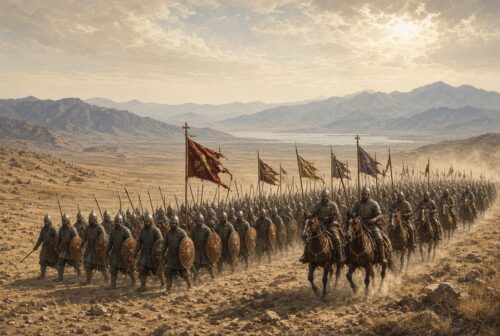
The Eastern Roman Empire still called itself Roman. Its capital still sat on the Bosporus. Its armies still used Greek fire and still claimed the old tagmata, the professional regiments that had once made the empire the best-organized military machine west of China. By 1071 that machine was running on fumes, mercenaries, and family grudges. The heartland of the empire was no longer the Balkans or Italy. It was Anatolia: the plateau that produced the grain, the horses, the taxes, and the recruits. Lose Anatolia and the empire became a city-state with a long memory and a shrinking tax base.
The new problem on the eastern frontier was not the old Arab caliphates. It was the Seljuk Turks. These were horse-archers from the Central Asian steppe who had converted to Islam, overrun Persia, and now raided deep into Byzantine Armenia and Cappadocia. Their sultan in 1071 was Alp Arslan, a man in his early forties who had already beaten the Fatimids in Syria and who moved his army the way a good chess player moves a knight: suddenly, and from an unexpected square.
The man who decided to stop him was Romanos IV Diogenes. Romanos was a soldier, not a palace eunuch. He had been a successful general on the Danube frontier. In 1068 the empress Eudokia Makrembolitissa, widow of Constantine X Doukas, married him to give the empire a fighting emperor. The Doukas family never forgave the marriage. They regarded the throne as their private furniture. Romanos knew it. He also knew that if he did not restore the eastern frontier the furniture would not matter.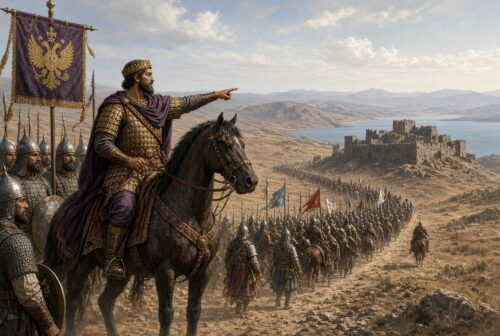
In the spring of 1071 he assembled what contemporary writers called a large army. Modern estimates usually settle between forty and seventy thousand men, though some chroniclers, never shy of a round number, claimed far more. The force was a museum of the late Byzantine military: the remaining professional tagmata, Armenian infantry, Pecheneg and Uz mercenaries who fought as light cavalry, a contingent of Normans under Roussel de Bailleul, and the emperor’s own household troops, including Varangians. It was not a homogeneous machine. It was a coalition held together by pay, fear of the emperor, and the hope of loot. Romanos marched east along the southern branch of the Upper Euphrates, into the high country of Armenia. The air in August is thin and the days are hot. The nights drop fast. Water is a military problem.
Near the fortress of Manzikert, modern Malazgirt, Romanos made the decision that still gets argued over in staff colleges. He split the army. One portion, under the experienced general Joseph Tarchaneiotes, was sent toward the fortress of Akhlat (Khliat) on the northwestern shore of Lake Van. The emperor kept the rest and took Manzikert itself with little trouble. The idea was to secure two strongpoints and then reunite. The execution was that Tarchaneiotes and his men never came back. Byzantine sources go quiet about why. Muslim sources say Alp Arslan’s men met them and they withdrew or were beaten. Later Byzantine writers muttered about desertion or Doukas loyalty. Whatever the reason, on the day that mattered Romanos had half the army he thought he had.
Alp Arslan had been campaigning in Syria against the Fatimids. When he learned a Byzantine emperor was sitting on his northern frontier with a large host, he turned around. He moved fast. By late August the two armies were close enough to skirmish. On 25 August Seljuk horse-archers stung the Byzantine outposts. Nicephorus Bryennius, commanding part of the line, took three wounds that were more embarrassing than fatal. Some of the Norman mercenaries showed an early interest in leaving. Some of the Uz auxiliaries began to calculate which side paid better. Alp Arslan sent a peace feeler. Romanos rejected it. He had come to fight, not to sign a truce that would look like weakness in Constantinople.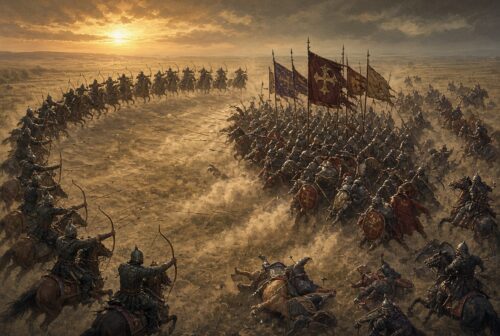
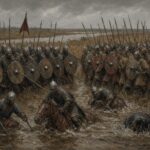
Friday, 26 August 1071. The Byzantine army left camp south of Manzikert and advanced in the traditional two-line formation: infantry in the center, cavalry on the wings, the emperor himself in the middle with the imperial standards and the best troops. Alp Arslan formed his men in a crescent. The Seljuk method was not a knightly charge. It was movement, arrows, feigned withdrawal, and then the horns closing on anyone foolish enough to chase. The Turks fell back. The Byzantines pushed. The day grew long. Dust rose. The center under Romanos reached what they thought was the sultan’s camp. It was not. It was a bait.
As dusk approached Romanos ordered a withdrawal to camp. That is the moment the battle became a disaster. A rumor ran down the line that the emperor was dead. The man who seems to have helped the rumor along was Andronikos Doukas, commanding the rear guard and belonging to the family that wanted Romanos gone. The rear guard did not cover the retreat. It left. The wings, already stretched by the pursuit, lost cohesion. Seljuk horse-archers swept in from both sides. The left tried to reach the emperor and was driven off. Romanos’s horse went down. He took a wound in the sword hand. The professional core around him fought until it could not. The rest of the army dissolved into the kind of flight that eyewitness Michael Attaleiates later described as shouting, sweat, fear, and dust, with the imperial army running and the empire looking as if it might collapse that same afternoon.
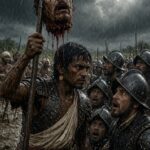
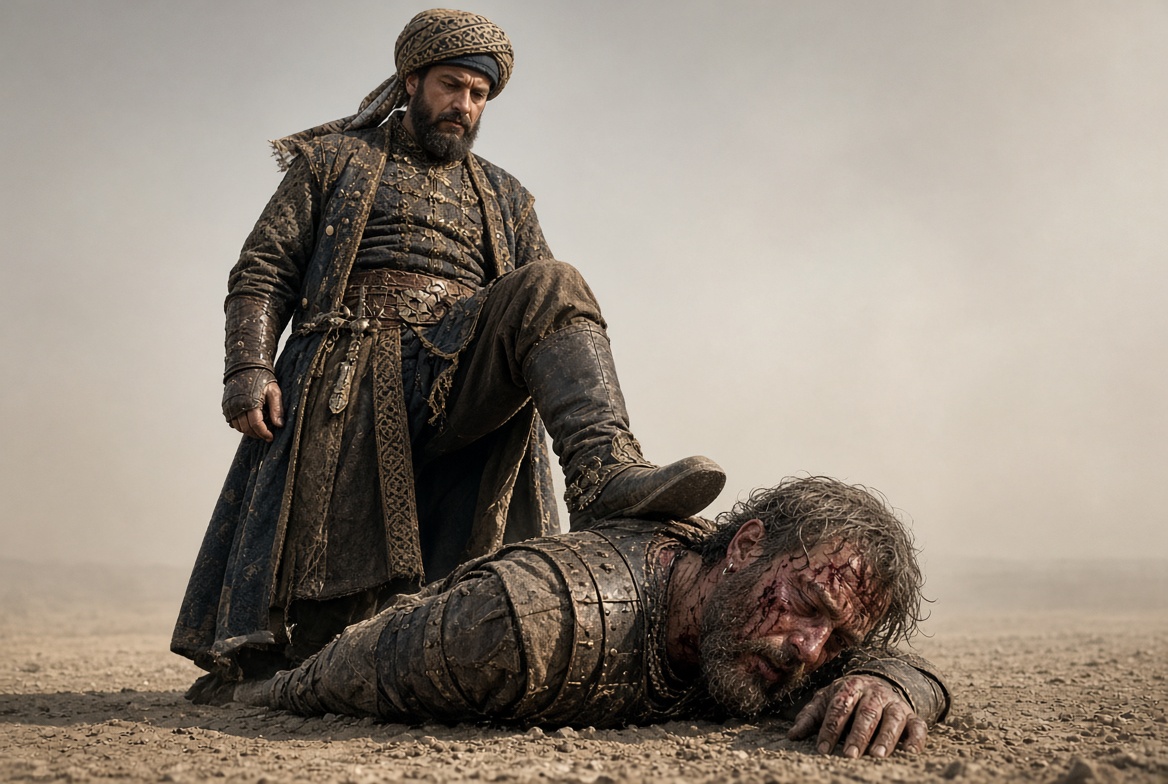
Romanos was taken. The identification scene has the quality of a dark joke. At first the captors did not believe they had the emperor. When they did, they brought him to Alp Arslan. The sultan had the emperor thrown to the ground and placed his boot on his neck. Then he asked the question that chroniclers loved: what would you do if our positions were reversed? Romanos, who was a soldier and not a diplomat, answered that he would have the sultan flogged or killed. Alp Arslan said he would not imitate that. He cited the milder counsel of the Christians’ own book. He had the chains removed. He fed the emperor for a week. He let him name prisoners to be freed. Then he sent him home.
The terms were not gentle, but they were not annihilation. Romanos promised a large ransom, an annual tribute, the cession of key frontier cities and Armenia, and a marriage alliance. Alp Arslan even gave him a horse. The Lion had what he needed: a defeated emperor who would carry the psychological wound back to the capital, and a treaty that opened the door to Anatolia without requiring the Seljuks to storm every fortress themselves.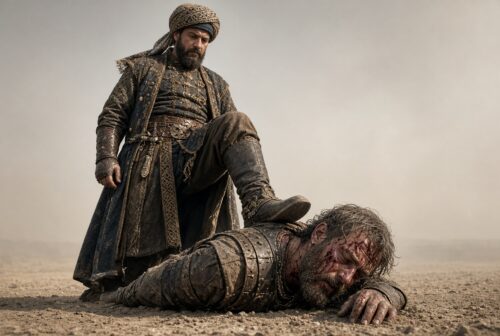
Romanos never got to enjoy the horse for long. When he reached imperial territory the Doukas faction was already moving. Michael VII Doukas was proclaimed. Romanos was seized, tonsured, and then blinded with a red-hot iron. The wound became infected. He died in 1072, a blinded monk. The civil war that followed did more damage than the afternoon at Manzikert. Generals marched on the capital instead of the frontier. The remaining professional troops were spent in domestic fights. Seljuk raiding parties, and then settlers, moved into the vacuum. By the late 1070s they had a capital at Nicaea, within striking distance of Constantinople. The Sultanate of Rum was born on the wreckage of Romanos’s campaign. In 1095 another emperor, Alexios I Komnenos, who had been a young officer in the Manzikert generation, wrote west for help. Pope Urban II answered at Clermont. The First Crusade was, among other things, a delayed invoice for 26 August 1071.
The battle itself was not a Cannae in body count. Many units escaped. The catastrophe was political and psychological. An emperor had been captured in the field for the first time in centuries. The sacred person of the basileus had been seen with a Turkish boot on his neck. The army that was supposed to be the shield of Christendom had come apart because half of it was somewhere else, because mercenaries changed sides, because a rival in the rear guard preferred a dead emperor to a living one, and because the man in the center kept fighting after the wings had already decided the day was lost. Anatolia, the recruiting ground and tax farm of the empire, began to change owners. The map of the eastern Mediterranean was redrawn in a single afternoon and the decade of chaos that followed it.
The terrain around Manzikert is still there: the plain, the approach to Lake Van, the summer heat, the sense that you are a long way from the Bosphorus. The fortress changed hands many times after 1071. The lesson did not require a fortress. It required an emperor who believed he could divide his strength, reject a usable peace, and still control the rumor that started in his own rear.
That is the history. The rest is what a person does with it.
The outcome at Manzikert was not that the bigger army lost to the smaller one. It was that the army that arrived as one piece left as two pieces that never found each other again, then discovered that some of the men it paid were already negotiating with the other side, and that the officer told to watch the back had his own coronation in mind. The capture of the leader mattered more than the casualty list. The civil war afterward mattered more than the capture.
A person looking at that Friday can take the following without dressing it up as ancient wisdom sold in a tote bag.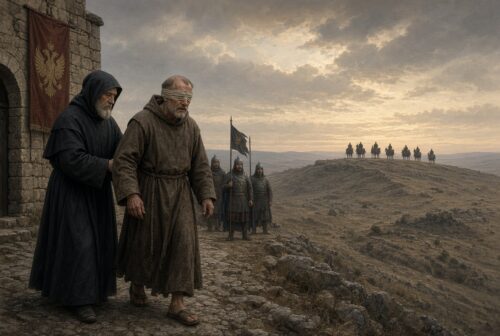
– Map every current effort as either the force you kept with you at Manzikert or the force you sent to Akhlat. If the second force has no scheduled hour of reunion and no messenger you actually trust, you have already given the afternoon away.
– Name the Andronikos in the formation: the person, habit, or side project that benefits if your main effort stumbles. Do not assign that person the rear guard.
– Treat mercenary energy the way Romanos should have treated the Uzes and the Normans. If a source of effort will leave the moment the rumor of your death is more profitable than the rumor of your success, stop paying it before Friday.
– When a decent offer arrives before the dust rises, look at it as Alp Arslan’s first message, not as an insult. Refusing it because you came to fight is how you end up answering questions with a boot on your neck.
– After a visible failure, the scramble among your own people is the second battle. Plan the week after the disaster with more care than the day of it. Romanos survived the Turks and died of his friends.
The plan that follows is not a morning routine, a journal prompt, or a vision board. It is a single Friday exercise built around the actual sequence of 26 August 1071 and meant to be finished in the time it takes to lose an army.
Call it the Lake Van Split Check. Do it on a Friday. Use one sheet of paper divided into four quadrants.
Quadrant one: the force you kept. Write the one project, relationship, or body of work that is actually with you this week. Not the portfolio. The piece that will still be standing if everything else rides off.
Quadrant two: the Akhlat detachment. Write the second front you opened “just to secure the other fortress.” Give it a reunion date and a named messenger. If you cannot name both, the detachment is already gone. Cancel or collapse it before dusk.
Quadrant three: the rear-guard name. Write the person, platform, or private story that would spread the rumor you were finished if it became convenient. You do not confront them. You simply stop letting them hold the standard.
Quadrant four: the first peace feeler you rejected this month because it felt like backing down. Write the smallest version of that offer you could still accept by Sunday. Then accept it or write one sentence why the Lion’s version was a trap.
That is the entire plan. No thirty-day challenge. No accountability partner. No app. One page, one Friday, four boxes that correspond to the four things that turned a large Byzantine army into a prisoner and a blinding iron. Do it once. If the page is still sitting there the next Friday with the same Akhlat detachment and the same unnamed rear guard, you already know how the afternoon ends.
The emperor kissed the dust, got his horse back, and still lost the plateau. The Lion stepped on a neck and then acted like a man who had read the other side’s book. The map changed. The date was 26 August. The habit is not to admire the Lion or pity the emperor. The habit is to refuse to split the only army you actually have.
Share: