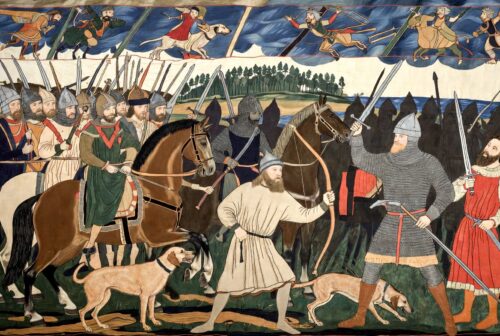

On the morning of 22 August 1138, on a stretch of open ground called Cowton Moor a couple of miles north of the little Yorkshire town that would later be known as Northallerton, a wooden ship’s mast stood upright on a four-wheeled cart. From its top hung a silver pyx containing the consecrated Host. Below it flew the banners of three northern saints: St Peter of York, St John of Beverley, and St Wilfrid of Ripon. Around that strange, wheeled totem gathered several thousand English and Norman fighting men who had every reason to expect they might be dead by midday. Opposite them, advancing through the morning mist, came a larger Scottish host under King David I, swollen with Galwegian spearmen, men from the Isles, Lothian, Teviotdale, Cumbria, and a hard core of knights. The English called the thing they had built the Standard. By the time the sun was properly up, the battle that took its name from that cart had already been decided, and the invaders were streaming back toward the Tees in a disorder so complete that chroniclers claimed more men died in the flight than in the fighting itself.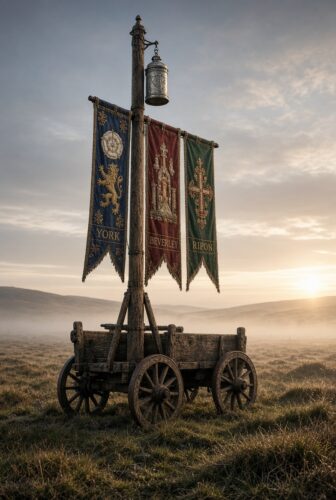
The wider stage was the long, messy civil war later labeled the Anarchy. Henry I of England had died in 1135 leaving his daughter Matilda as his designated heir. Stephen of Blois had seized the crown instead. David of Scotland, uncle to Matilda and a long-time beneficiary of Henry’s favor, invaded repeatedly in her name while also enlarging his own northern holdings. By the summer of 1138 he had already taken most of Northumberland except the stubborn castles at Wark and Bamburgh. His forces had crossed the Tees and were burning and stripping Yorkshire. Contemporary writers, especially Richard of Hexham, described the Scottish advance in language that still carries the heat of outrage: an “execrable army, more atrocious than the pagans,” slaughtering without regard for age or sex, driving naked and fettered women ahead of them, putting the sick, the pregnant, and the infants to the sword with particular relish. Whether every detail is exact or colored by propaganda, the northern English clearly believed they were facing something close to apocalyptic savagery. Archbishop Thurstan of York, old and ailing, nevertheless issued a summons that framed the coming fight as holy work. Parishes sent men. Barons from Yorkshire and the north Midlands answered. A handful of mercenaries and reinforcements from further south arrived. The force that assembled was not the full royal army—Stephen was busy in the south—but it was local, motivated, and under the practical command of William of Aumale, with Walter Espec and other northern lords playing prominent roles.
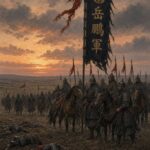
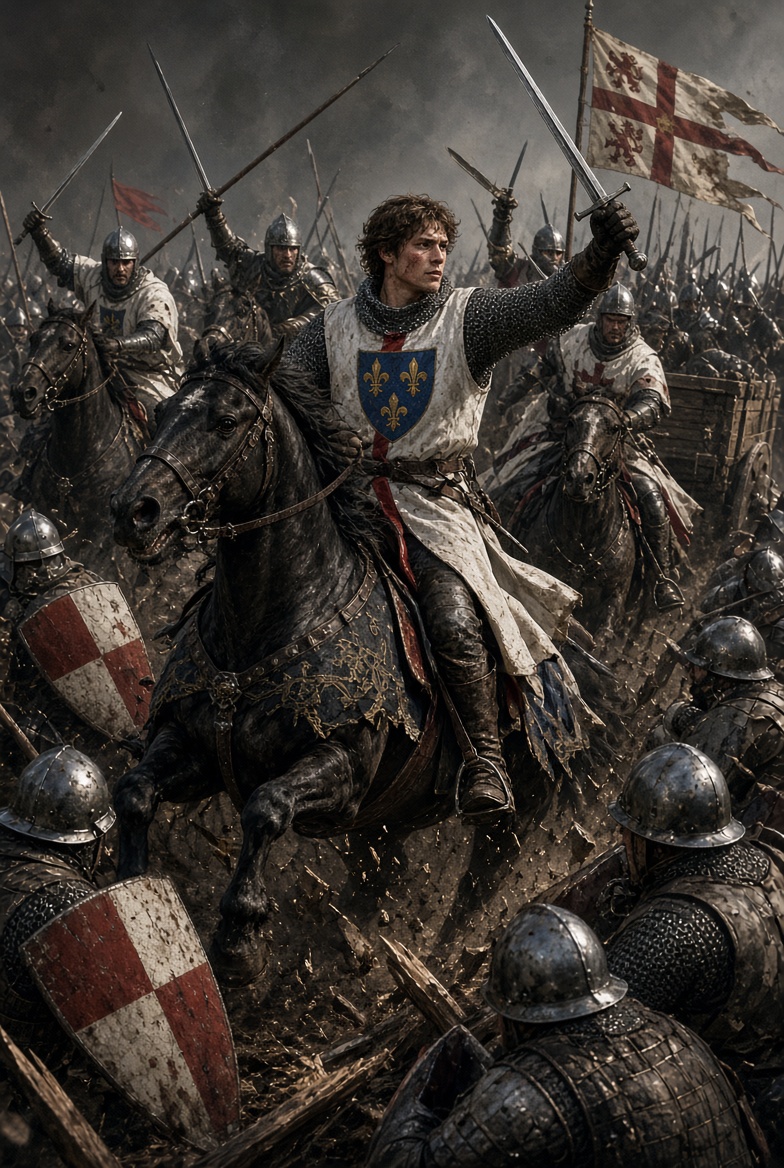
They chose their ground carefully. The English formed on a gentle ridge with marshy ground protecting the flanks. In the center they raised the Standard. This was no ordinary banner. It was a deliberate imitation of the Italian carroccio: a mobile sacred focus meant to stiffen morale and announce that God Himself was present as standard-bearer. A silver box with the Body of Christ hung at the top so that, in the words of one chronicler, “Jesus Christ our Lord, by the presence of His body, might be their leader in the war which they had undertaken for the defence of His church and their country.” The banners of the great northern minsters flew beneath it. Knights dismounted, sent their horses to the rear, and took their places in the line beside the armored men and the archers. There would be no easy escape if things went wrong. Walter Espec or another leader is said to have given a speech that mixed Norman pride with a practical reminder of past victories over the French and a pointed observation that the Scots, for all their numbers, had never stood successfully against the same quality of armored infantry and archery. The message was clear: you are the civilized men; they are the raiders; hold the line and the day is yours.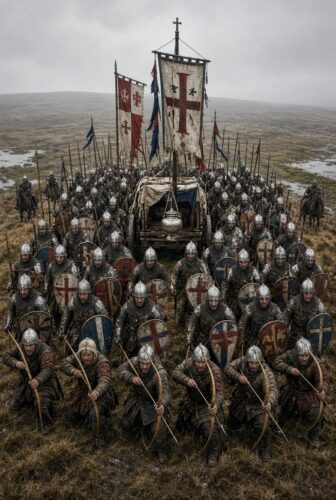
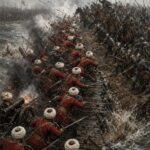
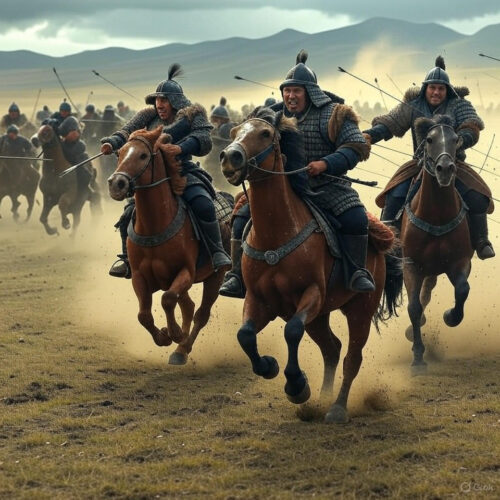
Across the field the Scottish army arranged itself in four roughly successive lines. The Galwegians—hard-fighting, lightly armored spearmen from the southwest—insisted on the place of honor in the front. Behind them came Prince Henry, David’s son, with the better-equipped knights and some archers. Further back stood the men of Lothian and the west, and finally David’s own household and the northern Scots. There was argument in the Scottish ranks about the order of attack; the Galwegians won the right to lead. Contemporary accounts, particularly that of Ailred of Rievaulx, paint the moment with sharp detail. The Galwegians advanced with their customary three great yells. They struck the English line hard enough to push the first ranks of spearmen back, but the dismounted knights and the denser formation held. Then the English archers opened up. The effect was immediate and ugly. Ailred’s famous image still works: a Galwegian bristled with arrows “like a hedgehog with its quills,” yet continued to slash wildly at empty air or at men he could no longer reach. Two of their leaders, Domnall and Ulgric, went down. The earl of Lothian was killed by an arrow. The front line disintegrated.
What followed was collapse rather than a prolonged struggle. The second Scottish line wavered. David himself was forced to pull back as the pressure mounted. Prince Henry, showing the personal courage that even hostile sources acknowledge, launched a mounted charge that punched through part of the English formation and even reached the area where the English horses were held, driving them off for a distance. But he was unsupported. The English foot closed in behind him. Henry cut his way out and fled. Within roughly three hours—between the first and third hours of the day, according to the chroniclers—the Scottish army had broken. Foot soldiers threw down their arms and ran. Knights scattered. David and Henry escaped separately with their immediate followers in something approaching good order, but the bulk of the host did not. Estimates of Scottish dead run from ten to twelve thousand, many of them cut down or drowned in the disorder of the retreat across the Tees and the surrounding country. English losses were light; one source claims only a single knight among those present was killed. Of the two hundred mailed knights David is said to have brought, only nineteen recovered their hauberks.
The battle did not reverse every Scottish gain. David still held Carlisle and substantial northern territories. A truce followed within a month. Further negotiations in 1139 confirmed his son Henry in the earldom of Northumberland (minus certain key castles) and left David in possession of Cumberland. Those arrangements lasted until after David’s death in 1153. When Henry II of England was firmly on the throne, the northern lands were reclaimed. So the immediate strategic fruit of the Standard was limited. Yet the day itself mattered. A larger invading force that had been terrorizing the north was shattered in a morning by a smaller, better-organized, and more cohesive army that had planted a single sacred object in the center of its position and refused to leave it. The psychological effect on both sides was considerable. English chroniclers treated the victory as divine judgment. Scottish sources, where they exist, are quieter. The image that survived was the cart, the mast, the saints’ banners, and the sudden transformation of a confident host into a fleeing mob.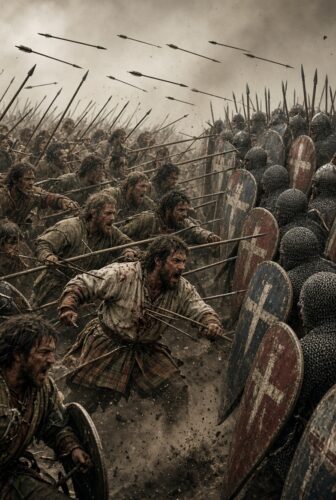
The Galwegians’ fate is especially instructive. They had demanded the front rank, charged with ferocity, and then discovered that courage without protection and without coordination against massed archery and armored infantry is simply a faster way to die. The English decision to fight on foot, to anchor everything on the Standard, and to let the archers do their work first, turned numerical inferiority into a decisive advantage. The battle was short, brutal, and one-sided once the initial momentum failed. By midday the field belonged to the men who had stood around a wheeled mast and refused to break.
That is the historical core: a specific morning in 1138, a specific piece of ground, a specific piece of kit (the Standard), specific tactical choices, and a specific, lopsided result that stopped an invasion in its tracks even if it did not permanently redraw the map.
The practical residue of that morning is straightforward and has nothing to do with medieval piety or national myth. When a larger, noisier, more aggressive force is coming at you—whether it is a wave of obligations, a sudden crisis, a long-running personal pressure, or simply the accumulated weight of daily disorder—the first useful move is not to match its volume or its speed. The first useful move is to plant something immovable in the center of your own position and organize everything else around it. The English did not invent a brilliant new weapon. They created a fixed reference point that told every man in the line exactly where the fight was and what it was for. Once that point existed, the rest of the tactics followed: dismount, hold, shoot, refuse to chase until the enemy is already running.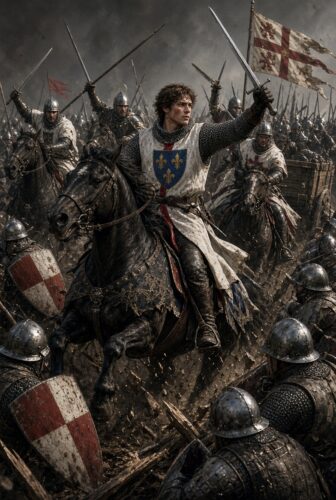
A person facing ordinary modern pressure can extract a concrete method from the same logic without borrowing any of the religious language or the battlefield romance. Call it the Single Fixed Point method. It is not a vision board, not a gratitude journal, not a morning routine stacked with affirmations, and not a productivity system that requires apps or color-coded calendars. It is deliberately narrow and physical.
Here is the plan, designed to be executable in under twenty minutes a day and resistant to the usual ways self-help collapses under real life.
– Choose one non-negotiable commitment that is already true of you or that you are prepared to make true by simple repetition. It must be concrete, observable, and independent of other people’s behavior. Examples that work: “I complete one defined piece of paid or creative work before I open any message stream,” or “I leave the house for a walk of at least thirty minutes before noon regardless of weather,” or “I prepare tomorrow’s primary task list in writing before the current day ends.” The content is secondary; the fixed quality is primary. Write it on a single index card or a small piece of paper in the plainest possible language. No slogans. No motivational framing. Just the sentence.
– Place that card in one permanent physical location that you pass every morning and every evening—inside the front cover of a notebook you already use, taped to the inside of a cupboard door you open daily, or set on the same corner of a desk. Do not move it. Do not decorate it. The point is that it stays exactly where it is, the way the mast stayed on the cart.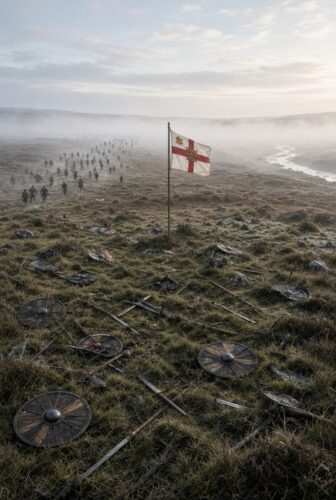
– Each morning, before any other decision, look at the card and perform the action it names or confirm that the conditions for performing it later in the day are already arranged. This takes less than a minute. If the action is scheduled for later, the morning check is simply verification that nothing has been allowed to displace it. If something has displaced it, restore it immediately. No negotiation, no “I’ll do it after this one email.” The Standard does not move because the line is hard.
– When external pressure arrives—an urgent demand, a cascade of interruptions, a feeling that the day is already lost—return to the card before responding. The question is not “How do I handle all of this?” The question is “Does this pressure require me to abandon the fixed point, or can the fixed point remain while I deal with the rest?” In the great majority of cases the fixed point can remain. That single act of checking re-centers the day the way the English line re-centered around the cart after the first Galwegian impact.
– Once a week, on the same day and at the same rough time, review the card for thirty seconds. If the commitment has been kept, leave it unchanged. If it has been broken more than twice in the week, rewrite it so that it is smaller and more automatic, then return it to the same physical place. Do not expand it. Do not add a second card. The method fails the moment it becomes a list.
That is the entire system. It borrows the only feature of the 1138 battle that actually transferred force: a single, visible, immovable reference that told every participant what the fight was about and where the center of the position lay. Everything else—the archery, the dismounted knights, the refusal to pursue too early—followed from the decision to plant the Standard and stay with it. The same sequence works when the opposing force is not a Scottish army but the ordinary, daily tendency of life to scatter attention and dilute effort. Plant one fixed point. Organize the rest of the day around the refusal to abandon it. Let the larger, noisier pressures break themselves against that refusal the way the Galwegians broke against the arrows and the armored line. The battle on Cowton Moor lasted less than three hours. The method that grew out of it does not need to last longer than the time it takes to look at a card and keep a single promise.
Share: