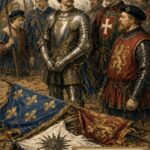

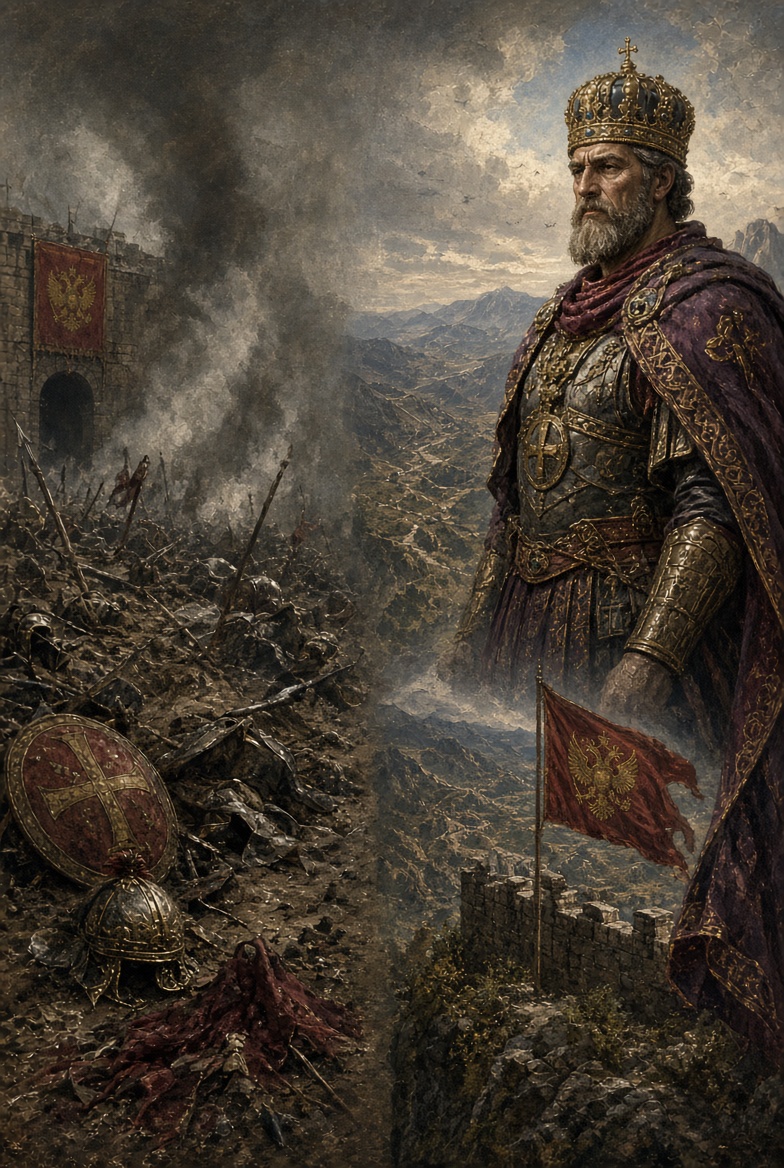
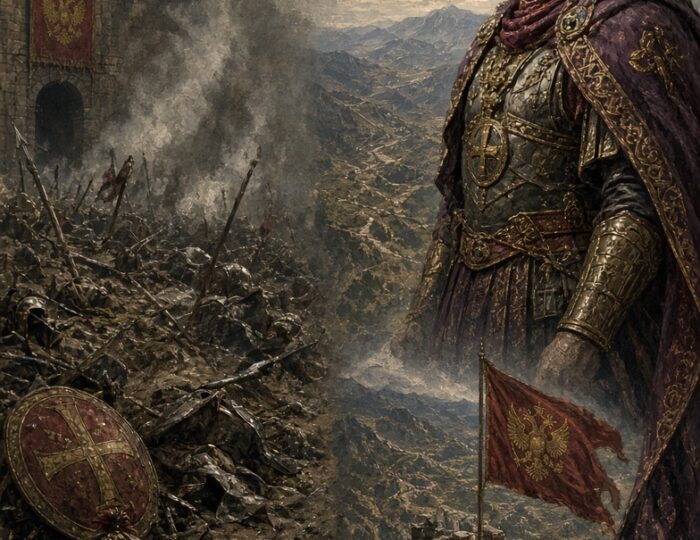
On the night of August 16 into the 17th in the year 986, under a Balkan sky that one eyewitness swore had just dropped a portentous falling star that burst into sparks over the Roman camp, a young Byzantine emperor named Basil II discovered what it felt like to have an empire’s entire campaign unravel in a wooded mountain pass. The place was the Gate of Trajan—modern Trayanovi Vrata in the Sredna Gora mountains of what is now Bulgaria—where the ancient Roman road still threaded a narrow saddle between Thrace and the interior. Basil, not yet the iron-willed “Bulgar-Slayer” of later legend, was retreating after a failed siege of Serdica (today’s Sofia). His army, somewhere between fifteen and twenty thousand strong, was tired, hungry, disordered, and suddenly surrounded. By the time the sun rose properly on August 17, most of that army was dead or captured, the imperial baggage and insignia were in Bulgarian hands, and the emperor himself was being hustled out of the trap by a hard-pressed contingent of Armenian infantry who knew secondary paths through the thickets. 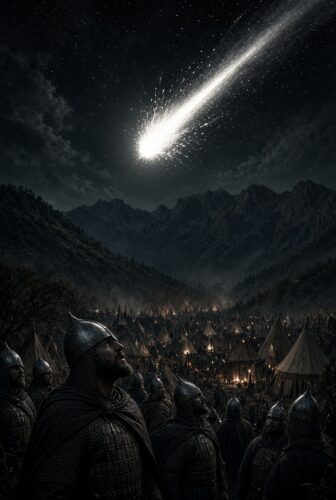
It was the largest military disaster Basil would ever suffer. It also became the hinge on which the rest of his fifty-year reign turned.
To understand why a single day in a mountain pass mattered so much, you have to rewind the Byzantine-Bulgarian story. In 971 Emperor John Tzimiskes had smashed the eastern Bulgarian state, taken the capital Preslav, and forced Tsar Boris II to abdicate in Constantinople. The Byzantines believed the Bulgarian problem was solved. They were wrong. In the western highlands around the lakes of Ohrid and Prespa, four sons of a local count named Nikola—David, Moses, Aaron, and Samuel—kept fighting. They ruled in a loose tetrarchy, each based in a different stronghold, and they proved far more durable than the old eastern court. After Tzimiskes died in 976 and the teenage Basil II (along with his brother Constantine) formally took the throne, the western Bulgarians went on the offensive. Samuel, the most capable of the brothers, liberated northeastern territories, raided deep into Thessaly, and even captured Larissa after a long siege. Byzantine governors in the Balkans could not stop him. Basil, still under the shadow of the powerful eunuch Basil Lekapenos and distracted by the dangerous rebellion of Bardas Skleros in Asia Minor, had not yet shown his teeth.
By the spring of 986 the young emperor decided it was time to act. He gathered a substantial force—eastern tagmata were still tied down against Arab threats, so the army was largely western and relatively inexperienced under his direct command—and marched from Adrianople through Philippopolis toward Serdica. The strategic idea was sound on paper: seize the fortress that controlled the corridor between the northeastern Bulgarian lands and Samuel’s southwestern heartland, then push on toward the lakes. Basil left a rear-guard detachment under the general Leo Melissenos to secure the line of retreat through the mountain passes.
The siege of Serdica lasted roughly twenty days and went badly from the start. The Bulgarians inside the walls, and Samuel’s mobile forces outside, practiced a textbook scorched-earth defense. Crops were burned, cattle driven off, and Byzantine foraging parties ambushed. The garrison made bold sorties, killing troops and setting fire to siege engines that had been pushed too close to the walls—an elementary mistake of placement that suggested the young emperor and his staff still had much to learn about the practical side of siegecraft. Food ran short inside the Byzantine camp. Rumors circulated that Samuel’s main army was closing in from the rear. Melissenos, whose job was to hold the passes, withdrew toward Philippopolis and, according to some reports that reached the army, may have been contemplating larger political ambitions of his own. Discipline frayed. 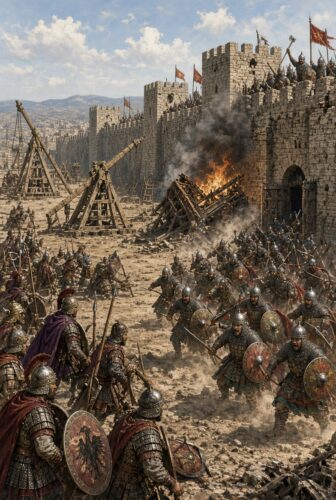
Basil ordered the retreat. The army pulled out of the Sofia valley and headed east toward the Gate of Trajan, the narrow, wooded, precipice-flanked pass that had controlled the route since Roman times. On the night of the 16th they camped in the approaches. Leo the Deacon, the historian who was present as a participant, recorded a striking omen: a great star appeared, illuminated the tents with unnatural brightness, then burst into sparks and vanished. In the morning the column began to move into the defile.
Samuel’s forces—possibly accompanied by his brother Aaron and elements under the nominal Tsar Roman—had already taken the heights. The Bulgarians knew the ground intimately. As the long Byzantine column entered the wooded valley and climbed toward the steeper sections of the pass, the trap closed. Arrows and stones poured down from above. Bulgarian warriors charged the flanks and rear. The vanguard managed to squeeze through and escape over less-guarded slopes, but the main body and the rear were enveloped. Panic spread. The imperial tent and the entire baggage train were overrun. Standards and the emperor’s personal insignia fell into Bulgarian hands. Contemporary accounts speak of “enormous numbers” of Byzantine dead; the survivors who were not cut down were taken prisoner.
Only a determined breakout by elite Armenian infantry saved Basil himself. They cut a path through secondary routes, shielding the emperor at heavy cost to their own ranks, and got him clear of the killing ground. He reached Philippopolis with the remnants of his force, where Melissenos’s detachment was waiting. There would be no immediate counterattack.
The political aftershocks were almost as severe as the military ones. Basil’s prestige collapsed. Within months Bardas Phokas, the powerful general in Asia Minor, rose in open rebellion, and the revolt lasted three years. Samuel, by contrast, rode a wave of prestige. The victory at the Gates of Trajan confirmed Bulgarian control over large stretches of the Balkans, allowed the transfer of the effective capital from the vulnerable northeast to Ohrid, and opened the way for further raids toward Thessaloniki, Edessa, and the Adriatic. A generation later the Bitola inscription of Ivan Vladislav still remembered the triumph over Basil. Poets such as John Geometres wrote bitter verses: even if the sun itself fell from the sky, he would never have believed Moesian arrows could break Avzonian spears; the Danube had taken the crown of Rome. 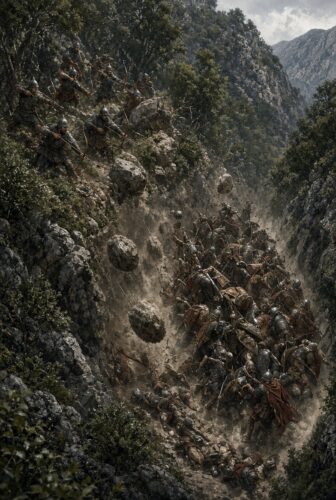
Yet the story did not end in 986. Basil II lived another thirty-nine years. He spent the next decade ruthlessly consolidating power, reforming the army, learning the value of logistics, intelligence, and relentless pressure, and developing a style of warfare that favored attrition over flashy single campaigns. In 1014, at the Battle of Kleidion, he finally broke Bulgarian resistance in a decisive victory; the subsequent blinding of thousands of prisoners gave him the grim epithet “Bulgar-Slayer.” Samuel died that same year, reportedly of a stroke after seeing his mutilated soldiers. The First Bulgarian Empire was absorbed. The emperor who had once fled through Trajan’s Gate in the night became one of the most successful soldier-emperors in Byzantine history.
The details of the 986 campaign repay close attention because they reveal a classic pattern of overconfidence meeting prepared local knowledge. The Byzantines arrived with numbers and imperial prestige but without adequate forage plans, without secure flanks, without reliable rear-guard coordination, and without a clear understanding of how the mountain terrain would amplify every mistake once the retreat began. The Bulgarians under Samuel used scorched earth to create scarcity, patient observation to choose the moment, and intimate knowledge of the pass to turn a withdrawal into an annihilation. Leo the Deacon’s falling-star omen, whether coincidence or literary flourish, underscored the sense that the universe itself had voted against the Roman column that night.
What makes the episode especially sharp is the character of the young Basil. He was not a soft court product; he had already survived political intrigue and the Skleros revolt. Yet the Gates of Trajan exposed gaps in operational experience that no amount of purple birth could paper over. He learned. The later Basil is almost unrecognizable from the commander of 986: methodical, suspicious of glamorous risk, willing to campaign year after year in the same theater, and utterly ruthless about logistics and intelligence. The disaster became the forge.
That is the historical core—nearly a thousand years old, specific to one mountain saddle on one August day, and still rich enough to fill a book. The rest of the story is what a person living now can actually do with it. 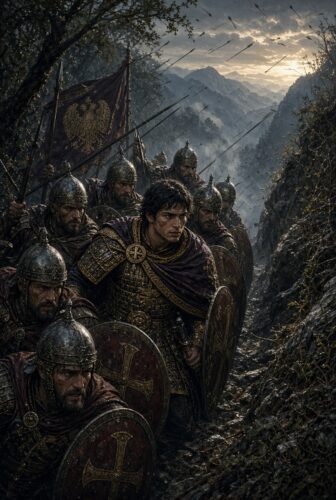
The outcome of August 17, 986, was not merely that Basil survived. It was that he converted a public, near-fatal humiliation into the longest and most effective military education any medieval ruler ever gave himself. He did not deny the defeat, romanticize it, or drown it in immediate revenge fantasies. He diagnosed the precise failures—logistics, rear security, terrain mastery, the difference between a parade army and a campaign army—and then spent the next decades rebuilding every weak system until those failures could never recur at scale.
A modern person benefits from the same sequence when a personal “campaign” collapses: a career move that implodes, a financial plan that burns, a health or creative project that stalls in public view, a relationship or reputation that takes a sudden hit. The historical fact supplies a template that is neither positive-thinking platitude nor vague “learn from failure” advice. It is a concrete operational response drawn from the specific mechanics of the 986 disaster.
Here is how the outcome applies, in specific bullet points:
– The siege of Serdica failed because the Byzantines could not feed themselves while the defenders and Samuel’s mobile forces controlled the countryside. Modern parallel: any goal that depends on continuous external “forage” (income streams, attention, energy, social validation) without built-in reserves will collapse the moment the environment turns hostile. Benefit today: audit every major personal project for its true logistical base and build a minimum thirty-day independent buffer before the next advance.
– Melissenos’s withdrawal left the rear unsecured and rumors of political disloyalty poisoned the column. Modern parallel: the people or systems you assume are “holding the pass” behind you may have their own agendas or simply fail under pressure. Benefit today: identify the three most critical supporting relationships or routines in your current life and run a deliberate stress test on each within the next fourteen days—ask the hard question about reliability while the stakes are still low.
– The army entered a narrow, wooded, precipice-lined pass without controlling the heights. Modern parallel: every major transition (job change, move, creative launch, financial shift) contains a “Gate of Trajan”—a constrained period where visibility is low and ambush is easy. Benefit today: map the next three transitions on your calendar and pre-position “height control” (information, cash, alternative routes, trusted scouts) before you enter the defile.
– Only the Armenian infantry’s disciplined breakout saved the emperor. Modern parallel: in a genuine crisis, only a small, pre-selected, high-trust core will actually move under fire. Benefit today: designate and actively cultivate a personal “Armenian contingent”—three to five people or systems that have already proven they will act when the baggage train is burning. 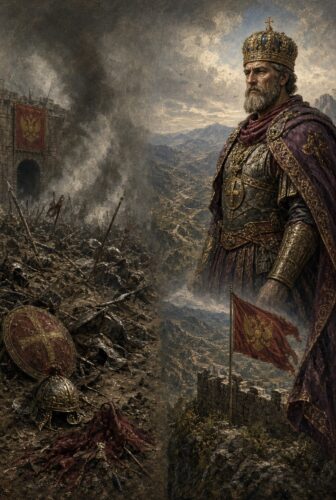
– Basil did not launch an immediate revenge campaign; he spent years rebuilding capability before returning to the same theater. Modern parallel: the urge to “show them” right after a public failure almost always compounds the original error. Benefit today: impose a mandatory cooling and reconstruction interval measured in months, not days, after any serious setback.
The unique plan that turns these points into daily practice is called the **Trajan Gate Protocol**. It is deliberately unlike generic self-help because it treats personal setbacks as operational intelligence failures rather than emotional events, and it forces the user to rebuild systems with the same cold specificity Basil eventually applied to his army.
**Phase 1 – The Night Audit (complete within 72 hours of recognizing a significant personal defeat)**
Write a single continuous document titled with the exact date and the name of the failed campaign. Divide it into four headings only: Logistics (what ran out and when), Rear Security (who or what was supposed to hold the line and what actually happened), Terrain (the specific constrained passage you entered without controlling the heights), and Breakout Assets (the people or resources that actually extracted you). No motivational language allowed. Pure operational after-action. Keep it under two thousand words. This mirrors Leo the Deacon’s eyewitness discipline: record the falling star, the arrows, the lost tent, and the secondary paths without editorializing.
**Phase 2 – The Height Map (next seven days)**
Take the three most important ongoing projects in your life. For each, draw or describe the “pass” you must still cross— the narrow period of maximum vulnerability. Then list the exact high ground you do not yet control (information you lack, relationships not yet tested, reserves not yet built). Assign one concrete action per high-ground item that can be completed in under ninety minutes. Execute those actions before the calendar week ends. The point is not inspiration; it is denying the enemy the heights the way Samuel seized them.
**Phase 3 – The Armenian Contingent Drill (ongoing, tested every thirty days)**
Name your core breakout team. Contact each member with a low-stakes but real request that requires them to act on short notice. Record response time and quality. Rotate one new candidate in and one under-performer out every quarter. This is the opposite of networking; it is the deliberate maintenance of the only unit that got Basil out of the pass alive.
**Phase 4 – The Forced March Calendar (ninety days)**
After the audit and the height map, construct a ninety-day calendar of small, irreversible advances in the same theater where you were defeated. Each advance must be logistically self-contained—no reliance on the forage that failed last time. At the thirty- and sixty-day marks, re-run a compressed version of the Night Audit. The calendar ends only when you can demonstrate that the original failure modes are no longer present. This is the long Basil method: return to the same mountains only after the army has been rebuilt.
The Protocol is unique because it rejects both the therapeutic “process your feelings” model and the hustle-culture “fail faster” model. It treats the personal equivalent of August 17, 986, as a logistics and terrain problem first, a character problem second, and an emotional problem almost not at all. It forces written operational records, physical or diagrammatic mapping of vulnerability, active stress-testing of support systems, and a multi-month reconstruction before re-engagement. No vision boards. No daily affirmations. No public declarations of resilience. Just the same cold sequence that turned a panicked emperor fleeing through the dark into the man who eventually owned the entire theater.
Basil II never forgot the night the baggage burned and the Armenian infantry had to cut him free. He simply refused to let that night remain the last word. On August 17, 986, history handed him a near-fatal education in a mountain pass. The same education remains available, free of charge, to anyone willing to treat their own disasters with the same ruthless specificity. The Gate of Trajan is still there. The only question is whether you walk through it as the young Basil or as the emperor he later became.
Share: