
On a summer morning in the year 1121, in a narrow, wooded valley west of what is now Tbilisi, a king who had spent decades stitching a shattered country back together watched two hundred of his own horsemen ride away from his lines and straight into the camp of an army that outnumbered his by several times. The horsemen claimed they were defecting. The enemy commanders, confident in their overwhelming numbers and the holy war they believed they were waging, not only let them in but gathered around to welcome the prize. Within moments the “deserters” had drawn swords and begun cutting down the very men who had opened the gates of their camp. Chaos followed. A three-hour slaughter ended with the largest Muslim coalition the Caucasus had seen in a generation broken, its leaders wounded or dead, its survivors fleeing for three full days while Georgian cavalry and Kipchak horse-archers hunted them across the hills. Rivers ran thick with corpses. Valleys and cliffs disappeared under the dead. Contemporary chroniclers, Christian and Muslim alike, struggled for language. Georgian sources simply called it the *dzlevay sak’virveli* — the miraculous victory.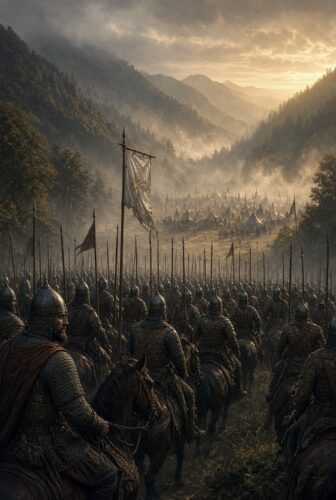
That victory, won on August 12, 1121, at Didgori, did not merely save a kingdom. It inaugurated the medieval Georgian Golden Age, moved the capital to Tbilisi after four centuries of foreign rule, and turned a once-fragmented Christian realm on the edge of the Islamic world into the dominant power of the Caucasus for the better part of a century. The story is almost never told outside Georgia or specialist histories of the Crusades, yet it contains one of the purest demonstrations in military history of how a smaller force, using terrain, deception, absolute commitment, and a carefully prepared strike at leadership, can convert numerical inferiority into total dominance.
### The Kingdom That Should Not Have Been Able to Fight
By the late eleventh century Georgia was a wreck. The Great Seljuk Empire had poured Turkic nomads across the Caucasus. Cities were raided, agricultural land turned into pasture, local lords played off against one another, and the Bagrationi kings ruled little more than a rump state centered on western Georgia. When David IV, later remembered as David the Builder or the Restorer, took the throne in 1089 as a teenager, the situation looked terminal. The capital at Kutaisi was safe only because the mountains and the remaining Georgian forces still held the west. Tbilisi itself, the historic heart of the country, had been under Muslim rule — first Arab, then successive Turkish and local emirs — for roughly four hundred years.
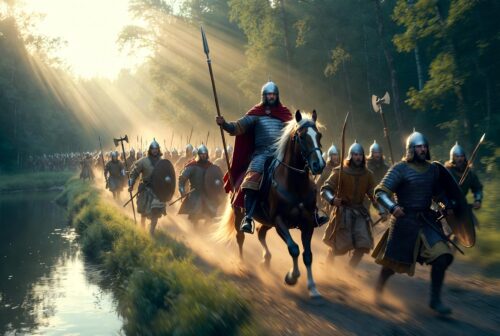
David did not inherit a ready-made army. He built one. He created a standing royal guard, the *Monaspa*, drawn from lesser nobility and paid professionals loyal only to the crown rather than to regional magnates. More dramatically, in 1118 he resettled some forty thousand Kipchak (Cuman) families from the northern steppes. These Turkic nomads had been driven south by the rising power of the Rus’ principalities; David baptized many of them, granted them land, and integrated their superb light cavalry into his forces. He also cultivated ties that brought a small contingent of Frankish knights — veterans or adventurers from the Crusader states — into his service. By 1121 the Georgian army that mustered for the decisive campaign numbered around 55,600 men: roughly 40,000 Georgians (including the elite 5,000 of the Monaspa), 15,000 Kipchaks, 500 Alans from the North Caucasus, and between 100 and 500 Franks depending on the source. It was a hybrid force — heavy Georgian and Frankish cavalry for the shock, Kipchak horse-archers for mobility and pursuit, infantry to hold ground.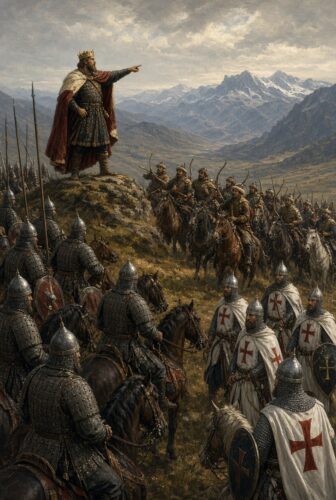
Opposite them stood a coalition assembled by the Seljuk sultan Mahmud II of Baghdad. Muslim merchants in Tbilisi, Ganja, and Dmanisi had complained that David’s growing power was strangling their trade and threatening their cities. The sultan declared a holy war. Command went to Najm al-Din Ilghazi ibn Artuq, the Artuqid ruler of Mardin, a hardened commander who only two years earlier had annihilated a Crusader army at the Field of Blood (Ager Sanguinis) near Antioch. Ilghazi brought vassals and allies: Tughan-Arslan of Arzen and Bidlis, Dubays ibn Sadaqa of al-Hilla, forces from Arran, the Shaddadids, the emirate of Tbilisi itself, and contingents from the Sultanate of Rum. Medieval Christian chroniclers, never shy about exaggeration, claimed the host numbered 400,000, 560,000, even 600,000 or 800,000. Muslim sources are more restrained, some putting the figure as low as 30,000. Modern estimates settle on a force several times larger than David’s — almost certainly over 100,000 and possibly approaching 200,000–250,000 when all the allied contingents are counted. Whatever the exact number, every contemporary agreed the Muslims enjoyed a crushing numerical advantage and expected to crush the upstart Christian king before linking up with the garrison of Tbilisi.
David refused to let that link-up occur. In the early months of 1121 he launched preemptive raids against Seljuk forces in the emirate of Ganja, disrupting the coalition’s timetable. When Ilghazi’s main army finally entered Georgian territory in July, advancing through the traditional invasion corridors from Kars and Erzurum toward Tbilisi, David evacuated the exposed countryside, denying the invaders easy forage, and concentrated his own army. He chose the battlefield with cold precision: the Didgori valley, a mountainous, wooded bottleneck roughly forty kilometers west of Tbilisi, where the terrain itself would cancel the enemy’s numbers.
### The Trap Is Set
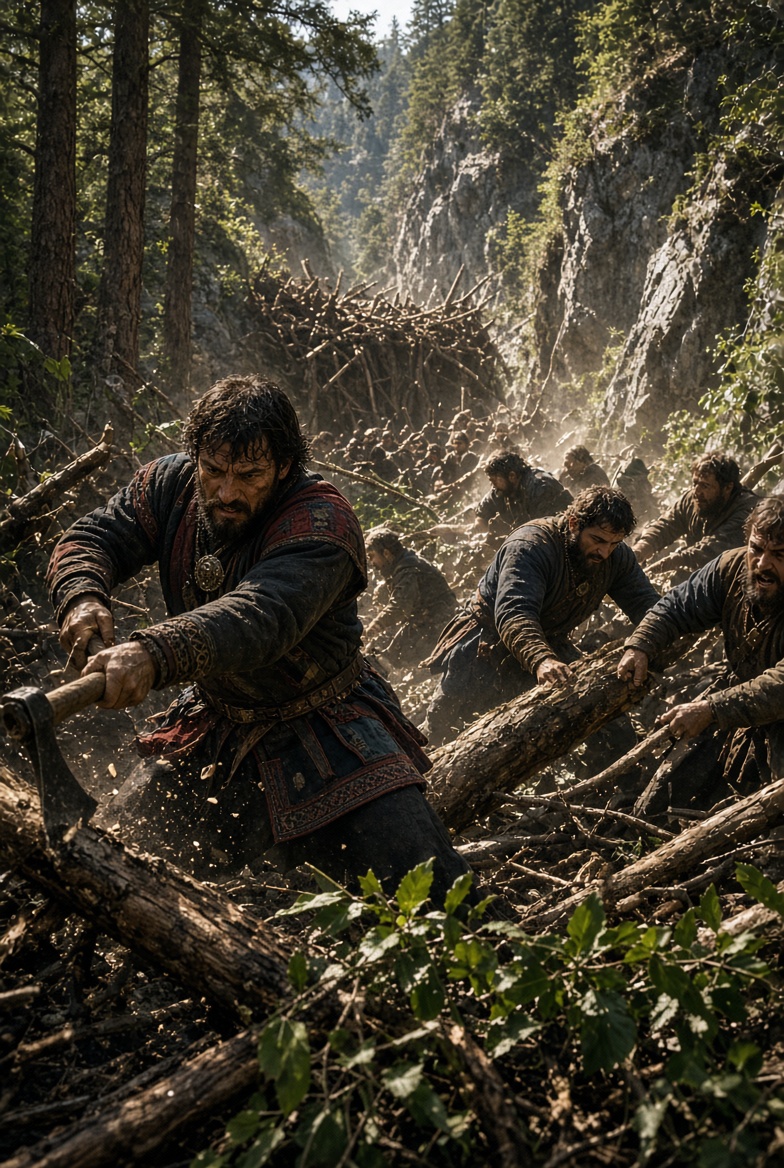
On August 10 the Muslim host encamped on the open ground near Didgori and Manglisi. The next day David moved. He led his army out of Mtskheta along the Nichbisi valley and split it. The larger portion remained under his personal command. A smaller force under his son and heir, Demetrius, took position in the heights, hidden and ready to fall on the enemy flank at a signal. Behind his own troops David ordered the gorge blocked with felled trees and branches. There would be no retreat. The speech he gave his men, preserved by the Frankish chronicler Walter the Chancellor, makes the psychology explicit:
“Soldiers of Christ! If we fight bravely for our Faith, we will defeat not only the devil’s servants, but the devil himself. We will gain the greatest weapon of spiritual warfare when we make a covenant with the Almighty God and vow that we would rather die for His love than escape from the enemy. And if any one of us should wish to retreat, let us take branches and block the entrance to the gorge to prevent this. When the enemy approaches, let us attack fiercely!”
The language is the language of crusading zeal, but the practical effect was simpler: every Georgian soldier understood that the only way out was forward.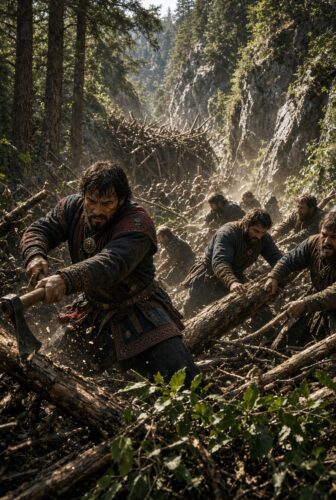
### The Decapitation
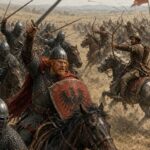
At dawn on August 12 the decisive move unfolded. Approximately two hundred cavalry — sources identify them as Kipchaks or a mixed detachment — rode out from the Georgian lines toward the Muslim camp under a flag of truce or the appearance of defection. Ilghazi’s commanders, perhaps overconfident, perhaps simply greedy for the propaganda value of high-ranking Georgian turncoats, allowed the horsemen into the camp and assembled to receive them. At a prearranged signal the “deserters” drew their weapons and attacked the gathered leaders. Arrows flew; swords flashed. Commanders fell or were wounded in the first chaotic minutes. Ilghazi himself suffered a serious head wound. The carefully ordered Muslim battle array — light archers and cavalry in the vanguard, heavier formations behind — dissolved into confusion before a single major engagement had been fought.
David did not wait. He ordered the general assault. Frankish and Georgian heavy cavalry smashed into the disorganized vanguard. Demetrius’s hidden wing poured down from the heights onto the exposed flank. Kipchak archers closed the rear. What had been a vast, confident army became a milling mass trapped in broken ground. The fighting proper lasted roughly three hours. Then the rout began. Georgian and Kipchak pursuit continued for three days. Chroniclers describe rivers choked with bodies and valleys carpeted with the dead. Matthew of Edessa wrote of a “terrible and savage slaughter” that filled rivers and covered cliffs. The entire enemy camp — tents, siege engines intended for Tbilisi, pack animals, treasure — fell into Georgian hands. Ilghazi escaped wounded. Many of his subordinate emirs did not.
### Aftermath and the Golden Age
The strategic consequences arrived almost immediately. With the field army destroyed, Tbilisi could no longer be reinforced. In 1122 David laid siege to the city, took it, and transferred the royal capital there from Kutaisi. The last major Muslim enclave in the Georgian heartland was gone. Over the remaining years of his reign David pushed outward: Dmanisi fell, Armenian territories were brought under protection or direct control, Shirvan was reduced to tributary status. By the time of his death in 1125 Georgia stretched from the Black Sea toward the Caspian and exercised influence deep into the highlands of the North Caucasus and eastern Anatolia. The cultural flowering that followed — architecture, literature, manuscript illumination, the great monasteries and academies — rested on the security and resources secured at Didgori.
David’s personal style after the victory is worth noting. Arab sources record that he abolished certain taxes for the Muslim and Jewish populations of Tbilisi, protected Sufis and scholars, and allowed the public call to prayer. The same king who had ordered a gorge blocked so his own men could not flee also understood that a multi-confessional capital required pragmatic tolerance if it was to function as an imperial center rather than a temporary prize of war.
Georgian memory never treated the battle as ordinary. Annual commemorations at the Didgori monument continue to this day. The chronicles place it alongside the great deeds of classical and biblical heroes and declare the comparison inadequate. For a small Christian kingdom on the fault line between empires, August 12, 1121, was the day the balance of power permanently shifted.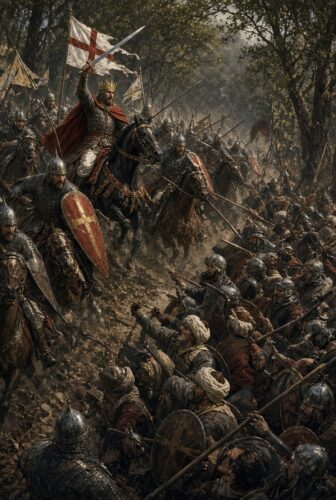
### Applying the Outcome: The Didgori Decapitation Protocol
The historical facts above occupy the overwhelming bulk of this account because the event itself is the point. Yet the mechanism that produced the result — choosing constricted terrain, eliminating the enemy’s command cohesion with a small, deniable strike that looked like surrender, blocking every private exit so that the only available energy flowed forward, and then committing the full force into the resulting vacuum — translates with uncomfortable clarity into the problems that confront an individual life when the pressures arrayed against it appear numerically or institutionally overwhelming.
Most modern advice urges incrementalism, self-care, or reframing. The Didgori method is different. It treats the overloaded situation as a hostile coalition that must be forced into a narrow space where its size becomes a liability, then struck at the point of decision before it can organize.
Here is the concrete, non-generic sequence:
– Identify the single constricted “valley” in your current circumstances where the opposing forces (deadlines, competing demands, institutional inertia, financial pressure, relational chaos) are forced to bunch up and lose their ability to maneuver. This is not the place of greatest comfort; it is the place of greatest friction that you can still control the entrances to. Map every resource you still command and every exit you still possess. Then deliberately close the exits that allow partial withdrawal or endless delay. Publicly or irreversibly commit the equivalent of felling the trees behind you so that the only remaining direction is through the problem.
– Assemble a small “deserter” detachment — a limited set of actions or communications that appear to the opposing forces as concession, compliance, or even quiet surrender. These must be real enough to be admitted into the center of the opposing structure (a meeting, a negotiation, a workflow, a family dynamic, a bureaucratic process). Once inside, the detachment’s only job is to disrupt coordination and decision-making at the precise moment the larger force is committed. This is not sabotage for its own sake; it is the creation of a brief window of leadership vacuum.
– The instant that vacuum appears, commit the main body without hesitation. The historical battle lasted three hours because the Georgians did not pause to congratulate themselves on the success of the ruse. Hesitation after the initial strike allows the larger force to re-form. Speed and totality of commitment convert temporary confusion into permanent rout.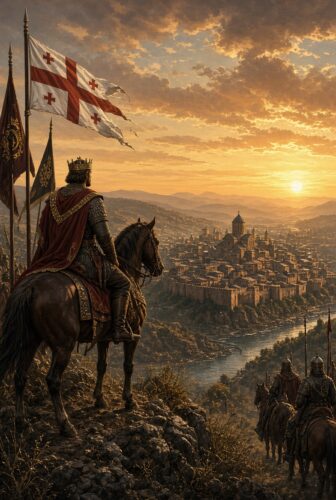
– Pursue the broken elements for the equivalent of three days. Partial victories that leave coherent remnants of the old pressure simply allow them to regroup. The Georgian pursuit prevented any coherent counter-concentration; the modern equivalent is the systematic elimination of residual obligations, half-resolved conflicts, or lingering sources of the original overload until the field is actually clear.
– Once the field is clear, move the capital. David did not remain in the western stronghold that had sheltered him during the hard years; he transferred the center of gravity to the newly secured heartland. After a genuine clearing of overwhelming pressure, the practical next step is to relocate energy, attention, and identity to the newly opened space rather than returning to the old defensive posture.
This sequence is not a mindset exercise. It is a tactical template extracted from a specific August morning in 1121. It assumes the pressures are real, the numbers unfavorable, and the only reliable advantage available is the ability to choose the ground, strike the decision-makers first, and remove every private escape hatch that would otherwise dissipate force. Most people faced with overload either disperse their energy across the entire front or attempt to negotiate from a position of acknowledged weakness. The Didgori method does neither. It forces the larger problem into a gorge of its own making and then walks two hundred carefully prepared “traitors” through the front gate.
The chroniclers called the result a miracle. The topography, the deception, the blocked gorge, and the three-hour commitment suggest something more practical and more transferable: a smaller force that refuses every form of partial engagement can, on the right ground and with the right first strike, leave an empire in pieces and claim the high ground that follows.
Share: