
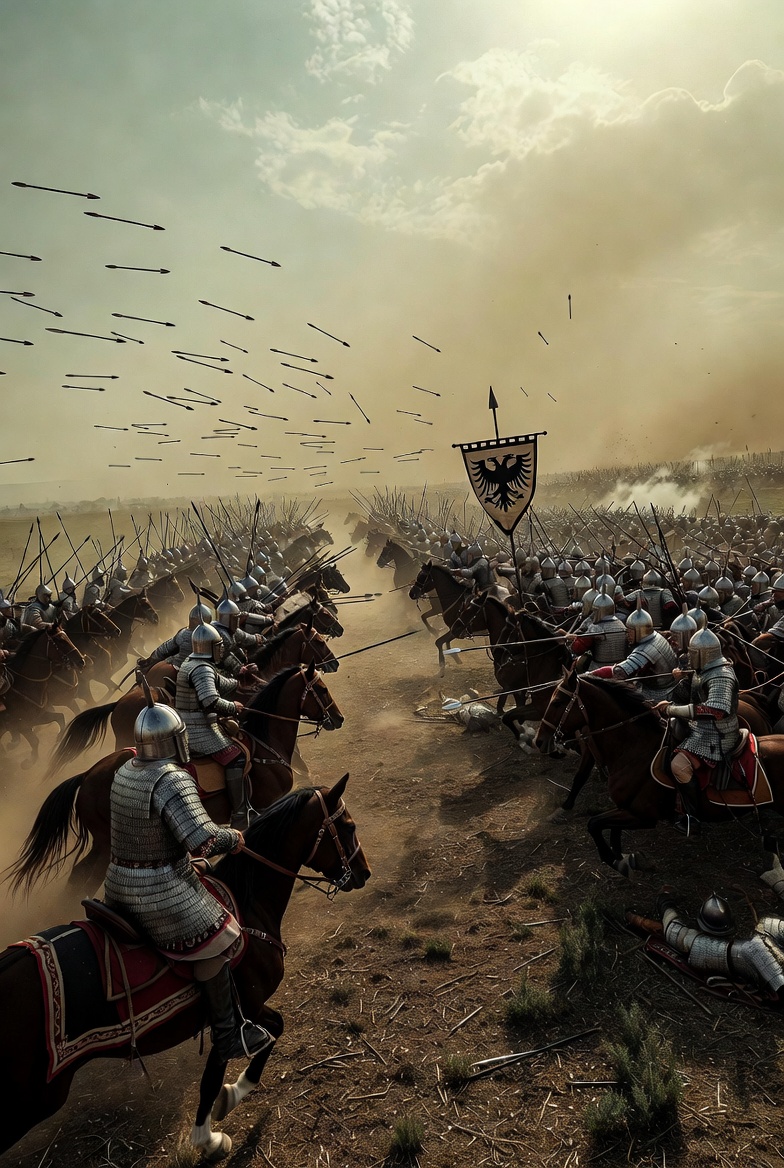
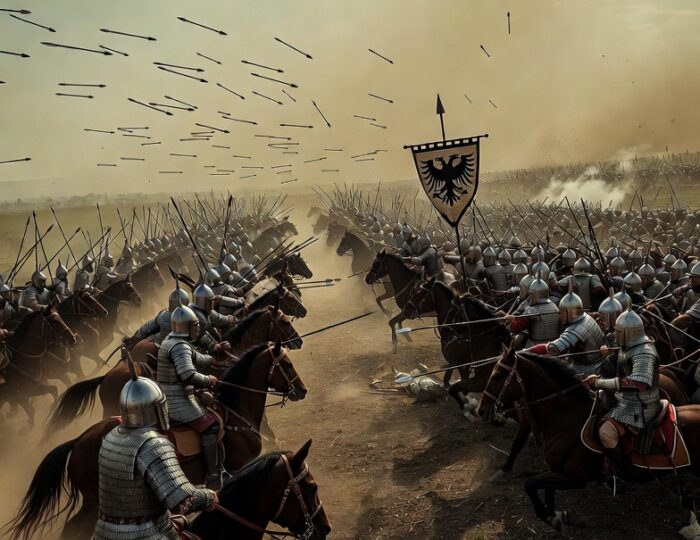
On a hot July day in 1302, in a place most modern maps cannot even pinpoint with certainty, a few thousand horsemen who still smelled of goat and woodsmoke did something that would echo for centuries. They broke a Byzantine field army on the plain the Greeks called Bapheus, near the fortress the Turks would remember as Koyunhisar. The date was exact: 27 July. The Byzantine chronicler George Pachymeres, writing while the dust was still settling in living memory, recorded the day and the month with unusual precision. That single afternoon is the moment a frontier warlord named Osman stepped out of the category of “troublesome raider” and into the category of “founder.”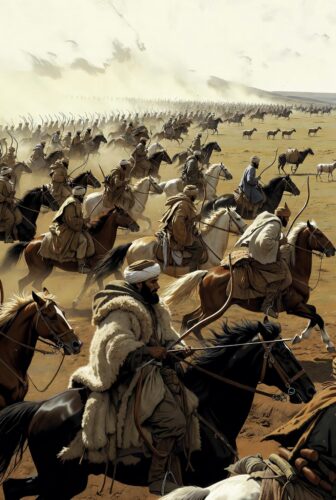
To understand why a victory by five thousand light cavalry over two thousand mixed troops matters so much, you have to rewind the tape of Byzantine decline. After the Fourth Crusade shattered the empire in 1204, the restored Palaiologan state never recovered its old muscle in Asia Minor. The Mongol storm had smashed the Seljuk Sultanate of Rum; the fragments that remained were small Turkish beyliks, each jostling for pasture, plunder, and prestige along the Byzantine frontier. One of those fragments clustered around Söğüt and the highlands south of the Sangarios River. Its leader, Osman, son of Ertuğrul, had been conducting ever-deeper raids into Bithynia for the better part of two decades. By 1301 those raids had become systematic. Turkish bands blocked the harvest around Nicomedia, starved the city of grain, and forced the population to watch their fields burn while the imperial garrisons sat behind walls.
Co-Emperor Michael IX tried to reverse the tide in the spring of 1302. He marched south with a sizable force as far as Magnesia. The Turks refused open battle, melted into the hills, and waited. Local Byzantine troops began to peel away to protect their own villages. The Alan mercenaries, recently hired and never fully integrated, decided their families in Thrace needed them more than the emperor did. Michael’s army simply dissolved without a major fight. He was forced to withdraw by sea, trailing columns of refugees. The countryside of Bithynia was left essentially undefended.
Andronikos II, the senior emperor, scrambled to plug the gap. He ordered the megas hetaireiarches Georgios Mouzalon to cross the Bosporus with roughly two thousand men—half of them those same unreliable Alans, the rest a mixture of regulars and local levies—and relieve Nicomedia. The force was not large, but it was the best the empire could scrape together on short notice. Mouzalon advanced toward the city. Osman, who had been operating near Nicaea, received word of the movement. He gathered his own riders and called in allies from Paphlagonia and the Maeander valley. By the time the two forces met on the plain of Bapheus on 27 July, Osman commanded something like five thousand light cavalry.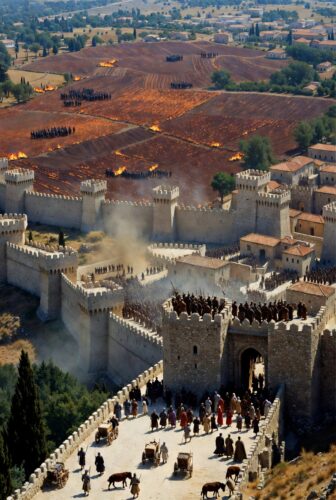
What followed was classic steppe tactics against a force that still thought in terms of heavy infantry and close-order discipline. The Turkish horsemen did not form a static line. They charged, poured arrows, wheeled, and charged again. The Alan contingent, for reasons that remain murky—perhaps delayed orders, perhaps simple unwillingness—did not engage properly. The Byzantine formation cracked. Mouzalon managed to fall back into Nicomedia under the partial cover of the Alans, but the field was lost. Casualties on the imperial side were heavy enough that the survivors never again attempted to contest the open country in force.
The immediate consequences were brutal and practical. The Byzantines abandoned the countryside and withdrew into their fortresses—Nicaea, Prusa, Nicomedia, and a handful of lesser castles. Those fortresses, now isolated, could no longer support one another or draw food from the surrounding land. Osman moved quickly. He took the castle of Koyunhisar itself and the coastal town of Gemlik. Turkish ghazis from farther east, hearing that the great empire’s field army had been beaten by a frontier beylik, began to pour into Bithynia looking for shares of the spoils. Pachymeres recorded the psychological shock: threats now reached the gates of Constantinople itself; Turks wandered in small groups on the European side of the Straits; not a day passed without news of another coastal fortress attacked or another village emptied.
Demographically the change was just as sharp. Christian peasants and townsmen who could flee did so, streaming toward the safer European provinces. The land they left behind filled with Turkish pastoralists and warriors. Within a generation the major cities of Bithynia would fall one by one: Prusa (Bursa) in 1326, Nicaea in 1331, Nicomedia in 1337. The process that began on the plain of Bapheus ended with the permanent loss of Asia Minor to the empire that still called itself Roman.
Historians still argue about whether 27 July 1302 should be treated as the formal foundation date of the Ottoman state. Some prefer 1299. Halil İnalcık, among others, argued that Bapheus was the moment the Ottomans acquired the characteristics of a true state: the ability to attract large numbers of independent warriors, the prestige to dictate terms on the frontier, and the territorial base that made further expansion inevitable. What is beyond dispute is that after Bapheus the trajectory changed. A local beylik had proved it could defeat an imperial army in the open. From that day forward every ambitious ghazi in western Anatolia had a clear destination for his ambitions.
The battle itself was not a grand set-piece of tens of thousands. It was a relatively modest clash on a dusty plain whose exact coordinates are still debated. Yet its effects were outsized precisely because it occurred at the precise moment when Byzantine strength in Asia Minor had already thinned to the breaking point. Osman did not invent the weakness; he recognized it, concentrated his mobile force against it, and then exploited the vacuum that followed. The fortresses remained for years, but without the countryside they were dead men walking. The empire that had once ruled from the Danube to the Euphrates now watched its last Asian foothold dissolve because a band of horsemen refused to let the harvest be gathered and then broke the relief column that tried to stop them.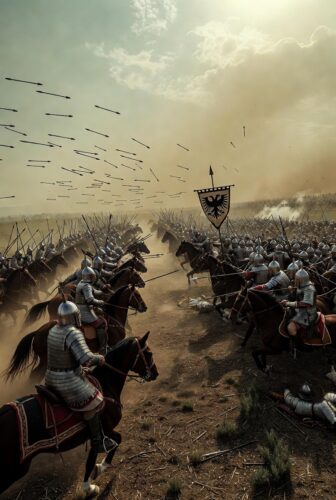
That is the historical core. A frontier leader with superior mobility, better intelligence, and the willingness to fight in the open against a heavier but slower and less cohesive opponent won a victory that permanently altered the balance of power in western Anatolia. The long-term result was the rise of a state that would, two centuries later, plant its banners on the walls of Constantinople itself.
Now the application—because the past is only useful if it hands you a working tool instead of a museum plaque.
The lesson of Bapheus is not “be bold” or “think positive.” Those slogans are wallpaper. The actual mechanism was more specific: identify the territory your opponent cannot defend without the open country, deny that open country systematically, force the opponent into isolated strongholds, then break the one relief force that still tries to operate in the field. After the break, the strongholds fall of their own accord because they can no longer feed themselves or reinforce one another. Allies and opportunists then arrive on their own because success is magnetic.
Translate that into an individual life and you get a protocol that looks nothing like the usual productivity advice.
**The Bapheus Open-Country Sweep**
– Map every recurring obligation, habit, or drain that functions like a Byzantine fortress: solid-looking, expensive to maintain, but completely dependent on the surrounding “countryside” of free time, attention, money, or energy. These are the things that appear secure only because nothing is currently attacking the fields around them.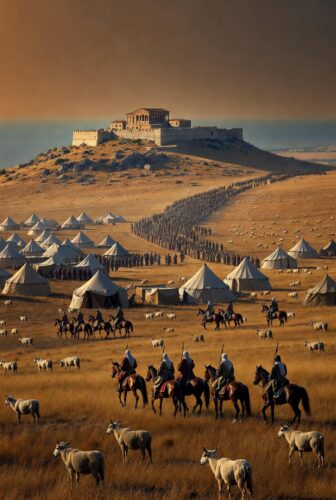
– For thirty consecutive days, refuse to let any of those fortresses collect their harvest. That means zero negotiation, zero “just this once.” If a fortress requires your evening attention, the evening is closed. If it requires discretionary spending, the money is already allocated elsewhere. If it requires emotional bandwidth, the bandwidth is already committed to a single priority. You are not attacking the walls yet. You are simply making sure no food reaches them.
– At the same time, assemble your own light cavalry: the smallest set of high-mobility actions that can be executed daily without heavy equipment or long preparation. These are not ambitious projects. They are short, repeatable, and capable of appearing anywhere on short notice—writing three hundred words, lifting for twenty minutes, making one outbound call, reviewing one set of numbers. Keep the force light so it can move.
– On a single designated day (your personal 27 July), concentrate every available unit of that light force against the one relief column your fortresses still send out. The relief column is the weekly or monthly ritual that keeps the fortresses supplied— the planning meeting, the shopping trip, the check-in call, the “I deserve this” purchase. Break that one coordinated attempt. Do not fight every fortress at once. Break the field army that tries to keep them alive.
– After the break, do nothing dramatic for two weeks. Simply continue denying the countryside. Watch which fortresses begin to starve. Some will surrender quietly. Others will demand negotiation. Offer none. The ones that matter least will empty first; the population (your time and attention) will migrate toward the territory you now control.
– The moment the first fortress falls or is abandoned, publicize the result in the smallest possible way—tell one person, record one metric, post one private note. Success on the frontier attracts ghazis. Other people, other opportunities, and other reserves of energy begin to arrive once it is clear the old regime can no longer protect its fields.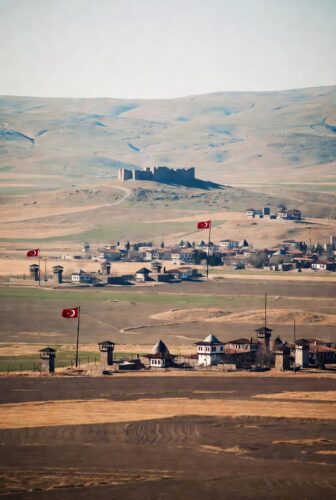
This is not a thirty-day challenge followed by a return to normal. It is a permanent shift in how territory is held. Once the open country is yours, the remaining fortresses are no longer strategic problems; they are administrative cleanup. The empire you inherit is the one that used to belong to the habits and obligations that could only survive while the countryside remained uncontested.
Osman did not storm Constantinople in 1302. He simply made sure the empire could no longer feed its Asian garrisons, then broke the only army still willing to march in the open. The rest followed with the slow inevitability of a harvest that never comes. The same sequence, applied without sentimentality to the fortresses of your own daily life, produces the same result: the territory that once belonged to inertia becomes the base from which everything else is built.
Share: