
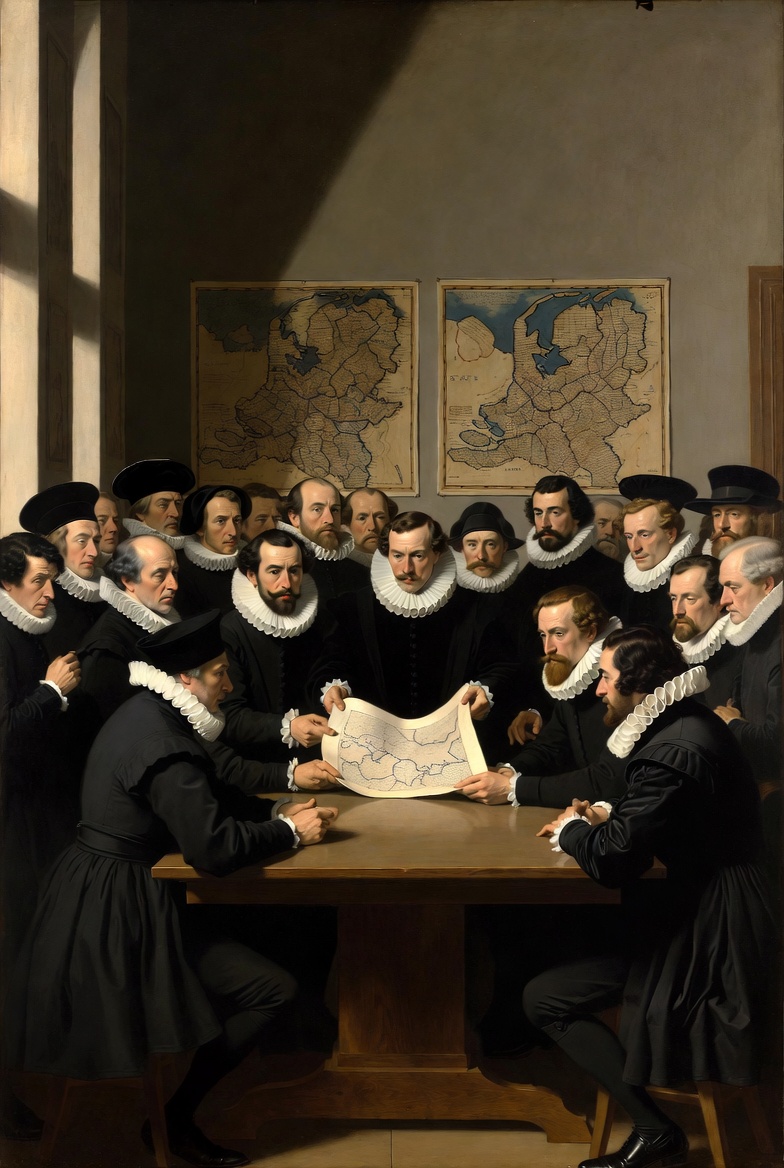
On a warm summer day in The Hague, July 26, 1581, a group of provincial delegates did something almost no one in Europe had done with this much paperwork and this little apology. They formally declared that their sovereign, Philip II of Spain, had forfeited every claim to rule them. Not because they were restless subjects looking for a better boss. Because, they insisted, *he* had already abandoned *them*.
They called the document the *Plakkaat van Verlatinghe*—the Placard of Desertion, or Act of Abjuration. In plain language it was a legal and moral eviction notice served on a king. The States General of the northern Netherlands announced that Philip had broken the ancient contract between prince and people so thoroughly that his authority simply evaporated. Magistrates were released from their oaths. His name and seal were banned from official business. Coins would no longer carry his arms. The throne, they said, stood vacant by his own failure.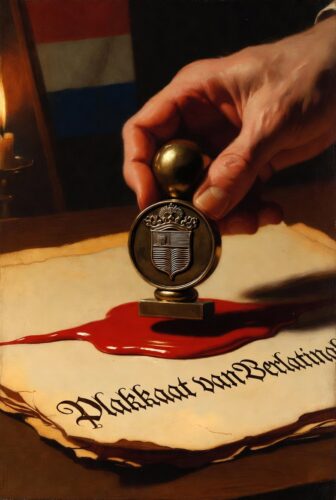
It was not a spontaneous riot. It was the culmination of thirteen years of war, massacre, tax rebellion, religious fury, and exhausted negotiation. And it remains one of the clearest early modern statements that a ruler’s legitimacy is not a birthright that survives every abuse. It is a conditional trust. When the trust is shattered, the people may, with deliberate ceremony, walk away.
### The Long Road to the Hague
The Seventeen Provinces of the Low Countries had never been a tidy nation-state. They were a patchwork of duchies, counties, and lordships—Brabant, Flanders, Holland, Zeeland, Utrecht, Guelders, and the rest—held together by the personal authority of the Habsburg rulers. Charles V, born in Ghent, had understood the local privileges and the stubborn particularism of the towns. His son Philip II, raised in Spain and more comfortable with Castilian absolutism, did not.
Philip inherited the provinces in 1555. He also inherited a mountain of debt from his father’s wars, a restless nobility, and a growing Protestant movement that his Spanish conscience could not tolerate. The Spanish Inquisition’s methods arrived with Spanish troops. The “Council of Troubles,” later nicknamed the Council of Blood by the Dutch, executed nobles and commoners alike. The Duke of Alba’s regime between 1567 and 1573 became a byword for systematic terror. Towns were sacked. Trade collapsed. Refugees flooded into the northern provinces and across the Channel.
The revolt that began in 1568 under William of Orange (William the Silent) was at first careful to maintain a legal fiction. The rebels claimed they were fighting the king’s evil counselors, not the king himself. Loyalty to the natural prince remained a useful political language even as Spanish armies burned their way through the countryside. That fiction frayed after the Pacification of Ghent in 1576, when the provinces briefly united against the mutinous Spanish soldiery who had just sacked Antwerp in the “Spanish Fury.” It frayed further when the southern provinces drifted back toward reconciliation with Spain under the Union of Arras in 1579, while the northern provinces answered with the Union of Utrecht—a defensive alliance that would become the constitutional skeleton of the future Dutch Republic.
By 1580 Philip had placed a massive bounty on William’s head and declared him an outlaw. The States General, meeting amid continuing war, began to confront the obvious: as long as they still acknowledged Philip as their lord, every act of resistance remained, in legal theory, treason. They needed a clean break.
On June 14, 1581, the States General resolved that the throne was vacant. Four men—Andries Hessels, Jacques Tayaert, Jacob Valcke, and Pieter van Dieven—were tasked with drafting the formal justification. Jan van Asseliers, the experienced audiencier of the States General, shaped the final text. On July 22 the decision was confirmed in Antwerp. Four days later, in The Hague, the Act was signed and sealed.
### What the Document Actually Said
The Act opens with a principle that still startles modern readers for its clarity. A prince is appointed by God to protect his subjects “as a shepherd his sheep.” The subjects are not created for the prince’s pleasure, to obey every command just or unjust. When a prince ceases to protect and instead oppresses, seizes ancient privileges, and treats free people as slaves, he ceases to be a prince and becomes a tyrant. The subjects may then lawfully refuse his authority and choose another protector.
The list of grievances that follows is long, specific, and bitter. Philip had introduced foreign troops and foreign officials who ignored local charters. He had levied taxes without consent. He had allowed the Inquisition to override traditional legal safeguards. He had ignored petitions and broken solemn promises. The provinces had begged for relief; the answer had been more soldiers and more executions. Therefore, the Act declared, Philip had “forfeited, ipso jure,” every hereditary right to sovereignty over these lands.
The practical clauses were equally blunt. No magistrate could continue to exercise office in Philip’s name. New commissions would be issued by the provincial States. Coins and seals would change. Anyone continuing to recognize Philip’s authority would be treated as an enemy of the common cause.
The language is deliberately conservative in tone even while radical in effect. The authors wrapped revolution in the vocabulary of ancient rights and natural law. They did not claim a new theory of popular sovereignty so much as insist that the old mutual obligations had been unilaterally destroyed by the king. Philip, not the Dutch, had walked away first. The placard merely recorded the desertion.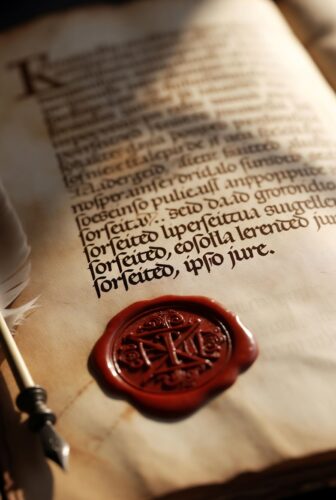
### Aftermath: Finding a New Boss Who Wouldn’t Stay, Then Realizing They Didn’t Need One
Immediate results were messy. Many magistrates simply resigned rather than swear new oaths. The States offered the sovereignty of most provinces to Francis, Duke of Anjou, brother of the French king, hoping a Catholic prince of royal blood would bring French military help and international respectability. Anjou accepted, arrived with ceremony, and then tried to seize power by force in the “French Fury” of 1583. The citizens of Antwerp and other cities threw him out. He left in humiliation and died soon after.
William of Orange was the obvious alternative, but Spanish agents finally succeeded in assassinating him in 1584. Offers to Queen Elizabeth of England produced only limited and conditional aid. By 1587 the States of Holland, guided by the jurist François Vranck, simply declared that sovereignty already resided in the States themselves. The United Provinces became a republic in practice long before any formal christening.
What followed is one of history’s more spectacular underdog stories. The small, flood-prone, religiously fractious northern Netherlands fought the greatest military power in Europe to a standstill, then to a truce, and finally to recognition. In the process they built the first modern stock exchange, pioneered global joint-stock companies, dominated Baltic and Asian trade, produced a golden age of painting and science, and offered relative tolerance to Jews, Protestants of various stripes, and even Catholics who kept their heads down. Amsterdam became a magnet for capital and talent precisely because the political order no longer depended on the whims of a distant absolutist.
The Act itself traveled. Its insistence that a ruler who becomes a tyrant may be set aside echoed in the English debates of the seventeenth century and, most famously, in the American Declaration of Independence nearly two centuries later. Jefferson and his colleagues did not copy the Dutch text line for line, but the structural similarity—long bill of grievances followed by a solemn declaration that the bond is dissolved—is hard to miss. The Dutch had already performed the intellectual and legal experiment of saying, in public and in writing, that legitimacy can expire.
### The Peculiar Humor of It All
There is something darkly comic in the whole episode. The rebels spent years pretending they still loved the king while fighting his armies. When they finally told the truth, they framed it as the king having left *them*. They then spent several more years shopping for a replacement monarch like people who have just divorced and immediately start interviewing new spouses, only to discover that the available candidates were either useless, treacherous, or both. Eventually they looked around the room, realized the furniture was still standing, and decided the house could run without a permanent landlord.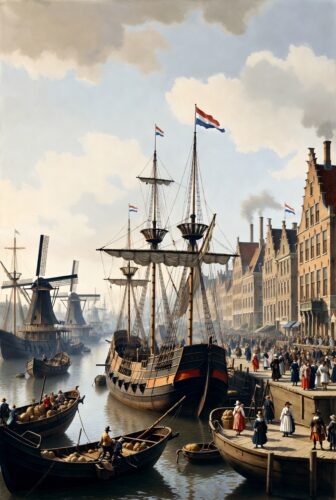
Philip, for his part, never recognized the Act. He continued to style himself lord of the Low Countries until his death. Reality, as usual, declined to consult the Spanish chancery.
### Why This Matters Beyond the Seventeenth Century
The outcome of July 26, 1581, was not merely the birth of a republic. It was a public demonstration that a political relationship built on protection and mutual obligation can be declared void when one side systematically violates the terms. The Dutch did not invent the idea. They gave it ceremonial form, legal language, and enough staying power that the experiment survived decades of war and produced a functioning commercial society.
That principle travels farther than national independence. Every person lives inside systems, habits, relationships, and internal authorities that claim the right to direct behavior. Some of those authorities protect and enable. Others tax, restrict, and punish while delivering diminishing returns. The Act of Abjuration is a historical proof that it is possible, after careful inventory of grievances, to serve formal notice that the old arrangement is over.
### The Abjuration Protocol: A Personal Operating Manual Drawn Straight from 1581
Most self-help advice tells you to “set boundaries” or “choose yourself.” That language is soft and easily ignored. The Dutch method was colder and more procedural. They listed specific broken promises, declared the contract void by the other party’s action, banned the old symbols, and installed new administrative habits. You can do the same with the quiet tyrannies that currently govern your days.
Here is the protocol, stripped of modern motivational fluff and built only from the historical sequence.
– **Conduct the Grievance Audit (the “Council of Troubles” inventory).** For seven consecutive days, keep a private list of every instance in which a habit, obligation, relationship pattern, or internal rule extracted energy, time, or peace while delivering no corresponding protection or growth. Be as specific as the Dutch were about taxes and foreign garrisons. “I scroll for forty minutes every night and wake up more tired” is a valid entry. “I say yes to every request and then resent the people I helped” is another. Do not editorialize yet. Just record the facts the way a clerk records seizures of property.
– **Draft the Personal Placard.** On a single sheet of paper—physical paper, not a notes app—write a short formal statement. Begin with the principle: this particular authority (name it: the procrastination loop, the people-pleasing reflex, the debt-cycle thinking, the perfectionism that prevents finishing) was supposed to serve a protective function. It has instead become extractive. List three to five concrete breaches drawn from your audit. Conclude with the operative sentence: “Therefore this authority has forfeited its claim to direct my choices. I no longer recognize its commissions.” Sign and date it July-style, even if the calendar says otherwise. The physical act of signing matters. The Dutch sealed theirs.
– **Ban the Old Symbols.** Identify the small environmental cues that keep the old authority alive—specific apps, certain chairs where the bad habit occurs, particular phrases you use to excuse it. Remove or alter three of them within forty-eight hours of signing the placard. The Dutch stopped minting coins with Philip’s arms. You stop opening the browser tab that always leads to the same wasted hour.
– **Issue New Commissions.** The States did not leave a power vacuum. They authorized provincial bodies to appoint new magistrates. Immediately after the placard, assign three concrete, time-bound actions that the old authority used to block. Make them embarrassingly small and non-negotiable for the first fourteen days. The point is not dramatic transformation. The point is to demonstrate, to yourself, that the new administration is already functioning.
– **Refuse the Anjou Temptation.** After any declaration of independence, the mind will scramble for a glamorous replacement authority—a new guru, a perfect system, a sudden life overhaul that solves everything. The Dutch tried that and got the French Fury. For thirty days after your placard, accept no new overarching ideology or program. Govern only by the specific commissions you have already issued. Stability first. Grand theories later, if ever.
– **Hold the States General Review.** Every Sunday for the next eight weeks, spend twenty minutes reviewing the placard and the week’s commissions. Note where the old authority tried to reassert itself and how the new administration responded. Adjust only the practical details. Do not rewrite the fundamental declaration. The original Act was not amended every time Spanish troops won a skirmish.
This protocol is deliberately bureaucratic because the historical event was bureaucratic. Emotion alone did not free the Netherlands. Procedure did. The same is true for personal systems that have outlived their usefulness. You do not need to feel ready. You need a dated document, a short list of forfeited claims, and a handful of new standing orders that you actually obey.
The sheep in 1581 did not wait for the shepherd to apologize. They noticed he had stopped protecting the flock, recorded the evidence, and walked. Four and a half centuries later the paperwork still works.
Share: