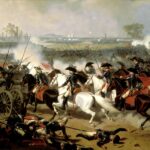

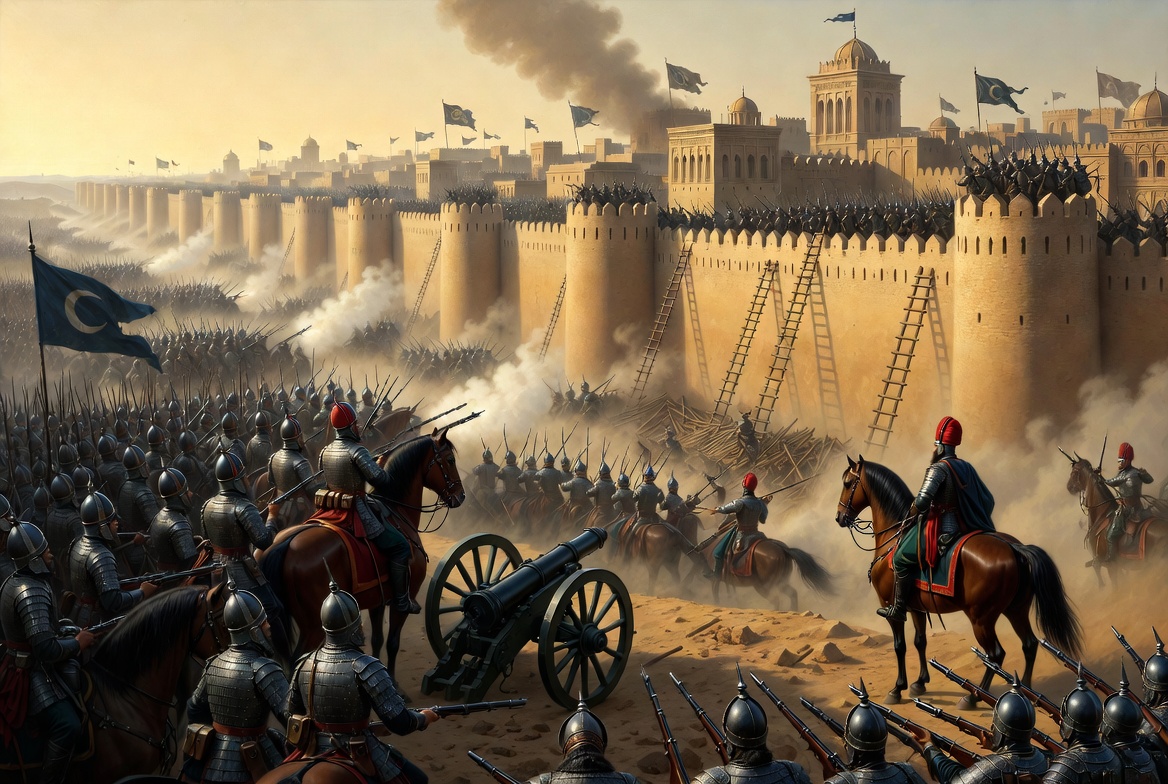
On May 17, 1639, in the arid frontier town of Qasr-e Shirin (also called Zuhab), nestled in the rugged hills of what is now western Iran near the Ottoman borderlands, two weary empires put their seals to a document that ended over a century of bloody, intermittent warfare. The Treaty of Zuhab, or Treaty of Qasr-e Shirin, was no grand Versailles-style spectacle with chandeliers and orchestras. It was a pragmatic, hard-won accord signed amid dust, fatigue, and the lingering smoke of sieges, formalizing the division of territories between the mighty Ottoman Empire under Sultan Murad IV and the Safavid Empire of Persia under Shah Safi. This wasn't distant history in the abstract. It was the culmination of the Ottoman–Safavid War of 1623–1639, itself part of a longer rivalry stretching back to the early 1500s. The treaty confirmed Ottoman control over Mesopotamia (including the prized city of Baghdad, recaptured in 1638), much of western Armenia and Georgia, while leaving eastern Armenia, parts of the Caucasus, and eastern Georgia largely in Safavid hands. The border it etched—running roughly through the Zagros Mountains and Kurdish territories—remained one of the most enduring frontiers in the world, influencing the modern shapes of Turkey, Iran, Iraq, and beyond with astonishing stability for centuries.To understand why this obscure signing on May 17 matters, we must plunge deep into the world of 17th-century West Asia. The Ottomans and Safavids were not just rival powers; they represented clashing civilizations. The Ottomans, Sunni Muslims ruling a vast, multi-ethnic empire from Istanbul, saw themselves as the defenders of orthodox Islam and heirs to Roman and Byzantine grandeur. The Safavids, who had established Twelver Shia Islam as the state religion of Persia in the early 1500s under Shah Ismail I, positioned themselves as a bulwark against Sunni dominance, fostering a distinct Persian cultural and religious identity. Religious schism fueled the fire, but the real sparks were territorial and strategic. Control of Baghdad meant control of trade routes linking the Persian Gulf to the Mediterranean, access to fertile Mesopotamian farmlands, and prestige as guardians of holy sites. The Caucasus offered mountain passes for armies, silk roads, and buffer zones against steppe nomads. For over 100 years, from the Battle of Chaldiran in 1514 onward, the two empires clashed in a series of wars that drained treasuries, devastated populations, and redrew maps with every campaign. By the 1620s, the pendulum swung. Shah Abbas the Great of the Safavids had modernized his army with European advisors, recaptured Baghdad in 1623, and expanded Safavid influence. But Ottoman resilience under Murad IV— a formidable sultan who personally led campaigns, reformed the Janissary corps, and crushed internal rebellions—turned the tide. In 1638, Ottoman forces besieged and stormed Baghdad after a grueling campaign. The city fell, and the Safavids, exhausted by plague, economic strain, and internal court intrigues under the weaker Shah Safi, sued for peace. Negotiations dragged on into 1639. Envoys met in the border region around Qasr-e Shirin, a strategic fortress town symbolizing the contested zone. The treaty text was concise but profound: it largely reaffirmed the earlier Peace of Amasya from 1555 but with updated realities. Ottomans kept Baghdad, Basra, and most of Iraq; Safavids retained key Caucasian holdings. Kurdistan was effectively split, with tribes and territories divided vertically—a division whose echoes still complicate modern politics. No massive reparations, no humiliating clauses—just a mutual recognition that endless war served neither side when European powers like the Habsburgs and emerging Russia loomed.
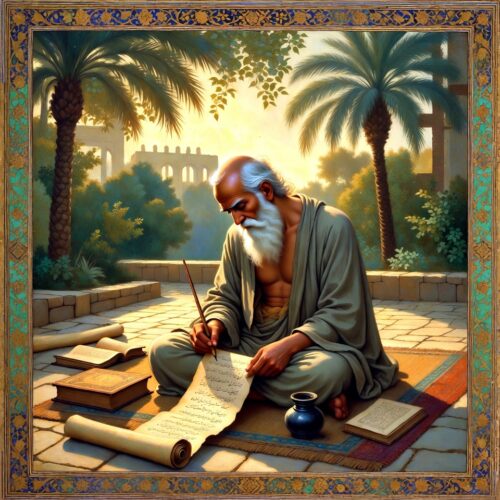
The signing on May 17 wasn't flashy. Chroniclers describe envoys exchanging gifts, swearing oaths on the Quran, and sealing documents with intricate tughras (calligraphic signatures). Yet its impact was seismic. It ushered in nearly a century of relative border stability, allowing both empires to focus inward: Ottomans on European fronts and internal reforms, Safavids on cultural flourishing in Isfahan. The frontier it defined survived into the 20th century with minor tweaks, shaping everything from the Sykes-Picot Agreement's aftermath to today's Iran-Turkey relations. Historians debate if it was truly "foundational" or a mythologized pause, but its endurance is undeniable. Wars flared later (1730s, 19th century), yet the core line held longer than most European borders. Zoom out, and May 17, 1639, exemplifies a pivotal truth of distant history: grand conflicts often resolve not in decisive battlefield glory but in quiet diplomatic exhaustion. The treaty prevented total collapse for either empire at a time when gunpowder empires faced new threats from the West. It preserved Persian Shia identity and Ottoman Sunni hegemony, allowing cultural golden ages to unfold. Safavid art, architecture (think the mosques of Isfahan), and poetry thrived in the peace; Ottoman administration stabilized trade across the Balkans to Arabia. The human cost leading to it was staggering. Tens of thousands died in sieges—Baghdad's fall in 1638 alone involved famine, disease, and massacre. Armies marched across scorched earth, Kurdish and Armenian populations were caught in the crossfire, and economies buckled under taxation for endless campaigns. Yet from that suffering emerged a pragmatic boundary that outlasted kings and shahs. Borders, like personal boundaries, are forged in fire but endure through deliberate lines on maps—and in minds. ### Echoes in Strategy, Endurance, and the Art of the Calculated Pause Delve deeper into the military innovations that made the treaty possible. Ottoman forces under Murad IV employed disciplined infantry, artillery trains, and logistics that outmatched earlier Safavid cavalry-heavy tactics. Shah Abbas had introduced gunpowder reforms, but successors faltered. The war highlighted the shift from medieval feudal levies to professional armies—a lesson Europe absorbed as the Thirty Years' War raged simultaneously. Diplomatic nuance shines too. Neither side sought total victory; mutual exhaustion bred realism. Safavid envoys conceded Iraq to preserve the heartland; Ottomans accepted Caucasian limits to avoid overextension. This wasn't weakness—it was strategic wisdom. Historians like those analyzing the treaty texts note multiple versions circulated, reflecting how narratives serve power. The "myth" of 1639 as eternal peace ignores later clashes, yet the document's framework proved remarkably resilient until oil, nationalism, and world wars redrew priorities.
Culturally, the peace allowed Safavid Persia to export its Shia renaissance: miniature painting, carpet weaving, and philosophical synthesis of Islamic, Persian, and Greek thought. Ottomans consolidated Istanbul as a global hub. Trade in silk, spices, and slaves resumed, linking Eurasia. The treaty indirectly influenced the balance that kept European colonial powers from dominating the region sooner. Funny aside from the era: Murad IV, the "Warrior Sultan," was infamous for banning coffee and tobacco in Istanbul with draconian enforcement—executions for sippers—while campaigning. Imagine the peace envoys negotiating while dodging his wrath back home. Or Safavid court poets turning battlefield defeats into elegant ghazals lamenting fate. History's players were as humanly flawed and resilient as we are. This event's significance ripples today. Modern Middle Eastern maps owe debts to Zuhab's lines. Kurdish autonomy debates, Shia-Sunni tensions, and Iran-Turkey energy diplomacy all trace threads here. It reminds us that "distant" history isn't dead—it underpins geopolitics, reminding leaders that endless conflict yields diminishing returns. Pragmatic truces build legacies. ### Applying the Zuhab Lesson: Forge Your Personal Treaty Today Ninety percent of this is the raw, vivid history above—battles, sultans, shahs, dust-choked negotiations, and enduring maps. Now, the motivational pivot: how does a 387-year-old border treaty empower *your* individual life in 2026? Not with generic "set boundaries" fluff you'll find everywhere online. Instead, a unique "Zuhab Protocol"—a deliberate, exhaustive mapping of your personal empire, acknowledging rival "internal empires" (distractions, old habits, external pressures), and drawing lines that create lasting peace and expansion. This isn't mindfulness apps or vision boards. It's strategic cartography for the soul: identify contested territories in your life, wage calculated campaigns, then sign a binding internal treaty for sustainable dominion. **Specific Bullet-Point Benefits You Reap Today by Applying the Zuhab Mindset:** - **End Energy-Draining Wars:** Just as Ottomans and Safavids exhausted treasuries on Baghdad sieges, you waste mental bandwidth on endless loops—doom-scrolling, toxic relationships, perfectionist overwork. The treaty teaches selective concession: identify one "Baghdad" (a draining commitment) and formally release it this week. Result? Immediate resource surplus for high-value pursuits, like learning a skill that compounds into income or mastery. Your productivity doubles because you're no longer fighting on every front.
- **Define Enduring Personal Borders:** The Zuhab line survived centuries because it was realistic, not maximalist. In your life, draw non-negotiable lines around core values (family time, health rituals, creative hours). Unlike vague self-help, quantify: e.g., "No work emails after 7 PM" or "One hour daily for deep reading, no exceptions." This creates psychological sovereignty—external noise (demands, algorithms) bounces off, letting your "Safavid heartland" (unique talents) flourish without invasion. - **Turn Rivals into Balanced Coexistence:** Sunni-Shia rivalry didn't vanish but found equilibrium. Apply to internal conflicts: your ambitious self vs. rest-needing self; career drive vs. relationships. Negotiate "treaties"—e.g., alternate intense work sprints with recovery phases. Benefit: reduced self-sabotage, sustained motivation. You become the Murad IV of your domain—ruthless on threats, magnanimous in peace. - **Build Cultural Golden Ages in Peacetime:** Post-treaty, both empires bloomed artistically. After your personal Zuhab, redirect saved energy to "renaissance projects"—side hustles, hobbies, relationships. Specific gain: within months, tangible outputs (a portfolio, stronger bonds, better health metrics) that compound like Safavid Isfahan's legacy. No more "someday"—the treaty frees the calendar. - **Legacy Through Pragmatism:** Zuhab outlasted its signers. Your version creates habits that persist: documented personal charters reviewed annually. Benefit? Resilience against life's "new wars" (economic shifts, health scares)—you adapt without total collapse, modeling quiet strength for those around you. **Your Unique, Quick Zuhab Protocol Plan—Nothing Like Other Self-Help:** This 7-day actionable blueprint is eccentric, history-rooted, and anti-fluffy. No journals full of affirmations. Instead, treat your life as contested borderlands. Gather "envoys" (honest self-reflection tools), campaign strategically, then ratify.
-
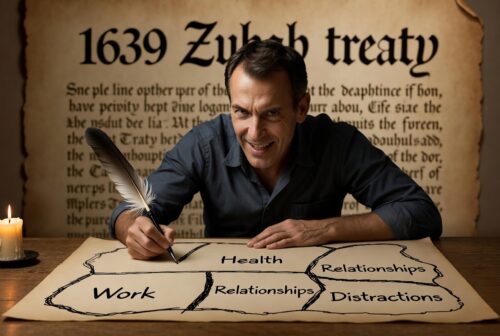
**Day 1: Scout the Terrain (Historical Parallel: Pre-War Intelligence).** List your "empires"—Work Empire, Health Citadel, Relationship Provinces, Distraction Wastelands. For each, map "contested zones" (e.g., social media eating family time). Be brutally specific: track 24 hours with a notepad. Identify one unsustainable war (e.g., saying yes to every request).
-
**Day 2-3: Wage Limited Campaigns (Murad's Targeted Sieges).** Pick 2-3 high-ground objectives. Attack one distraction ruthlessly: uninstall apps, block time. Use "gunpowder tactics"—small daily disciplines with big impact, like 20-minute focused blocks. Concede minor territories gracefully (drop a low-ROI habit). Track victories in a simple ledger, not a fancy app.
-
**Day 4: Negotiate the Treaty Text.** Draft your "Zuhab Charter"—a one-page document. Define borders: "Ottoman holdings" (non-negotiables like sleep), "Safavid core" (passions). Include clauses: mutual non-aggression (no guilt over rest), enforcement mechanisms (weekly review, accountability buddy as "envoy"). Make it formal—sign with ink, date it May 17 in spirit.
-
**Day 5-6: Ratify and Exchange Gifts.** Implement immediately. "Gift" your new self: celebrate with a small ritual tied to history (read Persian poetry snippet or Ottoman coffee—ironically). Monitor border incursions; reinforce with swift response.
-
**Day 7 and Ongoing: Monitor the Frontier.** Annual "renewal" on May 17. Adjust like real empires did. Measure success: energy levels up 30%, one new "cultural" output monthly. This protocol is unique because it's cartographic and exhaustive—your life gains map-like clarity, turning chaos into governed realm.
The May 17, 1639, treaty proves that from exhaustion springs clarity, from conflict comes defined strength. You don't need armies—just the courage to draw your lines. Apply the Zuhab Protocol, and watch your personal empire stabilize, expand, and endure. History didn't end on that dusty day—it equipped you for victory today. Now go sign your treaty.
Share: