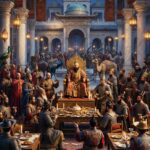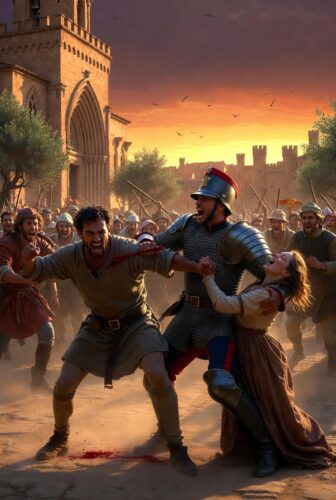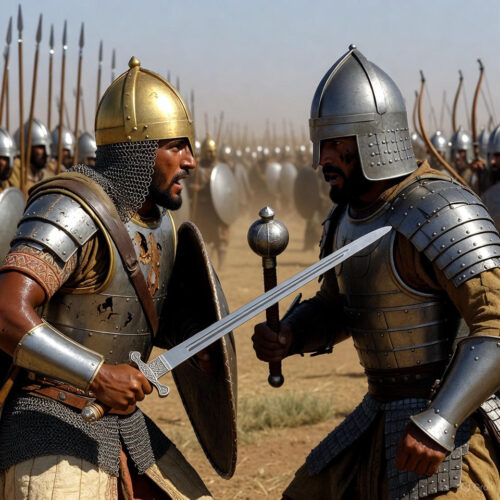

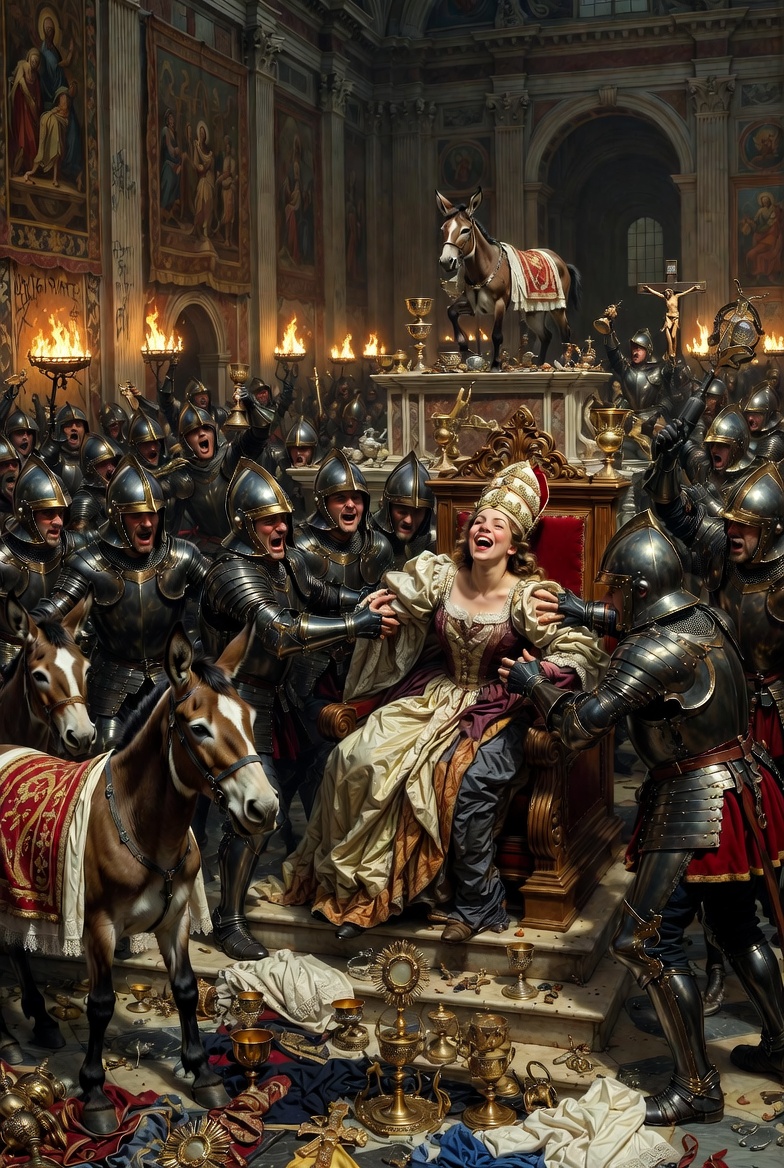
On May 6, 1527, the Eternal City woke up to hell wearing a white cloak. Rome had seen invaders before—Gauls in 390 BC, Visigoths under Alaric in 410, Vandals in 455—but this time the barbarians at the gate wore the colors of the Holy Roman Emperor himself. No grand strategy from Charles V in distant Spain. No papal conspiracy gone wrong. Just 20,000-plus starving, unpaid, pissed-off mercenaries who decided the richest city on earth was their final paycheck. By nightfall, the Renaissance’s glittering capital lay gutted. Churches became stables. Relics were smashed or sold for wine. A prostitute sat enthroned on Saint Peter’s chair while German Landsknechts cheered “Vivat Lutherus pontifex!” and force-fed communion wine to donkeys. The Pope was a prisoner in his own fortress. Half the population was dead, fled, or starving. And Europe would never be the same.This wasn’t ancient myth or vague “medieval chaos.” This was precise, documented, eyewitness-level mayhem on a single spring morning exactly 499 years ago today. Historians still call it the event that killed the Italian High Renaissance stone dead. Artists scattered like pigeons. Humanism took a generational gut punch. The papacy learned humility the hard way and pivoted toward the Counter-Reformation. Even Henry VIII’s divorce drama in England got its final push because the captive Pope couldn’t (or wouldn’t) grant it. Yet amid the blood and the bonfires, survivors rebuilt stronger. Rome rose again. The Church reformed. Power realigned. And that, dear reader, is where this story stops being dusty textbook fodder and starts handing you a tactical blueprint sharper than any self-help guru’s vision board. Let’s rewind the tape properly—because to understand how a mutiny in 1527 can bulletproof your 2026 life, you need the full, unflinching, often darkly hilarious saga. The stage was set years earlier in the endless Italian Wars. Francis I of France and Charles V (King of Spain, Holy Roman Emperor, ruler of half the known world) were locked in a cage match over Italy. Pope Clement VII, a Medici with more political cunning than spiritual fire, saw Charles as the bigger threat to papal independence. In 1526 he joined the League of Cognac—France, Venice, Milan, Florence, even the Swiss—aiming to check Habsburg power. It backfired spectacularly. Charles’s imperial army, fresh off crushing the French at Pavia in 1525, had been chasing League forces across northern Italy. Their commander? Charles III, Duke of Bourbon—a French noble who had defected to the Emperor after falling out with Francis. Bourbon was competent but broke. His troops—14,000 German Landsknechts (pike-wielding, beer-swilling mercenaries, many fresh converts to Lutheranism and nursing zero love for the “Whore of Babylon” in Rome), 6,000 Spanish tercios (hardened infantry who fought for loot as much as loyalty), and a ragtag mix of Italian condottieri and deserters—hadn’t been paid in months. Promises of wages after Pavia turned into IOUs. Morale curdled into mutiny.
By April 1527 the army was a feral beast. Bourbon tried to keep them pointed north toward Florence, but the men smelled richer pickings south. They sacked smaller towns en route, growing like a snowball of outlaws. On May 5 they camped outside Rome’s ancient Aurelian Walls. The city’s defenders numbered maybe 8,000 at best—papal militiamen under Renzo da Ceri plus 189 elite Swiss Guards. The walls were strong, the artillery decent, but the garrison was green and the leadership fractured. Pope Clement, ever the optimist, still believed negotiations might work. They didn’t. Dawn on May 6 broke foggy and tense. The imperial troops attacked in two columns: one at the Gianicolo hill, the other near the Vatican. Bourbon, ever the showman, wore a conspicuous white cloak so his men could spot him in the melee. Big mistake. Eyewitness Benvenuto Cellini—the goldsmith, sculptor, brawler, and world-class braggart—later claimed in his autobiography that he personally shot the Duke from the ramparts while defending with a small band of artists and soldiers. Whether Cellini’s crossbow bolt or someone else’s arquebus did the deed, Bourbon went down early, fatally wounded. His death was the match to the powder keg. Without their commander, discipline evaporated. The troops stormed the walls in a frenzy. The Swiss Guards—those 189 red-and-yellow-clad professionals—made their immortal last stand in the Teutonic Cemetery and around St. Peter’s. Captain Kaspar Röist was cut down in his own home in front of his wife after being wounded on the field. Of the 189, only 42 survived long enough to form a rearguard that bought Pope Clement precious minutes. The Pope, dressed in simple white to avoid notice, fled along the hidden Passetto di Borgo—the elevated corridor connecting the Vatican to Castel Sant’Angelo. Cannon fire and arquebus smoke filled the air. Defenders were slaughtered where they stood. By mid-morning the city was breached. What followed was eight months of systematic plunder that started as organized looting and devolved into pure anarchy. German Landsknechts, fueled by Lutheran zeal and months of hunger, targeted churches with special fury. Altars were stripped. Relics hurled into the Tiber. Sacred images smashed. One group dressed a courtesan in pontifical robes, sat her on St. Peter’s throne, and toasted “Long live Pope Luther!” while parodying Mass with farm animals as congregation. Spanish troops were no gentler; they ransacked palaces indiscriminately, held cardinals and merchants for ransom, and turned hospitals into abattoirs. Nuns were dragged from convents. Monks castrated for sport. Patients in hospices murdered in their beds. Bodies piled in the streets until the smell forced even the looters to move on.
Cardinal Pompeo Colonna—personal enemy of Clement and no friend of the Medici—entered on May 8 with his own peasants seeking payback for earlier papal raids. Yet even he was horrified by the carnage. He opened his palace as a refuge and tried (with partial success) to impose order. Philibert of Châlon, who took nominal command after Bourbon, set up headquarters in the Vatican Library (ironically saving many manuscripts) and issued halt orders that were mostly ignored. The first intense week of killing and rape gave way to weeks of extortion. Prisoners were tortured until families paid. Artworks worth millions were carted off or melted down. The city’s population—around 55,000 before the sack—plunged to perhaps 10,000. Plague and famine finished what swords started. Two thousand corpses were dumped in the Tiber. The Pope remained trapped in Castel Sant’Angelo until June 6, when he surrendered. The ransom: 400,000 ducats in cash plus territorial concessions (Parma, Piacenza, Civitavecchia, Modena—though only Modena actually changed hands). Clement emerged a broken man, beard grown long in mourning, authority in tatters. The imperial army eventually limped south to Naples, decimated by disease and their own excess, but Charles V had won the war without firing a strategic shot. The cultural body count was even higher. Rome had been the beating heart of the High Renaissance—Michelangelo’s Sistine ceiling still fresh, Raphael’s Vatican frescoes glowing, Bramante’s St. Peter’s rising. Patronage flowed like the Tiber. Artists flocked for commissions. Humanism flourished under Medici popes. After May 6, 1527, the party ended. Studios emptied. Patrons fled. Rome’s economy collapsed. Many treasures were lost forever; others surfaced years later in distant collections. Antonio Tebaldeo lamented that anyone returning would find “Rome unmade.” The golden age of Julius II and Leo X was over. Humanism’s sunny confidence in man’s perfectibility took a hit from which it never fully recovered in papal circles. Long-term ripples reshaped Europe. Clement, once anti-Habsburg, swung hard toward alliance with Charles. He crowned the Emperor in Bologna in 1530. He refused Henry VIII’s annulment request in 1533—partly because he was now politically dependent on Charles (whose aunt was Catherine of Aragon). England broke with Rome. The Protestant Reformation gained momentum; Luther himself quipped that God was using the Emperor to punish the Pope on his behalf. The sack accelerated the Catholic Church’s turn inward. By the 1540s the Council of Trent was reforming doctrine and discipline—the Counter-Reformation was born. Rome itself recovered slowly. New popes poured money into rebuilding and art (the Baroque was coming), but the carefree Medici Renaissance spirit was gone. Power had shifted decisively toward the Habsburgs. Italy became a Habsburg-dominated peninsula for centuries. The ironies are deliciously dark. A “Holy Roman” army sacked the Holy City. Protestant German mercenaries did more damage to Catholic shrines than any Ottoman fleet ever managed. The Emperor who ordered no such attack still pocketed the strategic jackpot. Cellini—the same man who later cast Perseus with the Head of Medusa—bragged about killing a duke while casually mentioning he also murdered a few others that week. The Swiss Guards’ sacrifice became legend; they still swear their oath and commemorate the stand every May 6. And the Passetto di Borgo? That secret escape tunnel still exists today as a quiet reminder that even popes need back doors.
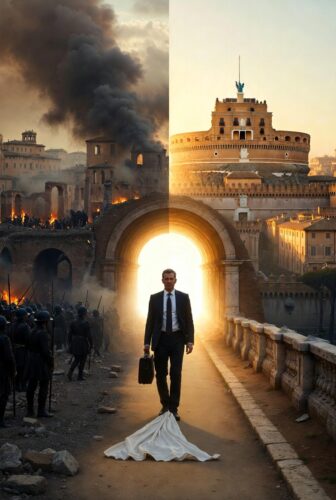
Everything—if you stop treating history as decoration and start treating it as tactical intelligence. The sack wasn’t random apocalypse. It was the predictable explosion when unpaid mercenaries, weak leadership, overextended alliances, and a complacent city all collided. The defenders who survived did three things right in the chaos: they made a heroic last stand to buy time, they executed a precise strategic retreat through the Passetto, and they rebuilt their fortress (literally and politically) once the storm passed. Clement pivoted from enemy to uneasy ally with Charles and lived to see the Church adapt. Rome rose again, scarred but wiser. Your life will face its own “May 6, 1527” moments—financial mutinies, health revolts, relationship sackings, career plunders. Most self-help tells you to “journal your feelings” or “manifest better vibes.” This historical fact hands you something sharper: a military-grade protocol forged in actual blood and Renaissance steel. Call it the Castel Protocol. It is not generic positivity. It is not hustle culture. It is not therapy-speak. It is a quick, repeatable system built from the exact mechanics that let a handful of Swiss Guards, one crafty Pope, and a gutted city survive history’s ultimate mutiny. Here is how the outcome of that distant May morning delivers concrete benefits to your individual life today, translated into hyper-specific, actionable terms: - You learn to spot mutiny signals weeks before your personal “army” (habits, finances, relationships, health routines) storms the walls. The Landsknechts didn’t wake up angry on May 6; they’d been unpaid and ignored for months. Track your own “wages”—sleep debt, ignored emotional needs, deferred maintenance on key life areas—and pay them proactively instead of waiting for revolt. - You master the Swiss Guard last-stand principle: identify your non-negotiable core (the 189 things worth dying on the hill for) and defend them ferociously while everything else is negotiable. Most people defend everything weakly and lose everything. The Guards defended the Pope’s escape route and changed history. - You gain the Passetto Pivot skill: when walls are breached, execute a controlled retreat to your personal Castel Sant’Angelo (a pre-built fortress of skills, allies, cash reserves, or mindset) instead of panicking in the open. Clement didn’t fight to the death in the Vatican; he ran through the tunnel and lived to negotiate from strength. - You internalize the Colonna Intervention tactic: when chaos hits, recruit unlikely allies (the very cardinal who hated the Pope still provided refuge). Your network’s “enemies” or outsiders often become saviors if you swallow pride fast enough. - You absorb the Cellini Precision Strike: in the fog of crisis, one accurate shot at the “white cloak” (the visible leader of the problem—bad debt, toxic boss, self-sabotage habit) can decapitate the entire mutiny. Cellini didn’t spray bullets; he aimed at the man in white. - You embrace the post-sack rebuild truth: total plunder is not the end. Rome’s population cratered and its treasures were looted, yet within decades it hosted the Baroque flowering and the Counter-Reformation. Your lowest point is raw material for a stronger second act—if you treat it as data instead of defeat. Now the detailed, quick, unique plan. This is not a 90-day transformation. This is a 21-day Castel Protocol you can launch tomorrow morning and run for the rest of your life. It is deliberately military, historically immersive, and nothing like the pastel self-help flooding your feed. No vision boards. No morning pages. Just Renaissance siege-craft applied to modern chaos. **Week 1 – Wall Audit & Swiss Oath (Days 1-7):** Map your “Aurelian Walls” (the structures protecting your time, money, energy, relationships). List every vulnerability the way Renzo da Ceri should have scouted Rome’s defenses. Then swear the Swiss Oath: write down your 189 (or fewer) non-negotiables—specific, measurable, sacred. Example: “I will never skip gym before 7 a.m. or check email before 9 a.m.” Read it aloud every morning like the Guards recited their pledge. Post it visibly. Defend it like Kaspar Röist defended his captain’s honor. **Week 2 – Passetto Construction & Cellini Targeting (Days 8-14):** Build your escape tunnel. Create three literal “Castel” assets: (1) a hidden emergency cash or skill reserve (e.g., $2,000 no-touch account or a side skill you can monetize in 48 hours), (2) a pre-written network script for unlikely allies (Colonna-style), (3) one high-leverage “white cloak” target per major life domain (the single habit, expense, or person whose removal collapses the mutiny). Practice one precision strike per day—delete the app, confront the conversation, cancel the subscription. No vague goals. One arquebus shot. **Week 3 – Colonna Alliance & Rebuild Rehearsal (Days 15-21):** Run three simulated sack scenarios. Write the story of your worst possible “May 6” (job loss, health scare, financial crash) in brutal detail. Then script the response using the protocol: last stand on non-negotiables, Passetto retreat to your Castel, Colonna outreach to one unlikely helper, Cellini strike on the root cause. Rehearse it mentally and log the actions you would take within 24 hours. At the end of day 21, celebrate like Clement emerging from the fortress—shave the mourning beard, commission new art (buy one small thing that symbolizes your rebuilt Rome), and schedule quarterly protocol refreshers forever.Run this once and it becomes muscle memory. Life will still throw mutinies—unpaid emotional wages, surprise attacks on your health, alliances that crumble—but you will never again wake up to your personal Rome in flames without a white-cloak target in sight, a tunnel pre-built, and 42 loyal Swiss Guards (your core habits and values) already forming the rearguard. The mercenaries of 1527 got their loot and then rotted from plague. The Pope got his freedom and rewrote the rules of power. Rome got its scars and its second golden age. You get the cheat code. History doesn’t repeat, but it rhymes with terrifying precision. On this exact date in 1527 the white cloak backfired, the walls fell, and the survivors pivoted into something stronger. Your move is simpler: audit the walls, swear the oath, dig the tunnel, aim for the cloak, call the unlikely ally, and rebuild like the Eternal City itself. The Renaissance ended on May 6. Your unbreakable second act starts today.
Share: