Picture this: It’s May 5, 1260, in the rolling grasslands of northern China, just north of the Great Wall that the Mongols had already smashed through decades earlier. A massive felt yurt city—part nomadic camp, part budding imperial capital—buzzes with the low thunder of horse hooves, the clank of lamellar armor, and the murmur of princes, generals, shamans, and Chinese advisors gathered under silk banners snapping in the wind. At the center stands Kublai, grandson of the legendary Genghis Khan, second son of Tolui, and now, by the acclamation of his assembled supporters, the new Great Khan (Khagan) of the Mongol Empire. No golden crown, no ancient throne—just a proclamation shouted across the steppe at his summer palace of Kaiping, soon to be renamed Shangdu (the Xanadu of Coleridge’s dreamy poem). This wasn’t some tidy coronation with trumpets and incense. It was raw, urgent, and borderline treasonous. His younger brother Ariq Böke was hundreds of miles away in the traditional Mongol heartland of Karakorum, already claiming the same title. What followed was a brutal family civil war that fractured the world’s largest contiguous empire forever—but also birthed something new: the Yuan Dynasty, which would rule China for nearly a century.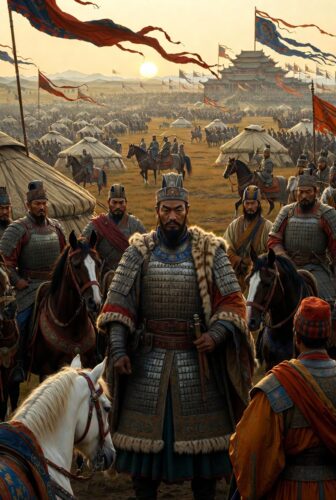 This single day—May 5, 1260—marked the moment the Mongol whirlwind began to settle into something more permanent: a hybrid superpower that blended the lightning-strike terror of the steppes with the bureaucratic genius of ancient China. Kublai didn’t just inherit an empire; he re-engineered it while fighting for his life. And the lessons from that messy, brilliant power play still echo today. But before we leap to how you can steal Kublai’s playbook for your own modern “empire” (your career, your goals, your sanity), let’s dive deep into the history—because 90 percent of this story is the raw, blood-and-silk reality of 13th-century Asia, the kind of epic that makes Game of Thrones look like a polite dinner party.
To understand May 5, 1260, you have to rewind to the man who started it all: Temüjin, better known as Genghis Khan. Born around 1162 amid the fractious Mongol tribes of the steppe, he unified them through sheer will, brutal alliances, and a genius for mobile warfare. By his death in 1227, his empire stretched from the Pacific to the Caspian Sea—an area larger than any before or since. He divided it among his sons: Jochi (whose line became the Golden Horde in Russia), Chagatai (Central Asia), Ögedei (the Great Khanate in Mongolia), and Tolui (the youngest, who got the Mongol homeland and army core). Genghis’s deathbed advice was simple: stay united, or the world will swallow you.
Ögedei took the throne in 1229 and kept the conquest machine humming—invading Korea, Persia, and Eastern Europe. But by 1241, he was dead from (legend says) too much drinking at a feast. The empire’s leadership ping-ponged: Güyük (Ögedei’s son) in 1246, then Möngke (Tolui’s son and Kublai’s older brother) in 1251 after a nasty power struggle that involved purges and poison accusations. Möngke was the last truly unified Great Khan. Ruthless, efficient, and expansionist, he launched simultaneous campaigns against the Islamic world (his brother Hulagu sacked Baghdad in 1258) and Song China.
Enter Kublai, born September 23, 1215—right around the time Genghis was conquering northern China. As a boy, he was already marked. During a hunt near the Ili River in 1224, nine-year-old Kublai killed a rabbit and an antelope. Genghis smeared fat on the boy’s finger and told the assembled warriors, “The words of this boy Kublai are full of wisdom—heed them well.” Kublai grew up steeped in Mongol tradition—riding, archery, falconry—but his mother Sorghaghtani Beki (one of the most brilliant political minds of the era) steered him toward Chinese culture. She was a Nestorian Christian who respected Buddhism, Taoism, and Confucianism, and she made sure her sons learned from the conquered. Kublai’s nurse was a Tangut Buddhist woman. By his teens, he was inviting Chinese scholars and monks to his ordo (mobile court).
This single day—May 5, 1260—marked the moment the Mongol whirlwind began to settle into something more permanent: a hybrid superpower that blended the lightning-strike terror of the steppes with the bureaucratic genius of ancient China. Kublai didn’t just inherit an empire; he re-engineered it while fighting for his life. And the lessons from that messy, brilliant power play still echo today. But before we leap to how you can steal Kublai’s playbook for your own modern “empire” (your career, your goals, your sanity), let’s dive deep into the history—because 90 percent of this story is the raw, blood-and-silk reality of 13th-century Asia, the kind of epic that makes Game of Thrones look like a polite dinner party.
To understand May 5, 1260, you have to rewind to the man who started it all: Temüjin, better known as Genghis Khan. Born around 1162 amid the fractious Mongol tribes of the steppe, he unified them through sheer will, brutal alliances, and a genius for mobile warfare. By his death in 1227, his empire stretched from the Pacific to the Caspian Sea—an area larger than any before or since. He divided it among his sons: Jochi (whose line became the Golden Horde in Russia), Chagatai (Central Asia), Ögedei (the Great Khanate in Mongolia), and Tolui (the youngest, who got the Mongol homeland and army core). Genghis’s deathbed advice was simple: stay united, or the world will swallow you.
Ögedei took the throne in 1229 and kept the conquest machine humming—invading Korea, Persia, and Eastern Europe. But by 1241, he was dead from (legend says) too much drinking at a feast. The empire’s leadership ping-ponged: Güyük (Ögedei’s son) in 1246, then Möngke (Tolui’s son and Kublai’s older brother) in 1251 after a nasty power struggle that involved purges and poison accusations. Möngke was the last truly unified Great Khan. Ruthless, efficient, and expansionist, he launched simultaneous campaigns against the Islamic world (his brother Hulagu sacked Baghdad in 1258) and Song China.
Enter Kublai, born September 23, 1215—right around the time Genghis was conquering northern China. As a boy, he was already marked. During a hunt near the Ili River in 1224, nine-year-old Kublai killed a rabbit and an antelope. Genghis smeared fat on the boy’s finger and told the assembled warriors, “The words of this boy Kublai are full of wisdom—heed them well.” Kublai grew up steeped in Mongol tradition—riding, archery, falconry—but his mother Sorghaghtani Beki (one of the most brilliant political minds of the era) steered him toward Chinese culture. She was a Nestorian Christian who respected Buddhism, Taoism, and Confucianism, and she made sure her sons learned from the conquered. Kublai’s nurse was a Tangut Buddhist woman. By his teens, he was inviting Chinese scholars and monks to his ordo (mobile court).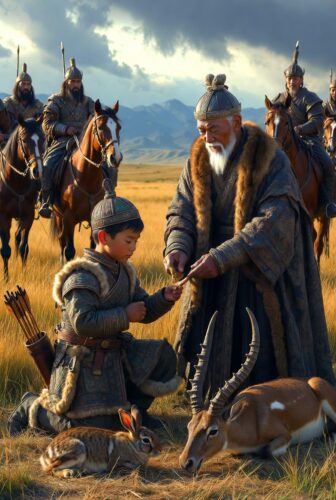 In 1236, after his father Tolui died (possibly from alcoholism or poison), Kublai received an appanage in Hebei province—10,000 households of Chinese peasants. At first, he let local officials run wild. Taxes skyrocketed, corruption bloomed, and peasants fled en masse. Kublai woke up fast. He imported his mother’s trusted administrators, slashed exploitative taxes, and offered incentives for refugees to return. Revenues soared. It was his first taste of hybrid rule: Mongol muscle enforcing Chinese-style governance. He loved it. In 1242, he invited the Buddhist monk Haiyun to Karakorum for deep philosophical talks. Haiyun later named Kublai’s first son Zhenjin (“True Gold”). Another advisor, Liu Bingzhong—a former Taoist turned Buddhist monk, poet, painter, mathematician, and engineer—became Kublai’s lifelong brain trust. Kublai surrounded himself with talent from every corner: Uyghurs, Persians, Tibetans, even a few Europeans later on.
By 1251, when Möngke became Great Khan, Kublai was given viceroyalty over northern China. He moved his ordo to central Inner Mongolia and turned Henan into a model agricultural zone. He dug irrigation canals, promoted silk and grain production, and protected war-weary Han Chinese peasants. When Möngke gave him Xi’an, Kublai’s welfare programs earned praise from local warlords. But tensions simmered. In 1252, he clashed with administrator Mahmud Yalavach over mass executions of suspected disloyal officials. Kublai’s mercy (and Confucian leanings) won the day—Mahmud was dismissed. Two years later, Möngke ordered Kublai to conquer the Dali Kingdom in Yunnan to outflank the Song dynasty from the southwest.
The 1253 Yunnan campaign was textbook Kublai: strategic brilliance wrapped in calculated mercy. His forces split—Uriyangkhadai took the brutal mountain route, while Kublai swept down the grasslands. They captured the capital, but instead of the usual Mongol slaughter, Kublai spared the population after the king Duan Xingzhi surrendered and offered loyalty. Dali became a loyal vassal, providing troops and intelligence for future wars. Kublai even brought Tibetan lama Drogön Chögyal Phagpa into his inner circle. Phagpa initiated Kublai and his wife Chabi into Buddhism and later created a new “Phags-pa script” for the empire. Kublai was becoming the bridge between steppe and sown field.
Möngke’s death in August 1259 changed everything. The Great Khan died during the siege of Diaoyu Castle in Sichuan—possibly from dysentery, arrow wound, or (conspiracy theorists still argue) poison. The news reached Kublai while he was besieging Wuchang on the Yangtze. His Chinese advisors begged him to keep it secret from the troops and rush north. Ariq Böke, the traditionalist younger brother left guarding Karakorum, was already mobilizing. Ariq represented the old ways: pure nomadic warfare, plunder over administration, Mongol purity over “soft” Chinese influences.
Kublai played it like a chess master with a Mongol bow. He negotiated a hasty truce with the Song (promising tribute they never fully paid), then raced north with his elite forces. His supporters—princes from Manchuria and northern China—urged immediate action. On April 15, 1260 (some records pin the formal proclamation to May 5 after final rituals and arrivals), at Kaiping (Shangdu), Kublai convened his own kurultai. It wasn’t the grand assembly of all Borjigin lines that tradition demanded, but it was enough. Princes, generals, and advisors proclaimed him Great Khan. For the first time, the supreme leader was elected outside the Mongol homeland. Ariq Böke countered in June 1260 at Karakorum with his own kurultai—backed by Möngke’s widow, sons, and the descendants of Genghis’s older brothers. Two Khans. One empire. Civil war was inevitable.
In 1236, after his father Tolui died (possibly from alcoholism or poison), Kublai received an appanage in Hebei province—10,000 households of Chinese peasants. At first, he let local officials run wild. Taxes skyrocketed, corruption bloomed, and peasants fled en masse. Kublai woke up fast. He imported his mother’s trusted administrators, slashed exploitative taxes, and offered incentives for refugees to return. Revenues soared. It was his first taste of hybrid rule: Mongol muscle enforcing Chinese-style governance. He loved it. In 1242, he invited the Buddhist monk Haiyun to Karakorum for deep philosophical talks. Haiyun later named Kublai’s first son Zhenjin (“True Gold”). Another advisor, Liu Bingzhong—a former Taoist turned Buddhist monk, poet, painter, mathematician, and engineer—became Kublai’s lifelong brain trust. Kublai surrounded himself with talent from every corner: Uyghurs, Persians, Tibetans, even a few Europeans later on.
By 1251, when Möngke became Great Khan, Kublai was given viceroyalty over northern China. He moved his ordo to central Inner Mongolia and turned Henan into a model agricultural zone. He dug irrigation canals, promoted silk and grain production, and protected war-weary Han Chinese peasants. When Möngke gave him Xi’an, Kublai’s welfare programs earned praise from local warlords. But tensions simmered. In 1252, he clashed with administrator Mahmud Yalavach over mass executions of suspected disloyal officials. Kublai’s mercy (and Confucian leanings) won the day—Mahmud was dismissed. Two years later, Möngke ordered Kublai to conquer the Dali Kingdom in Yunnan to outflank the Song dynasty from the southwest.
The 1253 Yunnan campaign was textbook Kublai: strategic brilliance wrapped in calculated mercy. His forces split—Uriyangkhadai took the brutal mountain route, while Kublai swept down the grasslands. They captured the capital, but instead of the usual Mongol slaughter, Kublai spared the population after the king Duan Xingzhi surrendered and offered loyalty. Dali became a loyal vassal, providing troops and intelligence for future wars. Kublai even brought Tibetan lama Drogön Chögyal Phagpa into his inner circle. Phagpa initiated Kublai and his wife Chabi into Buddhism and later created a new “Phags-pa script” for the empire. Kublai was becoming the bridge between steppe and sown field.
Möngke’s death in August 1259 changed everything. The Great Khan died during the siege of Diaoyu Castle in Sichuan—possibly from dysentery, arrow wound, or (conspiracy theorists still argue) poison. The news reached Kublai while he was besieging Wuchang on the Yangtze. His Chinese advisors begged him to keep it secret from the troops and rush north. Ariq Böke, the traditionalist younger brother left guarding Karakorum, was already mobilizing. Ariq represented the old ways: pure nomadic warfare, plunder over administration, Mongol purity over “soft” Chinese influences.
Kublai played it like a chess master with a Mongol bow. He negotiated a hasty truce with the Song (promising tribute they never fully paid), then raced north with his elite forces. His supporters—princes from Manchuria and northern China—urged immediate action. On April 15, 1260 (some records pin the formal proclamation to May 5 after final rituals and arrivals), at Kaiping (Shangdu), Kublai convened his own kurultai. It wasn’t the grand assembly of all Borjigin lines that tradition demanded, but it was enough. Princes, generals, and advisors proclaimed him Great Khan. For the first time, the supreme leader was elected outside the Mongol homeland. Ariq Böke countered in June 1260 at Karakorum with his own kurultai—backed by Möngke’s widow, sons, and the descendants of Genghis’s older brothers. Two Khans. One empire. Civil war was inevitable.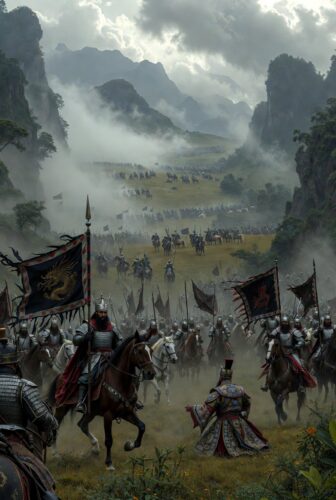 The Toluid Civil War (1260–1264) was ugly, intimate, and decisive. Kublai had the economic edge: Chinese grain, taxes, and manpower. He blockaded Karakorum, cutting supply lines until famine set in. Battles raged across Mongolia and northern China—Shimultai, the Khingan Mountains. Ariq’s forces retook Karakorum temporarily in 1261, but Kublai’s cousin Kadan and loyal generals kept hammering. Defections piled up. Alghu, whom Ariq had installed as Chagatai Khan, switched sides and crushed Ariq’s western expedition. Hulagu (Ilkhan of Persia) sent diplomatic support to Kublai. By 1262, a revolt by Han general Li Tan in Shandong gave Kublai an excuse to purge potentially disloyal Chinese warlords, tightening his grip. Ariq surrendered at Shangdu in August 1264. Kublai pardoned his brother (who died suspiciously in 1266, possibly poisoned), but executed key supporters to send a message.
Victory secured, Kublai didn’t rest. In 1271, he formally renamed his regime the Great Yuan—claiming legitimate succession from the Chinese dynasties while keeping Mongol military supremacy. He moved the capital to Dadu (modern Beijing) in 1272, building a magnificent palace city while keeping Shangdu as the summer retreat. Xanadu became legendary: marble halls, vast hunting parks stocked with elephants and exotic animals, gardens that inspired European poets centuries later. The Grand Canal was repaired and extended. A pony-express postal system (yam) linked the empire with relay stations every 25 miles. And in 1260—right after his proclamation—Kublai introduced Jiaochao, the world’s first widespread fiat paper currency. Backed by silver reserves at first, it revolutionized trade. Marco Polo later marveled at it: “You could buy anything with these pieces of paper that looked like they were made by alchemists!”
The conquest of the Southern Song took until 1279. Kublai’s general Bayan used massive river fleets and siege engines (built by Persian and Muslim engineers) to grind down the Song navy and fortresses. Xiangyang fell in 1273 after a six-year siege. By 1276, the Song empress dowager and young emperor surrendered in Hangzhou. Kublai treated them with surprising dignity—housing them in Dadu, where his wife Chabi personally cared for the royal children. The last Song loyalists were crushed at the Battle of Yamen in 1279; the boy emperor drowned rather than submit.
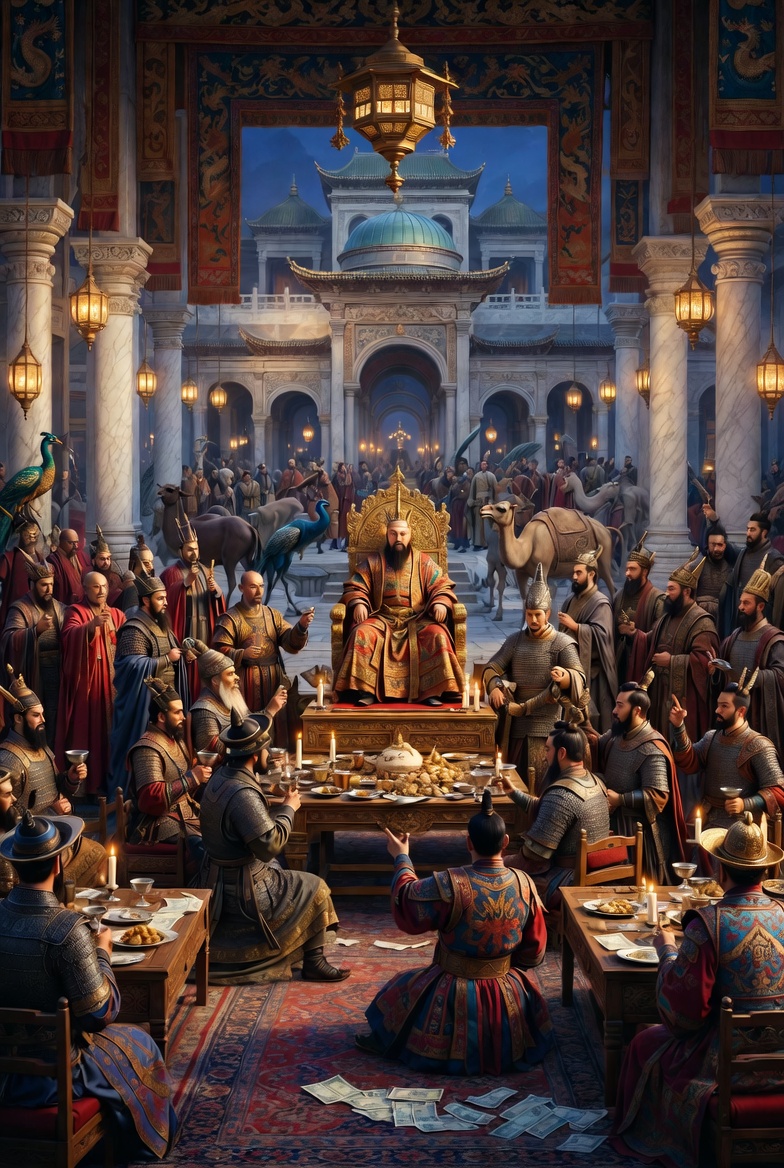
Kublai’s court was a multicultural circus. Marco Polo arrived around 1275 (or so he claimed) and served 17 years as an emissary, tax official, and storyteller. His Travels describe opulent banquets where Kublai sat on a golden throne elevated above the crowd, feasting on exotic meats while thousands of guests drank fermented mare’s milk from jeweled cups. Polo gushed about Hangzhou’s “heaven on earth” canals, coal-heated homes (Europeans thought he invented the stuff), and the sheer scale of Dadu’s markets. Skeptics later called Polo’s numbers (“a million people!”) exaggerations—hence the phrase “a Marco Polo” for tall tales. But archaeology backs much of it. Kublai employed Tibetans, Muslims, Christians, and Jews. He favored Buddhism (Phagpa became Imperial Preceptor), tolerated Nestorian Christianity and Islam, but cracked down on Taoists after a 1258 debate where Buddhists humiliated their rivals by burning texts.
The Toluid Civil War (1260–1264) was ugly, intimate, and decisive. Kublai had the economic edge: Chinese grain, taxes, and manpower. He blockaded Karakorum, cutting supply lines until famine set in. Battles raged across Mongolia and northern China—Shimultai, the Khingan Mountains. Ariq’s forces retook Karakorum temporarily in 1261, but Kublai’s cousin Kadan and loyal generals kept hammering. Defections piled up. Alghu, whom Ariq had installed as Chagatai Khan, switched sides and crushed Ariq’s western expedition. Hulagu (Ilkhan of Persia) sent diplomatic support to Kublai. By 1262, a revolt by Han general Li Tan in Shandong gave Kublai an excuse to purge potentially disloyal Chinese warlords, tightening his grip. Ariq surrendered at Shangdu in August 1264. Kublai pardoned his brother (who died suspiciously in 1266, possibly poisoned), but executed key supporters to send a message.
Victory secured, Kublai didn’t rest. In 1271, he formally renamed his regime the Great Yuan—claiming legitimate succession from the Chinese dynasties while keeping Mongol military supremacy. He moved the capital to Dadu (modern Beijing) in 1272, building a magnificent palace city while keeping Shangdu as the summer retreat. Xanadu became legendary: marble halls, vast hunting parks stocked with elephants and exotic animals, gardens that inspired European poets centuries later. The Grand Canal was repaired and extended. A pony-express postal system (yam) linked the empire with relay stations every 25 miles. And in 1260—right after his proclamation—Kublai introduced Jiaochao, the world’s first widespread fiat paper currency. Backed by silver reserves at first, it revolutionized trade. Marco Polo later marveled at it: “You could buy anything with these pieces of paper that looked like they were made by alchemists!”
The conquest of the Southern Song took until 1279. Kublai’s general Bayan used massive river fleets and siege engines (built by Persian and Muslim engineers) to grind down the Song navy and fortresses. Xiangyang fell in 1273 after a six-year siege. By 1276, the Song empress dowager and young emperor surrendered in Hangzhou. Kublai treated them with surprising dignity—housing them in Dadu, where his wife Chabi personally cared for the royal children. The last Song loyalists were crushed at the Battle of Yamen in 1279; the boy emperor drowned rather than submit.
Kublai’s court was a multicultural circus. Marco Polo arrived around 1275 (or so he claimed) and served 17 years as an emissary, tax official, and storyteller. His Travels describe opulent banquets where Kublai sat on a golden throne elevated above the crowd, feasting on exotic meats while thousands of guests drank fermented mare’s milk from jeweled cups. Polo gushed about Hangzhou’s “heaven on earth” canals, coal-heated homes (Europeans thought he invented the stuff), and the sheer scale of Dadu’s markets. Skeptics later called Polo’s numbers (“a million people!”) exaggerations—hence the phrase “a Marco Polo” for tall tales. But archaeology backs much of it. Kublai employed Tibetans, Muslims, Christians, and Jews. He favored Buddhism (Phagpa became Imperial Preceptor), tolerated Nestorian Christianity and Islam, but cracked down on Taoists after a 1258 debate where Buddhists humiliated their rivals by burning texts.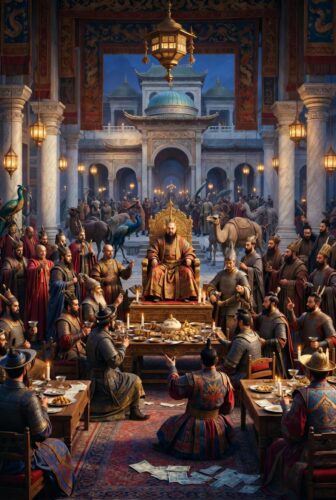 Foreign policy was aggressive. Kublai demanded tribute from Korea, Vietnam, Burma, Java, and Japan. The 1274 and 1281 invasions of Japan ended in disaster—typhoons (the famous kamikaze, or “divine wind”) wrecked the fleets. Kublai raged, but the failures highlighted the limits of overextension. Vietnam and Java campaigns also bogged down in jungles and disease. At home, he promoted astronomy (a Persian observatory in Dadu), medicine, and Confucian academies—while reserving top military posts for Mongols. Han Chinese faced some discrimination (they couldn’t hold certain high offices), but the economy boomed under his hybrid system.
Late life brought sorrow. Chabi died in 1281; Kublai grieved deeply, overeating and suffering gout. His favorite son Zhenjin died young in 1285. By 1294, the once-vigorous conqueror was bedridden. He died February 18, 1294, at age 78. His grandson Temür succeeded him. The Yuan lasted until 1368, when the Ming overthrew them. The broader Mongol Empire had already splintered: Golden Horde, Ilkhanate, Chagatai Khanate—all nominally under the Great Khan but increasingly independent. Kublai’s May 5 proclamation had unified the east at the cost of the whole.
Yet his legacy endures. He created the first unified Chinese state under foreign rule in centuries, reopened the Silk Road, and exported ideas (paper money, gunpowder recipes, administrative models) that reached Europe. Pax Mongolica made travel safer than ever. Marco Polo’s book inspired Columbus. Kublai proved you could be both steppe warrior and civilized emperor—without losing your edge.
Now, fast-forward 766 years. Why should any of this dusty steppe drama matter to you on May 5, 2026? Because Kublai’s story isn’t about horses and arrows. It’s about adaptive leadership in chaos, blending old strengths with new tools, and outmaneuvering rivals without becoming them. The outcome of that May 5 proclamation—victory in civil war, a new dynasty, cultural fusion—shows that real power comes from strategic hybridity, not purity or brute force alone.
Here’s how you can apply Kublai’s hard-won wisdom to your individual life with ruthless specificity:
- **Claim your “Shangdu moment” publicly and early**: Kublai didn’t wait for universal approval—he proclaimed his vision with the allies he had. In your life, stop polling everyone before acting. Pick a date (maybe today, May 5), gather your inner circle or even just journal it, and declare your major goal out loud or in writing. No vague resolutions. Write it like a khan’s edict: “I proclaim myself leader of [specific project/career shift/health overhaul] starting now.” The act of public proclamation creates momentum and forces accountability, just as Kublai’s kurultai locked in his supporters.
- **Wage “civil war” on your internal Ariq Böke**: Ariq represented tradition and resistance to change. Identify the “traditionalist” voice in your head—the one clinging to old habits, comfort zones, or self-doubt that sabotages progress. Blockade it like Kublai blockaded Karakorum: cut off its resources. For 30 days, replace one daily ritual (scrolling, procrastination snack, negative self-talk) with a Kublai-style action (morning planning session, skill-building micro-task). Starve the rival until it surrenders.
Foreign policy was aggressive. Kublai demanded tribute from Korea, Vietnam, Burma, Java, and Japan. The 1274 and 1281 invasions of Japan ended in disaster—typhoons (the famous kamikaze, or “divine wind”) wrecked the fleets. Kublai raged, but the failures highlighted the limits of overextension. Vietnam and Java campaigns also bogged down in jungles and disease. At home, he promoted astronomy (a Persian observatory in Dadu), medicine, and Confucian academies—while reserving top military posts for Mongols. Han Chinese faced some discrimination (they couldn’t hold certain high offices), but the economy boomed under his hybrid system.
Late life brought sorrow. Chabi died in 1281; Kublai grieved deeply, overeating and suffering gout. His favorite son Zhenjin died young in 1285. By 1294, the once-vigorous conqueror was bedridden. He died February 18, 1294, at age 78. His grandson Temür succeeded him. The Yuan lasted until 1368, when the Ming overthrew them. The broader Mongol Empire had already splintered: Golden Horde, Ilkhanate, Chagatai Khanate—all nominally under the Great Khan but increasingly independent. Kublai’s May 5 proclamation had unified the east at the cost of the whole.
Yet his legacy endures. He created the first unified Chinese state under foreign rule in centuries, reopened the Silk Road, and exported ideas (paper money, gunpowder recipes, administrative models) that reached Europe. Pax Mongolica made travel safer than ever. Marco Polo’s book inspired Columbus. Kublai proved you could be both steppe warrior and civilized emperor—without losing your edge.
Now, fast-forward 766 years. Why should any of this dusty steppe drama matter to you on May 5, 2026? Because Kublai’s story isn’t about horses and arrows. It’s about adaptive leadership in chaos, blending old strengths with new tools, and outmaneuvering rivals without becoming them. The outcome of that May 5 proclamation—victory in civil war, a new dynasty, cultural fusion—shows that real power comes from strategic hybridity, not purity or brute force alone.
Here’s how you can apply Kublai’s hard-won wisdom to your individual life with ruthless specificity:
- **Claim your “Shangdu moment” publicly and early**: Kublai didn’t wait for universal approval—he proclaimed his vision with the allies he had. In your life, stop polling everyone before acting. Pick a date (maybe today, May 5), gather your inner circle or even just journal it, and declare your major goal out loud or in writing. No vague resolutions. Write it like a khan’s edict: “I proclaim myself leader of [specific project/career shift/health overhaul] starting now.” The act of public proclamation creates momentum and forces accountability, just as Kublai’s kurultai locked in his supporters.
- **Wage “civil war” on your internal Ariq Böke**: Ariq represented tradition and resistance to change. Identify the “traditionalist” voice in your head—the one clinging to old habits, comfort zones, or self-doubt that sabotages progress. Blockade it like Kublai blockaded Karakorum: cut off its resources. For 30 days, replace one daily ritual (scrolling, procrastination snack, negative self-talk) with a Kublai-style action (morning planning session, skill-building micro-task). Starve the rival until it surrenders. - **Fuse traditions for hybrid superiority**: Kublai kept Mongol military discipline but adopted Chinese bureaucracy, paper money, and engineering. In your world, blend your core identity (your “steppe” strengths—raw drive, resilience) with new tools (apps, networks, mindsets). Example: If you’re a creative type (“nomad”), fuse it with corporate structure (“palace”) by using a simple project-management board to turn wild ideas into revenue. The result? A personal “Yuan” that no pure traditionalist or pure modernist can match.
- **Practice strategic mercy after victory**: After Dali, Kublai spared the population and gained loyal vassals. In personal conflicts—at work, in relationships—don’t annihilate defeated rivals. Offer them a face-saving role or alliance. It turns enemies into assets and builds long-term loyalty, unlike endless grudges that drain your empire.
- **Issue your own “paper currency” of resources**: Kublai’s Jiaochao turned paper into power. Audit your time, energy, and money like fiat assets. Create a monthly “edict” reallocating 20 percent of your resources to high-leverage investments (learning, networking, health) instead of consumption. Track it obsessively—Kublai’s accountants would approve.
Here is the detailed, quick, unique plan—no generic self-help mantras, no vision boards, no gratitude journals. This is the **Xanadu Proclamation Protocol**: a 21-day hybrid conquest system inspired directly by Kublai’s 1260 playbook. It’s designed to be executed in the chaos of real life, not a quiet retreat. Do it once, then repeat quarterly.
**Days 1–3: The Kurultai Assembly**
Hold a private “proclamation” session (30 minutes max). List your three biggest “Song dynasties” (seemingly unbeatable obstacles). Gather input from 2–3 diverse “advisors” (friends, books, podcasts—anyone not in your usual echo chamber). Write a one-page edict declaring victory over them. Read it aloud. Burn or archive the old hesitation notes.
**Days 4–10: The Blockade Phase**
Cut supply lines to one bad habit or energy drain per day (social media doomscroll, toxic relationship check-ins, perfectionism loops). Replace each with a 15-minute “Yunnan campaign” micro-action: research, one outreach email, or physical movement. Log results like a Mongol scout report. Starve the rivals.
**Days 11–15: The Fusion Forge**
Take one core strength (your “Mongol” trait) and one new tool (Chinese “bureaucracy”). Fuse them: e.g., your discipline + AI tools = automated daily empire tracker. Test it on a small goal. Measure output like Kublai measured tax revenue—quantify the boost.
**Days 16–20: The Mercy and Expansion Raids**
After any “win” (even tiny), offer mercy: send a kind follow-up to a recent rival or forgive a personal setback. Then launch one bold “foreign campaign”: pitch an idea, apply for something scary, or invest in a new skill. Document the alliance formed.
**Day 21: The Great Khan Review**
Review the 21 days like a Yuan census. Celebrate with a personal feast (not overeating—something meaningful). Proclaim the next cycle’s edict. If you slipped, pardon yourself but execute the weak link (replace the failed tactic).
This protocol is lightning-fast, historically grounded, and deliberately weird—no one else online is telling you to role-play a 13th-century khan while fixing your life. It works because it mirrors what actually worked for Kublai: vision + logistics + adaptation + mercy + systems. Apply it, and on the next May 5 you’ll look back at your own fractured “civil wars” and smile at the empire you built.
Kublai didn’t just survive May 5, 1260—he weaponized it. So can you. The steppe is calling. Answer like a khan.
- **Fuse traditions for hybrid superiority**: Kublai kept Mongol military discipline but adopted Chinese bureaucracy, paper money, and engineering. In your world, blend your core identity (your “steppe” strengths—raw drive, resilience) with new tools (apps, networks, mindsets). Example: If you’re a creative type (“nomad”), fuse it with corporate structure (“palace”) by using a simple project-management board to turn wild ideas into revenue. The result? A personal “Yuan” that no pure traditionalist or pure modernist can match.
- **Practice strategic mercy after victory**: After Dali, Kublai spared the population and gained loyal vassals. In personal conflicts—at work, in relationships—don’t annihilate defeated rivals. Offer them a face-saving role or alliance. It turns enemies into assets and builds long-term loyalty, unlike endless grudges that drain your empire.
- **Issue your own “paper currency” of resources**: Kublai’s Jiaochao turned paper into power. Audit your time, energy, and money like fiat assets. Create a monthly “edict” reallocating 20 percent of your resources to high-leverage investments (learning, networking, health) instead of consumption. Track it obsessively—Kublai’s accountants would approve.
Here is the detailed, quick, unique plan—no generic self-help mantras, no vision boards, no gratitude journals. This is the **Xanadu Proclamation Protocol**: a 21-day hybrid conquest system inspired directly by Kublai’s 1260 playbook. It’s designed to be executed in the chaos of real life, not a quiet retreat. Do it once, then repeat quarterly.
**Days 1–3: The Kurultai Assembly**
Hold a private “proclamation” session (30 minutes max). List your three biggest “Song dynasties” (seemingly unbeatable obstacles). Gather input from 2–3 diverse “advisors” (friends, books, podcasts—anyone not in your usual echo chamber). Write a one-page edict declaring victory over them. Read it aloud. Burn or archive the old hesitation notes.
**Days 4–10: The Blockade Phase**
Cut supply lines to one bad habit or energy drain per day (social media doomscroll, toxic relationship check-ins, perfectionism loops). Replace each with a 15-minute “Yunnan campaign” micro-action: research, one outreach email, or physical movement. Log results like a Mongol scout report. Starve the rivals.
**Days 11–15: The Fusion Forge**
Take one core strength (your “Mongol” trait) and one new tool (Chinese “bureaucracy”). Fuse them: e.g., your discipline + AI tools = automated daily empire tracker. Test it on a small goal. Measure output like Kublai measured tax revenue—quantify the boost.
**Days 16–20: The Mercy and Expansion Raids**
After any “win” (even tiny), offer mercy: send a kind follow-up to a recent rival or forgive a personal setback. Then launch one bold “foreign campaign”: pitch an idea, apply for something scary, or invest in a new skill. Document the alliance formed.
**Day 21: The Great Khan Review**
Review the 21 days like a Yuan census. Celebrate with a personal feast (not overeating—something meaningful). Proclaim the next cycle’s edict. If you slipped, pardon yourself but execute the weak link (replace the failed tactic).
This protocol is lightning-fast, historically grounded, and deliberately weird—no one else online is telling you to role-play a 13th-century khan while fixing your life. It works because it mirrors what actually worked for Kublai: vision + logistics + adaptation + mercy + systems. Apply it, and on the next May 5 you’ll look back at your own fractured “civil wars” and smile at the empire you built.
Kublai didn’t just survive May 5, 1260—he weaponized it. So can you. The steppe is calling. Answer like a khan.