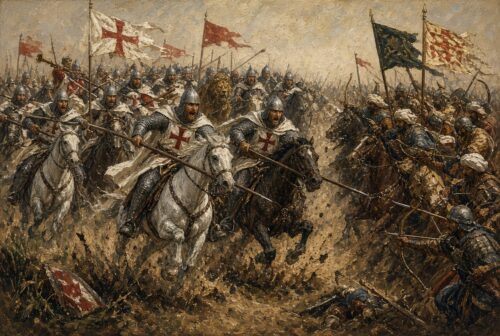


Picture this: It’s April 19, 1012, in the muddy flats of Greenwich on the Thames. The air reeks of salt, smoke, and spilled southern wine. A mob of battle-hardened Danish Vikings—longships beached like predatory whales along the river—have turned their Easter feast into a grotesque carnival. Ox bones and cattle skulls fly through the air like macabre confetti. In the middle of their “hustings,” the open-air assembly where they settle scores and divide loot, stands an elderly archbishop in tattered robes. His name is Ælfheah, or Alphege, the 29th Archbishop of Canterbury. He’s been their prisoner for seven brutal months. They want gold—ransom money extracted from the already-taxed English poor. He says no. Not a polite no. A thunderous, principle-fueled, kingdom-protecting no. The Vikings, drunk and furious, pelt him with the leftovers of their feast. One swings an axe butt into the back of his skull. Blood spills on English soil. His holy soul heads to God’s kingdom. And just like that, one man’s refusal to play the extortion game changes the course of Anglo-Saxon history forever.This isn’t some dusty footnote. This is the raw, visceral birth of a saint whose feast day falls exactly on today’s date—April 19—and whose story is packed with enough drama, betrayal, naval terror, political incompetence, and sheer human stubbornness to fill libraries. We’re diving deep into the world of 11th-century England, the relentless Viking storm that nearly broke it, and the one archbishop who refused to bend. Ninety percent of what follows is pure, unfiltered history: the raids, the sieges, the feasts, the politics, the miracles, and the legacy that echoed through centuries. Only at the end do we flip the script and extract a razor-sharp, wildly unique modern plan—no generic “be authentic” fluff, no recycled self-help mantras. Just a quick, battle-tested protocol drawn straight from Alphege’s axe-proof spine that you can deploy in your own life tomorrow. Let’s rewind to set the stage properly. England in the late 900s and early 1000s was a land under siege—literally. The Anglo-Saxon kingdoms had unified under kings like Alfred the Great a century earlier, but fresh waves of Scandinavian raiders kept crashing ashore. These weren’t the horn-helmeted cartoons of Hollywood; these were professional seafarers, traders turned pirates, farmers seeking glory and gold. Their longships—shallow-draft marvels of clinker-built oak—could sail up rivers, beach on any shore, and disgorge dozens of warriors armed with axes, spears, and shields. By the reign of King Æthelred II (nicknamed “the Unready,” meaning “ill-advised” or “lacking good counsel”—a brutal burn from chroniclers), the raids had escalated from hit-and-run looting to full-scale invasions. Æthelred’s solution? Danegeld—massive cash tributes paid to the Danes to buy peace. It started small but ballooned. In 991, after the Battle of Maldon, he forked over 10,000 pounds of silver. By 1002, another 24,000 pounds. In 1007, 36,000 pounds. Think about that: entire kingdoms taxed to the bone, monasteries stripped, peasants starving, all to fund the very ships that would return next season for more. It was like paying your bully’s lunch money so he’ll leave you alone—except the bully uses it to buy a bigger bat. Historians still debate whether Æthelred was weak or strategically buying time, but the result was clear: the policy backfired spectacularly, signaling weakness and inviting bigger armies.
Enter our hero, Ælfheah. Born around 953 in Weston, Somerset, to a noble family, he chose the monastic life early. He trained at Deerhurst Abbey, then moved to Bath where he became an anchorite—a hermit walled into a cell with only a small window for food and prayer. Austerity wasn’t a trend for him; it was oxygen. By the 970s or early 980s he rose to abbot of Bath Abbey (possibly sharing duties with a predecessor named Æscwig). Chronicler William of Malmesbury later claimed he’d also been at Glastonbury, but that’s debated—either way, his reputation for piety and learning spread. In 984, thanks to the influence of the great reformer Archbishop Dunstan of Canterbury, Ælfheah was elected Bishop of Winchester. He threw himself into the role with medieval gusto. He commissioned a monstrous organ for the Old Minster—big enough that its sound carried over a mile and required more than two dozen men to pump the bellows and play the keys. He built and enlarged churches across the city. He championed the cults of local saints like Swithun and Æthelwold, presiding over Æthelwold’s grand translation of relics in 996. He negotiated with Vikings too: after the 994 raid, he likely played a role in the treaty with Norwegian king Olaf Tryggvason, who converted to Christianity—possibly with Ælfheah confirming him in the faith. Peace treaties and baptisms were diplomatic tools, but they didn’t stop the raids for long. By 1006, Ælfheah succeeded Ælfric as Archbishop of Canterbury. He traveled to Rome that year (or 1007) to collect his pallium—the woolen band symbolizing metropolitan authority—from Pope John XVIII. Robbers ambushed him en route; even archbishops weren’t immune to highwaymen. Back home, he continued Dunstan’s reforms: he commissioned a new Life of Dunstan by Adelard of Ghent, introduced fresh liturgical practices, and got the Witenagemot (the king’s council) to recognize Wulfsige of Sherborne as a saint. He sent the scholar Ælfric of Eynsham to run a monastic school. In 1008 he sat through Wulfstan II of York’s fiery sermon *Sermo Lupi ad Anglos* (“Sermon of the Wolf to the English”), which blamed moral decay—greed, injustice, broken oaths—for inviting divine punishment in the form of Viking swords. The archbishop was no passive observer; he was trying to hold the spiritual and moral center while the kingdom teetered. The storm broke in September 1011. A massive Danish army, commanded by leaders including the formidable Thorkell the Tall (a Christian convert in some accounts, but still very much a Viking warlord), laid siege to Canterbury. The city held for three weeks—from the 8th to the 29th—before betrayal from within. Ælfmær, abbot of St Augustine’s Abbey, whose life Alphege had once saved, allegedly helped the Danes breach the defenses. The raiders sacked the city, looted the cathedral, burned parts of it, and hauled off captives: Bishop Godwine of Rochester, Abbess Leofrun of St Mildrith’s, the king’s reeve Ælfweard, and—most prized—Archbishop Ælfheah himself. They dragged their prisoners downriver to their ships moored at Greenwich. For seven months the archbishop languished in captivity. The Vikings demanded an enormous ransom specifically for him—on top of the 48,000 pounds of silver the English had just paid the army as general Danegeld that Easter. Alphege refused. Flat-out. He forbade anyone from paying it, arguing it would further impoverish the already-burdened English people and reward the very violence destroying the kingdom. No negotiations, no compromises, no secret back-channel deals. He was willing to die rather than enable the cycle. Fast-forward to April 19, 1012—Saturday in the octave of Easter. The Viking camp was buzzing. Wine from the south had flowed freely; the warriors were “very drunk,” as the Anglo-Saxon Chronicle bluntly records. Frustrated by the archbishop’s stubbornness, they hauled him before their hustings. The E version of the Chronicle gives us the chilling play-by-play: “The raiding-army became much stirred up against the bishop, because he did not want to offer them any money, and forbade that anything might be granted in return for him. Also they were very drunk… Then they seized the bishop, led him to their hustings… and then pelted him there with bones and the heads of cattle; and one of them struck him on the head with the butt of an axe, so that with the blow he sank down and his holy blood fell on the earth, and sent forth his holy soul to God’s kingdom.”
Contemporary accounts add color. Thorkell the Tall tried desperately to intervene, offering everything he owned except his ship in exchange for the archbishop’s life. Some later chroniclers say a converted Dane named Thrum delivered the fatal axe blow as an act of mercy after the bone-pelting had already left Alphege broken and bleeding. Either way, it was brutal, chaotic, and utterly pointless—except it wasn’t. Alphege became the first Archbishop of Canterbury to die a violent death. His body was carried to London and buried with honor in the Old St Paul’s Cathedral by order of the king. The aftermath rippled outward like waves from a longship’s wake. Thorkell the Tall, appalled by the murder, defected to King Æthelred’s side and fought for the English. In 1023, the Danish king Cnut (who had conquered England by then) ordered the archbishop’s remains translated to Canterbury Cathedral in a magnificent ceremony. Miracles were soon reported at the tomb—healings, visions, the usual medieval saintly greatest hits. Pope Gregory VII formally canonized him in 1078. Lanfranc, the post-Conquest Norman archbishop, kept Alphege (along with Augustine) on the calendar when other Anglo-Saxon saints were sidelined. Anselm of Canterbury rebuilt the shrine in the early 12th century. Thomas Becket prayed to Alphege just before his own murder in 1170, drawing strength from his predecessor’s example. Churches sprang up dedicated to him: St Alfege’s in Greenwich (on the very spot of the martyrdom), one in Solihull, others in Kent and Winchester. Even in late-medieval Scandinavia, thanks to Cnut’s influence, his feast was observed. Artistically, he’s depicted holding an axe or a pile of stones (a later hagiographic flourish equating the bone-pelting to stoning). Osbern of Canterbury wrote a Life of Saint Ælfheah—hagiographic and full of biblical parallels, but it preserved the core story. The Anglo-Saxon Chronicle remains our most reliable eyewitness-level source. Historians today see Alphege’s death as a pivot: it highlighted the moral cost of endless tribute, galvanized English resistance in some quarters, and accelerated the Christianization of incoming Scandinavians. One man’s principled stand didn’t stop the Viking age overnight—Cnut still became king—but it planted a seed of integrity that outlasted swords and longships. The sheer absurdity makes it memorable. Imagine burly, battle-scarred warriors, fresh off plundering a cathedral, getting sloppy drunk and turning their victory feast into a deadly game of “pin the ox skull on the archbishop.” It’s grotesque, darkly comic, and profoundly human—all at once. Yet beneath the chaos was steel: Alphege’s refusal wasn’t suicidal stubbornness. It was calculated defiance. Paying would have signaled that high-value clerics were profitable hostages, encouraging more raids. It would have drained the realm further. By saying no, he protected the collective even as it cost him everything. Now, here’s where the history lesson pays dividends in your own life. Alphege’s outcome—martyrdom that became sainthood, a legacy of moral courage that influenced kings, popes, and future archbishops—proves that refusing to enable bad systems creates ripples far beyond the immediate cost. In 1012, one archbishop’s “no” disrupted the Viking business model and modeled integrity for a kingdom on the brink. Today, that same refusal can shield you from personal raiders: toxic relationships demanding emotional Danegeld, workplaces pressuring ethical shortcuts, or internal voices urging you to compromise for quick peace.
Here are the specific benefits you reap by channeling Alphege’s stand: - **You break the cycle of escalating demands.** Just as paying Danegeld invited bigger raids, caving to one unreasonable “ransom” (extra hours without pay, tolerating disrespect, ignoring your boundaries) trains others to demand more. Saying no early protects your future bandwidth and self-respect. - **You preserve resources for what matters.** Alphege refused to impoverish the poor further. In your life, that translates to safeguarding time, energy, and money for your real priorities—family, health, creative work—instead of bleeding them into black holes of obligation or guilt. - **You earn long-term respect and legacy.** Vikings respected (and defected to) strength of character. Modern “raiders”—colleagues, partners, even your own habits—do the same. People notice when you hold the line; it inspires loyalty and deters opportunists. - **You cultivate unshakeable inner peace.** Alphege faced death with clarity because his principles were settled. You sleep better, stress less, and move through chaos with the calm of someone whose core is non-negotiable. - **You accelerate bigger victories.** His death helped shift alliances (Thorkell’s defection) and fueled the cult that strengthened English identity. Your principled stands create unexpected allies and open doors you couldn’t have forced. Ready for the part that separates this from every other self-help screed online? Most advice tells you to “set boundaries” or “say no more often.” Cute. This is the **Alphege Axe Protocol**—a five-day, Viking-raid-proof integrity challenge that’s absurdly specific, historically anchored, and engineered to be executed in under 15 minutes a day. No journals full of affirmations. No vision boards. Just targeted actions modeled on the archbishop’s seven-month captivity and final stand. You’ll treat your life like 1012 England: identify the raiders, refuse the ransom, endure the pelting, and watch your personal “kingdom” stabilize.
**Day 1: Map the Longships (Audit the Demands)** List every active “Viking demand” in your life—situations where someone or something (boss, family member, social media, your own procrastination) is holding you hostage for emotional, financial, or time ransom. Write them as if you’re the Anglo-Saxon Chronicle: blunt, factual, dated. Example: “Colleague keeps dumping last-minute work expecting me to stay late—costs me family dinners.” Limit to five. This is your siege reconnaissance. **Day 2: Channel the Anchorite (Fortify Your Cell)** Pick the biggest demand and build your “hermit cell”—a non-negotiable boundary statement. Phrase it like Alphege: “I will not pay this ransom because it impoverishes [my health/family/future goals].” Write it on a card. Practice saying it out loud once, imagining drunk Vikings jeering. No explanations, no apologies. Austerity training starts here. **Day 3: Hold Your Hustings (Convene Your Inner Council)** Gather one or two trusted “thegns” (friends or mentors) for a 10-minute virtual or real talk. Present the demand and your refusal plan. Listen to input but decide alone, exactly as Alphege forbade others from paying on his behalf. End by declaring your decision aloud. This builds accountability without outsourcing your spine. **Day 4: Endure the Bone Pelting (Stress-Test the Refusal)** Deliberately trigger mild pushback today. Send the “no” message or enforce the boundary in real time. When the inevitable flak flies (guilt trips, anger, silent treatment), visualize ox skulls bouncing off your shield. Note how you feel after 24 hours. Most people cave here; you won’t. This is the axe-butt moment—lean into the temporary discomfort. **Day 5: Translate the Relics (Lock in the Legacy)** Document the outcome in a one-paragraph “chronicle entry.” What shifted? What unexpected ally appeared? What did you protect? Then perform a small ritual: light a candle (or just make coffee) and toast “to the kingdom that endures.” Schedule a quarterly review—your personal translation to Canterbury. Repeat the full protocol anytime new longships appear on the horizon. Execute this once and you’ll feel the difference: lighter shoulders, clearer decisions, and the quiet swagger of someone who just outlasted a drunken mob. Alphege didn’t survive the day, but his “no” outlived empires. Yours can too. The Vikings eventually became Normans, then English. The raids faded. But the archbishop who refused their gold is still remembered every April 19. History doesn’t reward the loudest or richest—it remembers the ones who held the line when it counted. Your life is no different. Today, on the anniversary of bones flying and blood spilling, decide: will you pay the ransom, or will you stand? The axe is waiting. Swing it your way.
Share: