
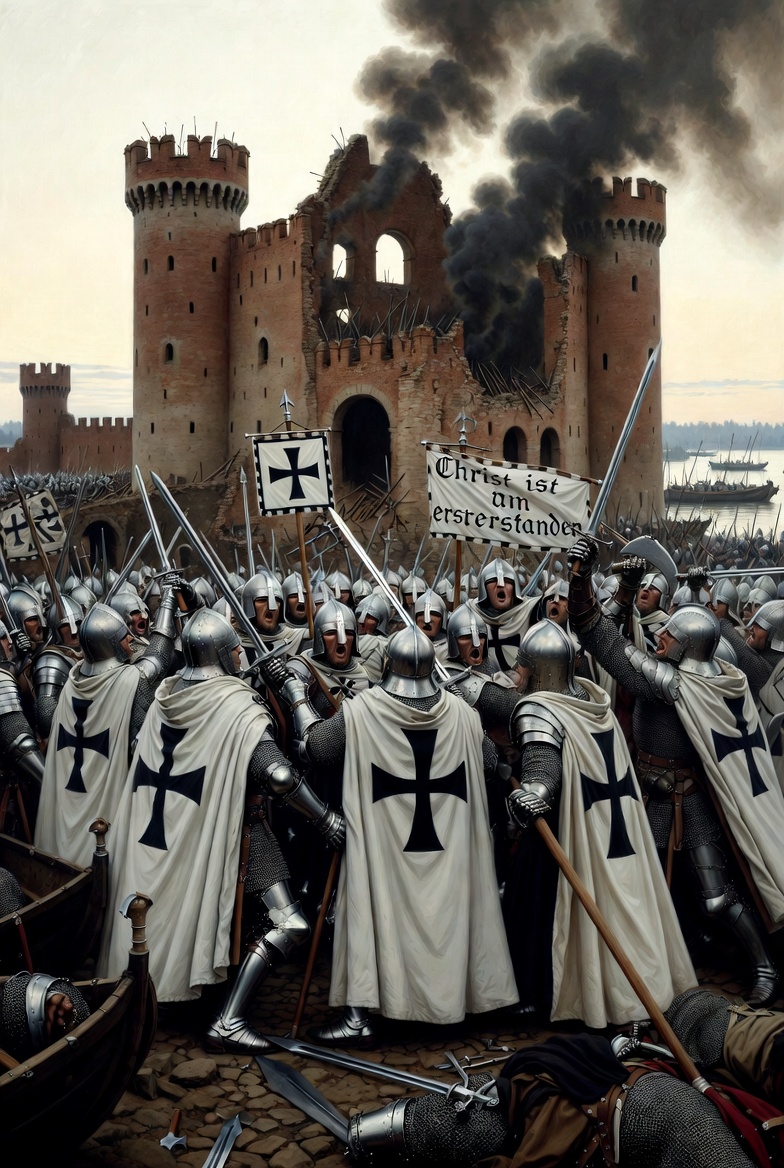
On April 17, 1362—Holy Saturday, the day before Easter—the Teutonic Order’s Grand Master Winrich von Kniprode stood amid the smoking ruins of Kaunas Castle and ordered his multinational army of armored knights, crossbowmen, and siege engineers to belt out the Easter hymn *Christ ist erstanden*. “Christ is risen!” they sang in triumphant Latin and German, their voices echoing across the freshly breached brick walls of the Grand Duchy of Lithuania’s newest and most ambitious fortress. The pagan defenders inside had fought like cornered wolves: 350 of them lay dead, another 37—including the commander, Vaidotas, son of the legendary defender Kęstutis—dragged off in chains. The castle, the first major brick structure the Lithuanians had ever dared to build, was torched, razed, and abandoned. The crusaders sailed back down the Nemunas River the next day, mission accomplished. Or so they thought.What looked like a total Teutonic triumph on that holy spring morning was actually the spark that lit a slow-burning fuse under the entire Northern Crusades. Lithuania didn’t crumble. It rebuilt faster, struck harder, and ultimately outlasted the Order that had spent over a century trying to baptize it at swordpoint. The fall of Kaunas Castle wasn’t the end of pagan resistance—it was the moment the Lithuanians upgraded their entire defensive game, turned temporary loss into permanent strategic wisdom, and set the stage for one of medieval Europe’s most improbable power shifts. By the time the smoke cleared decades later, the Teutonic Knights were the ones singing a different tune—at the Battle of Grunwald in 1410, where a Polish-Lithuanian army annihilated them so thoroughly that the Order never recovered. This isn’t just dusty medieval trivia. It’s a masterclass in how a single, spectacular setback on a specific calendar date can become the foundation for long-term dominance—if you know how to read the ruins correctly. Today, in 2026, the exact same principle applies to your individual life. The outcome of April 17, 1362, wasn’t defeat; it was data. The Lithuanians learned exactly where their “wooden” habits were vulnerable, upgraded to brick-level resilience, recruited unexpected allies, chronicled every assault like obsessive war correspondents, and rebuilt before the enemy could capitalize. You can do the exact same thing with the “sieges” life throws at you—deadlines, distractions, self-doubt, financial ambushes—without ever picking up a sword or singing a hymn (unless you want to, for dramatic effect). Let’s dive deep into the history—because 90 percent of this story deserves every bloody, muddy, arrow-filled detail. Only then can we extract the razor-sharp, anti-self-help lessons that actually work in 2026. ### The Long Shadow of the Northern Crusades: Why Pagan Lithuania Refused to Die To understand why April 17, 1362, mattered so much, we have to rewind to the 1230s, when the Teutonic Order—originally a German hospital brotherhood from the Holy Land—got invited (and then ordered) by the Pope and various Polish dukes to “Christianize” the pagan Prussians along the Baltic coast. These weren’t gentle missionaries. The Order combined monkish discipline with knightly brutality: white mantles emblazoned with black crosses, iron discipline, and a charter that let them conquer, convert, and tax any pagans they could reach. By the 1280s they had turned Prussia into their own semi-independent Ordensstaat—a militarized theocracy with stone castles every few miles, river fleets, and annual “reysas” (crusading raids) that brought in fresh batches of glory-hungry knights from France, England, and Italy who treated the Baltic like a medieval adventure park. Lithuania was next. Unlike the fragmented Prussian tribes, the Grand Duchy was a rising pagan superpower. Under Grand Duke Gediminas (r. 1315–1341), it had exploded eastward, swallowing huge chunks of what is now Belarus, Ukraine, and western Russia. Gediminas was a master diplomat: he wrote polite letters to the Pope promising conversion while simultaneously marrying his daughters into European royalty and building wooden forts along the Nemunas River frontier. His sons Algirdas and Kęstutis perfected the tag-team rulership. Algirdas handled the east—pushing toward Moscow and the Black Sea steppes. Kęstutis, the iron-willed western guardian, lived in the forests and marshes, raiding Teutonic territory as often as they raided his. He escaped captivity three separate times, once by setting his own prison on fire and riding out on a stolen horse. Lithuanian warriors were light cavalry experts—fast, deadly with javelins and axes, masters of hit-and-run ambushes through the endless woodlands. They worshipped Perkūnas the thunder god, practiced sacred oak rituals, and saw no reason to trade their freedom for a foreign god who seemed suspiciously allied with land-hungry Germans.
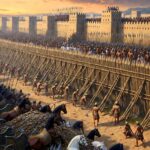
By the 1350s the frontier along the Nemunas (Neman) River had become a chessboard of fortifications. The Teutonic side had sophisticated stone and brick Ordensburgen—fortresses with moats, towers, and supply chains. Lithuanian forts were mostly wood and earth: quick to build, easy to burn. But wooden walls had a fatal flaw against professional siege engineers. In 1361, Grand Master Winrich von Kniprode—widely regarded as one of the Order’s greatest leaders—sent a scout named Henry of Schöningen to spy on a brand-new Lithuanian project: Kaunas Castle. Kaunas sat at the critical confluence of the Nemunas and Neris rivers, a natural choke point controlling access to the Lithuanian heartland around Trakai and Vilnius. It was their first serious brick-and-stone experiment—double walls up to nine meters high with fighting galleries, a shallow moat, and strategic river frontage. The Lithuanians had finally learned the lesson: wood burns, brick does not. Or so they hoped. ### The Siege Begins: March 13, 1362 – A Textbook Crusader Operation Spring 1362 arrived with perfect crusading weather. Winrich assembled a massive force: Teutonic brothers, Livonian reinforcements from the north, and a glittering roster of “guest knights” from England, Italy, Germany, and beyond. These weren’t conscripts—they were wealthy adventurers who paid their own way for the indulgences, the loot, and the bragging rights back home. They loaded onto riverboats, slipped past the other Lithuanian wooden forts under cover of darkness, and disembarked below Kaunas on March 13. For two full days the crusaders built bridges and causeways across the marshy terrain. Then they went to work with terrifying medieval efficiency. They dug trenches and ramparts to protect their camp. They constructed a canal linking the two rivers, literally turning the castle peninsula into an isolated island. Siege towers rolled forward. Trebuchets—massive counterweight catapults—began lobbing stones the size of beer barrels. Primitive handgonnes (early gunpowder weapons) may even have been used; archaeology is inconclusive, but contemporary accounts hint at “fire-throwing machines” that terrified the defenders. Inside the castle, Vaidotas—Kęstutis’s son and a capable young commander—led roughly 350 seasoned warriors. They answered with arrows, boiling water, logs rolled down the walls, and desperate counter-measures. They even built their own temporary tower by the Neris River to rake the attackers with missile fire. The Teutons quickly destroyed it and dragged the wreckage into the water. The outer wall took pounding after pounding. The Lithuanians repaired the inner wall under fire, night after night.
On March 30 a Lithuanian relief force under both Algirdas and Kęstutis appeared on the opposite bank. But the Teutonic engineers had fortified the river neck so well that any crossing would have been suicidal. The grand dukes held back—smart tactics, but heartbreaking for the men trapped inside. By April 10 the Livonian Order’s reinforcements arrived, tightening the noose. Kęstutis tried to negotiate directly with Winrich von Kniprode. The Grand Master, ever the pragmatist, refused. No mercy for pagans holding a strategic brick prize. ### Holy Saturday, April 17, 1362: The Fall and the Hymn The final assault was brutal and methodical. The Teutons used fire as the ultimate siege weapon: bundles of wood and resin-soaked kindling hurled over the walls to ignite the inner wooden buildings. The outer wall finally collapsed under sustained bombardment, burying defenders and attackers alike. The inner wall followed. Vaidotas and his remaining men fought a last-stand breakout attempt, but the numbers were overwhelming. Thirty-seven survivors, including Vaidotas, were taken prisoner. The castle fell on Holy Saturday. According to the Teutonic chronicler Wigand of Marburg—whose *New Prussian Chronicle* is our primary eyewitness source—the victorious army spontaneously burst into *Christ ist erstanden*, the joyous Easter resurrection hymn. Picture it: mud-caked knights, smoke-blackened faces, blood on their swords, singing about new life while standing on the still-warm corpses of pagan warriors whose only crime was refusing to convert on demand. The irony is delicious and darkly funny. The crusaders had come to bring salvation; instead they delivered a masterclass in how not to win hearts and minds. The next day, April 18, the entire Teutonic force packed up and sailed home. They didn’t even try to garrison the site. The castle was demolished and burned. Mission complete.
### The Aftermath: Why This “Defeat” Was Lithuania’s Greatest Gift At first glance, Kaunas looked like a disaster. The Nemunas frontier was breached. In 1363 the Teutons followed up by destroying Veliuona and Pieštvė. Central Lithuania lay open to raids on Trakai and Vilnius. The brick experiment had failed spectacularly. But here’s where the story flips. The Lithuanians did not despair. Kęstutis and Algirdas immediately began rebuilding—on the exact same foundations, only stronger. By 1368 Kaunas Castle rose again, this time with lessons learned: better moats, more sophisticated outworks, and a renewed emphasis on rapid reinforcement. The fall had exposed exactly which tactics worked against brick and which didn’t. Lithuanian counter-raids intensified. They struck deep into Prussia, burning Teutonic farms and monasteries. The Order’s annual reysas became more expensive and less profitable. The long-term ripple effects were enormous. The pressure on Lithuania forced political evolution. In 1386 Grand Duke Jogaila (Algirdas’s son) married Queen Jadwiga of Poland, converted to Christianity (on his own terms), and created the Polish-Lithuanian union—the largest state in Europe at the time. The Teutonic pretext for crusading evaporated, yet they kept attacking anyway. That arrogance culminated at Grunwald on July 15, 1410, when the combined Polish-Lithuanian army, led by Jogaila and his cousin Vytautas (Kęstutis’s grandson), crushed the Teutonic Knights in history’s largest medieval battle. The Order never recovered its prestige or power. Lithuania had survived, converted strategically, and flipped the script from victim to conqueror. The brick castle that fell on April 17, 1362, taught a simple truth: temporary structural failure is not strategic failure. It is intelligence. The Lithuanians turned one lost fortress into an upgraded defensive doctrine that ultimately outlived the entire crusading enterprise. ### How the Outcome of April 17, 1362, Benefits You Today The same mechanics that turned a ruined brick fortress into the seed of a superpower apply directly to your personal life. Here are the precise, non-fluffy ways this historical fact upgrades your daily existence: - **You learn to treat every “breach” as diagnostic data instead of personal failure.** Just as the Lithuanians studied exactly how the Teutonic trebuchets collapsed their outer wall and rebuilt accordingly, you can autopsy your last missed deadline, blown budget, or relationship argument and reinforce the exact weak point with a permanent system rather than a temporary patch. - **You upgrade from “wooden” habits to “brick” systems that survive real sieges.** Wooden forts burned fast because they were quick-and-dirty. Your current routines—New Year’s resolutions, vague “I’ll try harder” promises—are wooden. Brick habits are engineered: specific, redundant, and tested under fire. One month-long siege in 1362 forced Lithuania to innovate; one honest review of your last setback can do the same for you. - **You recruit “guest knights” from unexpected places.** The Teutonic victory relied on English, Italian, and Livonian allies who weren’t even local. Translate that: your next big project doesn’t need perfect insiders—it needs one or two unconventional outsiders whose skills or perspectives you never considered. The right “guest knight” turns a solo defense into an overwhelming counter-attack. - **You chronicle your sieges with ruthless honesty and dark humor.** Wigand of Marburg didn’t sugar-coat the blood and smoke—he recorded it for posterity. Keeping your own “New Prussian Chronicle” (a private daily log of assaults, defenses, and rebuilds) turns emotional chaos into usable intelligence and prevents the same wall from collapsing twice. - **You celebrate the fall with resurrection energy.** The crusaders sang on Holy Saturday because they believed defeat was temporary. You can do the same: reframe every personal Kaunas moment as the day before your own “Easter”—the moment you rise stronger, rebuilt, and ready to strike back. - **You rebuild in days, not decades.** Kęstutis didn’t wait years to reconstruct Kaunas; he moved within months. Speed of recovery becomes your superpower. The faster you rebuild after a professional, financial, or personal collapse, the less territory the “enemy” (chaos, doubt, competitors) can claim. ### The Kaunas Fortress Protocol: Your Quick, Unique, Anti-Self-Help Rebuild Plan Forget vision boards, morning affirmations, or generic “rise and grind” advice. This is a medieval siege-engineer’s blueprint—practical, ruthless, and engineered for real-world pressure. It takes one focused hour to set up and runs on autopilot afterward. Call it the **Kaunas Fortress Protocol**. It turns any life setback into a deliberate, documented upgrade. **Step 1: Scout and Map Your Frontier (10 minutes).** Identify your personal “Nemunas River”—the one strategic area where everything else flows through (career bottleneck, health keystone, relationship linchpin, or financial chokepoint). Write it down like a 14th-century scout report: exact location, current defenses (what you’re already doing), and obvious vulnerabilities (what always collapses first). **Step 2: Recruit Your Guest Knights (15 minutes).** Send three short messages to unconventional allies—someone outside your usual circle whose skills complement yours (a friend’s accountant, a colleague’s mentor, an online expert you’ve never met). Offer them something small in return (coffee, credit, introduction). Frame it as a joint defense contract, not a favor. Historical note: the Teutonic victory came from outsiders; your breakthroughs will too.
**Step 3: Build the Brick Layer (20 minutes).** Design one single, redundant “brick” habit that directly counters the vulnerability you scouted. Make it idiot-proof and siege-resistant: e.g., if procrastination is your outer wall, create a “double-wall rule” where you must complete the hardest task before touching your phone, with a public accountability log. Test it once today. It must survive fire—meaning it works even when you’re exhausted or distracted. **Step 4: Chronicle the Siege Daily (5 minutes every evening).** Keep a one-paragraph “Wigand Report”: what attacked today, how your walls held or cracked, what the enemy (distractions, doubt, external chaos) tried, and one tactical note for tomorrow. Add dark humor. The act of writing turns emotion into intelligence and prevents repeated mistakes. **Step 5: Rebuild at Dawn (immediate counter-action).** The morning after any breach—missed workout, blown deadline, argument—execute a 15-minute “Kaunas Rebuild Drill”: fix the exact broken piece, reinforce it with the new brick habit, and log the upgrade. Speed is everything. Lithuania rebuilt in months; you rebuild in hours. Do this for 21 straight days and the protocol becomes automatic. **Step 6: Sing the Hymn on Holy Saturday Moments (instant mindset shift).** When something genuinely collapses, pause, smile, and literally say (or sing, if you’re feeling theatrical) “Christ ist erstanden”—or any personal resurrection phrase. It signals to your brain: this is data, not defeat. Then immediately trigger Step 5. The psychological edge is massive. **Step 7: Annual Reassessment (once a year on April 17).** Review your chronicles. Celebrate what survived. Demolish what didn’t. Upgrade to the next-level fortress. The original Kaunas siege happened on this exact date; use the anniversary as your personal fortress audit day. This protocol is nothing like the self-help industrial complex. No manifestation. No toxic positivity. Just medieval engineering applied to modern chaos: scout, recruit, fortify, chronicle, rebuild, celebrate, repeat. It works because it mirrors exactly what the Lithuanians did after April 17, 1362—they turned a smoking ruin into the foundation of an empire that outlived its attackers. So the next time life feels like it’s besieging you with trebuchets and fire arrows, remember the brick castle on the Nemunas. It fell on Holy Saturday 1362. The defenders sang no hymns that day—but the people who learned from its fall eventually made history sing theirs. Your turn starts now. Build the brick. Recruit the knights. Chronicle the siege. And when the wall comes down, rebuild before breakfast. The outcome of that distant April 17 belongs to you today—if you choose to wield it. The Teutonic Order thought they’d won. Lithuania proved them wrong for centuries. One fortress at a time.
Share: