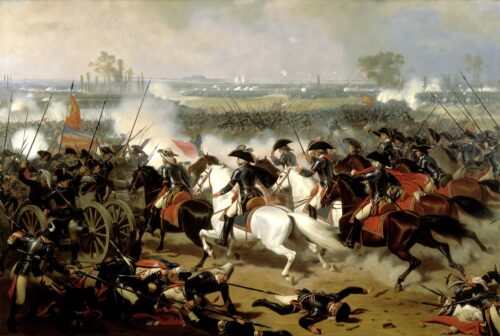

On July 9, 1755, in the dense, mosquito-infested forests near what is now Braddock, Pennsylvania, one of the most humiliating military disasters in British imperial history unfolded along the banks of the Monongahela River. A formidable British force—disciplined redcoats, gleaming artillery, and colonial auxiliaries—marched confidently toward Fort Duquesne, expecting an easy triumph over the French. Instead, they walked straight into a masterclass in asymmetric warfare delivered by a scrappy alliance of French Canadians, colonial militia, and, most decisively, hundreds of Native American warriors from tribes like the Ottawa, Ojibwa, Potawatomi, Huron, and others. The result? Nearly two-thirds of the British flying column became casualties in a few chaotic hours. General Edward Braddock lay mortally wounded, his grand expedition in tatters, and the road to a global war—later called the Seven Years’ War or French and Indian War—paved with British blood and colonial disillusionment.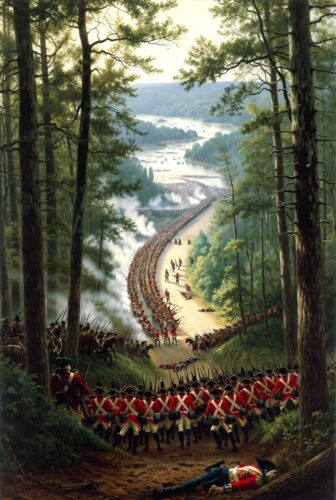
This wasn’t just another colonial skirmish. It was a brutal collision of worlds: rigid European linear tactics versus the fluid, terrain-savvy guerrilla style of the North American wilderness. The battle exposed the arrogance of empire, the power of adaptation, and the lethal effectiveness of underdogs who refused to play by the opponent’s rules. For modern readers building their own “personal empires”—careers, creative projects, fitness goals, or businesses—the lessons scream across the centuries: rigid plans fail in chaotic terrain; scouts and allies win more than brute force; and surviving a rout often forges the leaders who rewrite history. Let’s dive deep into the gritty, often hilarious-in-hindsight details of that fateful July day, then extract a fresh, no-BS plan for applying its hard-won wisdom to your life today.
### The Road to Disaster: Braddock’s Arrogant March
The backstory begins in the contested Ohio Country, a vast wilderness claimed by both Britain and France but truly dominated by Native nations whose hunting grounds, alliances, and trade networks made them the real power brokers. By the early 1750s, French forts like Duquesne (at the forks of the Ohio River, modern Pittsburgh) threatened British expansion. Virginia’s young militia officer George Washington had already tangled with the French in 1754 at Fort Necessity, suffering a humiliating surrender that only inflamed tensions.
Enter Major General Edward Braddock, a 60-year-old career British officer with a reputation for discipline but zero experience in American forests. Dispatched by London as Commander-in-Chief in North America, he arrived with two regiments (the 44th and 48th Foot) from Ireland. He bolstered them with provincial troops from the colonies, aiming for a multi-pronged offensive against French holdings. Braddock’s target: seize Fort Duquesne, then push to Niagara. Sounds straightforward on paper—European firepower conquering “savages” and frog-eaters.
Braddock’s force swelled to about 2,200 by the time it departed Fort Cumberland, Maryland, on May 29, 1755. But problems piled up faster than wagons on a muddy trail. The general scorned local knowledge, recruiting only a handful of Mingo scouts. He dismissed colonial rangers’ advice on wilderness fighting, insisting on parade-ground precision. The road—carved laboriously through mountains, rivers, and thickets—slowed everything. Artillery, supply wagons, and camp followers (including dozens of women) turned the advance into a lumbering beast. Supplies dwindled; disease and desertion nipped at the heels.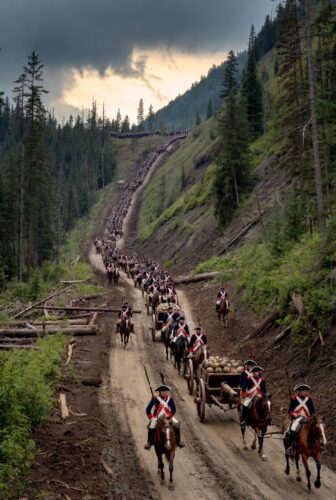
Frustrated, Braddock split his command. He pushed ahead with a “flying column” of roughly 1,300 men—mostly regulars, some provincials, light artillery—leaving the slower baggage train behind under Colonel Thomas Dunbar. By early July, this vanguard had crossed the Alleghenies, enduring brutal heat, insects, flooded rivers, and the constant, eerie sense of being watched. They forded the Monongahela River twice on July 9 to bypass tricky narrows, emerging cocky and close to their prize—only 10 miles from Fort Duquesne. Many expected the French to bolt at the sight of disciplined redcoats.
Meanwhile, at the fort, French commander Claude-Pierre Pecaudy de Contrecœur faced long odds but acted decisively. With limited regulars and militia, he relied on Native allies. He dispatched Captain Daniel Liénard de Beaujeu, a veteran Canadian officer, with about 891 men: 108 troupes de la Marine, 146 militia, and crucially, around 637 warriors from multiple nations. Beaujeu’s plan? Intercept and harass. The Indians weren’t mere auxiliaries—they were the backbone, fighting on home turf with intimate knowledge of every ravine, tree, and ridge.
### July 9: The Meeting Engagement That Became a Massacre
Dawn on July 9 broke with the British in high spirits after their double river crossing. Advance guard under Lieutenant Colonel Thomas Gage (future British commander in the Revolution) pushed forward. The column snaked along a narrow road flanked by dense forest—perfect killing ground, though Braddock’s men didn’t see it that way. They marched in tight formations, drums beating, colors flying, as if on a European battlefield.
Beaujeu’s force arrived late for a planned ambush but stumbled into a meeting engagement. Around 2 PM, the French and Indians spotted Gage’s vanguard. Beaujeu, in a flashy Canadian officer’s uniform, tried to rally his men. Gage’s grenadiers opened fire; their volleys cut down Beaujeu and several others. For a moment, it looked like British discipline might prevail—some French and Canadians fled back toward the fort.
But the Indians? They melted into the trees, using cover like ghosts. They spread out in a wide arc, enveloping the British flanks. War whoops echoed—terrifying psychological warfare that unnerved even veterans. Invisible snipers poured accurate fire from behind logs, rocks, and foliage. British platoons fired blindly into the woods, often hitting their own comrades or trees. The narrow road became a nightmare: men collided, orders were lost in the din, formations crumbled as wounded horses and falling soldiers created bottlenecks.
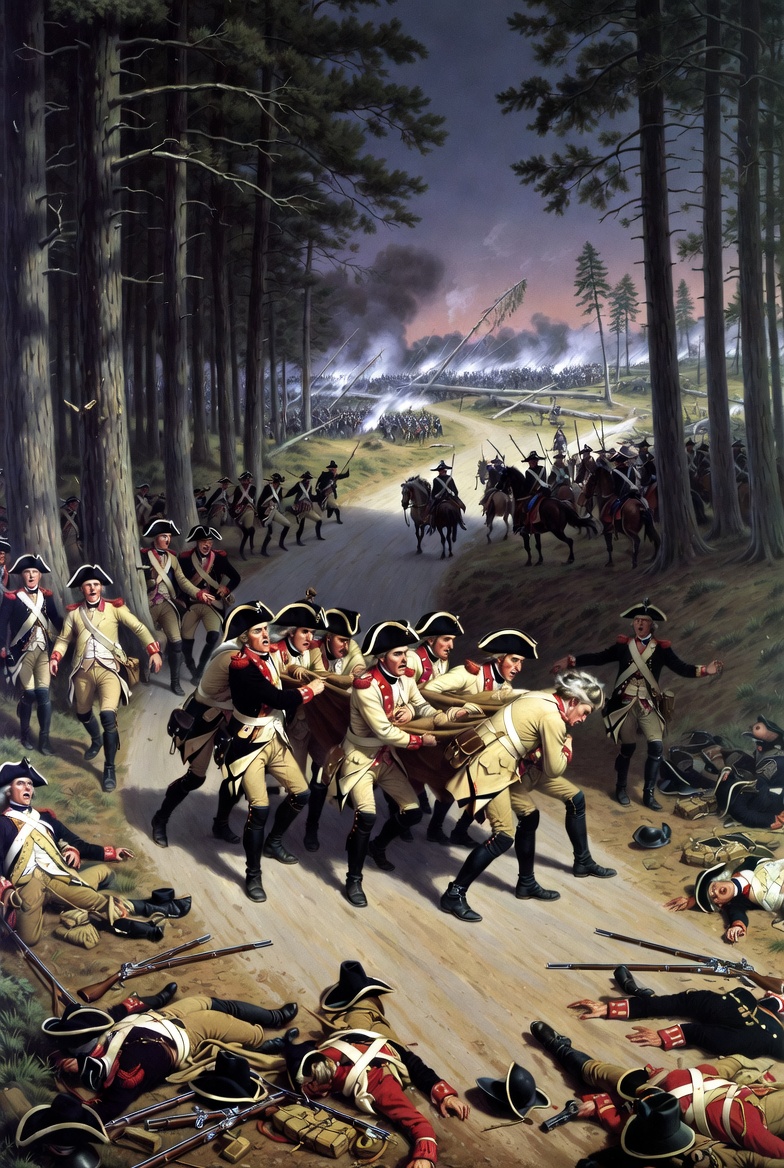
Braddock rode forward repeatedly, cursing and rallying with his sword. He had horses shot from under him but kept trying to impose order. Provincial troops who took cover behind trees were sometimes mistaken for enemies by panicking regulars and fired upon. Cannons were dragged up but had no clear targets or room to maneuver. Smoke, screams, and the relentless crack of musketry turned the scene into pandemonium. Washington, serving as an aide (and already battle-hardened), dashed about on horseback, miraculously untouched despite bullets piercing his coat and killing two horses beneath him.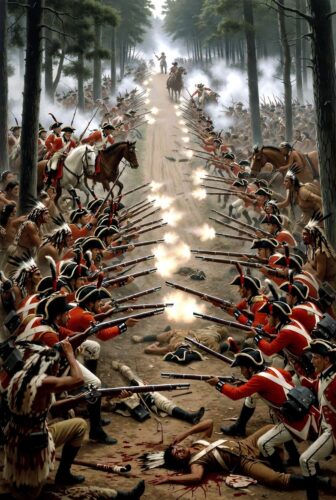
After three grueling hours, Braddock took a bullet to the lung—possibly friendly fire. Chaos peaked. The retreat began orderly but dissolved at the river crossing under renewed attacks. Indians swarmed the field afterward, scalping, looting, and capturing rum (which they drank in celebration). Captives faced grim fates; some were tortured. The British left behind a trail of dead, wounded, and abandoned gear. Of the ~1,300 in the flying column, 457 were killed and over 450 wounded—devastating officer losses (63 of 89 killed or wounded). French and Indian losses: around 39 killed, 57 wounded. A stunning upset.
Braddock died on July 13, reportedly muttering regrets about underestimating the enemy and praising Washington’s coolness. Washington buried him in the road near Fort Necessity, marching troops over the grave to hide it from desecration. Dunbar’s rear force burned supplies and retreated in panic, abandoning much of the expedition’s might. Fort Duquesne stayed French until 1758.
### Deeper Historical Ripples: From Wilderness Rout to Global War and Revolution
This wasn’t an isolated flop. Braddock’s Defeat shocked the colonies, exposing British vulnerabilities and boosting French-Native confidence. It escalated the French and Indian War into the Seven Years’ War (1756–1763), a truly global conflict involving Europe, India, the Caribbean, and beyond. Britain ultimately prevailed, expelling France from much of North America—but at enormous cost. The war’s debts and taxes fueled colonial resentment, planting seeds for the American Revolution. Many officers present—Washington, Gage, Horatio Gates, Charles Lee—would face each other again in 1775.
Native nations gained short-term leverage but faced shifting alliances and eventual displacement as British (and later American) power grew. The battle highlighted the limits of European hubris against indigenous knowledge and hybrid warfare. French Canadian tactics—blending European discipline with woodland savvy—proved decisive. Historians like David Preston emphasize Beaujeu’s leadership and Indian discipline over the “Braddock was arrogant” trope; the victors simply fought smarter in that environment.
Funny sidelights abound in the horror: British soldiers, trained to fire volleys in lines, blasting away at “invisible” foes while their own formations self-destructed like a comedy of errors. Camp followers caught in the crossfire. The sheer absurdity of expecting parade drills to conquer a continent of trees. One survivor noted the impossibility of describing the “horrors”—a sentiment echoed in many after-action reports. Yet amid the farce, Washington’s poise shone, forging his legend as the “Hero of the Monongahela.”
### Extracting Gold from the Blood: Timeless Lessons in Adaptability, Alliances, and Antifragility
Ninety percent of this story is raw history—the marches, ambushes, whoops, volleys, and retreats that defined an era. The remaining slice? Pure motivational fuel for today. Empires fall when they ignore terrain (literal or metaphorical). Individuals thrive by scouting, allying wisely, and pivoting when linear plans meet chaotic reality.
Here are very specific bullet points on benefits today, drawn directly from the Monongahela’s hard truths:
– **Master Terrain Intelligence Before Charging Ahead**: Braddock ignored local scouts and wilderness realities, paying in blood. In your life, map your “terrain”—market conditions, personal weaknesses, competitor moves—*before* launching a big project. Spend dedicated time on reconnaissance: talk to mentors, run small tests, analyze data. Benefit: Avoid blind marches that waste months or years. A freelancer skips generic “hustle” advice and niches down after researching client pain points, landing steady gigs instead of scattered proposals.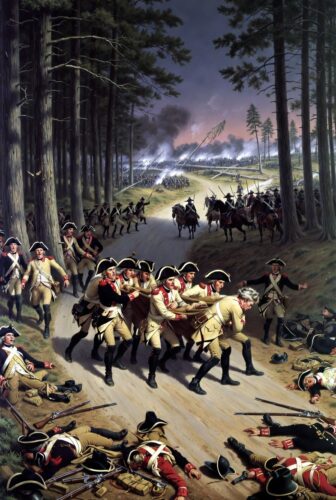
– **Build Hybrid Tactics—Don’t Cling to One Style**: British linear formations failed in forests; Indians used cover, mobility, and psychology. Translate this: Blend proven structures (habits, routines) with flexible improvisation. In fitness, don’t follow rigid gym programs if life throws curveballs—adapt with bodyweight circuits or trail runs. In career, combine corporate skills with entrepreneurial side hustles. Result: Resilience when “the road narrows.” A musician rigidly releasing one genre flops; one who hybrids EDM with motivational history themes (think cinematic drops over epic narratives) builds a unique audience.
– **Forge Unlikely Alliances and Value Local Expertise**: Braddock dismissed colonials and Natives; Beaujeu leveraged them brilliantly. Today, network beyond your bubble—seek diverse mentors, collaborators, or even “frenemies” for honest feedback. A solo entrepreneur partners with complementary creators (e.g., a historian YouTuber teams with AI visual artists) for exponential growth. Benefit: Amplified power without solo burnout. Isolation loses; coalitions win battles.
– **Embrace the Scout’s Mindset for Antifragility**: Washington survived by staying mobile, learning under fire, and maintaining composure. Cultivate constant learning from setbacks. After a “rout” (failed launch, health scare), debrief ruthlessly but move forward. Track “near misses” like scouts spotting ambushes. In investing or creativity, small risks build experience faster than one big gamble. Outcome: Turn disasters into legends, just as Washington did.
– **Maintain Command Presence Amid Chaos**: Braddock rallied despite wounds; Washington imposed order in retreat. Develop calm under pressure through deliberate practice—meditation, simulations, or public speaking reps. Leaders (or self-leaders) who project steadiness retain followers and clarity. A parent or manager facing family/career “ambush” stays composed, de-escalates, and pivots, preserving morale and options.
– **Know When to Retreat and Rebuild**: The British withdrawal saved remnants but exposed deeper flaws. Recognize sunk costs; cut losses smartly. Burn supplies if needed (metaphorically: drop failing strategies). Reorganize at “Dunbar’s camp” and strike smarter next time. Benefit: Survival enables future victories, like Britain’s eventual win in the larger war.
These aren’t fluffy affirmations. They’re battle-tested mechanics for turning personal wildernesses—debt, creative blocks, health flares, relocations—into launchpads.
### Your Unique “Monongahela Maneuver” Plan: A 7-Day Antifragile Reset (Unlike Any Self-Help Template Online)
Forget vision boards, generic gratitude journals, or “hustle harder” mantras. This plan weaponizes the battle’s specifics into a rapid, terrain-aware protocol emphasizing scouting, hybrid adaptation, alliance leverage, and disciplined retreat/rebuild. It’s quick (one focused week), unique (military history as operating system), and executable solo or with a small “unit.” Do it when facing a big push—new job, project launch, habit overhaul, or life transition. Track in a simple notebook: daily “terrain report,” “ambush log,” and “rally orders.”
**Day 1: Reconnaissance March (Map Your Terrain)**
Spend 2-3 hours auditing your current “expedition.” List goals, obstacles (internal/external), resources, and allies/enemies. Walk a literal trail or park while brainstorming—no screens. Identify 3 “narrow roads” (bottlenecks) and scout alternatives. Output: A one-page “march order” with primary route and contingencies. Funny twist: Narrate it aloud like a grizzled scout spotting French signs.
**Day 2-3: Hybrid Tactics Drill (Train Flexible Formations)**
Break your main goal into linear steps *and* adaptive variants. Practice one core skill rigidly (e.g., 30-min focused work block), then improvise variations under “simulated fire” (set timers for distractions, switch environments). For creativity: Write a rigid outline, then freestyle in the woods or noisy café. Log what works. Build “woodland proficiency”—test bodyweight alternatives if gym access fails. Aim: One small win via pivot.
**Day 4: Alliance Assembly (Recruit Your Beaujeus and Warriors)**
Reach out to 2-3 potential allies/mentors with specific value-exchange asks (not vague networking). Join or observe one relevant community (online forum, local meetup, or even historical reenactment group for inspiration). Share one vulnerability or lesson from your “past Necessity” to build trust. Note: Prioritize those with local “terrain” knowledge over status.
**Day 5: Command Simulation (Pressure-Test Presence)**
Role-play a “battle” scenario: Tackle a dreaded task while introducing controlled chaos (background noise, interruptions). Practice verbal rallying (affirmations tied to evidence, not fluff). Review Washington’s poise—journal 3 composure techniques that fit you. Physical: Do a hard workout or cold exposure to simulate stress.
**Day 6: Controlled Retreat Drill (Sunk Cost Purge)**
Audit one ongoing commitment or habit. Ask: Is this advancing the objective? If no, plan an orderly withdrawal (delegate, sunset, or abandon). Redirect resources to high-ground positions. Celebrate the “saved lives” (time/energy). Read a short account of Braddock’s burial for perspective on graceful exits.
**Day 7: After-Action Rally and Next March (Rebuild Stronger)**
Synthesize logs into a refined plan. Celebrate survivals with a symbolic “victory fire” (bonfire, nice meal, or playlist). Set one bold next objective within 30 days, incorporating all elements. Share key insights anonymously online to “rally survivors” and attract more allies. Measure success not by flawless victory but by fewer casualties and faster learning.
Repeat monthly or as needed. This isn’t passive reflection—it’s active campaigning. It works because it’s rooted in a real, bloody event where rigidity died and adaptability conquered. Braddock’s men marched expecting glory; survivors learned to fight like the land demanded. You can too.
In the end, July 9, 1755, reminds us that history’s greatest teachers wear war paint, not crowns. The wilderness doesn’t care about your rank or shiny equipment—it rewards those who read the ground, move with it, and rise from the rout wiser, tougher, and ready for the real campaign ahead. Charge smartly, adapt relentlessly, and turn your Monongahela into the foundation of something unbreakable. The forest awaits—go win it on your terms.
Share: