On June 7, 1494, in the unassuming Castilian town of Tordesillas—known more for its dusty streets, medieval convent, and strategic position along the Duero River than for world-altering diplomacy—representatives of the Catholic Monarchs of Spain (Ferdinand II of Aragon and Isabella I of Castile) and King John II of Portugal put quills to parchment. They signed the Treaty of Tordesillas, an audacious agreement that sliced the unknown globe like a cosmic pie, drawing an imaginary north-south meridian 370 leagues (roughly 1,300–1,500 miles, depending on whose leaky league measurement you trusted) west of the Cape Verde Islands. Lands to the east of this line belonged to Portugal; lands to the west to Spain. No footnotes, no appeals to the Pope (at least not initially), and certainly no input from the millions of Indigenous souls who actually lived there.
This wasn't some polite academic boundary dispute. It was raw power politics dressed in the finery of Renaissance diplomacy, born from the explosive aftermath of Christopher Columbus's 1492 voyage. Columbus had sailed west for Spain, bumped into the Caribbean (which he stubbornly insisted were the outskirts of Asia), and returned with tales of gold, spices, and "Indians." Portugal, which had spent decades pioneering the African coast and rounding the Cape of Good Hope under explorers like Bartolomeu Dias, saw its monopoly on eastern routes threatened. King John II fired off angry letters claiming the new discoveries violated earlier treaties and papal bulls. Spain countered with its own papal backing from the Borgia Pope Alexander VI, whose *Inter caetera* bull had generously gifted most of the non-Christian world to Castile.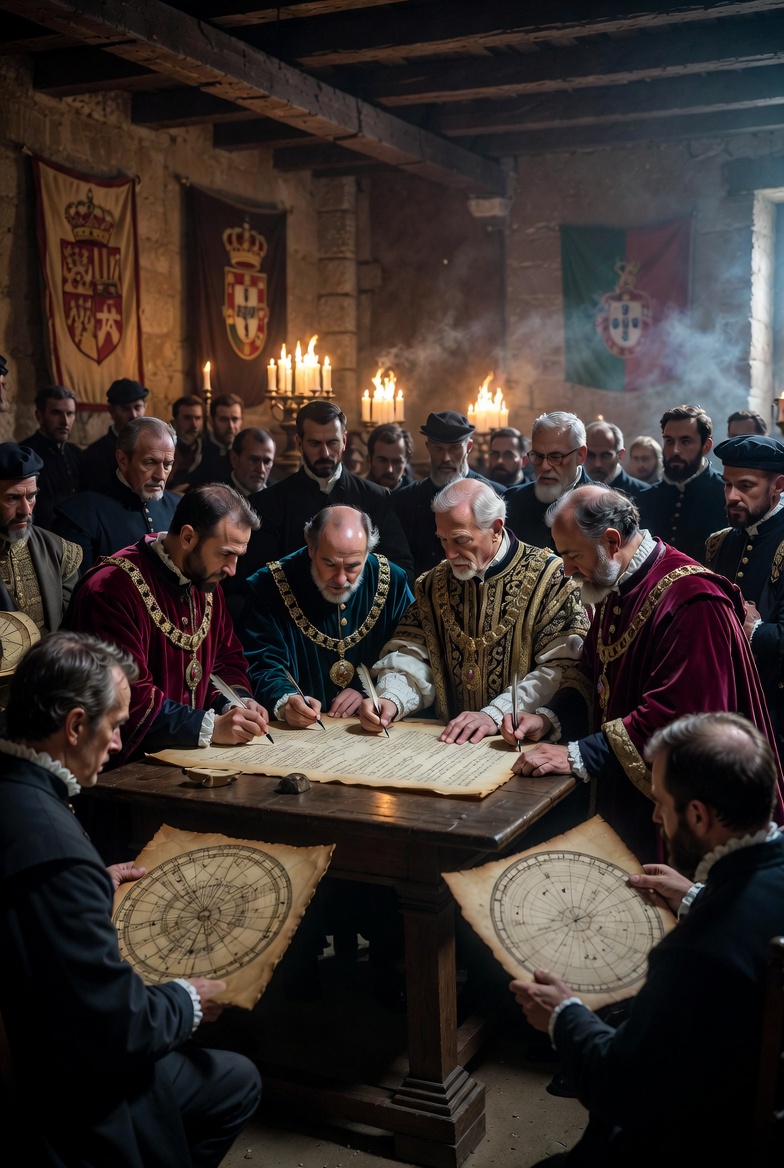 Negotiations dragged from Medina del Campo to Tordesillas itself. Ambassadors, pilots, cosmographers, and lawyers haggled over leagues, meridians, and who got what slice of the Atlantic. The Portuguese wanted breathing room for their African trade routes and a potential western bulge they might have already glimpsed on secret maps. The Spanish wanted everything Columbus had touched and more. After weeks of back-and-forth, they settled on that 370-league line. It was deliberately vague—leagues weren't standardized, the Earth's exact circumference was guesswork, and no one had sailed the full route yet. Both sides probably thought they were pulling a fast one. History would prove the Portuguese got the better long-term bargain in the short run.
The treaty's text, preserved in originals at Spain's Archivo General de Indias and Portugal's Torre do Tombo, reads like a medieval real estate deed for an entire hemisphere. It referenced prior agreements like the 1479 Treaty of Alcáçovas and adjusted papal lines. Crucially, it bypassed direct papal arbitration after the fact, though Pope Julius II later ratified it in 1506. This was one of the first major instances where secular monarchs carved up the globe without deferring entirely to Rome, a quiet step toward modern international law—even if it was still drenched in conquest ideology.
To appreciate the sheer audacity, rewind a bit. Portugal's maritime empire was built on methodical, state-sponsored exploration. Prince Henry the Navigator (though more organizer than sailor) kickstarted it in the 15th century. By the 1480s, Portuguese caravels hugged Africa's coast, establishing trading posts, raiding for slaves, and seeking the mythical Christian kingdom of Prester John. Vasco da Gama would round the Cape in 1497–98 and reach India, opening the lucrative spice trade. Spain, unified after the Reconquista (Granada fell in 1492), was playing catch-up but with explosive energy. Columbus's voyage was a high-stakes gamble funded on a shoestring.
The line's placement was critical. It gave Portugal rights to the eastern Atlantic and, fatefully, a chunk of South America. When Pedro Álvares Cabral "accidentally" landed on Brazil's coast in 1500 while heading to India (historians debate how accidental it really was—Portuguese maps may have hinted at the land bulge), it fell east of the line. Brazil became Portuguese, explaining why today one giant country speaks Portuguese amid a Spanish-speaking continent. Spain got the rest of the Americas: the Caribbean, Mexico, Peru, the silver mines of Potosí, the Aztec and Inca empires. The flood of New World silver would fuel Spain's Golden Age, fund wars in Europe, and trigger massive inflation—the Price Revolution.
Negotiations dragged from Medina del Campo to Tordesillas itself. Ambassadors, pilots, cosmographers, and lawyers haggled over leagues, meridians, and who got what slice of the Atlantic. The Portuguese wanted breathing room for their African trade routes and a potential western bulge they might have already glimpsed on secret maps. The Spanish wanted everything Columbus had touched and more. After weeks of back-and-forth, they settled on that 370-league line. It was deliberately vague—leagues weren't standardized, the Earth's exact circumference was guesswork, and no one had sailed the full route yet. Both sides probably thought they were pulling a fast one. History would prove the Portuguese got the better long-term bargain in the short run.
The treaty's text, preserved in originals at Spain's Archivo General de Indias and Portugal's Torre do Tombo, reads like a medieval real estate deed for an entire hemisphere. It referenced prior agreements like the 1479 Treaty of Alcáçovas and adjusted papal lines. Crucially, it bypassed direct papal arbitration after the fact, though Pope Julius II later ratified it in 1506. This was one of the first major instances where secular monarchs carved up the globe without deferring entirely to Rome, a quiet step toward modern international law—even if it was still drenched in conquest ideology.
To appreciate the sheer audacity, rewind a bit. Portugal's maritime empire was built on methodical, state-sponsored exploration. Prince Henry the Navigator (though more organizer than sailor) kickstarted it in the 15th century. By the 1480s, Portuguese caravels hugged Africa's coast, establishing trading posts, raiding for slaves, and seeking the mythical Christian kingdom of Prester John. Vasco da Gama would round the Cape in 1497–98 and reach India, opening the lucrative spice trade. Spain, unified after the Reconquista (Granada fell in 1492), was playing catch-up but with explosive energy. Columbus's voyage was a high-stakes gamble funded on a shoestring.
The line's placement was critical. It gave Portugal rights to the eastern Atlantic and, fatefully, a chunk of South America. When Pedro Álvares Cabral "accidentally" landed on Brazil's coast in 1500 while heading to India (historians debate how accidental it really was—Portuguese maps may have hinted at the land bulge), it fell east of the line. Brazil became Portuguese, explaining why today one giant country speaks Portuguese amid a Spanish-speaking continent. Spain got the rest of the Americas: the Caribbean, Mexico, Peru, the silver mines of Potosí, the Aztec and Inca empires. The flood of New World silver would fuel Spain's Golden Age, fund wars in Europe, and trigger massive inflation—the Price Revolution.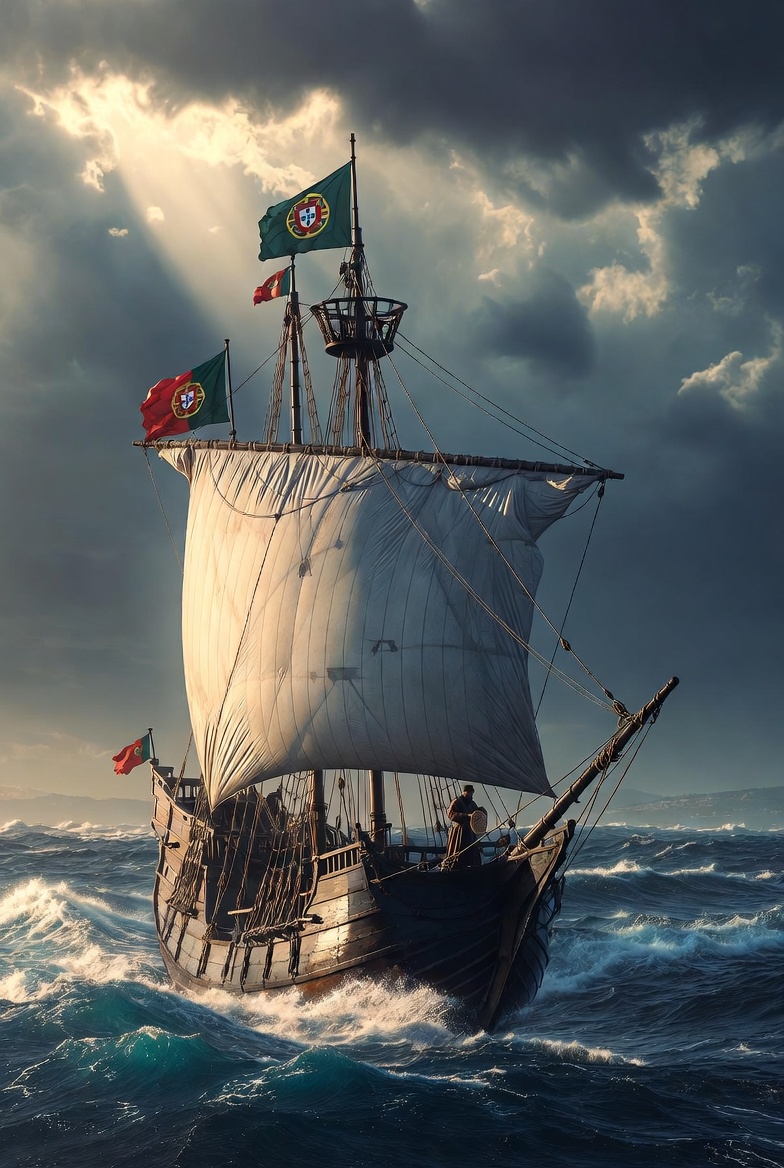 But the treaty's ripples went far beyond Latin America. It set the stage for the 1529 Treaty of Zaragoza, which extended the line via an antimeridian into the Pacific, dividing the Spice Islands (Moluccas). Portugal got the prized eastern route; Spain the western one via the Philippines. Magellan's circumnavigation (1519–1522, completed by survivors) tested these boundaries in bloody, scurvy-ridden fashion. The treaties fueled the Age of Discovery's rivalries, with Iberian ships dominating until Protestant powers like England and the Dutch thumbed their noses at the "papal" division and started their own empires. Francis Drake, privateering for Elizabeth I, famously didn't care about some line drawn in a Spanish town.
Zoom in on the human drama in Tordesillas. The town, with its royal palace and convents, hosted tense meetings. Technical experts debated astronomy and navigation using rudimentary tools—astrolabes, quadrants, dead reckoning. Errors in longitude measurement plagued everyone; accurate clocks for sea use were centuries away. The Portuguese likely had superior cartographic intelligence from their African voyages. One can imagine the Spanish diplomats sweating over how far west to concede, while Portuguese envoys pushed for every league that might secure their India route. It was diplomacy as high-stakes poker with the planet as the pot.
Enforcement was spotty. Joint expeditions to physically mark the line never fully materialized. Spain didn't seriously contest Portugal's Brazilian expansion eastward. Portugal complained when Spain pushed into Asia. Indigenous peoples, of course, ignored the whole thing—empires rose and fell, millions died from disease, war, and exploitation regardless of European ink on paper. The treaty symbolized the Eurocentric hubris of the era: two Catholic kingdoms claiming divine right to divide what they hadn't fully seen or conquered.
Fast-forward through centuries: The cultural split endures. Spanish America developed distinct societies, legal traditions (based on Roman law with strong Church influence), and economies tied to mining and haciendas. Portuguese Brazil evolved with more emphasis on sugar plantations, slavery, and later coffee, blending African, Indigenous, and European elements into a unique mosaic. Languages, cuisine, architecture, even soccer rivalries trace back to that 1494 line. In the 18th century, the Treaty of Madrid (1750) largely superseded Tordesillas, recognizing realities on the ground, but the original deal had already baked in the divisions.
But the treaty's ripples went far beyond Latin America. It set the stage for the 1529 Treaty of Zaragoza, which extended the line via an antimeridian into the Pacific, dividing the Spice Islands (Moluccas). Portugal got the prized eastern route; Spain the western one via the Philippines. Magellan's circumnavigation (1519–1522, completed by survivors) tested these boundaries in bloody, scurvy-ridden fashion. The treaties fueled the Age of Discovery's rivalries, with Iberian ships dominating until Protestant powers like England and the Dutch thumbed their noses at the "papal" division and started their own empires. Francis Drake, privateering for Elizabeth I, famously didn't care about some line drawn in a Spanish town.
Zoom in on the human drama in Tordesillas. The town, with its royal palace and convents, hosted tense meetings. Technical experts debated astronomy and navigation using rudimentary tools—astrolabes, quadrants, dead reckoning. Errors in longitude measurement plagued everyone; accurate clocks for sea use were centuries away. The Portuguese likely had superior cartographic intelligence from their African voyages. One can imagine the Spanish diplomats sweating over how far west to concede, while Portuguese envoys pushed for every league that might secure their India route. It was diplomacy as high-stakes poker with the planet as the pot.
Enforcement was spotty. Joint expeditions to physically mark the line never fully materialized. Spain didn't seriously contest Portugal's Brazilian expansion eastward. Portugal complained when Spain pushed into Asia. Indigenous peoples, of course, ignored the whole thing—empires rose and fell, millions died from disease, war, and exploitation regardless of European ink on paper. The treaty symbolized the Eurocentric hubris of the era: two Catholic kingdoms claiming divine right to divide what they hadn't fully seen or conquered.
Fast-forward through centuries: The cultural split endures. Spanish America developed distinct societies, legal traditions (based on Roman law with strong Church influence), and economies tied to mining and haciendas. Portuguese Brazil evolved with more emphasis on sugar plantations, slavery, and later coffee, blending African, Indigenous, and European elements into a unique mosaic. Languages, cuisine, architecture, even soccer rivalries trace back to that 1494 line. In the 18th century, the Treaty of Madrid (1750) largely superseded Tordesillas, recognizing realities on the ground, but the original deal had already baked in the divisions.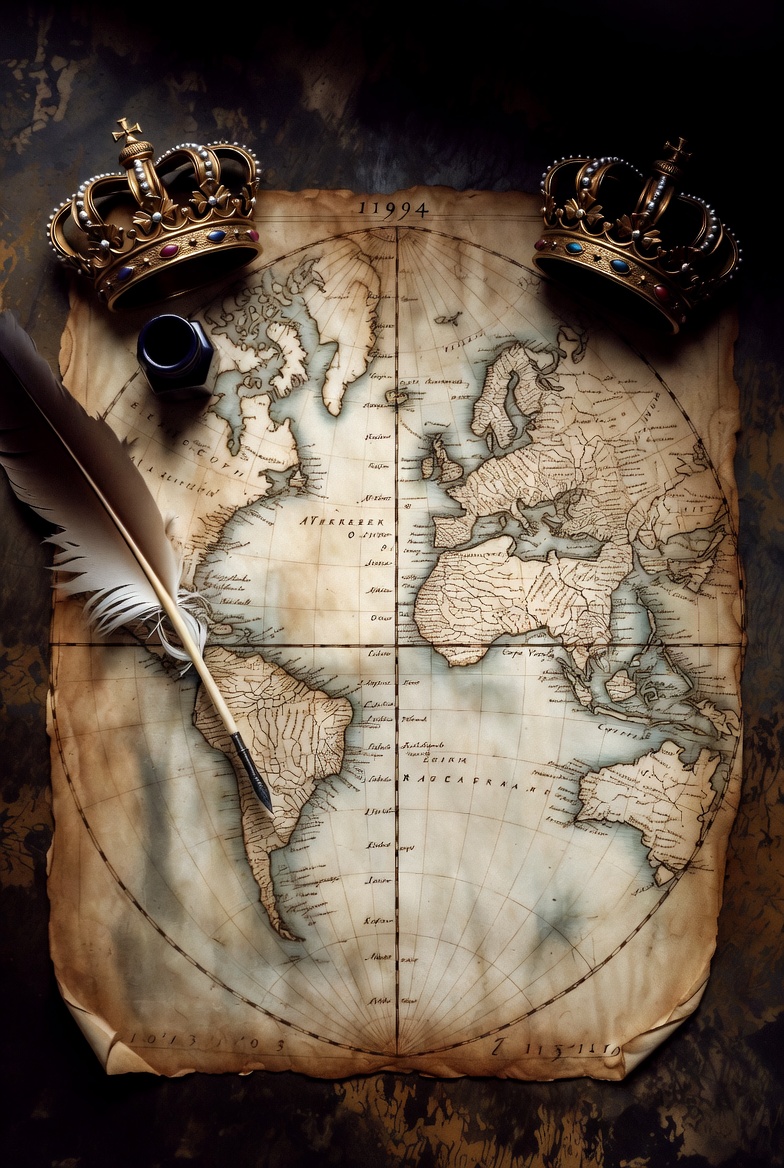 The treaty also highlights the power of clear (if imperfect) boundaries in reducing conflict. Without it, Spain and Portugal might have come to blows repeatedly over the New World, weakening both against rising rivals. Instead, they focused energies outward, accelerating global exploration, trade, and the Columbian Exchange—the massive transfer of plants, animals, diseases, and peoples that reshaped the world economy. Potatoes to Europe, horses to Americas, wheat and smallpox everywhere. It was globalization's violent, messy birth certificate.
Humorously, imagine the mapmakers back then. "370 leagues? Sure, whatever that means in actual miles." Their calculations varied wildly depending on the size of the Earth they assumed and which Cape Verde island was the starting point. Modern reconstructions place the line somewhere around 46–49 degrees West, but debates raged for decades. It was less precision engineering and more "close enough for empire-building." One side's "victory" was the other's strategic retreat, yet both profited enormously until others crashed the party.
This event on June 7, 1494, wasn't a battlefield triumph or royal wedding. It was quiet paperwork with world-shaking consequences—proof that pens, when backed by ships and cannons, can redraw continents. It reminds us history often turns on mundane negotiations in unremarkable towns, not just epic charges or coronations.
**Drawing Your Own Lines: Lessons from Tordesillas for Conquering Your Personal Unknown**
The Treaty of Tordesillas teaches that bold, deliberate boundary-setting in uncertainty creates opportunity, focus, and long-term empire (personal or otherwise). Here's how its core outcome—strategic division of vast unknowns into manageable, claimable spheres—translates to explosive individual advantage today. Not generic positivity, but a gritty, mapmaker's mindset.
The treaty also highlights the power of clear (if imperfect) boundaries in reducing conflict. Without it, Spain and Portugal might have come to blows repeatedly over the New World, weakening both against rising rivals. Instead, they focused energies outward, accelerating global exploration, trade, and the Columbian Exchange—the massive transfer of plants, animals, diseases, and peoples that reshaped the world economy. Potatoes to Europe, horses to Americas, wheat and smallpox everywhere. It was globalization's violent, messy birth certificate.
Humorously, imagine the mapmakers back then. "370 leagues? Sure, whatever that means in actual miles." Their calculations varied wildly depending on the size of the Earth they assumed and which Cape Verde island was the starting point. Modern reconstructions place the line somewhere around 46–49 degrees West, but debates raged for decades. It was less precision engineering and more "close enough for empire-building." One side's "victory" was the other's strategic retreat, yet both profited enormously until others crashed the party.
This event on June 7, 1494, wasn't a battlefield triumph or royal wedding. It was quiet paperwork with world-shaking consequences—proof that pens, when backed by ships and cannons, can redraw continents. It reminds us history often turns on mundane negotiations in unremarkable towns, not just epic charges or coronations.
**Drawing Your Own Lines: Lessons from Tordesillas for Conquering Your Personal Unknown**
The Treaty of Tordesillas teaches that bold, deliberate boundary-setting in uncertainty creates opportunity, focus, and long-term empire (personal or otherwise). Here's how its core outcome—strategic division of vast unknowns into manageable, claimable spheres—translates to explosive individual advantage today. Not generic positivity, but a gritty, mapmaker's mindset.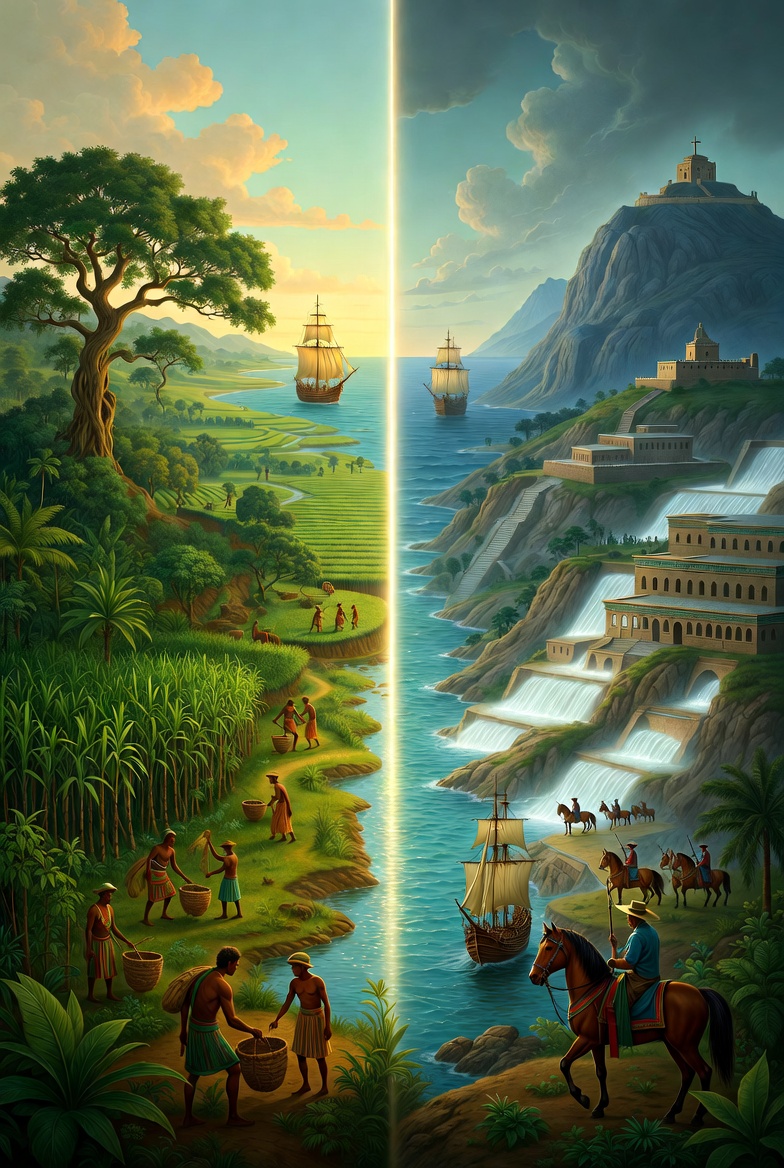 - **Claim Your "East" and "West" Ruthlessly**: Just as Spain and Portugal assigned spheres to avoid wasteful overlap, audit your life domains (career, health, relationships, learning, finances). Designate non-negotiable priorities. If fitness is your Portugal route to vitality, wall it off from work creep. Specific: Block 6-7 AM daily for training—no emails, no exceptions. This prevents "empire drift" where everything bleeds into mediocrity.
- **Negotiate Your Meridian with Precision (But Accept Vagueness)**: The treaty's fuzzy leagues worked because intent was clear. Set ambitious but adjustable goals. Want to launch a side project? Define success metrics now (e.g., first revenue in 90 days) but leave room for course correction. Track weekly like cosmographers plotting stars—adjust without abandoning the line.
- **Exploit the "Accidental Brazil" Moments**: Cabral's landing wasn't pure luck. Prepare for serendipity in your mapped territories. When an unexpected opportunity arises in your "west" (core focus area), pounce. Example: A random conversation leads to a client—treat it as your Brazil and develop it fully rather than dismissing as distraction.
- **Ignore External "Papal Bulls" When They Don't Serve You**: The treaty bypassed initial papal overreach. Politely disregard unhelpful external rules, trends, or opinions that don't align with your claimed spheres. Boss demanding after-hours work invading family time? Negotiate or redraw. Social media dictating your hustle? Opt out of that hemisphere.
- **Build Joint Ventures Only on Mutual Strength**: Spain and Portugal cooperated where beneficial but competed fiercely. Partner selectively—mentor, collaborator, or spouse—in ways that expand your map without ceding core territory. Vet alliances like diplomats checking leagues.
- **Anticipate the Antimeridian**: The later Zaragoza treaty extended the logic globally. Plan for long-term consequences of today's divisions. Short-term sacrifice in health (your Africa route) pays in sustained energy for career conquests decades later.
**Your 7-Day Tordesillas Protocol: A Non-Fluffy, Empire-Building Sprint**
This isn't another vision-board ritual or 5-minute habit hack. It's a ruthless, week-long exercise in claiming unknown territory like 15th-century monarchs, forcing immediate action and measurable expansion. Do it once, then repeat quarterly. Tools: notebook, calendar, honest mirror.
**Day 1: Scout the Globe (Full Audit)**
List every major "ocean" in your life: Work/Income, Health/Body, Relationships, Skills/Learning, Rest/Recovery, Legacy/Projects. For each, note current "possessions" (what's working), "disputed territories" (neglected or conflicting), and "unknown west" (aspirations). Be brutally specific—e.g., "Finances: $X debt at Y% interest, no emergency buffer beyond Z weeks."
**Day 2: Draw the Meridian**
Choose your primary "line." Pick one domain as your Portugal (secure trade route—foundational, like health) and one as Spain (expansionist, like income or creative output). Draw literal or digital boundaries: time blocks, rules, metrics. Example: Health meridian at 8 PM—no screens, mandatory wind-down. Expansion meridian: 2 hours daily blocked for deep work on revenue project, phone in another room.
**Day 3-4: Dispatch Your Caravels (Execution)**
Launch micro-expeditions. Tackle one disputed territory per day with treaty-level commitment. Research one new skill for 90 focused minutes. Have the hard conversation in relationships. Log "discoveries" (insights, small wins) nightly. Fuel with high-protein meals and movement—treat body like a flagship that must stay seaworthy.
- **Claim Your "East" and "West" Ruthlessly**: Just as Spain and Portugal assigned spheres to avoid wasteful overlap, audit your life domains (career, health, relationships, learning, finances). Designate non-negotiable priorities. If fitness is your Portugal route to vitality, wall it off from work creep. Specific: Block 6-7 AM daily for training—no emails, no exceptions. This prevents "empire drift" where everything bleeds into mediocrity.
- **Negotiate Your Meridian with Precision (But Accept Vagueness)**: The treaty's fuzzy leagues worked because intent was clear. Set ambitious but adjustable goals. Want to launch a side project? Define success metrics now (e.g., first revenue in 90 days) but leave room for course correction. Track weekly like cosmographers plotting stars—adjust without abandoning the line.
- **Exploit the "Accidental Brazil" Moments**: Cabral's landing wasn't pure luck. Prepare for serendipity in your mapped territories. When an unexpected opportunity arises in your "west" (core focus area), pounce. Example: A random conversation leads to a client—treat it as your Brazil and develop it fully rather than dismissing as distraction.
- **Ignore External "Papal Bulls" When They Don't Serve You**: The treaty bypassed initial papal overreach. Politely disregard unhelpful external rules, trends, or opinions that don't align with your claimed spheres. Boss demanding after-hours work invading family time? Negotiate or redraw. Social media dictating your hustle? Opt out of that hemisphere.
- **Build Joint Ventures Only on Mutual Strength**: Spain and Portugal cooperated where beneficial but competed fiercely. Partner selectively—mentor, collaborator, or spouse—in ways that expand your map without ceding core territory. Vet alliances like diplomats checking leagues.
- **Anticipate the Antimeridian**: The later Zaragoza treaty extended the logic globally. Plan for long-term consequences of today's divisions. Short-term sacrifice in health (your Africa route) pays in sustained energy for career conquests decades later.
**Your 7-Day Tordesillas Protocol: A Non-Fluffy, Empire-Building Sprint**
This isn't another vision-board ritual or 5-minute habit hack. It's a ruthless, week-long exercise in claiming unknown territory like 15th-century monarchs, forcing immediate action and measurable expansion. Do it once, then repeat quarterly. Tools: notebook, calendar, honest mirror.
**Day 1: Scout the Globe (Full Audit)**
List every major "ocean" in your life: Work/Income, Health/Body, Relationships, Skills/Learning, Rest/Recovery, Legacy/Projects. For each, note current "possessions" (what's working), "disputed territories" (neglected or conflicting), and "unknown west" (aspirations). Be brutally specific—e.g., "Finances: $X debt at Y% interest, no emergency buffer beyond Z weeks."
**Day 2: Draw the Meridian**
Choose your primary "line." Pick one domain as your Portugal (secure trade route—foundational, like health) and one as Spain (expansionist, like income or creative output). Draw literal or digital boundaries: time blocks, rules, metrics. Example: Health meridian at 8 PM—no screens, mandatory wind-down. Expansion meridian: 2 hours daily blocked for deep work on revenue project, phone in another room.
**Day 3-4: Dispatch Your Caravels (Execution)**
Launch micro-expeditions. Tackle one disputed territory per day with treaty-level commitment. Research one new skill for 90 focused minutes. Have the hard conversation in relationships. Log "discoveries" (insights, small wins) nightly. Fuel with high-protein meals and movement—treat body like a flagship that must stay seaworthy. **Day 5: Ratify and Adjust**
Review like envoys in Tordesillas. What vague leagues need tightening? Adjust one boundary. Celebrate small claims (e.g., completed task = "planted flag"). Ratify with a symbolic act: sign your own "treaty" page outlining non-negotiables.
**Day 6: Prepare for Pacific Extension**
Map long-term ripple: How does today's health meridian support 5-year career goals? Identify one "antimeridian" risk (e.g., burnout from over-expansion) and counter it.
**Day 7: Ignore the Naysayers, Sail On**
Publicly (or privately) declare one boundary to create accountability. Then act as if the treaty is law: defend your spheres. Track one key metric for the next month. The "empire" compounds—focus narrows waste, boundaries multiply output.
This protocol weaponizes history's lesson: In life's vast unknowns, those who draw clear lines first and defend them smartest build lasting domains. The Tordesillas signers didn't explore everything themselves—they set rules that let others (and fortune) fill the map profitably. You can too. No papal approval needed. Start today, redraw tomorrow if required, but never sail without your meridian. Your personal New World awaits—claim it.
**Day 5: Ratify and Adjust**
Review like envoys in Tordesillas. What vague leagues need tightening? Adjust one boundary. Celebrate small claims (e.g., completed task = "planted flag"). Ratify with a symbolic act: sign your own "treaty" page outlining non-negotiables.
**Day 6: Prepare for Pacific Extension**
Map long-term ripple: How does today's health meridian support 5-year career goals? Identify one "antimeridian" risk (e.g., burnout from over-expansion) and counter it.
**Day 7: Ignore the Naysayers, Sail On**
Publicly (or privately) declare one boundary to create accountability. Then act as if the treaty is law: defend your spheres. Track one key metric for the next month. The "empire" compounds—focus narrows waste, boundaries multiply output.
This protocol weaponizes history's lesson: In life's vast unknowns, those who draw clear lines first and defend them smartest build lasting domains. The Tordesillas signers didn't explore everything themselves—they set rules that let others (and fortune) fill the map profitably. You can too. No papal approval needed. Start today, redraw tomorrow if required, but never sail without your meridian. Your personal New World awaits—claim it.